
Silver-Plated London Dome Hearing Aid by F. C. Rein and Son
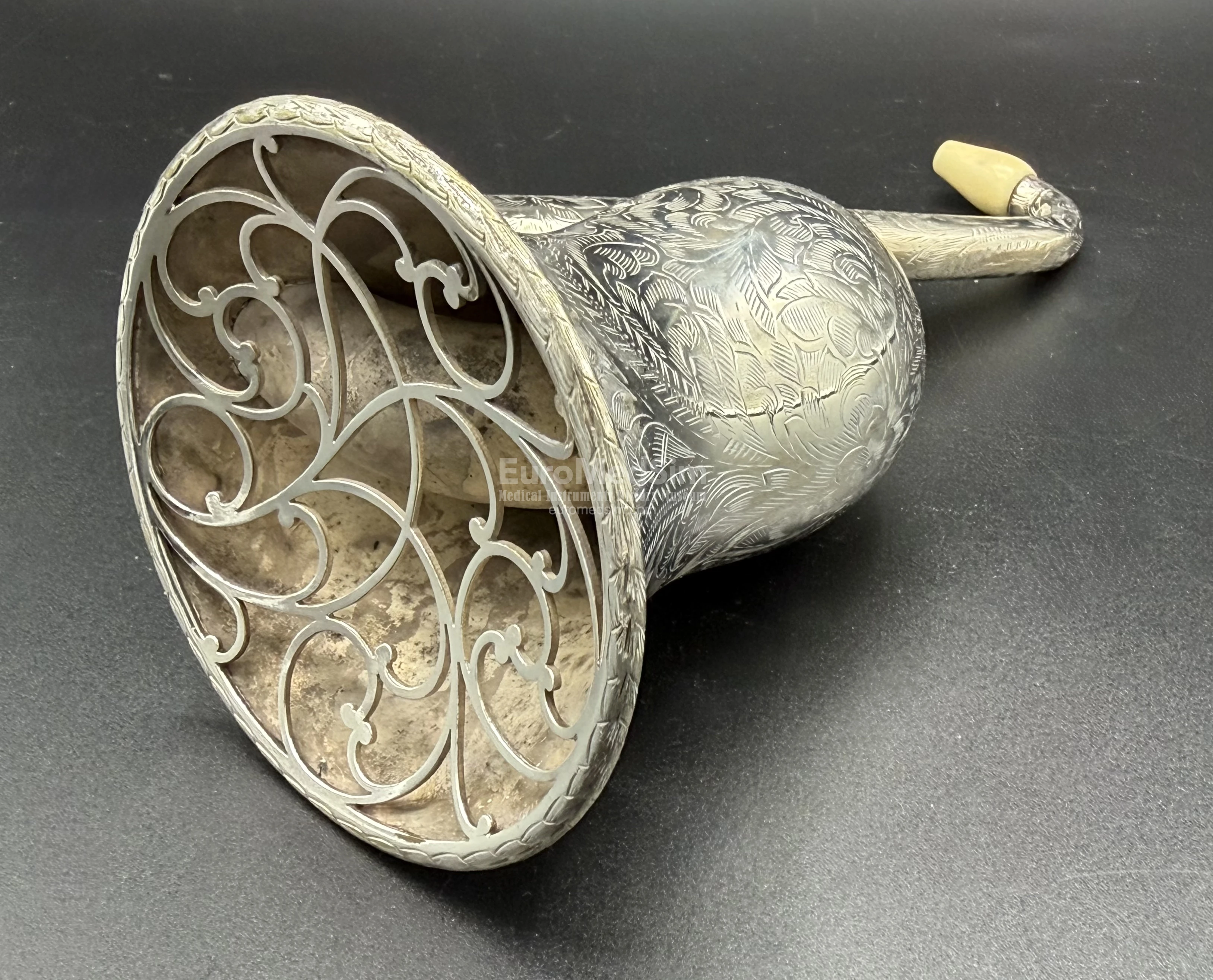
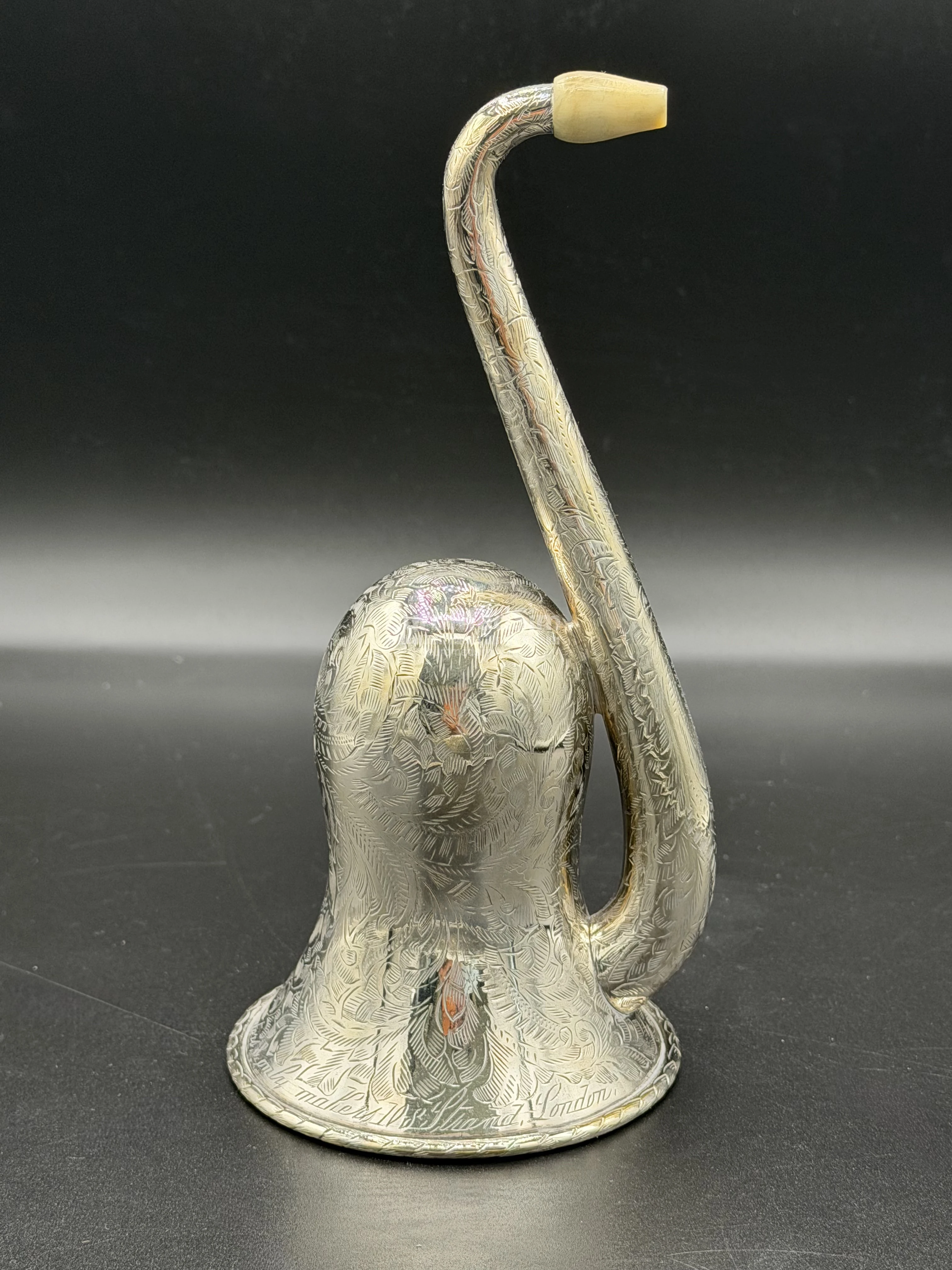
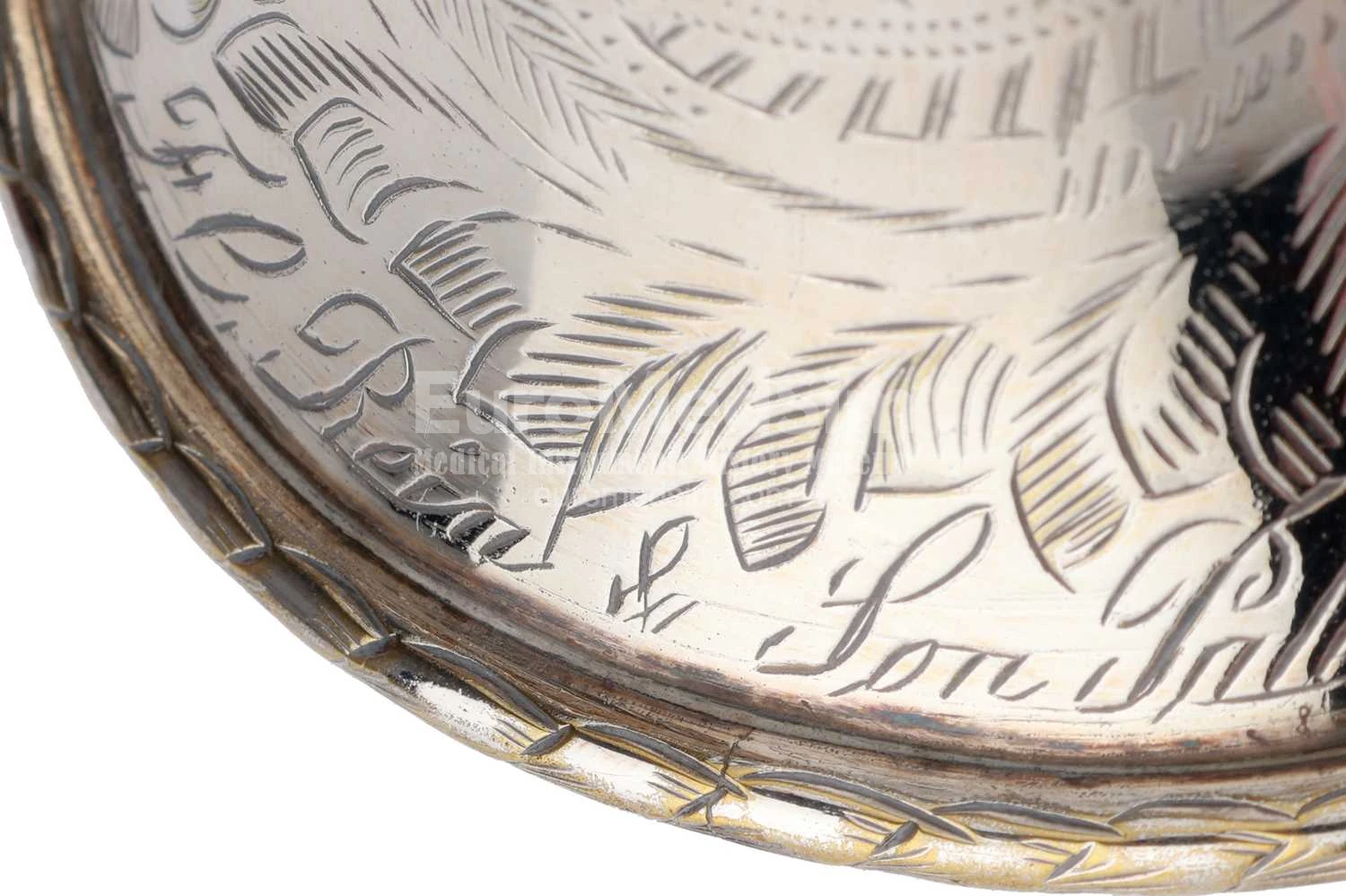
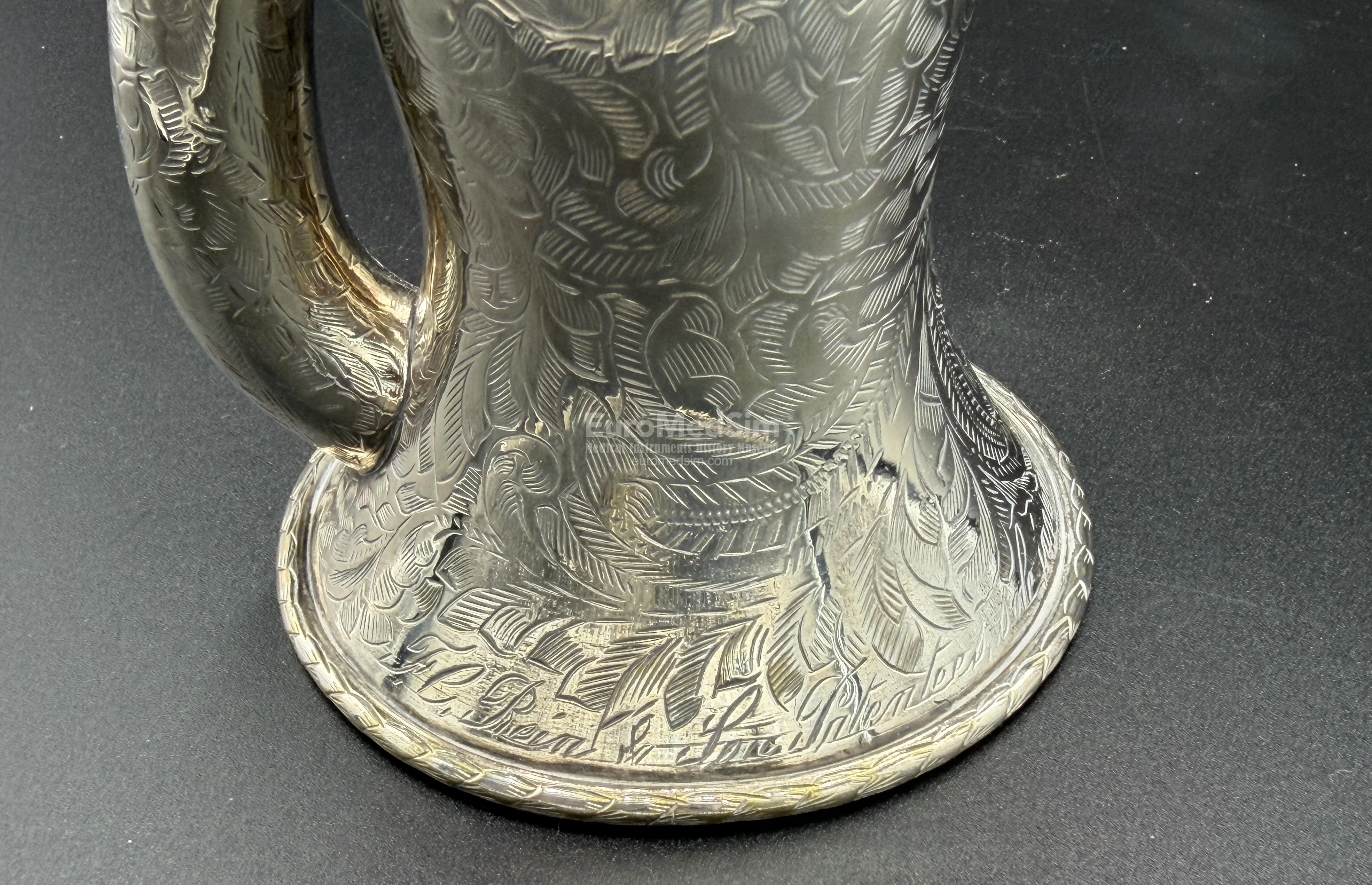
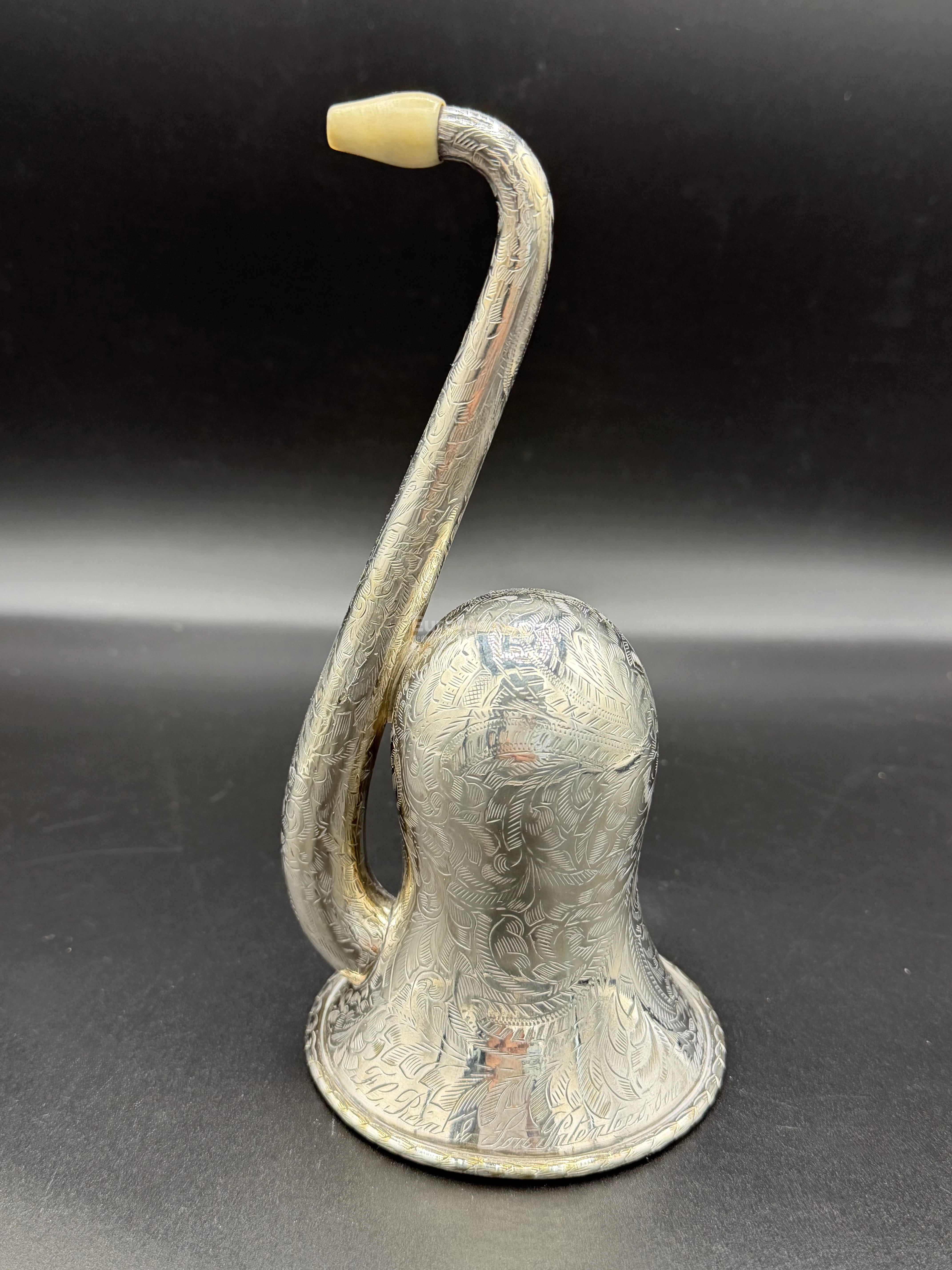
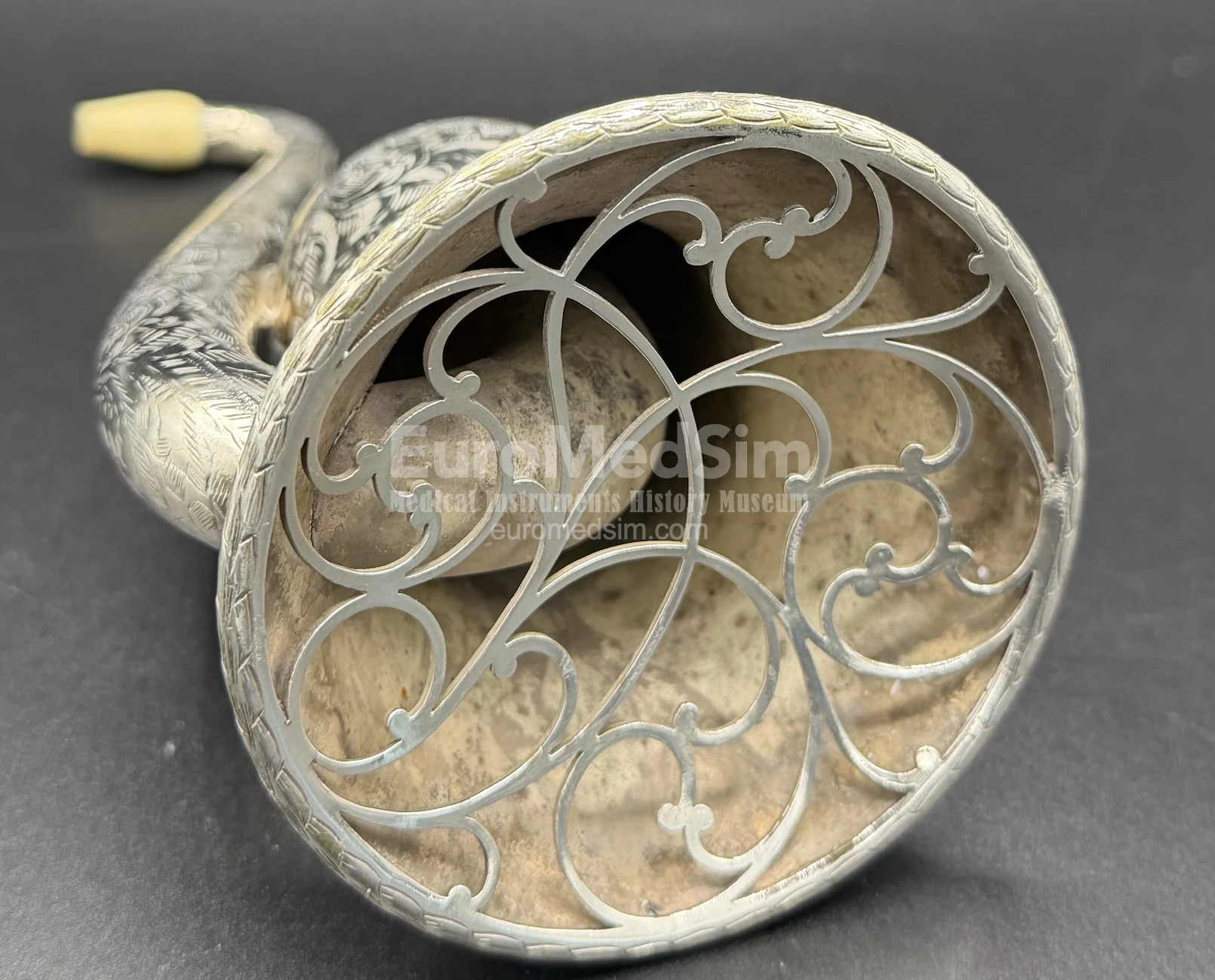
An elaborately-engraved silver-plated (white metal) F. C. Rein & Son Parabolic Bell Hearing Aid. English, ca. 1860. The bell-shaped ear trumpet (type 'London Dome') is coated in shiny white metal and adorned with intricate floral patterns across its entire surface. The curved ear tube is topped with a removable ivory earpiece (with a tiny crack). Total height of the trumpet is about 20 cm. The opening of the wide trumpet part is featured by a decorative grille, also adorned with floral patterns. An inscription is engraved along the rim of the bell: 'F. C. Rein & Son Patentees, sole inventors, & only makers, 108 Strand, London.'
The parabolic bell shape is not merely decorative. The ear trumpet functions as a parabolic reflector, projecting sound energy onto a focal point — in this case, enter opening of the curved tube located inside of the bottom of the bell, leading to the external ear and further — to the eardrum — through refraction and reflection, enabling effective amplification while keeping the device relatively compact.
London Dome
Between roughly 1850 and 1930, one type of acoustic hearing aid stood out from all the others for a single, compelling reason: you could conceal it in a cupped hand while using it. The London Dome — also known as the London Hearing Horn — was named after the silhouette of St. Paul's Cathedral, whose great dome it closely resembled in profile. Compact, practical, and cleverly engineered, it became one of the most widely sold hearing devices of the pre-electric era.
The London Dome was no simple funnel. Its internal architecture was built around three interlocking acoustic principles. The outer shell formed a parabolic reflector, gathering incoming sound waves and focusing them onto a single point just inside the mouth of the device. Positioned precisely at that focal point was the flared opening of a narrow sound tube, which captured the concentrated sound and channelled it toward the ear. The tube itself ran in a U-shape through and around the body of the dome, its tapering diameter progressively concentrating the signal as it travelled. The result was meaningful amplification in the speech frequency range — roughly 300 to 2,000 Hz — from an object small enough to pocket.
London Domes came in a wide range of sizes, from tiny 2-inch models designed for moderate hearing loss up to the imposing 'Grand Opera Domes' — some nearly ten inches tall and weighing close to two pounds — intended for severely hard-of-hearing users in large public spaces such as concert halls and churches. The largest known Grand Opera Dome was made around 1850 by F. C. Rein of London, fitted with a handle on the opposite side from the ear tube so the user could hold it steady.
Materials ranged from plain brass painted black — the most common finish, chosen because it was inconspicuous against dark Victorian clothing — to nickel plate, aluminium, and sterling silver. The most luxurious examples were ornately engraved and fitted with intricate grilles: simple punched holes in budget models gave way to wire mesh, starburst patterns, and silver filigree in finer ones. A particularly striking variant was made from faux tortoiseshell, a translucent celluloid material that, when held up to the light, revealed the internal tube and glowed with deep amber and orange hues — beautiful, but hardly discreet.
What made the London Dome genuinely distinctive was not just its acoustic performance but the social anxiety it addressed. Victorian and Edwardian attitudes toward deafness were largely defined by stigma, and the desire to conceal a hearing aid from public view was a powerful commercial driver. The London Dome offered a practical answer: small enough to disappear into a closed fist, dark enough to vanish against a coat, yet effective enough to follow a conversation or follow the sermon. It was sold in major retail catalogues on both sides of the Atlantic, from Sears Roebuck to specialist surgical instrument suppliers, and remained in production for eighty years — a testament to how well it balanced the competing demands of function, discretion, and affordability.
Olive Earpiece
The detachable earpiece, mounted over the end of the ear tube, is made of ivory, ensuring comfort, a snug fit, better acoustics, and hygiene.
Metal is cold, hard, and lacks any “elasticity.” Ivory, or horn felt slightly warmer to the touch and could be finely hand-carved—a craftsman could shape the earpiece into a form that fit snugly, yet painlessly, into a specific patient’s ear canal. A tight fit is of fundamental importance: even the slightest gap between the earpiece and the canal wall drastically reduced sound transmission.
Metal, coming into contact with the skull bone, produced parasitic resonances and extraneous sounds. Materials with lower acoustic conductivity—ivory, horn, or ebony—served as a sort of 'isolator,' transmitting only the desired sound signal from the bell without adding extraneous sounds from the instrument’s body.
The ear tips wore out, became contaminated with earwax, and became saturated with skin oils. A removable earpiece made of organic material could be easily replaced separately—without having to replace the entire expensive instrument. Furthermore, metal in the ear canal could injure the delicate skin if handled carelessly, whereas polished bone or horn were significantly gentler.
Ivory was expensive and was seen as a marker of the owner’s wealth—just like the handles of canes or the cutlery of that era. The contrast between the shiny nickel-silver body and the creamy-white olive was intentionally beautiful.
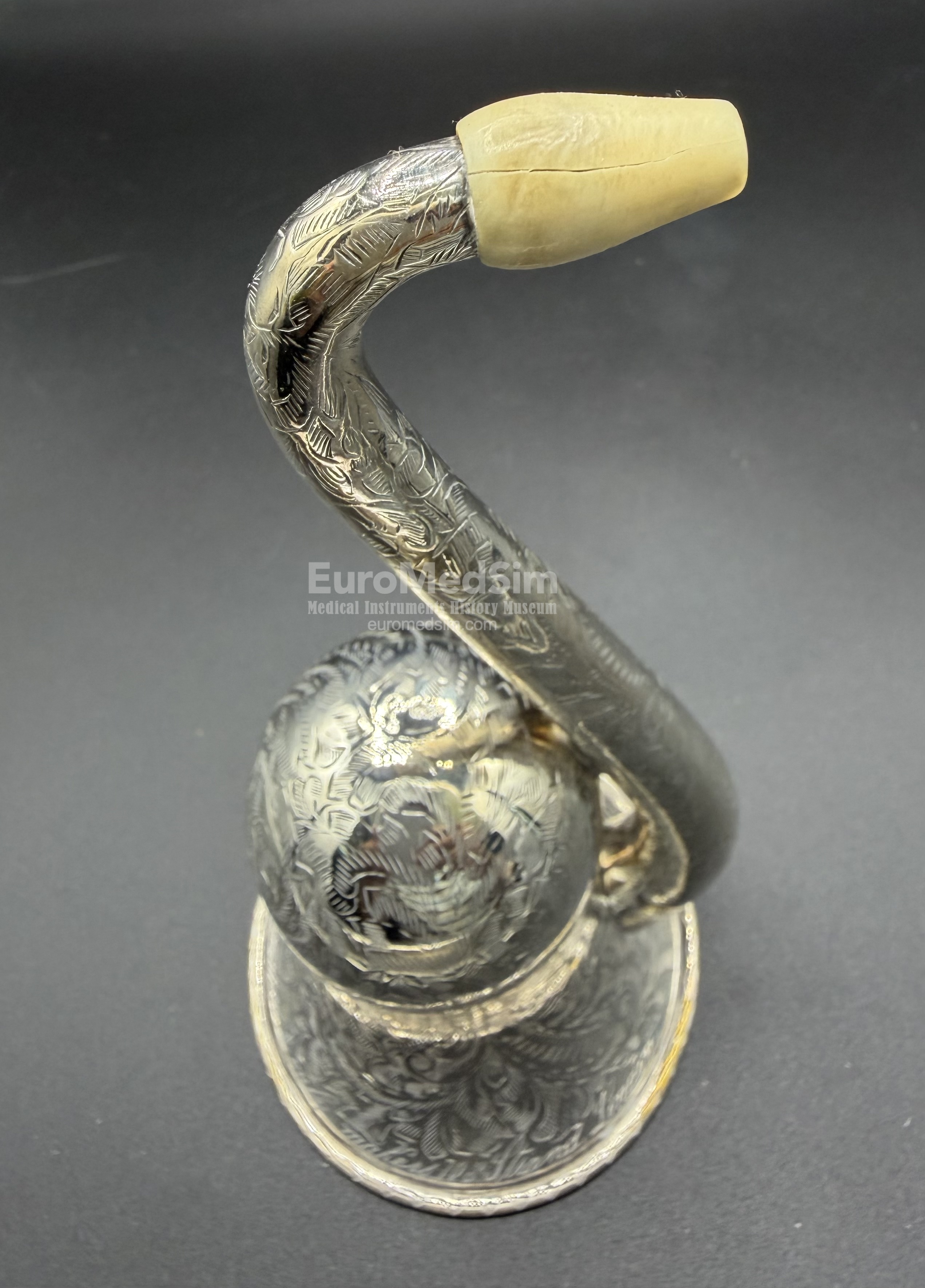
The detachable made of ivory olive (earpiece) is fixed over the end of the ear tube, ensuring comfort, a snug fit, better acoustics, and hygiene.
Silver-plated brass
Similar ear trumpets (made of shiny white metal with floral ornamentation) presented in various museums are described as silver (Thackray Museum, National Museum of American History), sterling silver (The Hearing Aid Museum), or silver-plated (The Science Museum). We tend to believe that it is unlikely that such a large item would have been made of silver without a jeweler’s hallmark. This is also indicated by its weight and nature of the metal’s surface inside the cornet itself. Most likely, this is a silver-plated item.
In the context of Victorian and Edwardian trade catalogues, "silver-plated" meant that a base metal — almost always brass, and occasionally white metal (an alloy of tin, antimony and copper) — had been coated with a thin layer of pure silver through electroplating.
The process, known commercially as Electroplated Nickel Silver (EPNS) or simply electroplate, was developed in the 1840s and became the standard industrial method almost immediately. An electric current was passed through a bath of silver salt solution, depositing a thin but even layer of silver onto the surface of the submerged metal object. The thickness of the deposit could be controlled, and better-quality pieces received a heavier coating.
For hearing aids specifically, "silver-plated" in a catalogue almost certainly meant electroplated brass — the dome body was spun or pressed from brass sheet, then plated and polished to a bright mirror finish. This gave the appearance of solid silver at a fraction of the cost.
It is worth distinguishing this clearly from three related terms that appear in period sources:
- Sterling silver meant the object was made from a solid alloy of 92.5% pure silver — genuinely precious, expensive, and relatively rare among hearing aids.
- Nickel-plated meant a coating of nickel rather than silver — cheaper, harder, and with a slightly cooler, whiter tone than silver plate.
- German silver or nickel silver (also called alpaca or argentan) was a silver-coloured alloy of copper, zinc and nickel containing no silver at all — despite the name — and was often itself then electroplated with actual silver.
So when a Sears or Lentz catalogue offered a "nickel-plated" London Dome alongside a "silver-plated" one at a slightly higher price, the difference was largely cosmetic: the warmer, brighter tone of silver plate versus the cooler sheen of nickel, applied over essentially the same brass body.
Frederick Charles Rein
The address alone tells a story: the firm was established in 1830s (sic! not 1800) at 108 Strand, London and became the earliest company known to manufacture hearing aids on a commercial basis — making Rein a name virtually synonymous with acoustic instruments throughout the nineteenth century.
What sets Rein's instruments apart is the tension between utility and vanity. The firm pioneered designs like "acoustic headbands" where the hearing device was concealed within hair or headgear, and hearing aids were also hidden in couches, clothing, and accessories — a drive toward invisibility that was often more about concealing disability from the public than about helping the wearer cope. The parabolic bell, with its ornate engraving, represents the opposite approach: a frankly visible device elevated into an object of craftsmanship and even status.
Frederick Charles Rein (ca. 1812-1896) was born in Leipzig, moved to London in the 1830s, opened an acoustic instrument shop on the Strand which he termed “Paradise for the Deaf,” and won a prize medal, the first of many, at the London Crystal Palace Exhibition of 1851. The firm became C. Rein & Son Rein in 1867. Since 1916 the company began using new address at the Charing Cross like 'F. C. Rein & Son, Inventors & Patentees, 30 Charing X Rd., London.' The firm continued manufacturing until 1963, making it both the first and last company of its kind.
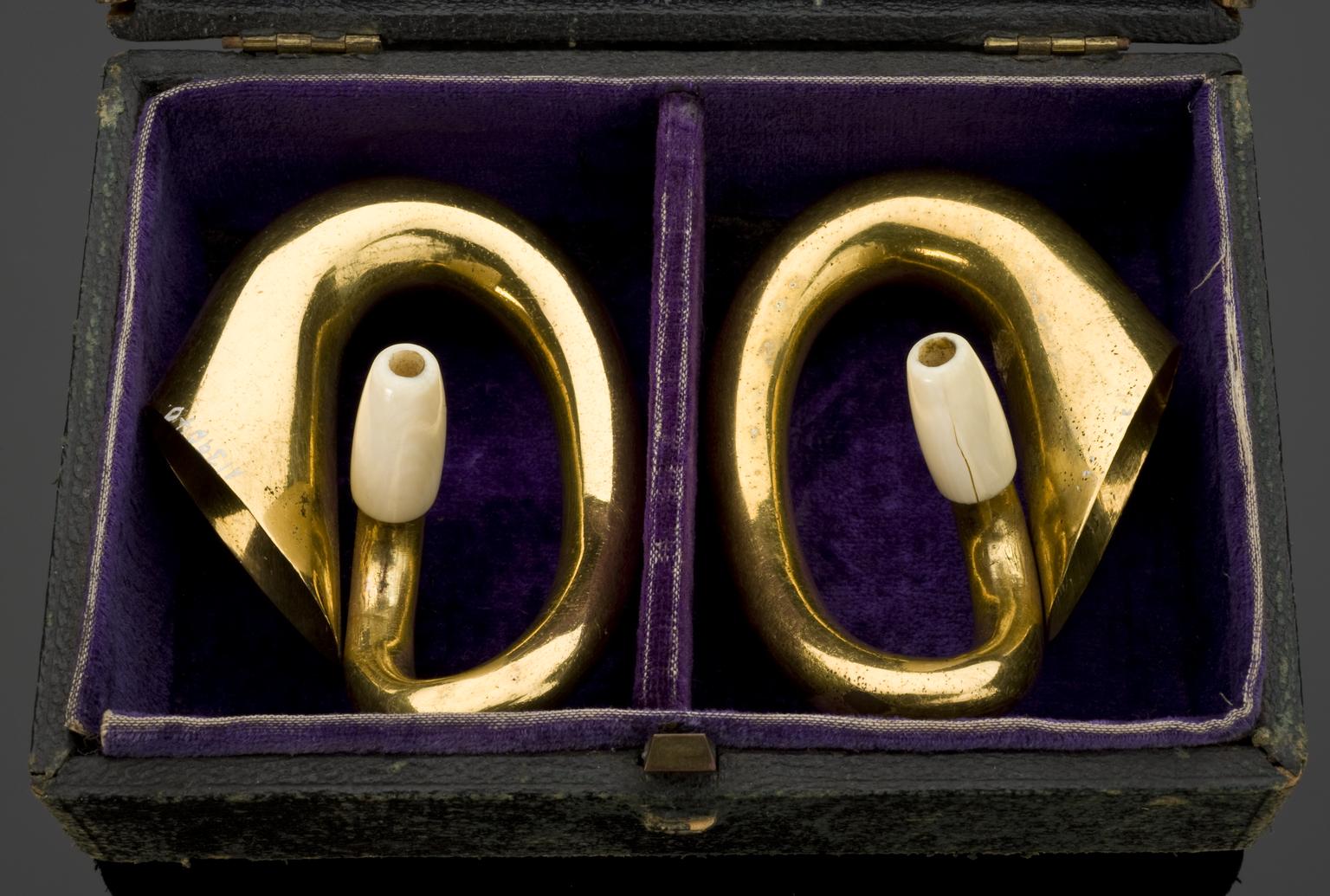
A pair of miniature hearing tubes made of gilded brass with ivory earpieces, designed to be worn discreetly under the hair (Bugle type). Manufactured by F. C. Rein and Son, London. Credit: Science Museum London, The Wellcome Galleries
Reference Object
- Science Museum, London. Silver-plated ear trumpet hearing aid, with ivory earpiece and ornate decoration, made by F. C. Rein & Son, London, England, 1850-1900: collection.sciencemuseumgroup.org.uk/objects/co77857/ear-trumpet
- Thackray Museum, Queen Victoria/s Hearing Aid in 'London Dome' shape, ca. 1880: https://collections.thackraymuseum.co.uk/object-1333-004
- National Museum of American History, Washington, DC, USA. Patented silver ear trumpet made by F. C. Rein & Son, 108 The Strand, London, England: https://americanhistory.si.edu/collections/object/nmah_737480