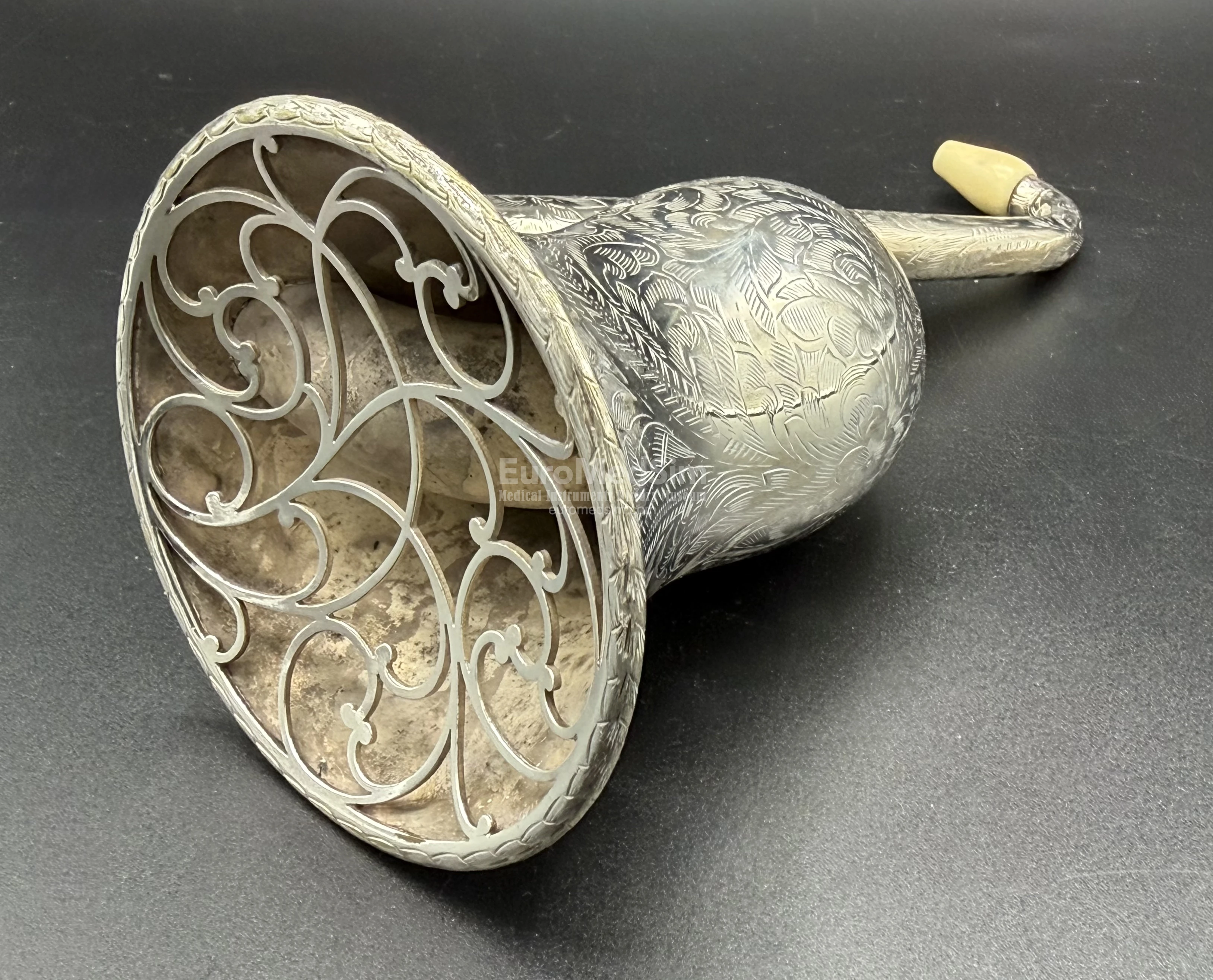

F. C. Rein & Son
F. C. Rein & Son — London's "Paradise for the Deaf" (c.1835–1963)
Among the handful of firms that shaped the history of hearing aids, none had a longer or more distinctive presence than F. C. Rein & Son of London. For over a century, from a shop on the Strand, the company produced some of the finest acoustic instruments available anywhere in the world — ear trumpets, speaking tubes, acoustic chairs, and devices of remarkable ingenuity — and left behind a legacy that reaches into the earliest chapters of audiology as a discipline.
The firm's founder, Frederick Charles Rein, was born in Leipzig, Saxony, around 1812–13, the son of a merchant. At some point around 1834–1835 he moved to England, where he set up as an instrument maker. Thus, Frederick C. Rein established his firm after 1834–1835, not "no later than 1800," as some sources indicate, probably quoting Prof. Kenneth W. Berger [Berger was the director of audiology at Kent State University for 20 years and founded the Hearing Aid Museum, which probably has the world's largest collection of these devices, with over 3,000. In the preface to his classic book, he wrote: "The oldest manufacturing firm whose primary work was with hearing aids was established by Frederick C. Rein." He began making non-electric hearing aids in London no later than 1800" (Kenneth W. Berger, The Hearing Aid: Its Operation and Development, 1970, p. 7)].
The early years of the young Saxon in London remain somewhat obscure, but by 1841 he was established already at 340 Strand, and his 1843 advertisement describes him as “INVENTER [sic] and MAKER of the NEW ACOUSTIC INSTRUMENTS to H.R.H. the DUKE of SUSSEX, 340, STRAND, (nearly opposite Somerset House)”. The Duke of Sussex was Queen Victoria's uncle — a notable royal endorsement early in the firm's life. By 1851, Rein was both an exhibitor and a medallist at the Great Exhibition. The Crystal Palace prize confirmed his reputation not only as a craftsman but as an innovator, and the business grew steadily through the mid-Victorian decades. By the 1880s, the shop was being described in the press as a "Paradise for the Deaf."
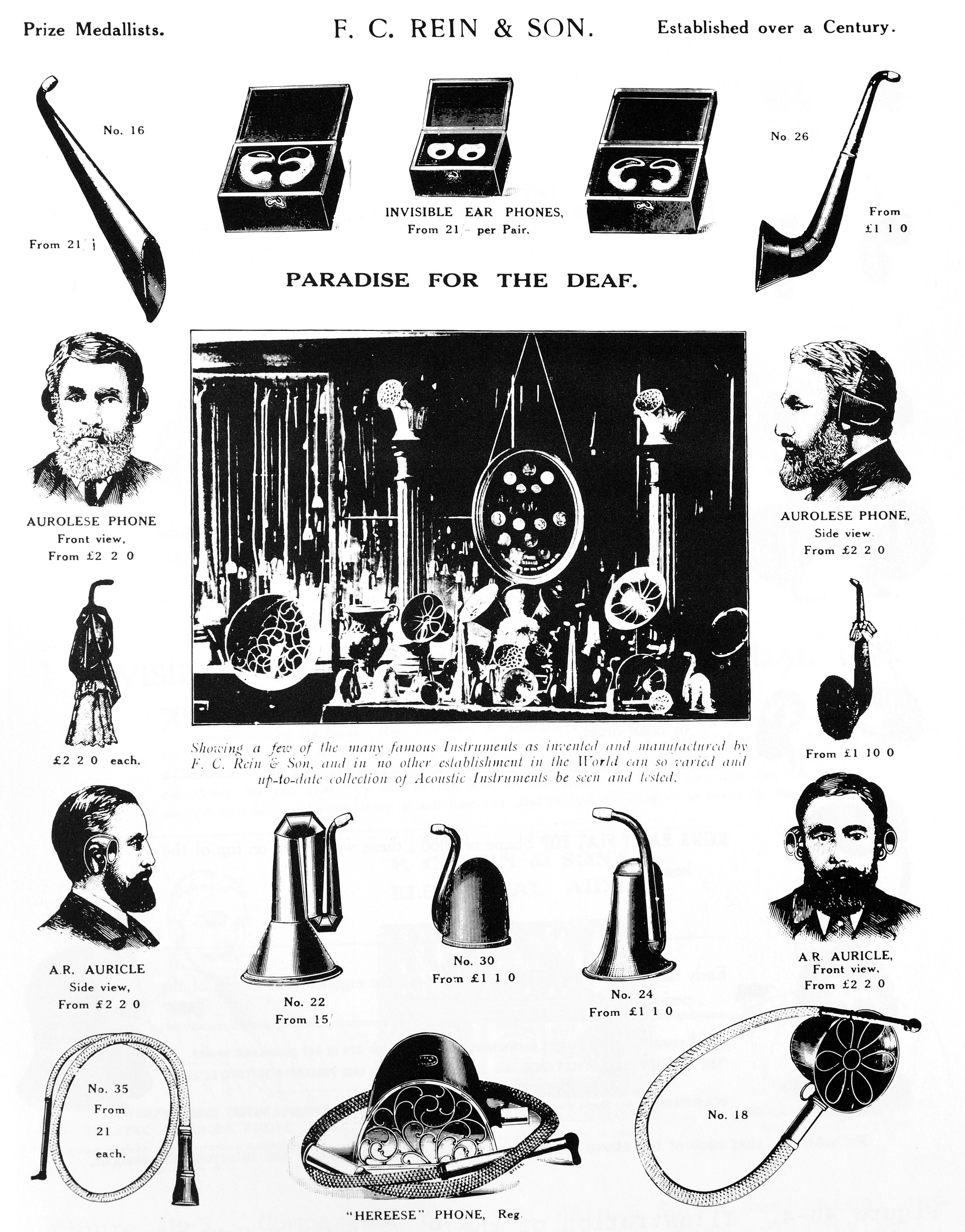
Ear trumpet page from the catalogue of 'F. C. Rein & Son', 1914. Source: The Packington Collection of the Ear Trumpets (eartrumpets.co.uk)
The Hearing Aids
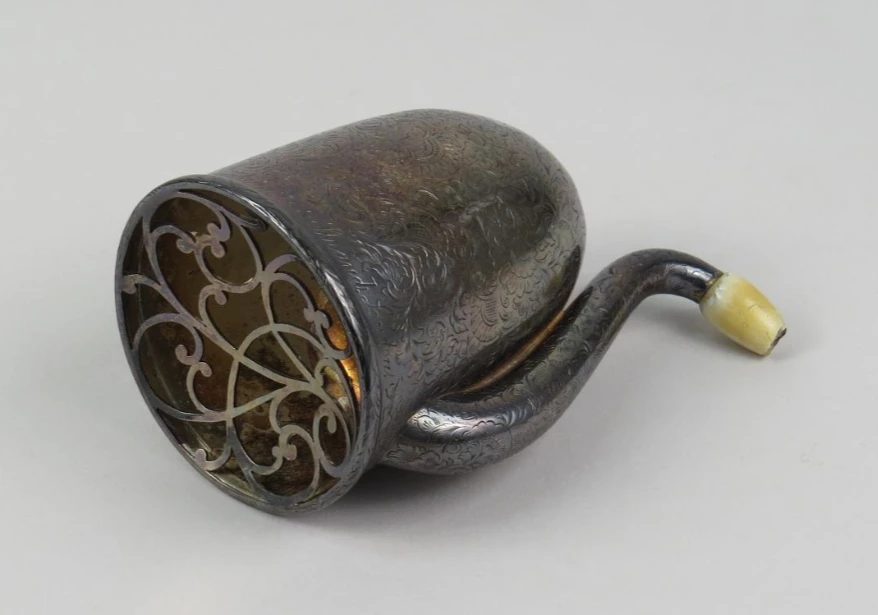
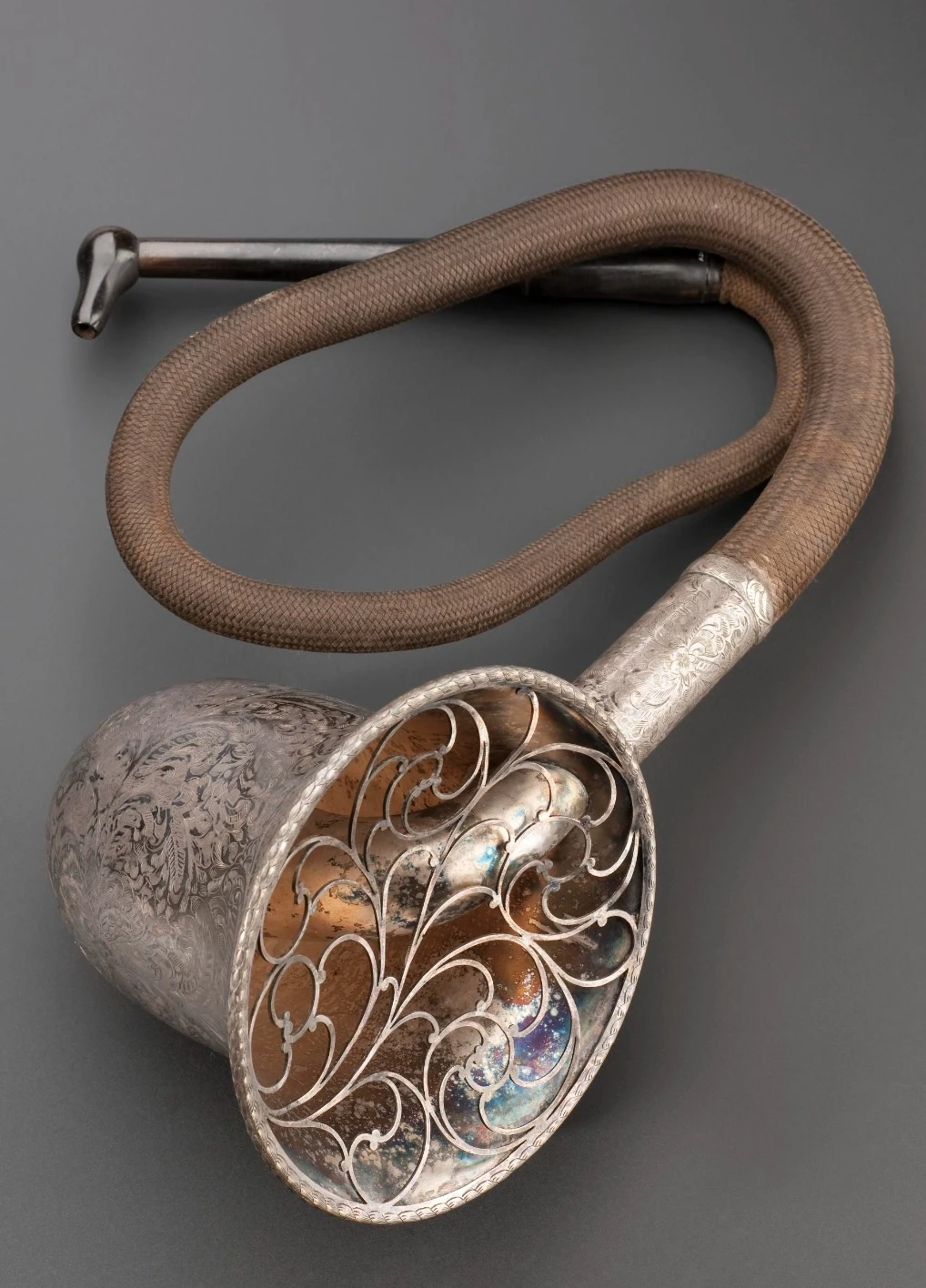
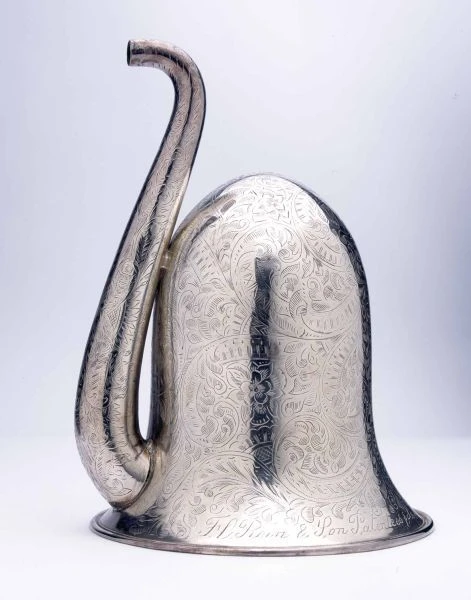
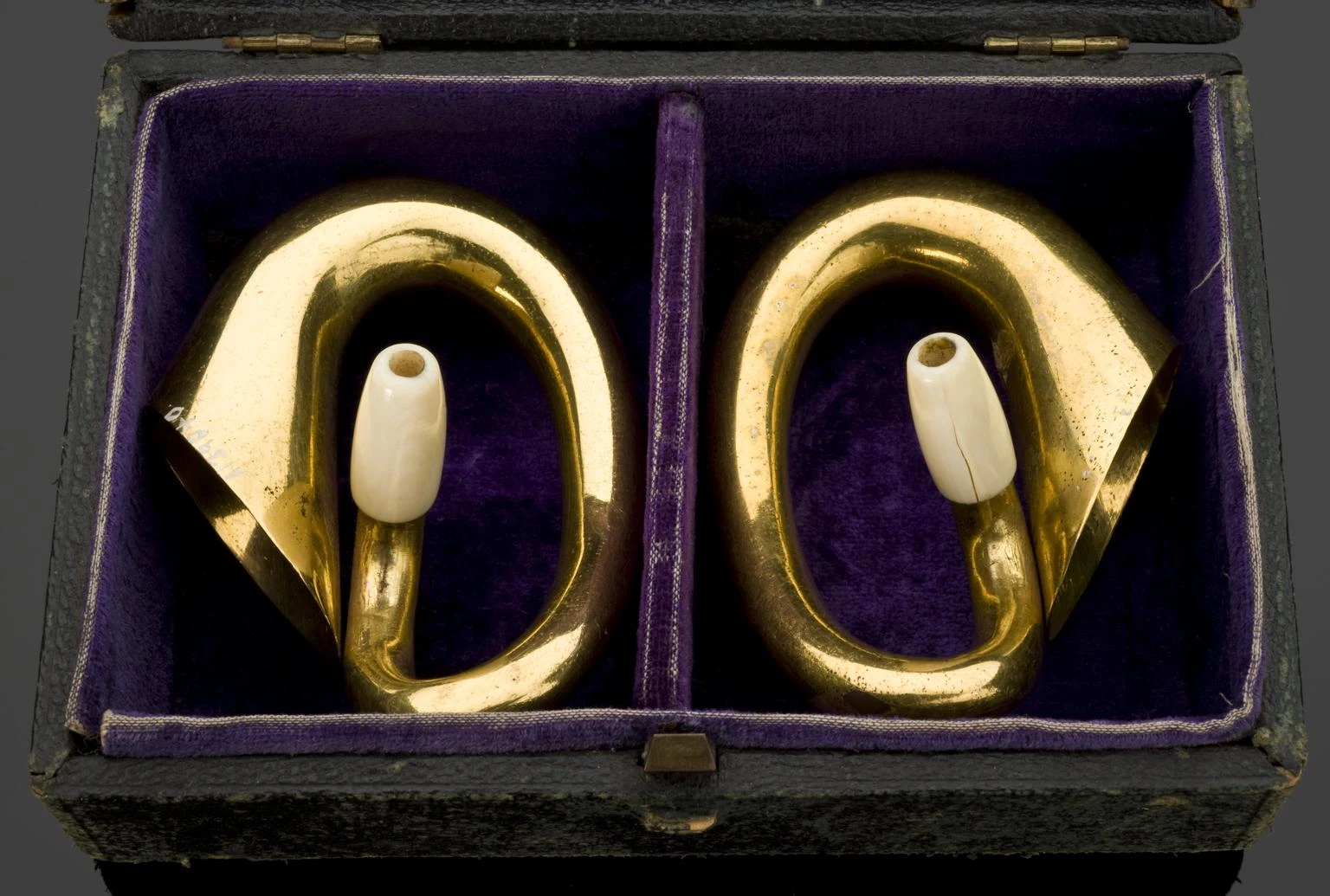
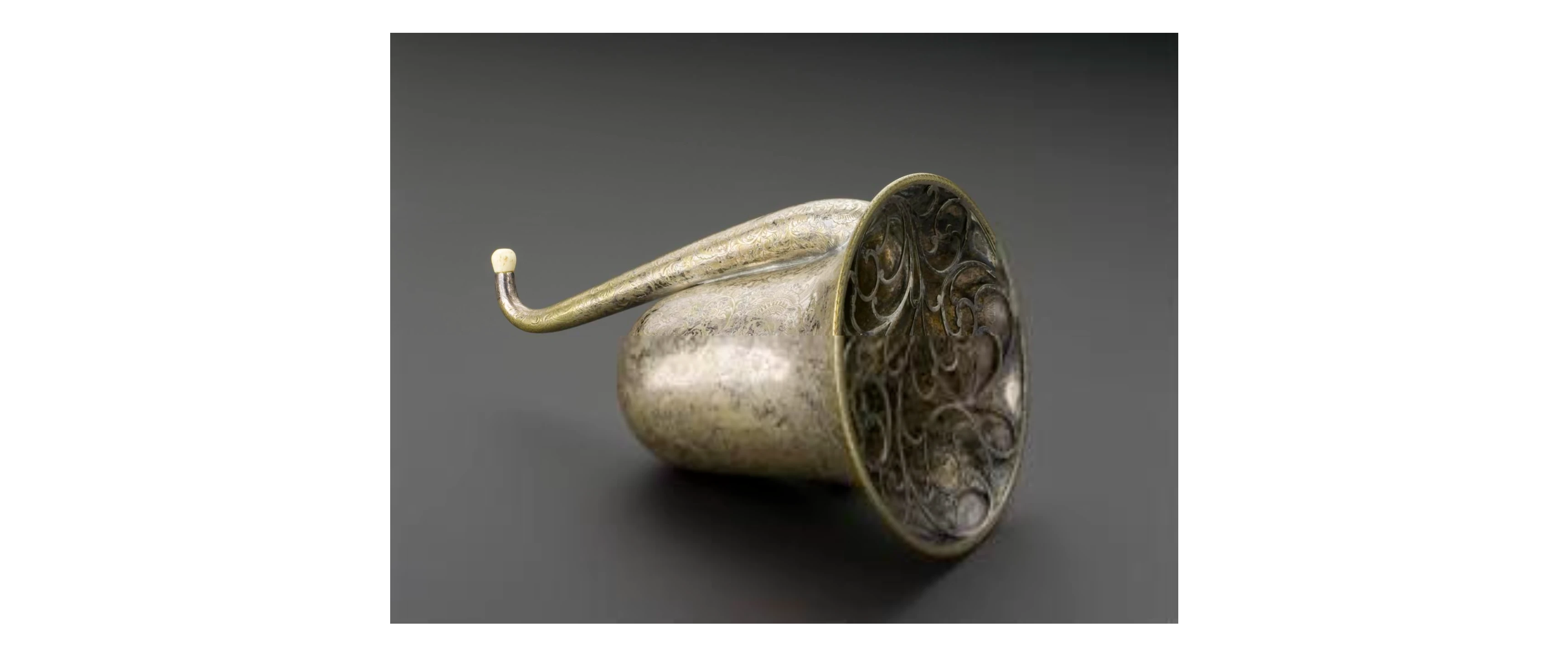
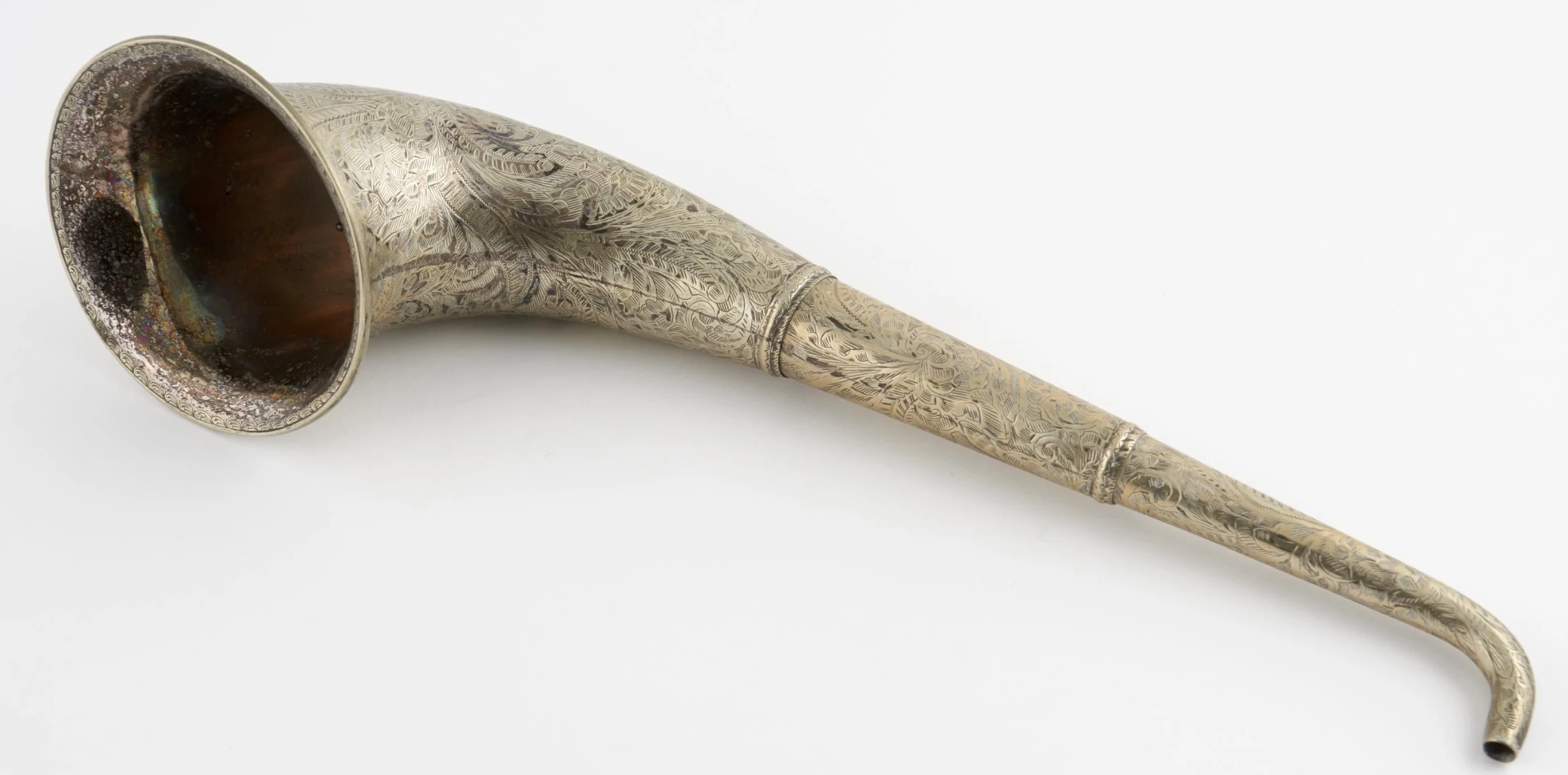
Rein's core product was the ear trumpet — a parabolic acoustic device that concentrates sound and directs it toward the eardrum. As a type of parabolic reflector, the ear trumpet projects sound energy onto a focal point through refraction and reflection, making it an effective hearing aid while remaining relatively compact. Rein produced these in a wide range of forms: large bell-mouthed trumpets for severe hearing loss ('London Dome'), compact collapsible versions that could be slipped into a pocket, and finely engraved presentation instruments in nickel silver, silver plate, and other metals.
Beyond the trumpet, the firm's catalogue was remarkably broad. Rein pioneered Acoustic Headbands — devices artfully concealed within hair or headgear — and his Aurolese Phones were headbands in various shapes incorporating sound collectors near the ear. Hearing aids were also integrated into furniture: they were hidden in couches, clothing, and accessories, a drive toward invisibility that was often more about concealing disability from the public than about helping the individual cope.
Among the firm's most spectacular creations was an acoustic chair — a piece of furniture engineered to gather and transmit sound to a seated listener through hidden tubes built into the armrests. Max Goldstein's 1933 book Problems of the Deaf includes a picture of Rein's acoustic chair, dated to around 1830, likely made as a showpiece. A widespread legend holds that a similar Acoustic Throne was commissioned by King João VI of Portugal, who reportedly suffered from hearing loss — but careful historical research has failed to find any contemporary evidence that the king was deaf, and the claim appears to originate from a single secondary source of uncertain reliability.
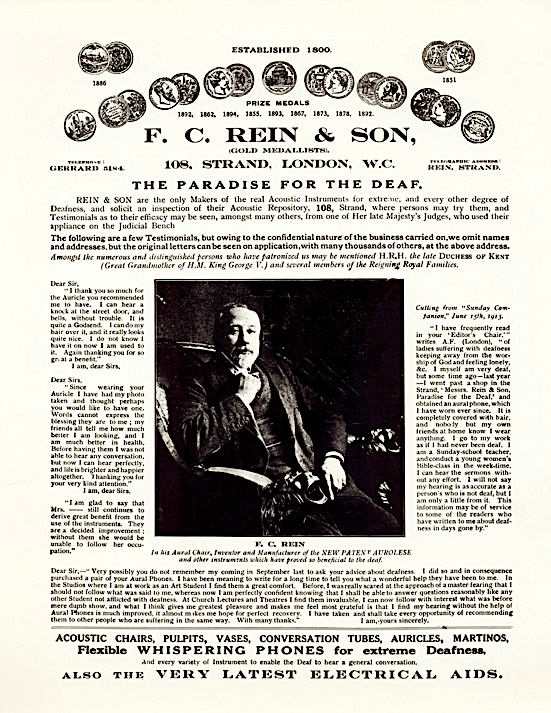
The founder of the company, Frederick Charles Rein sitting in the Acoustic Chair. Published in the later newspaper advertisement, after 1913 (right quote is dated June 1913). It is interesting that Rein’s followers chose to set the company’s founding date as 1800, even though it is known that Rein was born no earlier than 1813 and did not move to London until at least 1835. Source: Bernard Becker Medical Library, Washington University School of Medicine, St. Louis, Missouri, USA
Rein's work was recognised by leading otologists of the day. Joseph Toynbee, writing in 'The Diseases of the Ear' (1868), described Rein's small cornets connected by a spring over the head as 'the most useful of this class of instruments,' while William Wilde praised Rein in 1853 as someone who had 'given much attention to the subject, and made many improvements therein.'
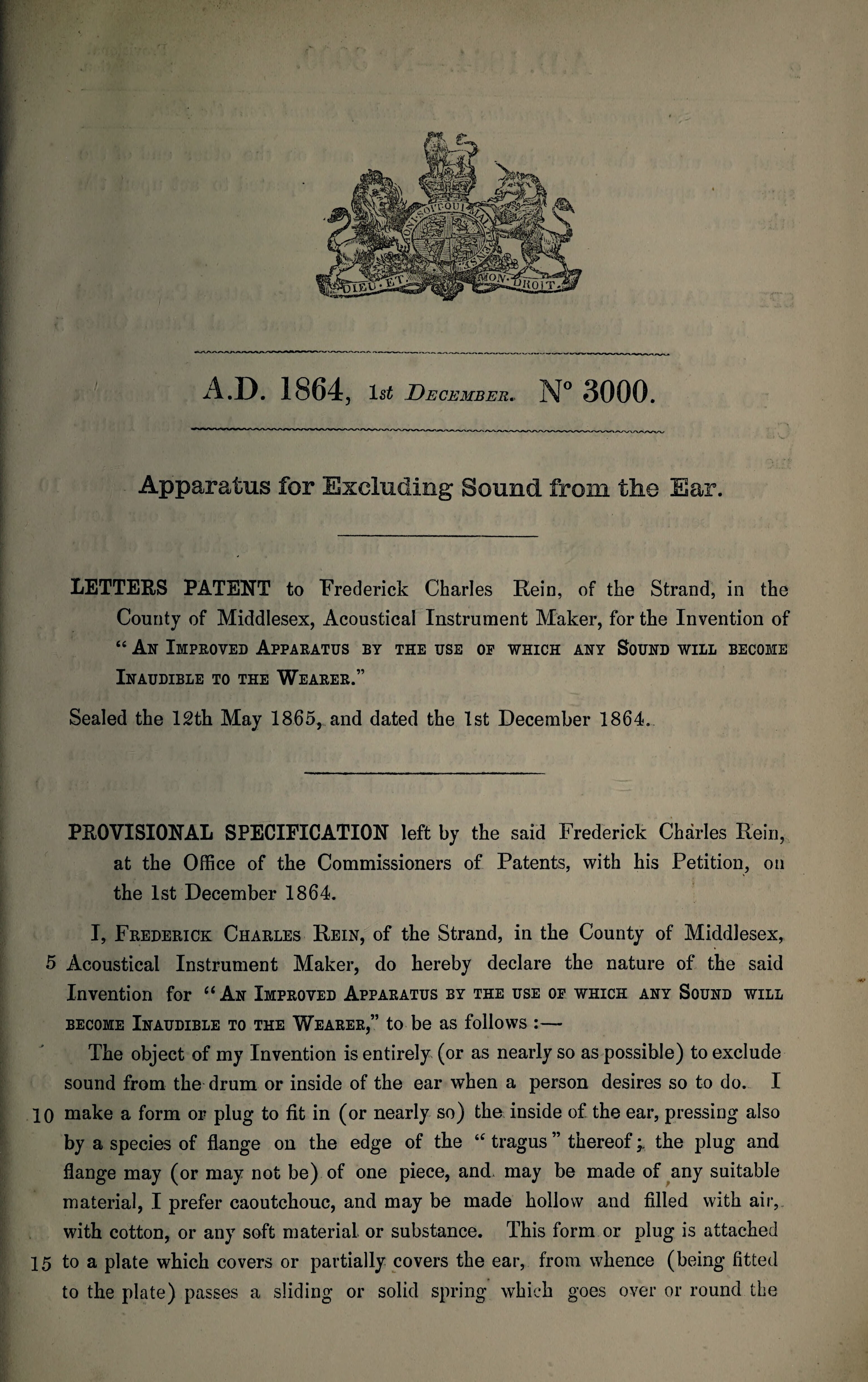
Rein also installed acoustic systems in ecclesiastical architecture: part of a Rein pulpit speaking system survives to this day in the Victorian church of St. John the Baptist in Enderby. In 1864, he applied for a patent for an "apparatus for excluding sound from the ear," which was issued in 1865. Also, he reported in The Gazette: "Frederick Charles Rein, of the Strand, in the county of Middlesex, Manufacturer of Acoustic Instruments, for an invention of “improved means of conveying sound from preachers or lecturers to the congregation or audience.” — Dated 22nd January, 1867."
Rein continued his business until his death on 1 March 1896 (by other sources: 6th of March 1896 — Frederick Charles Rein was buried at the Highgate Cemetery West, Square 41, Grave 17102, Memorial ID 285542767), from diabetes, senile decay, and exhaustion, employing over the years a brother-in-law, Michael Payne, and later a nephew, Cornelius Payne. His son, The third Frederick Charles, worked alongside him but had a troubled life. Newspaper records reveal public incidents of drunkenness and worse, and he died on 20 April 1900 in Wendover, of chronic alcoholism complicated by influenza and bronchitis, leaving his wife and daughter in difficult circumstances.
Following Frederick senior's death, his wife likely sold the business to the optician who worked in the adjacent shop, Charles Kahn. Kahn kept the trading name of F. C. Rein and Son, and his son Leslie Victor Kahn eventually adopted the surname Rein himself. Under Leslie Kahn-Rein, the firm adapted to new technology: he wrote to Wireless World in 1932 appealing for what we would now call professional audiologists, stating that he had ten years of experience working with audiometers and had invented two of them. The firm moved with the times, bridging the era of purely acoustic instruments and the age of electronics.
Leslie Kahn-Rein died in 1956; then in 1963, the business was reportedly taken over by Amplivox, according to various publications. Thus, the company 'F. C. Rein and Son' ended its ear trumpet manufacturing activity in 1963, making it both the first and last company of its kind—a span of well over a century in the service of the hard of hearing.
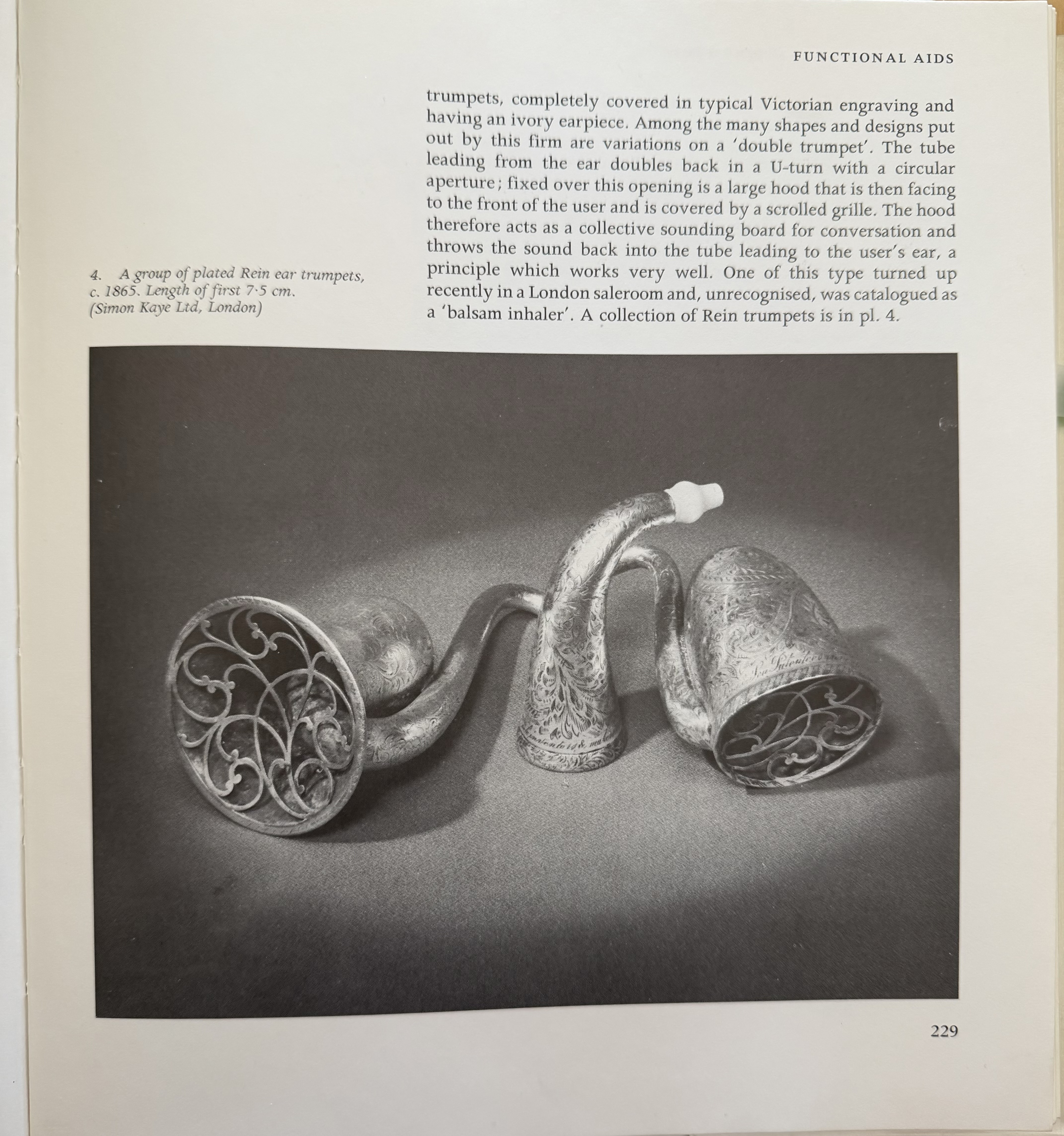
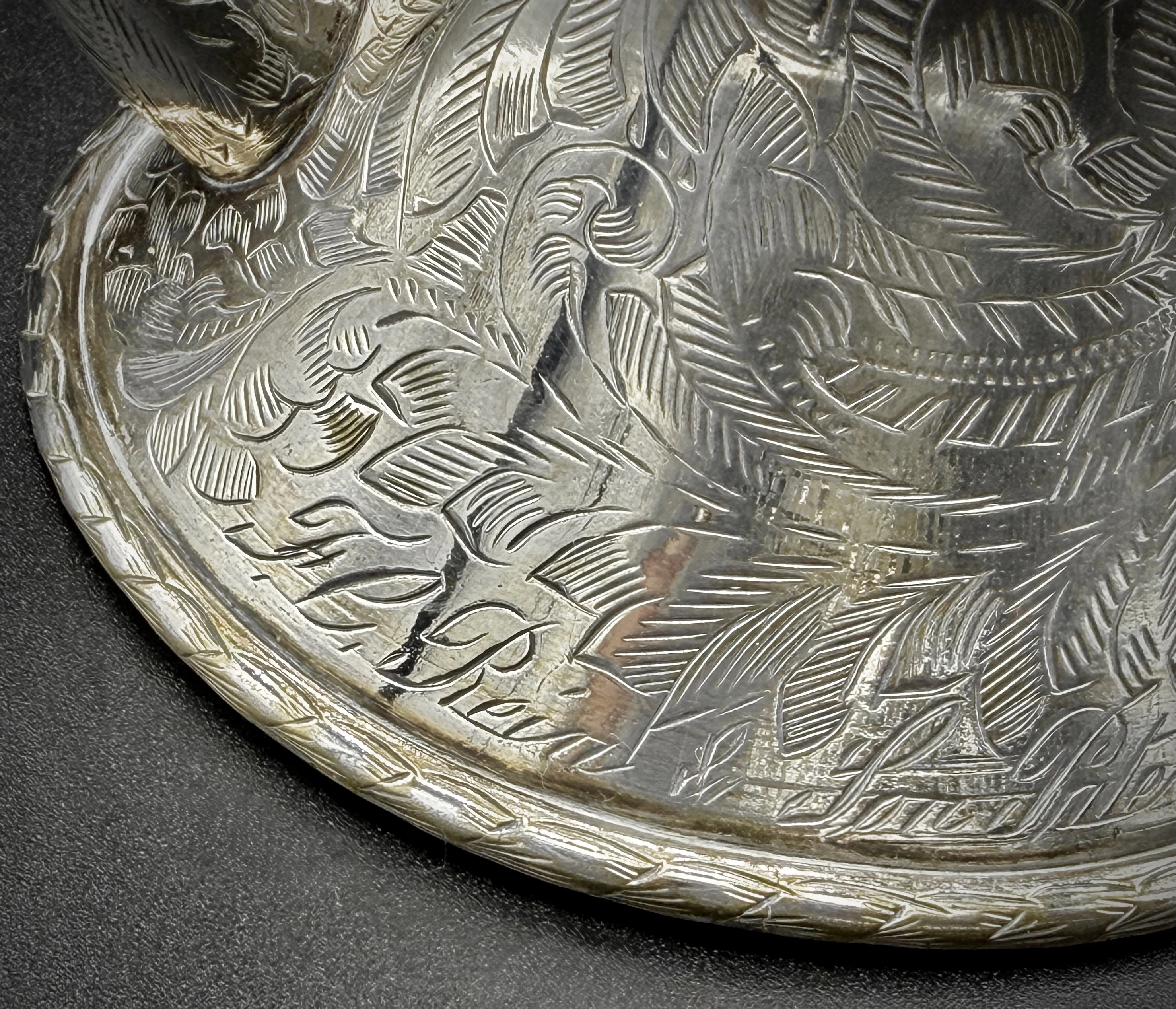
Photo and description of three silver-plated ear trumpets made by F. C. Rein & Son, dated 1865. The left instrument is almost identical to the Ear Trumpet presented in EuroMedSim collection except for the fact that its decorative floral grille is mirrored. Illustration from 'Antique Medical Instruments' by Elisabeth Bennion, 1979.
Addresses and Important Dates
1813. Frederick Charles Rein, was born in Leipzig, Saxony
1834–1835. Frederick Charles Rein moved to England
1834–1835, after. Frederick Charles Rein established his firm
1841. The first address at 340 Strand, London was mentioned
1847. Next address at 110 Strand, London
1850. The firm moved to the next address at 108 Strand, London
1851. Rein was both an exhibitor and a medallist at the Great Exhibition in Crystal Palace, London
1865. Frederick Charles Rein received a patent for an "apparatus for excluding sound from the ear"
1865-1866 (?). The firm was named 'F. C. Rein & Son'
1867, January 22. Invention of “improved means of conveying sound from preachers or lecturers to the congregation or audience.”
1896, 6 of March. Frederick Charles Rein died, later the business was sold to Charles Kahn
1916–1918 (?). New address at 30 Charing Cross with the following label: 'F. C. Rein & Son, Inventors & Patentees, 30 Charing X Rd., London'
1963, January. The company 'F. C. Rein and Son' was bought by Amplivox Ltd, ended its over hundred years manufacturing activity
References
- Barr, Thomas. Manual of Diseases of the Ear: For the Use of Students and Practitioners of Medicine. 1st ed. Glasgow: James Maclehose, 1884.
- Bennion, Elisabeth. Antique Medical Instruments. 1st ed. London: Sotheby Parke Bernet; Berkeley: University of California Press, 1979.
- Berger, Kenneth W. The Hearing Aid: Its Operation and Development. 1st ed. Detroit: National Hearing Aid Society, 1970.