
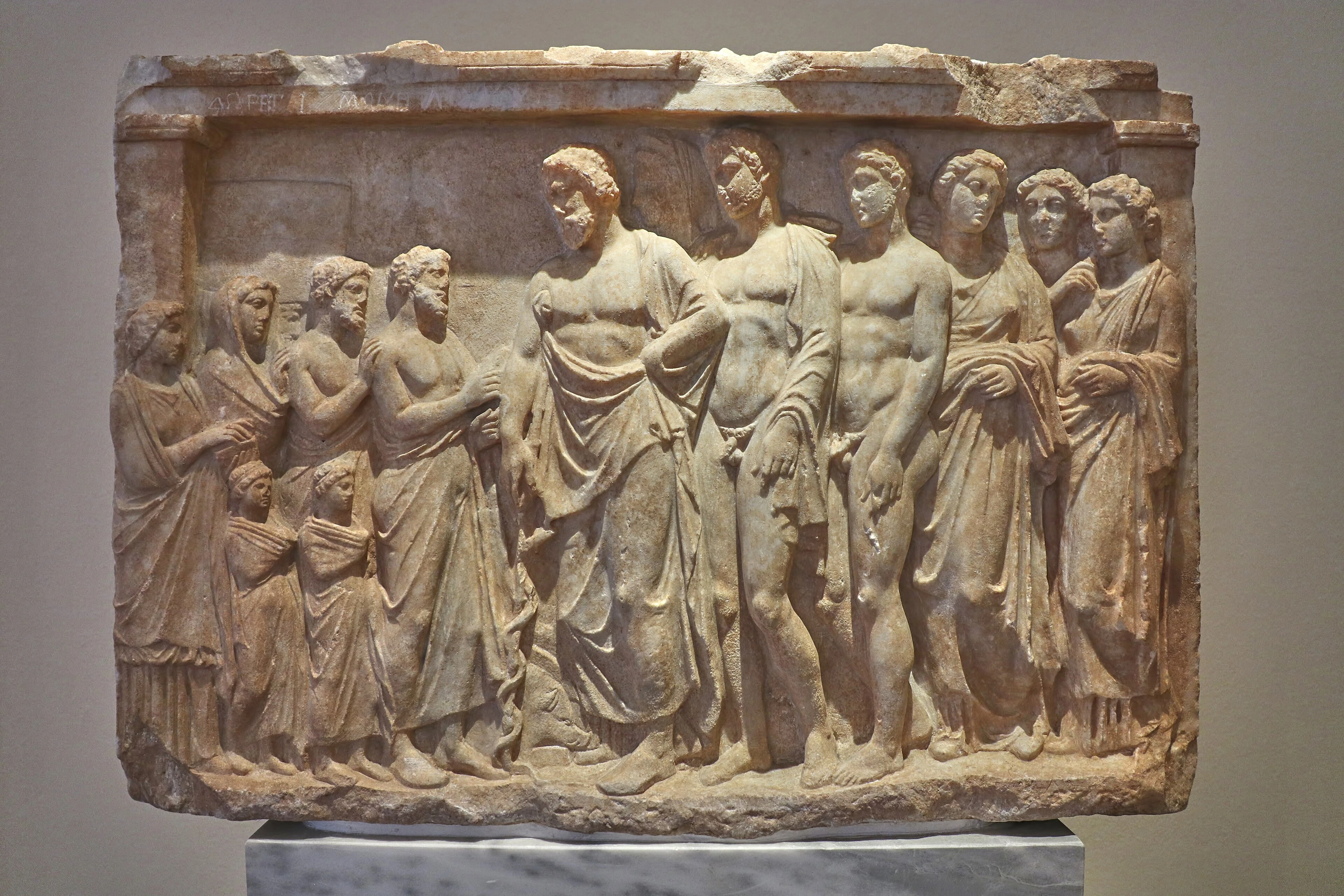
Asklepios, (Aesculapius)
Asclepius: God of Healing
he Greek god of medicine and healing, Asclepius—Greek Asklepios (Asklēpiós), known to the Romans as Aesculapius—was closely associated with Thessaly, particularly the town of Trikka. He may initially have been worshipped as a local healer-hero; in Homer’s Iliad, he appears as an exceptional physician rather than explicitly as a god. His cult subsequently spread to Epidaurus, Kos, Pergamon, and throughout the Mediterranean. His origins belong to overlapping local traditions, while his mythology tells of a mortal healer who ultimately received divine honours.

Sculpture of Aesculapius in the Museum of Medical History in the Rome University, Italy. Credit: Maxim Gorshkov
His father was Apollo, the god of music, prophecy, and healing, who could both send and relieve plague. His mother was Coronis, a mortal princess and daughter of Phlegyas, traditionally associated with Thessaly. In a competing Messenian tradition, his mother was Arsinoe, daughter of Leucippus. In the familiar story of Coronis, Apollo discovered that she had taken another lover, Ischys. Coronis was killed by Apollo or, in another version, by his sister Artemis. Before her body was consumed on the funeral pyre, Apollo rescued their unborn child and entrusted him to the centaur Chiron, who raised him and taught him the art of medicine.
Under Chiron’s guidance, Asclepius became a healer of extraordinary ability. Ancient accounts describe him treating wounds and diseases with medicines, incantations, and surgical procedures. His skill eventually crossed the boundary between healing and resurrection: he was said to have restored the dead to life, including, in some versions, Hippolytus, the son of Theseus. This challenged the order separating mortals from the gods, and Zeus struck him down with a thunderbolt. Yet death did not end his story. Other traditions describe his subsequent immortality or placement among the stars, while worshippers honoured him as a god capable of bringing relief even when human medicine seemed powerless.
Asclepius’s family extended his healing powers into a whole circle of protective figures. His wife, Epione, personified the soothing of pain. Their daughters embodied complementary aspects of health and recovery: Hygieia represented health and its preservation; Panacea, universal remedy; Iaso, healing and recovery; Aceso, the process of healing; and Aegle, radiance, commonly understood as the glow of good health. These relationships were not identical in every ancient source, but together the figures expressed a broad understanding of medicine, encompassing the prevention of illness, treatment, relief, and restored well-being.
His sons Machaon and Podalirius carried the family’s medical knowledge into the world of heroic warfare. In the Iliad, they lead warriors from Trikka and neighbouring towns to Troy and serve as physicians to the Greek army. Machaon treats Menelaus after an arrow wound, removing blood and applying healing medicines inherited through his father’s connection with Chiron. Through these sons, the mythical ancestry of medicine becomes part of the practical care of injured bodies on the battlefield.
For worshippers, Asclepius was more than a figure from heroic legend. His sanctuaries, known as Asklepieia, offered places to seek divine assistance. A characteristic ritual was incubation: after preparation and offerings, supplicants slept in a sacred area, hoping that the god would appear in a dream to heal them or reveal a remedy. The sanctuary thus became a setting in which suffering, religious expectation, and the search for recovery met.
In sculpture, Asclepius is usually recognisable as a mature, bearded man leaning on a staff around which a single snake is coiled. The snake was sacred to him; its shedding of skin may have suggested renewal and restored vitality. This Rod of Asclepius remains an enduring emblem of medicine. His family also survives in medical language and tradition: Hygieia’s name underlies the word hygiene, while the ancient Hippocratic Oath invokes Apollo the physician, Asclepius, Hygieia, and Panacea—preserving the memory of healing as both a human craft and a sacred responsibility.
The main cult image of Asclepius: Epidaurus
Nearly all surviving statues of Asclepius are Roman copies and adaptations of several Greek originals from the 5th-4th centuries BC. The originals (mostly bronze and chryselephantine) are lost, so scholars reconstruct them from copies, coins, and ancient descriptions. The best-known image was the cult statue in the sanctuary of Asclepius at Epidaurus, by Thrasymedes of Paros (c. 370s BC). According to Pausanias (2.27.2), it was seated and made of gold and ivory. The god held a staff, rested one hand on the head of a serpent, and had a dog beside him. The type is known from Epidaurian coins and reliefs. It established the standard iconography: a mature, bearded man with a staff and a snake.
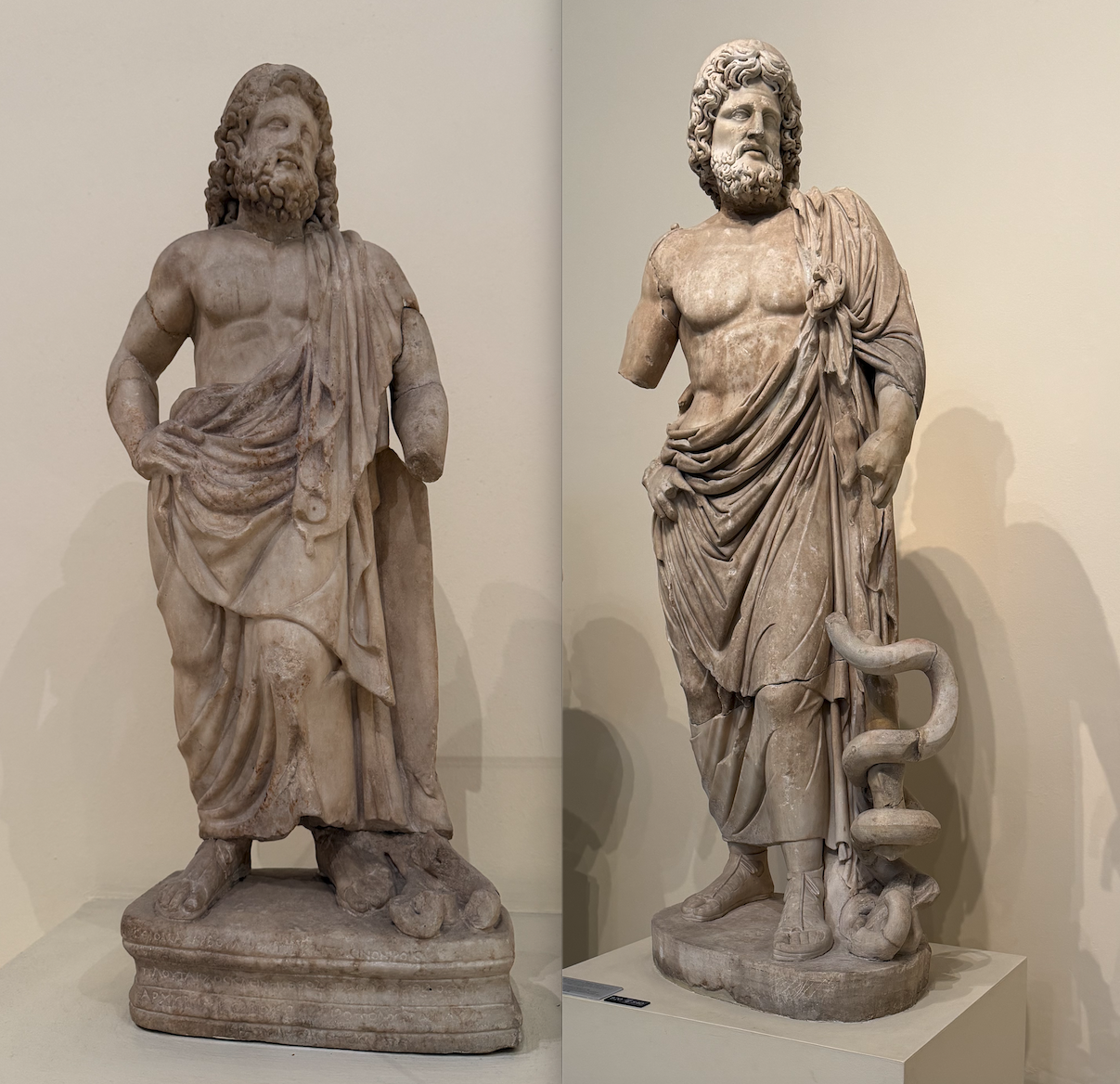
Two statues of the god Asclepius (in Roman mythology — Aesculapius). Pentelic marble. 2d–4th c. AD. The Hellenic National Archaeological Museum, Athens. Photo: Maxim Gorshkov
Main types of copies
Art historians group the surviving statues into “types,” named after the collections where the examples were found or kept:
- Giustini type: a standing Asclepius leaning on his staff. It is thought to go back to a classical original of the late 5th century BC. It is often linked to the circle of Pheidias and Alkamenes, but this is a hypothesis.
- Este type: a later, 4th-century BC creation, with a softer, “Scopasian” treatment of the face.
- Barberini type and others: variants in pose and drapery that arose in the Hellenistic and Roman periods.
Other important originals
- The Asclepius at Pergamon by Phyromachos (Hellenistic period), another famous cult image.
- Asclepius statues by Bryaxis and other 4th-century BC masters in various sanctuaries, known mainly from written sources.
The cult of Asclepius spread across Greece and then the Roman Empire, especially after it was introduced to Rome in 291 BC. Asklepieia (healing sanctuaries), baths, and villas commissioned statues based on well-known models, and workshops used ready-made iconographic schemes. As a result, copies differ in detail, and attributions to specific sculptors remain tentative.
Sources
- Pausanias, Description of Greece, 2.27.2 (Thrasymedes’ statue at Epidaurus); 1.40.6 (Bryaxis at Megara).
- Pliny the Elder, Natural History, 34.51 (Phyromachos).
- Holtzmann, B. “Asklepios.” In Lexicon Iconographicum Mythologiae Classicae (LIMC), vol. II. Zurich and Munich: Artemis, 1984. This is the standard catalogue of types, including the Giustini and Este types.
- Edelstein, E. J., and L. Edelstein. Asclepius: A Collection and Interpretation of the Testimonies. Baltimore: Johns Hopkins Press, 1945. A collection of ancient testimonies on the cult.
- Hart, G. D. Asclepius: The God of Medicine. London: Royal Society of Medicine Press, 2000.
