Origin of Blood Transfusion — Chirurgia Infusoria
Foreword
Distortion of facts, misattribution of sources, erroneous dating, and fabricated stories—today, all of this has become a common, routine occurrence, and it has not spared the history of blood transfusion. The roots of this phenomenon were laid from the very beginning, when, literally from the very first days, scientists from different countries began arguing over their own or national priority, publishing arguments and facts in print to support their specific point of view. Even then, it was enough simply to select suitable literary works, discarding contradictory ones, to prove the desired point of view. Later on, the authors of many articles did not bother to study the primary sources but simply copied others’ fabrications, compiling multi-page lists of references to lend credibility to their claims. Scientific fakes have a centuries-old tradition! Today, when scans of original articles are available with a single click online, proving or disproving facts has become significantly easier. Therefore, in the article below, we have endeavored not only to cite the source texts but also to provide an exact link to the original document for each one.
Background
Ancient Greek and Roman physicians did not practice blood transfusion and had no concept of circulating blood. Since ancient times, blood has been considered the most sacred element of the body. It contained vital energy, the main factor of life. But not only that — it was also a repository of special spiritual qualities that defined a person. So, animal blood could not be considered equal to human blood. Medical theory, especially in the works of Hippocrates and later Galen, held that blood was one of the four humors and was continuously produced in the liver from digested food and consumed by the tissues. As a result, therapeutic practices focused on regulating the balance of humors—most notably through bloodletting—rather than transferring blood from one individual to another.
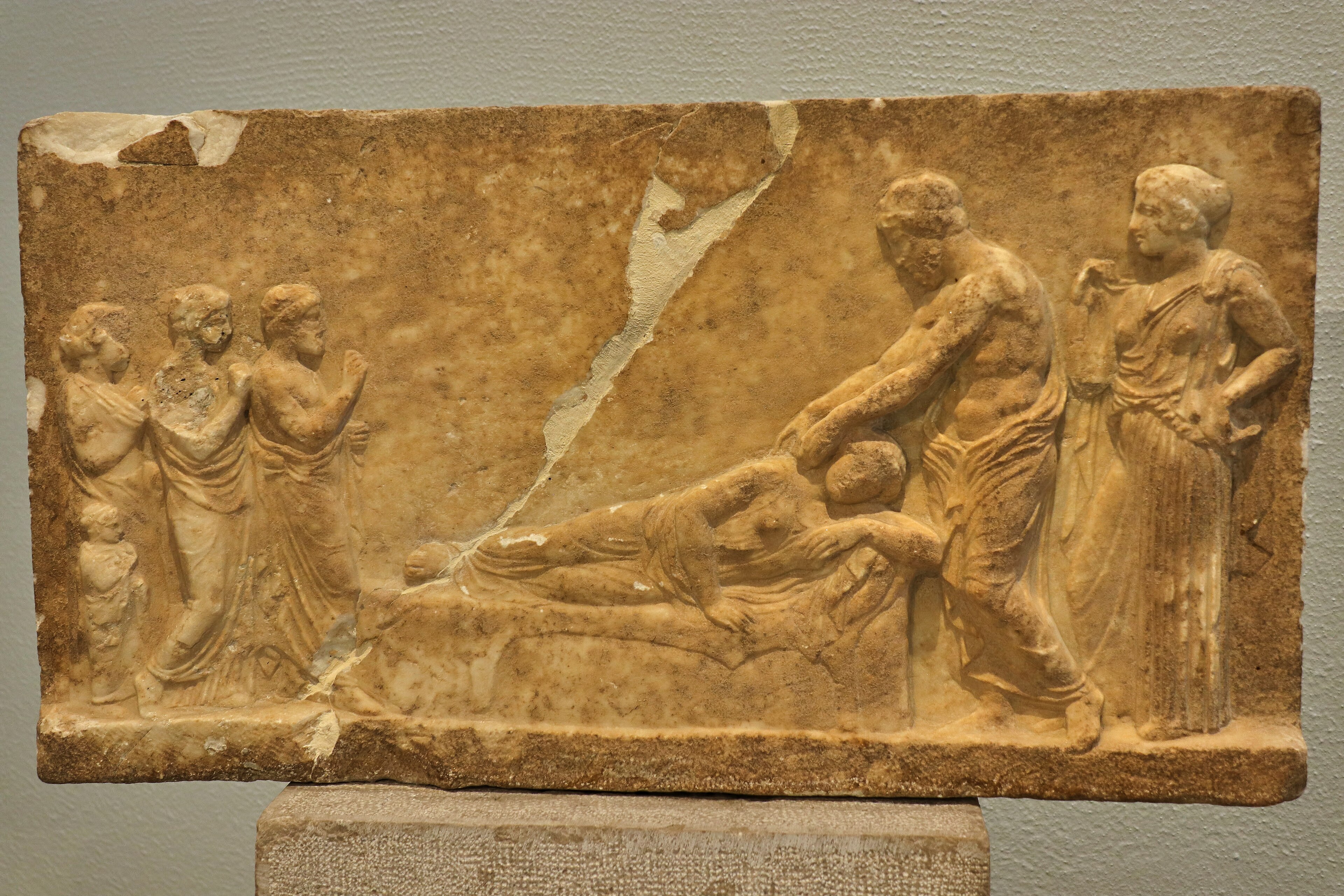
Votive relief of Asclepius. The god bends down over the reclining sick woman, placing his hands on her neck and back. Hygiea stands behind him and the family of the patient approaches as suppliants. From the Asclepeion of Piraeus. Around 350 B.C. Archaeological Museum of Piraeus, Greece. Source: wikimedia
But the inquiring minds of Renaissance scientists expressed various, sometimes mind-boggling ideas, including the possibility of replenishing blood loss in the wounded or replacing “bad” blood with “good” blood in the seriously ill. In the 17th century, William Harvey's discovery of continuous blood circulation led to the idea of new therapeutic methods. The early history of blood transfusion was presented in numerous publications in France, England, and Italy. Many of these works already raised the question of the priority of discoveries, who deserves credit for performing the first blood transfusion — between animals, from animal to human, and from human to human.
Key Milestones of the Blood Transfusions
1628. William Harvey (1578–1657) in his publication refuted the previously accepted Galenic views on the origin and movement of blood in the human body and mathematically demonstrated the existence of systemic blood circulation driven by the heart.
1665. In the end of February 1665, Richard Lower (1631–1691) successfully performed dog-to-dog blood transfusion at the University of Oxford. The recipient dog survived, but the donor dog died from blood loss.
1667 (15th of June 1667). French physician Jean-Baptiste Denis performed the world's first blood transfusion from a lamb to a human in Paris (xenotransfusion). Denis transfused about 12 ounces of lamb blood into the patient. The patient, a 15-year-old boy with a severe fever, survived.
1667 (December 10, 1667). Guglielmo Riva, a physician to Pope Clement IX and a surgeon at the Ospedale della Consolazione (Hospital of Consolation), conducted in Rome public demonstrations of three blood transfusions on humans in the presence of four authoritative physicians — at the first time in Italy.
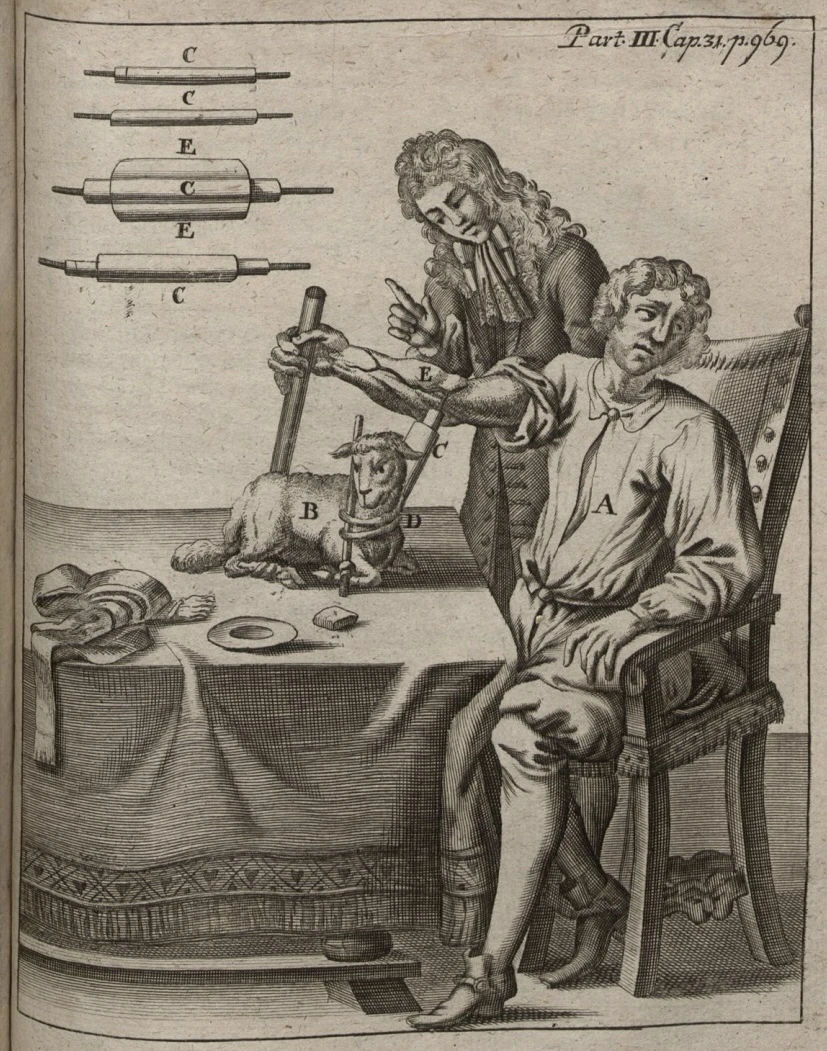
1668. The Silesian surgeon Matthaeus Gottfried Purmann performed the first blood transfusion from a lamb to a human in Germany in 1668. His publication on the procedure features one of the world's first illustration of a blood transfusion (see above the title illustration).
1668. The first blood transfusion court trial: Jean-Baptiste Denis and his colleague Paul Emmerez performed transfusions of calf’s blood into a mentally ill patient, Antoine Mauroy, who initially showed improvement but later that same night he died. Mauroy’s widow accused medics of causing her husband’s death by transfusion.
1818. British obstetrician James Blundell (UK) performed the first successful blood transfusion from one person to another. Due to postpartum hemorrhage, the woman was on the verge of death, and her husband agreed to be the blood donor. Blundell subsequently performed 10 transfusions (1825–1830) and developed special instruments for blood transfusion.
1901. Karl Landsteiner (Austria) made a discovery that marked the beginning of the era of safe blood transfusions. He identified blood groups, and for this discovery he was awarded the Nobel Prize in Medicine in 1930. Later, around 1940, he also co-discovered the Rh factor, which made transfusions even safer by accounting for the "+" and "-" designations we use today.
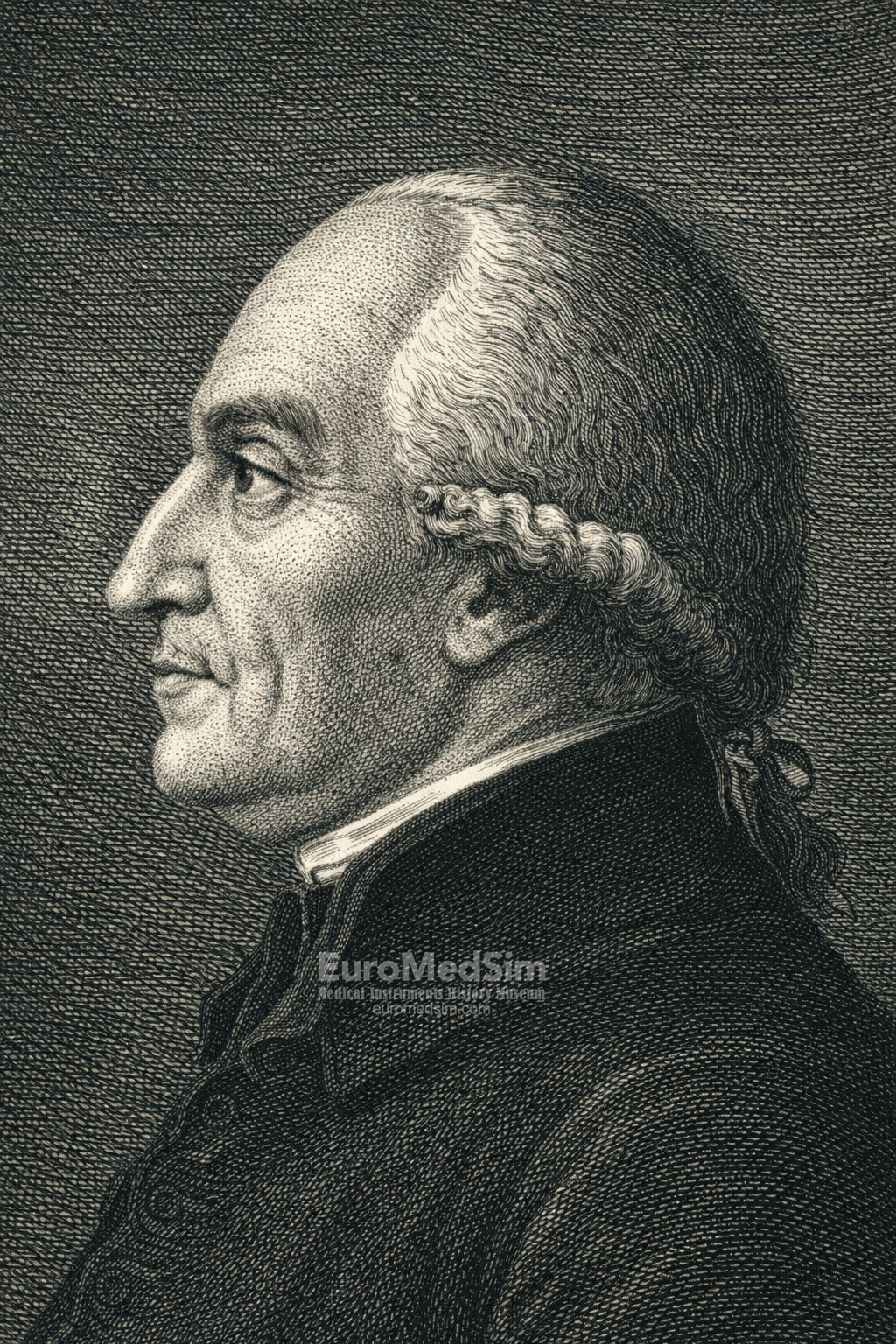
Jean-Baptiste Denis (1643–1704), French physician, professor of philosophy and mathematics, physician to King Louis XIV, performed the world first blood transfusion to a human in 1667. In that moment he was only 24 years old. A digitally restored and enlarged version of an antique engraving. Credit: EuroMedSim Medicine Museum.
Since ancient times, blood has been considered the most sacred element of the body. It contained vital energy, the main factor of life. But not only that — it was also a repository of special spiritual qualities that defined a person. Animal blood could not be considered equal to human blood. But the inquiring minds of Renaissance scientists expressed various, sometimes mind-boggling ideas, including the possibility of replenishing blood loss in the wounded or replacing “bad” blood with “good” blood in the seriously ill. In the 17th century, William Harvey's discovery of continuous blood circulation led to the idea of new therapeutic methods.
The early history of blood transfusion was presented in numerous publications in France, England, and Italy. Many of these works already raised the question of the priority of discoveries, who deserves credit for performing the first blood transfusion—between animals, from animal to human, and from human to human.
William Harvey's 'de Motu Cordis' - Blood Circulation
William Harvey (1578–1657) published Exercitatio Anatomica de Motu Cordis et Sanguinis in Animalibus (Frankfurt: William Fitzer, 1628), in which he overturned the long-standing Galenic doctrine that blood was continuously produced in the liver from digested food, consumed by the tissues, and moved back and forth in the veins with only a small portion passing from the right to the left side of the heart through invisible pores in the interventricular septum.
Harvey demonstrated instead that the heart functions as a pump and that blood circulates in a closed system through arteries and veins. He supported this conclusion with anatomical observations and quantitative reasoning: by calculating the volume of blood expelled by the heart with each contraction and multiplying it by the number of heartbeats per hour, he showed that the amount of blood passing through the heart far exceeded the total volume of the body, which would be impossible unless the same blood continually recirculated; he also performed ligature experiments on arteries and veins that demonstrated the directional flow of blood and the function of venous valves.

The title page of the work that laid the cornerstone of the theory of blood circulation. W. Harvey, 1628. Source: web-archive, contributor: McGill University Library
In Chapter XIV, which is very short, Harvey describes his conclusions, thereby formulating the groundbreaking principles of blood circulation:
Chapter XIV. Conclusio demonstrationis de sanguinis circuitu
Iam denique nostram de circuitu sanguinis sententiam ferre et omnibus proponere liceat.
Cum haec confirmata sint omnia et rationibus et ocularibus experimentis, quod sanguis per pulmones et cor pulsu ventriculorum pertranseat, et in universum corpus impellatur et immittatur, et ibi in venas et porositates carnis obrepat, et per ipsas venas undique de circumferentia ad centrum ab exiguis venis in maiores remittatur, et illinc in venam cavam ad auriculam cordis tandem veniat; et tanta copia, tanto fluxu et refluxu, hinc per arterias illuc, et illinc per venas huc retro, ut ab assumptis suppeditari non possit, atque multo quidem maiori quam sufficiens erat nutritioni proveniat.
Necesse est concludere circulari quodam motu in circuitu agitari in animalibus sanguinem, et esse in perpetuo motu; et hanc esse actionem sive functionem cordis, quam pulsu peragit, omnino motus et pulsus cordis causam unam esse.
which means in English:
Chapter XIV. Conclusion of the demonstration concerning the circulation of the blood
At last, therefore, it is permitted for us to set forth and present to all our opinion concerning the circulation of the blood.
Since all these things have been confirmed both by reasoning and by ocular experiments: that the blood passes through the lungs and the heart by the pulsation of the ventricles, and is driven and sent into the whole body; and there creeps into the veins and the pores of the flesh; and through the veins themselves from every side, from the circumference toward the center, it is returned from the smaller veins into the larger ones; and from there it comes into the vena cava and finally arrives at the atrium of the heart; and in such quantity, with such a flow and reflux—hence through the arteries thither, and thence through the veins back again—that it cannot be supplied from the food taken in, and indeed occurs in a quantity far greater than would be sufficient for nutrition.
It is therefore necessary to conclude that the blood in animals is driven in a certain circular motion, that is, in a circuit, and that it is in perpetual motion; and that this is the action or function of the heart, which it performs by its pulse, and that the motion and pulsation of the heart are the one cause of this movement.
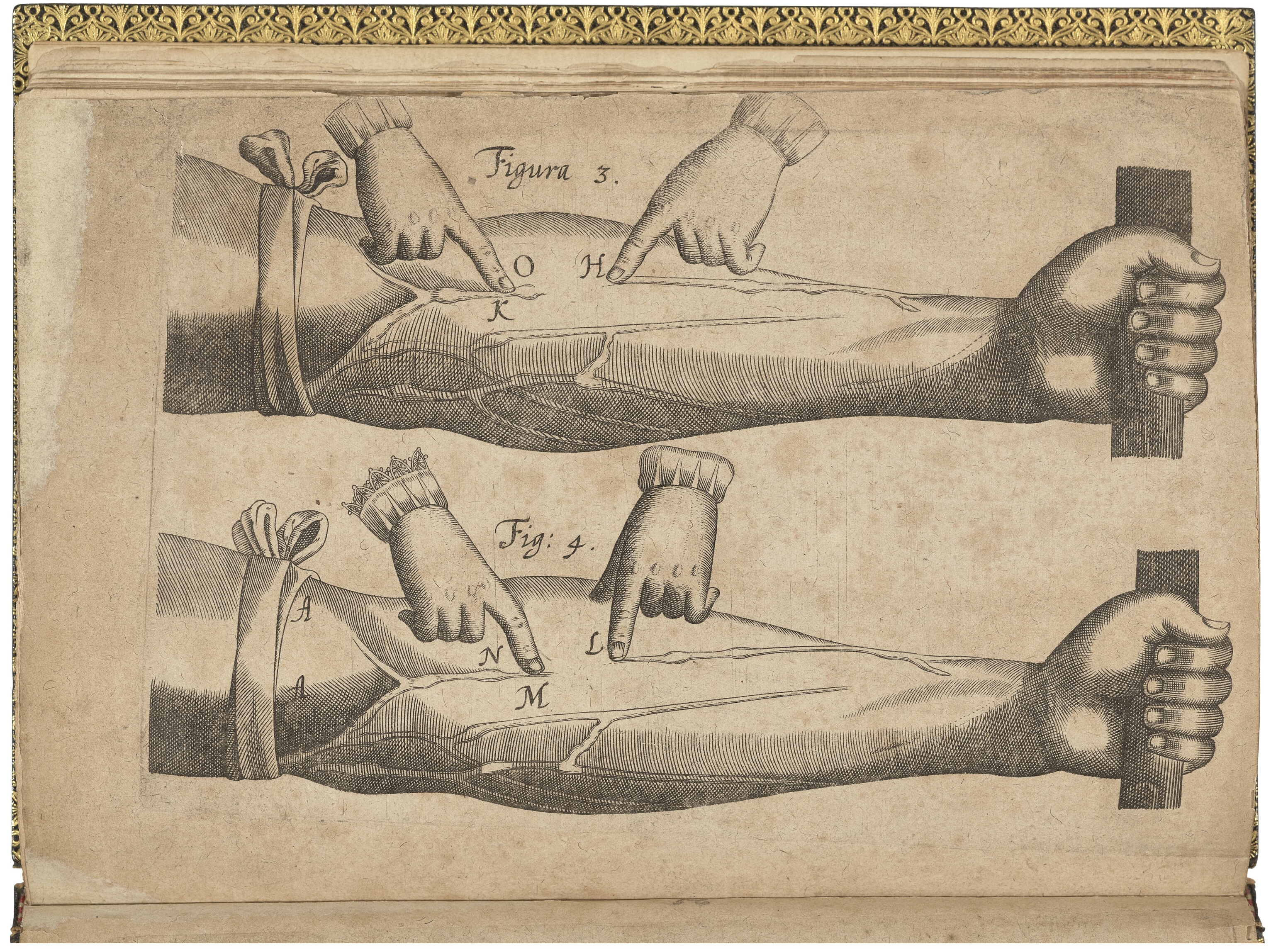
Demonstration of venous valves and their role in the movement of blood from the periphery to the heart. The pictures were based on an illustration from De venarum ostiolis, which was published in Padua in 1603 by Hieronymus Fabricius ab Aquapedente, one of Harvey's teachers. Source: Christie's Auction, 2025
Source:
Exercitatio anatomica de motv cordis et sangvinis in animalibvs. Gvilielmi Harvei Angli. Published: Francofvrti : Sumptibus (At his own expense) Gvilielmi Fitzeri, 1628. Full text in web-archive, contributor: McGill University Library.
Blood transfusion between dogs by Richard Lower
Many sources mistakenly cite the year of Richard Lower's experiment — 1666 instead of 1665, which is critical for the questions of the priority. They erroneously take as the date of priority a letter from Robert Boyle (representing the Royal Society) dated June 26, 1666, which is included in the book Tractatus de corde. Item de motu & colore sanguinis et chyli in eum transitu, written by Richard Lower and published in 1669.
In the fourth chapter of this book, entitled De Transfusione Sanguinis ex animali alio in aliud: Quo tempore & quâ occasione ab Authore inventa sit ("About the transfusion of blood from one animal to another: when and under what circumstances it was invented by the author"), Lower cites this letter addressed to him as evidence in defense of his primacy in performing animal-to-animal blood transfusion. This date today is often mistakenly attributed to the experiment itself. However, earlier in the same chapter, there is a description and an earlier date for the initial experiment:
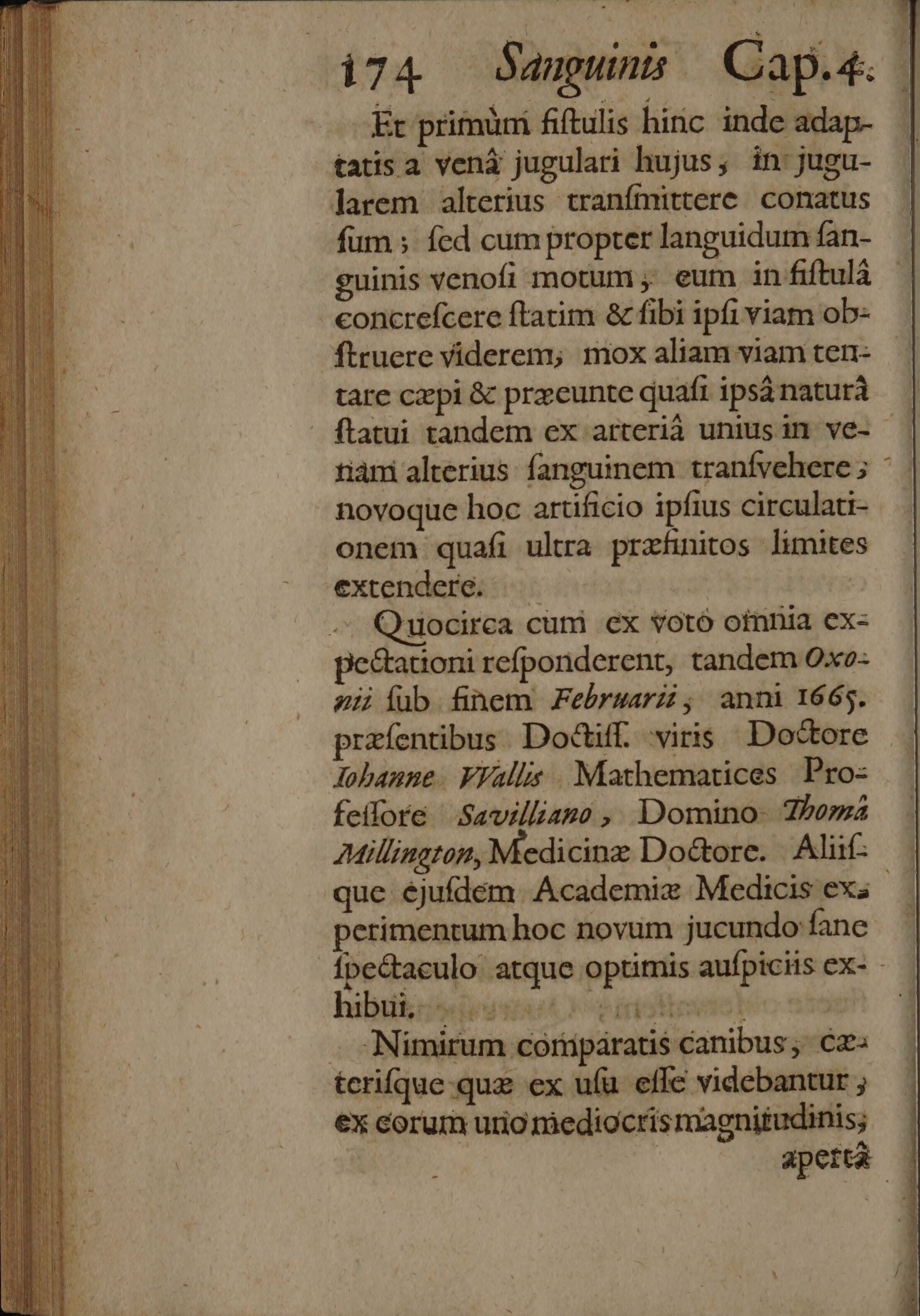
Quocirca cum ex voto omnia expectationi responderent, tandem Oxonii sub finem Februarii, anni 1665. præsentibus Doctiss. viris Doctore Johanne Wallis Mathematices Professore Saviliano, Domino Thomâ Millington, Medicinæ Doctore. Aliisque ejusdem Academiæ Medicis experimentum hoc novum jucundo sane spectaculo atque optimis auspiciis exhibui ("Therefore, since everything responded to expectation according to my desire, I finally exhibited this new experiment at Oxford toward the end of February, in the year 1665, in the presence of the most learned men: Doctor John Wallis, Savilian Professor of Mathematics, Mr. Thomas Millington, Doctor of Medicine, and other physicians of the same University; [it was] truly a pleasing spectacle and performed under the best auspices.")
The men mentioned as witnesses were titans of the scientific revolution: John Wallis was a world-renowned mathematician, and Thomas Millington was a co-founder of the Royal Society and personal doctor to King William III and Queen Mary II. Thus, this evidence alone was sufficiently compelling. However, Lower mentions that a repeat demonstration was held later in London, and even publishes the full text of the correspondence with Robert Boyle.
 digital engraving based on the oil portrait of Jacob Huysmans in Wellcome Collection EuroMedSim.png)
Lower Richard (1631-1691), digital engraving based on the oil portrait of Jacob Huysmans, Wellcome Collection, London. Source: EuroMedSim
Interestingly, later in this chapter there is a phrase that serves as the key to the purpose of the entire book. Lower mentions on the page 188 a certain Dionysius (is none other than the 24-years old Frenchman Jean-Baptiste Denis, a rival who claims to have been the first to perform a blood transfusion on a human being in Paris ten years ago). The full text is the following:
Cum igitur exeunte Februario, anni 1665, Transfusio a me primo perfecta fuerit; atque Clariss. Boylei literæ ad me datæ sexto Junii sequentis; & proximo Decembre Responsum nostrum Philosophicis Transactionibus, quæ jam tum typis mandabantur, insertum: Dionysii autem nulla super ea re mentio nisi integro post anno facta fuerit; & præterea ipse fateatur (utcunque jam ante decennium, ut ait, de ea aliquid animo conceperat) esse tamen transfusionem possibilem & quo ea modo fieri posset ex libellis philosophicis primum intellexisse; cui demum tribuenda sit hujusce experimenti inventio aliis judicandum relinquimus (Since, therefore, at the end of February 1665 the transfusion was first successfully performed by me, and since the letters of the distinguished Robert Boyle addressed to me were written on the sixth of June following, and our reply was inserted in the Philosophical Transactions in the following December, when they were already being printed; while Denis made no mention of the matter until a full year later; and since he himself admits that, although he had conceived something about it in his mind nearly ten years earlier, he nevertheless first understood from philosophical writings that transfusion was possible and by what method it might be carried out; we leave it to others to judge to whom the invention of this experiment should rightly be attributed.)
The eternal English-French rivalry was expressed here in the feeling that Denis stole his intellectual achievement. It is no coincidence that the book was published in Latin — clearly addressed to all colleagues, including those abroad. However, in fairness, it should be noted that this book was published post factum, in response to rumors about blood transfusions to humans that had reached the islands from the continent. One thing is certain: Richard Lower, in his Tractatus de corde, published in London in 1669, presented the world's first detailed illustration of a blood transfusion device (let's not count the simplified tube labelled "A" in the Denis's illustration below as an example of this).
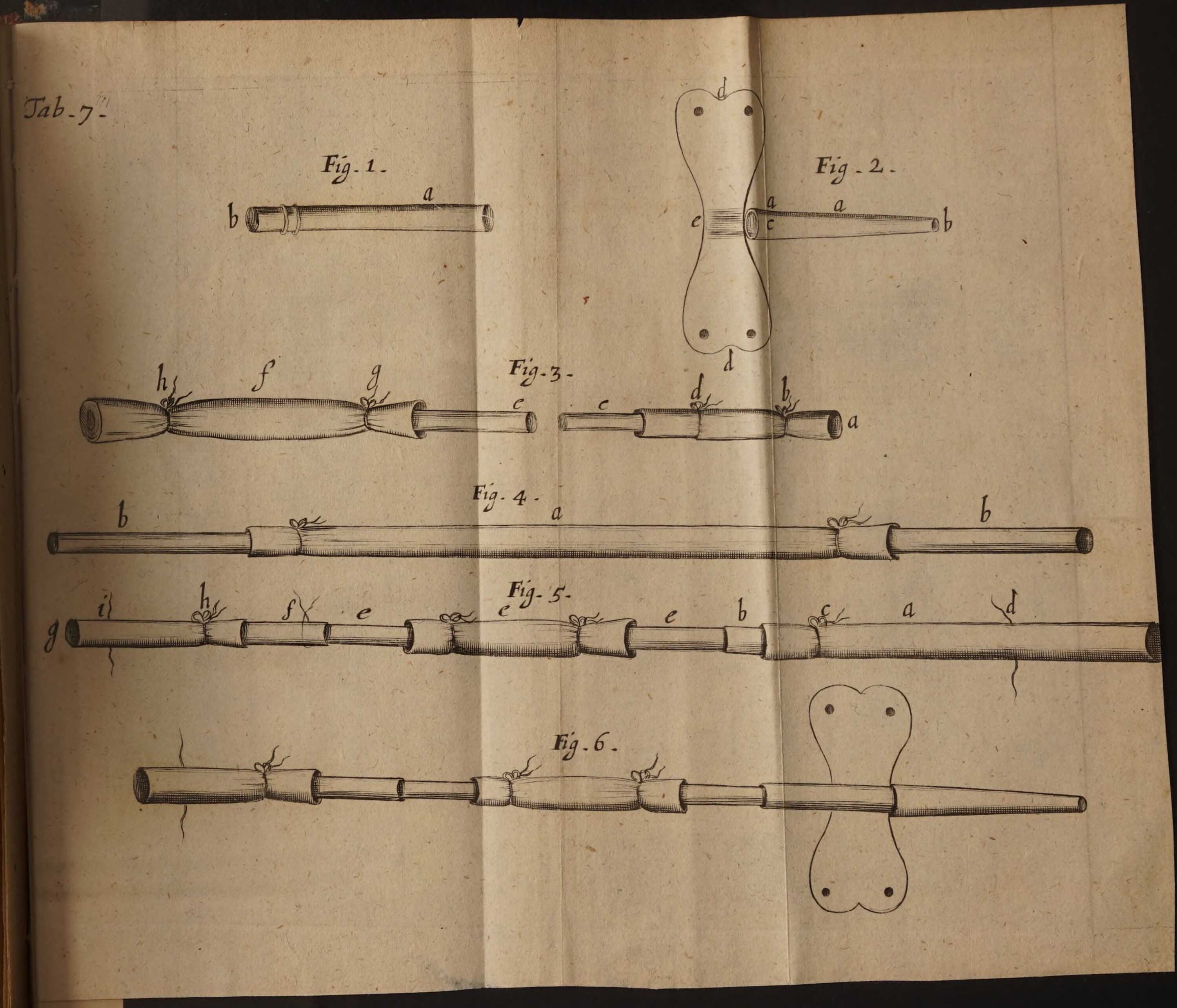
The world's first illustration of a blood transfusion device. Tractatus de corde. Item de motu & colore sanguinis et chyli in eum transitu by Richard Lower, London, 1669. Source: Wellcome Collection, London.
Sources:
- Richard Lower. The method observed in transfusing the blood out of one live animal into another. Monday December 17, 1666. Philos Trans 1666; 1: 353-358.
- Richard Lower. Tractatus de corde. Item de motu & colore sanguinis et chyli in eum transitu. Londini, 1669
The first blood transfusion to a human being — Jean-Baptiste Denis, 1667
The next very important step was done by Jean-Baptiste Denis (1643–1704), French physician, professor of philosophy and mathematics, physician to King Louis XIV. On the 15th of June 1667, he performed the world’s first blood transfusion on a human.
Ten days after, when the results have become clear, on June 25, 1667, Denis wrote a personal letter to Monsieur de Montmor, an advisor to the king and patron of a scientific circle, in which the idea of blood transfusion was discussed for the first time. The letter was then published and distributed — a common practice in the 17th century for communicating scientific news: the letter effectively served the function of a modern scientific article.
While describing this event in the Letter confirming priority, he mentions among other things "...de l’épreuve que nous fismes il y a environ 4 mois sur des chiens, pour faire passer le sang de l’artere crurale de l’un dans la veine jugulaire de l’autre. Et comme cette operation nous reüssit pour la premiere fois avec tout le bon-heur possible, ainsi qu’il a esté rapporté plus au long dans le journal des Sçavans du 14. Mars dernier ("...of the experiment we conducted about four months ago on dogs, to transfer blood from the femoral artery of one dog to the jugular vein of the other. And since this operation was a complete success on our first attempt, as was reported in greater detail in the Journal des Sçavans of March 14 of last year)“ — thereby emphasizing the thoroughness of his preparations of the next main experiment (note, Richard Lower indicates as the date of the experiment the end of February of the same ”last" year, 1666).
However, Dr. Denis describes also the experiment performed in England. On the page 8, is written: "L’experience consiste en ce qu’vn Docteur Anglois s’estant auisé depuis peu de faire passer le fang d’vn Chien galleux dans les veines d’vn autre qui ne l’estoit pas, pour tenter si la galle se communiqueroit avec le fang, le galleux a esté guery, & l’autre qui auoit receu son fang, n’en est point deuenu galleux." (The experiment consists in the following: an English doctor recently thought of passing the blood of a mangy dog into the veins of another dog that was not mangy, in order to test whether mange would be transmitted with the blood. The mangy dog was cured, while the other dog that had received its blood did not become mangy.)
Finally, having provided a scientific rationale for his experiments, he proceeded to describe the transfusion itself. In his account, it went as follows: "Le 15 de ce mois nous rencontrâmes vn ieune Garçon âgé de 15 à 16 ans, qui auoit eſté tourmenté pendant plus de deux mois d’vne fievre opiniastre & violente, laquelle auoit obligé les Medecins de le faire ſaigner iuſqu’à vingt fois pour en apaiſer les ardeurs." (On the 15th of this month we encountered a young boy aged about fifteen or sixteen years, who had been tormented for more than two months by a stubborn and violent fever, which had obliged the physicians to bleed him as many as twenty times in order to calm its ardour.)
Denis goes on to describe the young man as lethargic, weak, and severely sluggish, attributing his condition to the extensive bloodletting “that was necessary to save his life,” believing that the blood remaining in his body had thickened under the influence of the fever, stagnated in his vessels, and lost all movement and energy. When he and his assistant, surgeon Paul Emmerez, opened his ulnar vein, the blood was so black and thick that it could barely form a stream to reach the bleeding bowl. We drew about three ounces out of five from him that morning; and then performed a direct transfusion of arterial blood from a lamb’s carotid artery into the young man’s vein, approximately three times the amount we had drawn into the bowl. Afterward, we closed the opening in the vein with a compress, as is done in ordinary bloodletting.
During the procedure, the young man felt a strong heat along his arm, and afterward experienced significant relief from the pain in his side, which had developed after he fell the previous day from the top of a three-meter-high staircase. On the same day, his appetite, spirits, and physical strength began to return rapidly, and within a few days he had recovered.
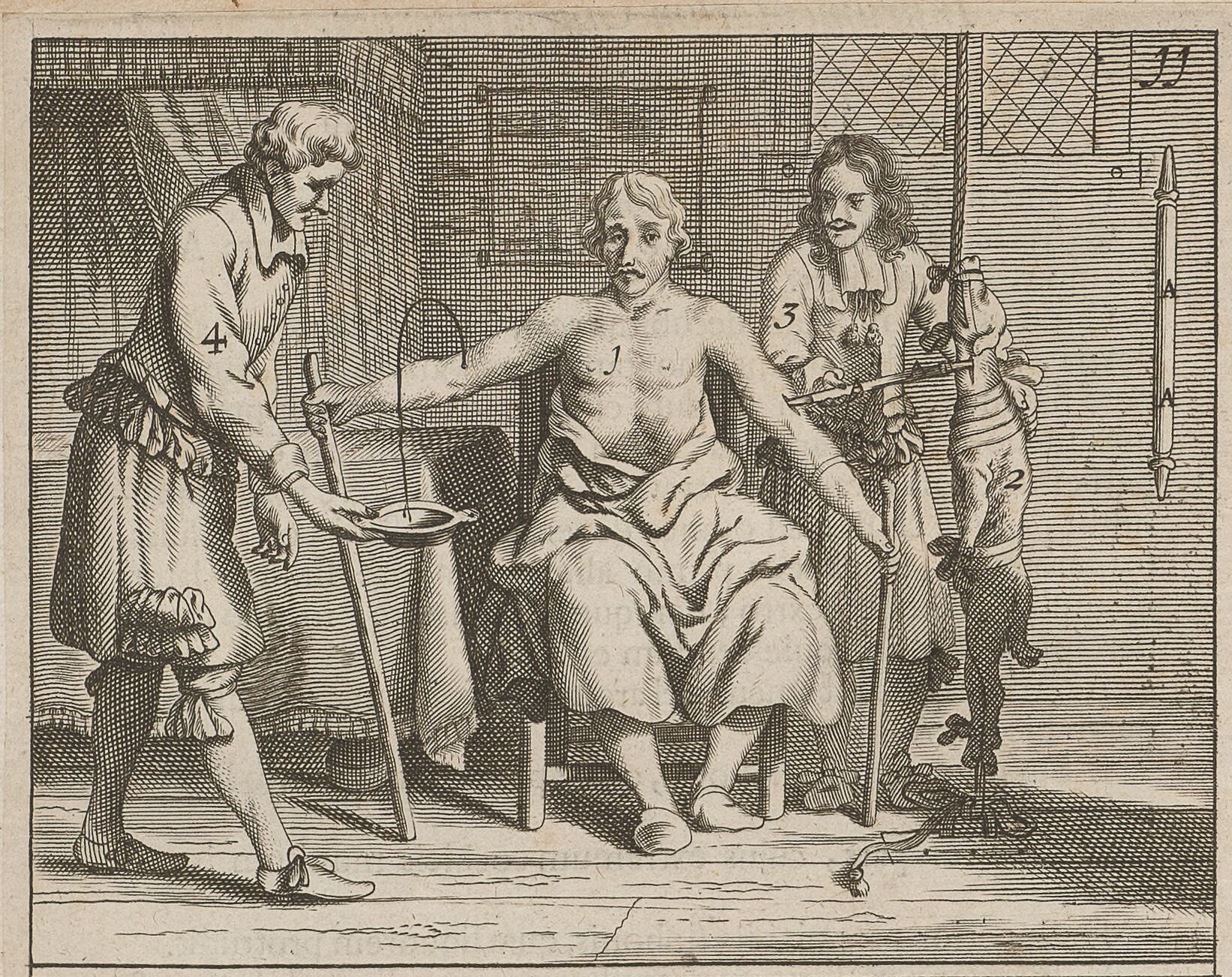
Blood transfusion from dog to human. Legend: 1 — the patient (a young man aged 15–16); 2 — a lamb secured to a stand; 3 — a surgeon, Mr. Emmerez, assistant to Dr. Denis; 4 — Denis, observing and supervising the procedure. AA — blood transfusion device — a tube with recesses at both ends for secure attachment to the blood vessels of the donor and recipient. Fragment of the illustration from the 'Copie d'une lettre escrite a monsieur de Montmor' ... Denis, Jean-Baptiste, 1667. Source: Bibliothèque nationale de France
This illustration deserves a separate discussion in its own right. It first appeared in a printed publication of the Letter from Jean-Baptiste Denis to Monsieur de Montmor, the primary purpose of which was apparently to assert his priority (sic!). The creator of the engraving remained unknown, and the sheet with illustration itself looks out of place, as if it had been artificially added to the publication from outside. The text of the letter contains no mention, reference or description of this illustration, nor does it explain the numbers and letters — the legend to the engraving is absent. Most importantly, Denis performed a blood transfusion using a lamb, whereas in the engraving we clearly see a dog. The composition presented is clearly inspired by Christian iconography — the patient (1), like Jesus on the cross, has his arms outstretched, reaching out with his right hand toward the doctor (4), who, like a ministering apostle, collects his “bad” blood into a bowl, while his left hand rests on a stick receiving blood from a donor dog (2). In addition to the most glaring discrepancy — replacing the lamb with a dog — the illustrator made several other inaccuracies, as if he had made up the whole story on his own, without consulting the experiment participants, who subsequently did not correct him. A sturdy man with a dapper mustache and a fashionable beard mouche, clearly bears no resemblance to the emaciated 15-year-old boy who was Denis’s first patient. It is doubtful that a weakened, barely alive teen would be sitting in a chair during a transfusion. Moreover, the straight tube (AA) transporting the blood resembles device depicted by Lower, rather than the composite apparatus with a leather bag-joint described by Denis in a letter from 1668 (see below). Later, this illustration was entirely carried over into later reprints of the 'Armamentarium Chirurgicum' written by German surgeon Johannes Scultetus. However, in the first edition of the Armamentarium published in 1655 in Ulm this illustration was not yet present. Most likely, it appeared at the end of the 17th century only, in the 1692 Leiden edition.
Further in this letter, we can read a unique description of the blood transfusion devise that was not presented in the previous document dated 1667. The operation, he says, "ne fait pas plus de douleur qu'une saignée ordinaire" (causes no more pain than an ordinary bloodletting). «Les deux autres bouts des tuyaux communiquent ensemble par le moyen d'vne petite bourse de cuir de la grosseur d'vne noix ou enuiron, laquelle sert 1. à faire ployer les tuyaux, ce qui peut estre requis pour la commodité de l'opération qui se feroit auec trop de contrainte par le moyen d'vn tuyau d'vne seule piece. 2. Elle sert à faire connoistre la quantité du sang qu'on fait passer. 3. Elle peut seruir à aider le mouuement du sang, estant eslargie & pressée alternatiuement auec deux doigts, dont l'action fera que le sang fermera vne petite valuule attachée à l'entrée du tuyau qui donne le sang, pour l'empescher de sortir après qu'il sera entré, & ouvrira vne autre valuule enfermée dans vne petite boëte à la sortie de l'autre tuyau, pour empescher le sang de rentrer dans la bourse."
Here is the English translation: "The other two ends of the tubes communicate with each other by means of a small leather pouch approximately the size of a walnut, which serves three purposes: 1. To allow the tubes to bend, which may be necessary for the convenience of the operation, since it would be performed with too much constraint by means of a single-piece tube. 2. It serves to determine the quantity of blood that is made to pass through. 3. It can serve to assist the movement of the blood, being alternately expanded and compressed with two fingers, the action of which will cause the blood to close a small valve attached to the inlet of the tube that supplies the blood, in order to prevent it from flowing back out after it has entered, and will open another valve enclosed in a small box at the outlet of the other tube, to prevent the blood from flowing back into the pouch."
An important detail is that the tubes were intentionally made short, no more than three inches in total, so that the blood would not have time to clot, "comme on nous a mandé qu'il était arrivé en Angleterre, à cause qu'il y avait trop de distance entre l'animal et l'homme" (as we were told had happened in England, because there was too much distance between the animal and the man).
Worth noting: the word valuule that de Gabets uses is the 17th-century spelling of 'valvule' — meaning a small valve. The device he describes is in essence a rudimentary pump with a double-valve system, remarkably close in principle to what we would today recognise as a one-way valve pump mechanism.
It is noteworthy that the scientific literature of the time recognized the importance of the discovery and attached great significance to the question of priority. Consequently, lots of publications were devoted not so much to clinical discussion as to the history of the issue and evidence of priority. Thus, in another letter, addressed to his colleague Samuel Sorbière (1615–1670), Denis begins by stating that he had read a Latin treatise by Paolo Mansfredi, a Roman professor and student of Guglielmo Riva (who was the first person in Italy to perform a blood transfusion in December 1667). Mansfredi asserted: the idea of blood transfusion “a été d'abord conçue en Allemagne, que l'Angleterre l'a mise en lumière, et que la France enfin lui a donné sa dernière perfection” (... was first conceived in Germany, brought to light by England, and finally perfected by France). Denis categorically disagrees with this and sets out to restore the true history in favour of French priority.According to Denis, the idea originated in Paris about ten years ago in the Montmor's scientific circle (above was mentioned the letter addressed to him). It was there, in July 1658, that the Benedictine monk Robert de Gabets read a short treatise. In his letter to Denis, de Gabets admits: "ayant remarqué par quelques petites railleries que quelques uns traitaient cette pensée de ridicule, je ne poussai pas la chose plus avant" (“having noticed through a few small taunts that some people considered this idea ridiculous, I did not pursue the matter further”) — noticing the mockery, he dropped investigation of this hypothesis.
Nevertheless, there were English nobles among those present, which, according to Denis, explains how the idea "a pu passer de France en d'autres pays fort éloignés" (was able to spread from France to other very distant countries).
The second xenotransfusion was performed on a healthy 45-year-old volunteer who participated in the experiment for money (also in June 1667) — he was administered approximately 300 ml of lamb’s blood. Since the participant was healthy, no positive effects were observed. The third transfusion (June 24, 1667) was performed on the ailing Swedish Baron Bonde, who had already undergone four bloodlettings prior to this. By the time of the experiment, the baron’s condition was dire—he could not speak, was practically unconscious, and was vomiting. As soon as he was given 6 ounces of calf’s blood, he regained consciousness and began to speak. Over the next 24 hours, he felt better, but then his condition worsened again. Denys began another transfusion, and the patient showed faint signs of recovery, but he died shortly thereafter. As for the fourth attempt, it not only ended in failure but also marked the beginning of the complete collapse of the idea of blood transfusion as described below.
Source:
- Copie d'une lettre escrite a monsieur de Montmor conseiller du Roy en ses conseils, & premier maistre des requestes . Par J. Denis professeur de philosophie & de mathematique. Touchant une nouvelle maniere de guarir plusieurs maladies par la transfusion du sang, confirmée par deux experiences faites sur des hommes. Denis, Jean-Baptiste (1640-1704). The date of the letter: 25 June, 1667. URL: https://gallica.bnf.fr/ark:/12148/bpt6k326277d
- Lettre écrite à Monsieur Sorbière,... par Jean Denis, touchant l'origine de la transfusion du sang et la manière de la pratiquer sur les hommes...
Author : Denis, Jean-Baptiste (1640-1704). Publisher : J. Cusson (Paris). The date of the letter: 2nd March, 1668. https://gallica.bnf.fr/ark:/12148/bpt6k58280889/f15.item
First blood transfusion in Italy — Guglielmo Riva (1667)
Guglielmo Riva, physician to Pope Clement IX and surgeon at the Ospedale della Consolazione (Hospital of Consolation), conducted in Rome public demonstrations of three blood transfusions on humans (December 1667). Four authoritative university doctors were present during the demonstrations and compiled a report, which was signed by them and certified by a notary. One of the patients was a colleague, Francesco Sinibaldi, professor of medicine at the University of Rome, who had been suffering from a serious illness for a long time and who received a transfusion of sheep's blood from the carotid artery into a vein in his arm. The procedure was deemed successful, although Sinibaldi died of his illness in February 1668. The second patient had been “ill for 16 years, suffering from constant fever,” and the third suffered from a three-day fever, a disease probably caused by malaria.
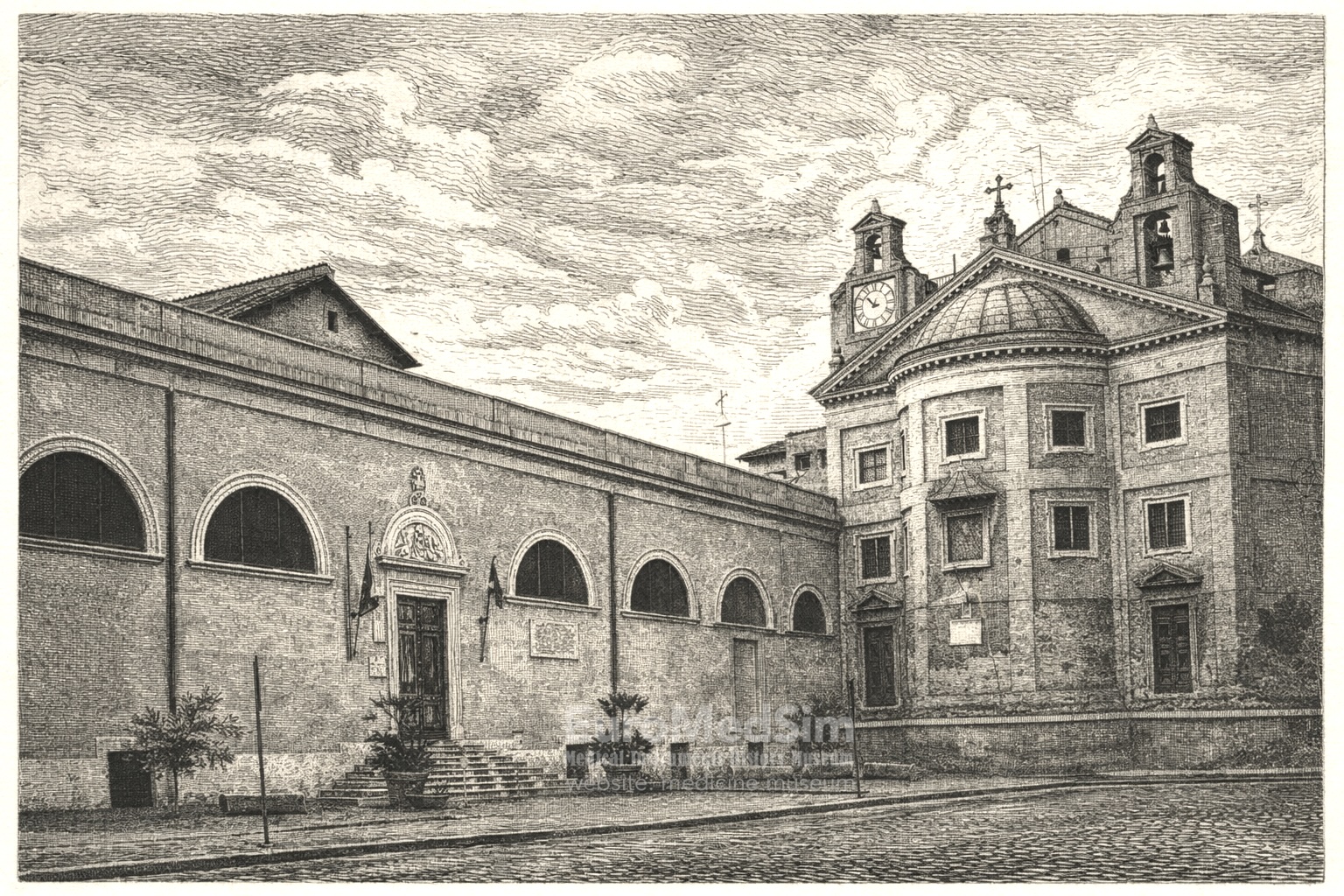
The Hospital of Santa Maria della Consolazione (L'Ospedale di Santa Maria della Consolazione or simply Ospedale della Consolazione), historic Roman hospital attached to the Church of Santa Maria della Consolazione, situated near Roman Forum. Digital engraving after modern photo. Credit: EuroMedSim
Source:
- The earliest blood transfusions in 17th century in Italy (1667–1668). Silvia Marinozzi, Valentina Gazzaniga, Silvia Iorio. doi.org/10.1016/j.tmrv.2017.09.003
First transfusion in Germany by Matthäus Purmann (1668)
Matthäus Gottfried Purmann, a surgeon from Silesia, was the first person to perform a blood transfusion in the German states — he performed a transfusion from a lamb to a human in 1668. Interestingly, in his work Grosser und gantz neugewundener Lorbeer-Krantz oder Wund-Artzney, published in Frankfurt/Leipzig in 1692, Purmann refers to a dissertation (sic!) from the same year, 1668. According to Purmann, the topic of the infusions of substances into transfusion had already been studied quite extensively by that time (below is a translation of the original German quote):
"D. Ettmüller in his Dissertatione medica de Chirurgia Infusoria, which is also very useful to me in the present chapter, because it is in few hands and is also somewhat difficult Latin, which not many surgeons understand. It was also popular and well-known some time ago, but it has now fallen into disrepute because it is difficult to perform and helps few people."
In those days, the term Chirurgia Infusoria was a broader term referring to the intravenous administration not only of blood but also of other substances, such as alcohol, wine, opium, laxatives, acids, etc. It was this term that Ettmüller used in his 1668 dissertation, and it was this term that Johann Daniel Major employed in his Prodromus (1664). This was a broad general category. As for Chirurgia Transfusoria — it was a narrower term referring specifically to the transfusion of blood from one creature to another. In his dissertation, Ettmüller clearly distinguishes between them: “cujus genuina Filia est Transfusoria, dum sanguis ex uno animali in aliud transfertur” (whose true daughter is Transfusoria, when blood is transferred from one animal to another).
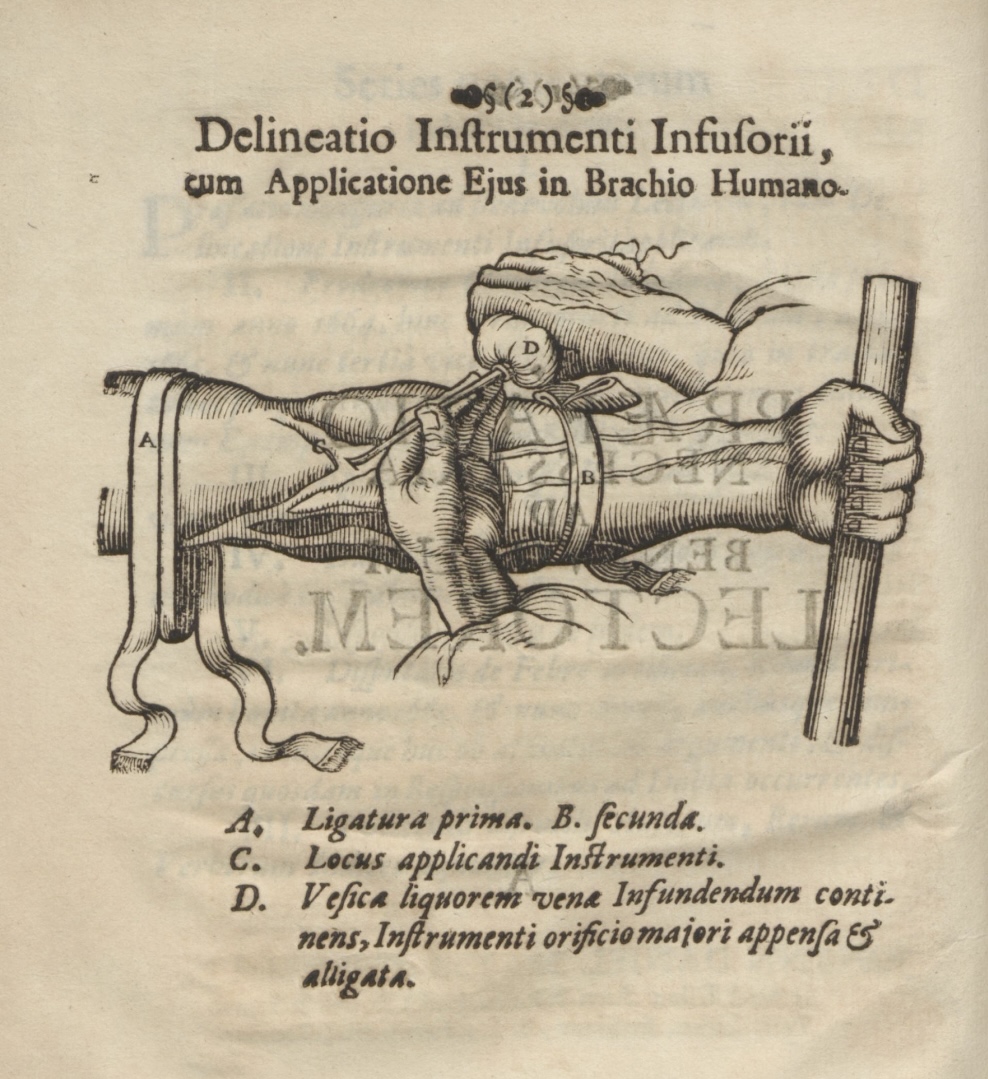
Illustration from the D. Joh. Danielis Majoris Chirurgia Infusoria... printed in 1667. The description says: A. First ligature. B. Second.
C. The place of application of the instrument. D. A vessel containing the liquid to be infused into the vein, attached and tied to the larger opening of the instrument. Source: Staatsbibliothek zu Berlin
In fact, dissertation of Michael Ettmüller even includes an entire chapter devoted to the “History of Infusion Surgery.” In it, he recounts the story of a certain stablehand who, for his own amusement, injected wine into dogs’ veins through a chicken bone, dating this account to 1642. It is notable that over time this story has become overgrown with various speculations, and today it is often retold as “a certain Georgius a Wahrendorff, commander of the cavalry in the village of Lur (Lusatia Superior), ordered his huntsman to pour wine into the veins of a hunting dog through a goose feather," directly citing this dissertation. Therefore, we will take the liberty of providing the original scan to clarify the inaccuracies in this historical anecdote. Here is this fragment:
"Retulit interea Vir qvidam Nobilis curiosus, & fide dignus, se anno 1642. in Lusatia superiore, apud Magistrumqvendam Eqvitum, virum rei venatoriae multum addictum, & ob id qvam plurimas canes alentem, vidisse, qvod ejus venator delectationis gratia interdum canibus in venam apertam per ossiculum gallinaceum ex ore vinum hispanicum, vel aqvam vitae infuderit..." (A certain curious and trustworthy Nobleman ("Nobilis") reported that in the year 1642. in Upper Lusatia, at the house of a certain horses owner ("Magistrum Equitum"), a man very devoted to the hunting and for that reason keeping as many dogs as possible, he saw that for the sake of pleasure a hunter ("venator") sometimes poured Spanish wine or aqua vitae (alcohol) into the dogs' open veins through a chicken bone from his mouth...)
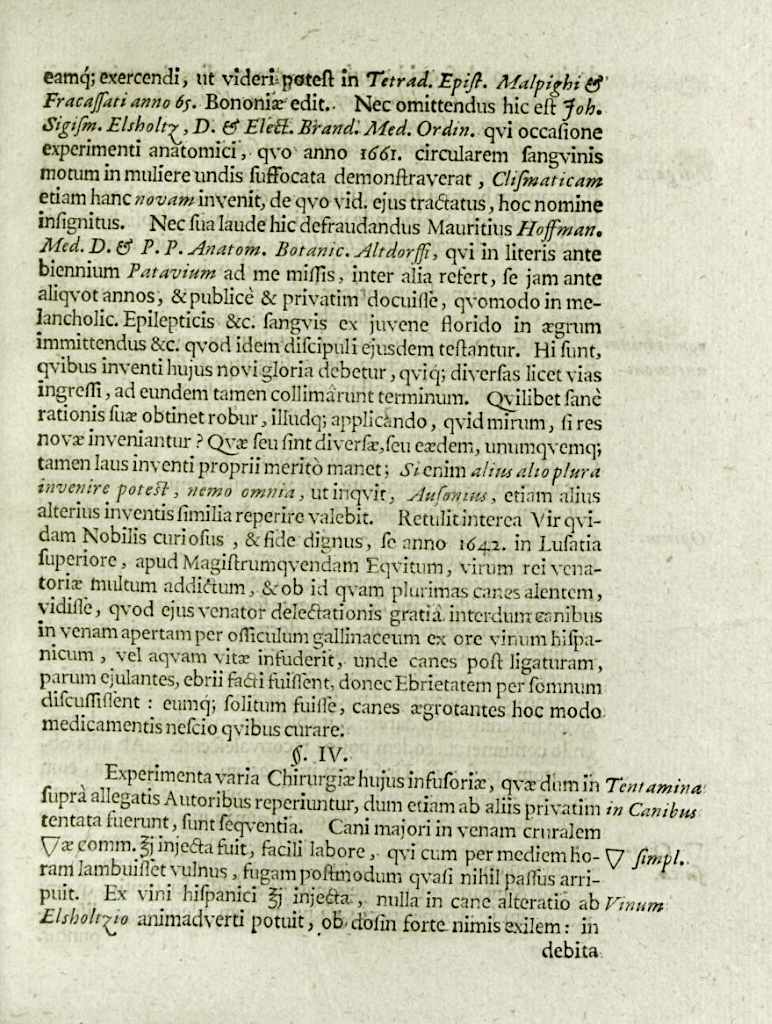
Page 5 from the "Dissertationen medicam de chirurgia infusoria" written by Michael Ettmüller and published in Leipzig, in 1668. Source: The Saxon State and University Library Dresden (SLUB)
As you can see — in the text there are no signs of Wahrendorff, cavalry commander, and goos feathers. Now, back to Purmann. Interestingly, during the public defensio of Ettmüller’s dissertation, the opponent (Respondens) was Georgio Friderico Stirio, a physician from Breslau (Silesia), whom Purmann could acquainted with. It is possible that this is how he first heard about this method and became interested in it. Following the mention of the dissertation, Purmann continues in the next sentence (again, translated from Old German):
"I did, however, have a fortunate example of it in Frankfurt an der Oder in 1668, when I was staying with Balthasar Kaufmann, who suffered greatly from it, and I treated him several times by drawing blood from the median vein. I had a successful experiment with the young Mr. Weislein, who was suffering greatly from consumption. We gradually drained a quantity of his blood from the median vein on several occasions, and immediately afterwards replaced it with blood from a lamb, whose jugular vein had been opened. This finally had such an effect that he was completely healthy within three months. On the other hand, however, we performed it very unsuccessfully on two soldiers from the Royal Regiment and on a citizen, for the first two, who were dead scurvy, and the other, who had a very bad hairworm, became much worse as a result, and lost so much strength that they have hardly recovered from their melancholy in a year and a day, which will also be apparent to the reader."
Sources:
- Grosser und gantz neugewundener Lorbeer-Krantz oder Wund-Artzney. Matthaeus Gottfried Purmann. Frankfurt/Leipzig in 1692
- Dissertationen medicam de chirurgia infusoria. Michael Ettmüller. Published by Nicolaum Scipione, Leipzig, 1668. Source: The Saxon State and University Library Dresden (SLUB)
- Joh. Danielis Majoris Prodromus inventae a se chirurgiae infusoriae : sive, quo pacto agonizantes quidam, pro deploratis habiti, servari aliquondiu possint infuso in venam sectam liquore peculiari (A prologue to the infusorial surgery he invented: whether, by what means certain dying persons, considered to be deplorable, can be preserved for some time by infusing a special liquid into a cut vein by John Daniel Major). Lipsiae, Wittigau, 1664. 37 pages. Full-Text PDF scanned from the Augsburg Staats- und Stadtbibliothek, source: Munich Digital Center (MDZ).
- D. Joh. Danielis Majoris Chirurgia Infusoria, placidis Cl: Virorum Dubiis impugnata, cum modesta, ad Eadem, Responsione (Dr. Johann Daniel Major’s Infusion Surgery, Challenged by the Calm Doubts of Distinguished Men, with a Modest Response Thereto). Magdeburg, Kiloni[i], published by Lüderwald Reumannus, 1667. Pages: [4] Bl., 328 S., [1] Bl. Full-text in PDF by the Library: Staatsbibliothek zu Berlin — Preußischer Kulturbesitz, Germany
The blood transfusion: the case of Jean-Baptiste Denis (Paris, 1668)
The first major legal scandal in the history of blood transfusion erupted in Paris following the experiments of Jean-Baptiste Denis in 1667. The fourth patient was a mentally ill man, Antoine Mauroy (c. 1633–1668), who had been running naked through the streets of Paris day and night for four months. His mental illness had begun eight years earlier, and as part of his treatment, he had undergone bloodletting 18 times.
Three attempts at blood transfusion were made by Denis, involving about half a litre of calf’s blood, but there was no improvement. The patient complained of a burning sensation in his arm and severe pain in his kidneys. Over the next few days, his urine was black, “as if mixed with soot from chimneys”; this is the first mention of an acute haemolytic reaction following a blood transfusion.
During the fourth attempt, on Monday, December 19, 1667, Denis, together with the surgeon Paul Emmerez, drew 10 ounces of blood from a vein in the patient’s arm, then opened the femoral artery of a calf and transfused up to 6 ounces of calf’s blood into the patient. During this procedure, Mauroy developed a severe reaction (tremors and distress); the operation was interrupted, and he died later that night.
Mauroy's widow accused Denis and his colleague Emmerez of causing her husband’s death through the blood transfusion. The case was referred to the Parliament of Paris in 1668. Witness testimony suggested that the patient may have been poisoned by his own wife, and Denis was ultimately acquitted. Nevertheless, this scandal prompted French authorities to restrict the practice of blood transfusion, marking the first instance of judicial intervention in transfusion medicine.
From human to human — James Blundell (1818)
For a long time, blood transfusions were strictly prohibited. The risk of adverse outcomes was too great, outweighing any benefits, whether perceived or real. Blood transfusions were performed only on patients who were already on the brink of death. Moreover, to transfuse human blood, it was necessary to find a volunteer donor. In the early 19th century, British obstetrician James Blundell successfully performed the first blood transfusion from one human to another. Due to postpartum hemorrhage, a woman was on the verge of death, and her husband agreed to be the blood donor. Subsequently, Blundell performed 10 human-to-human transfusions (1825–1830) and developed special instruments for blood transfusion. It should be noted that out of 10 patients, only five survived the transfusion, which, of course, did not inspire optimism regarding the procedure.
It was not until the 20th century, in 1901, that the Austrian immunologist Karl Landsteiner made a discovery that ushered in the era of safe blood transfusions—he identified three blood groups and determined the safe combinations for transfusion. For this discovery, he was awarded the Nobel Prize in Medicine in 1930. Later, in 1937, he also co-authored the discovery of the Rh factor, which made transfusions even safer thanks to the introduction of the “+” and “-” designations we use today. He is best known for discovering the ABO blood group system in 1901, which was the key breakthrough that made safe blood transfusions reliably possible. This discovery earned him the Nobel Prize in Medicine in 1930. Later, in 1937, he also co-authored the discovery of the Rh factor, which made transfusions even safer thanks to the introduction of the “+” and “-” designations we use today.
But that's a different story... (c)