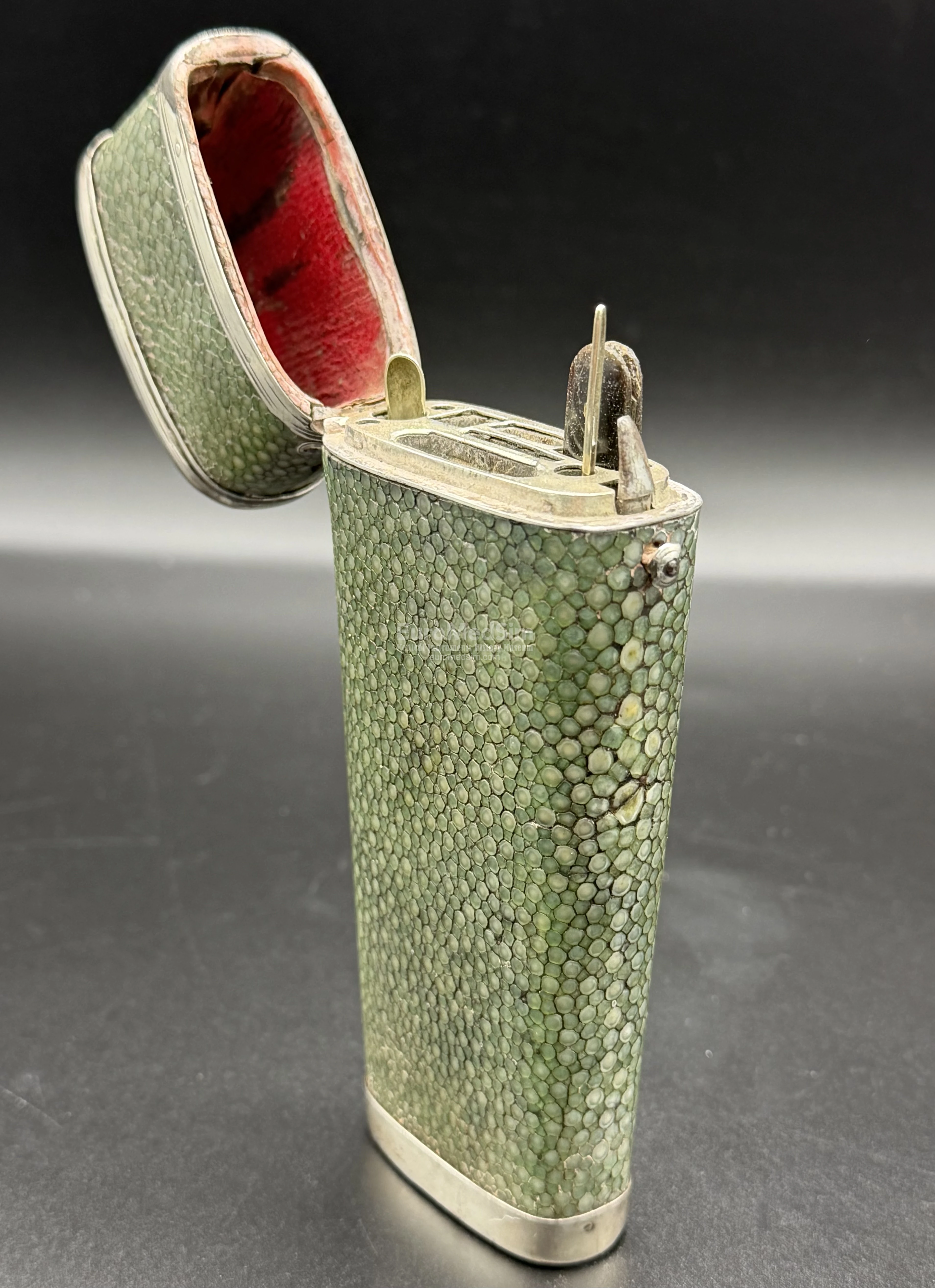
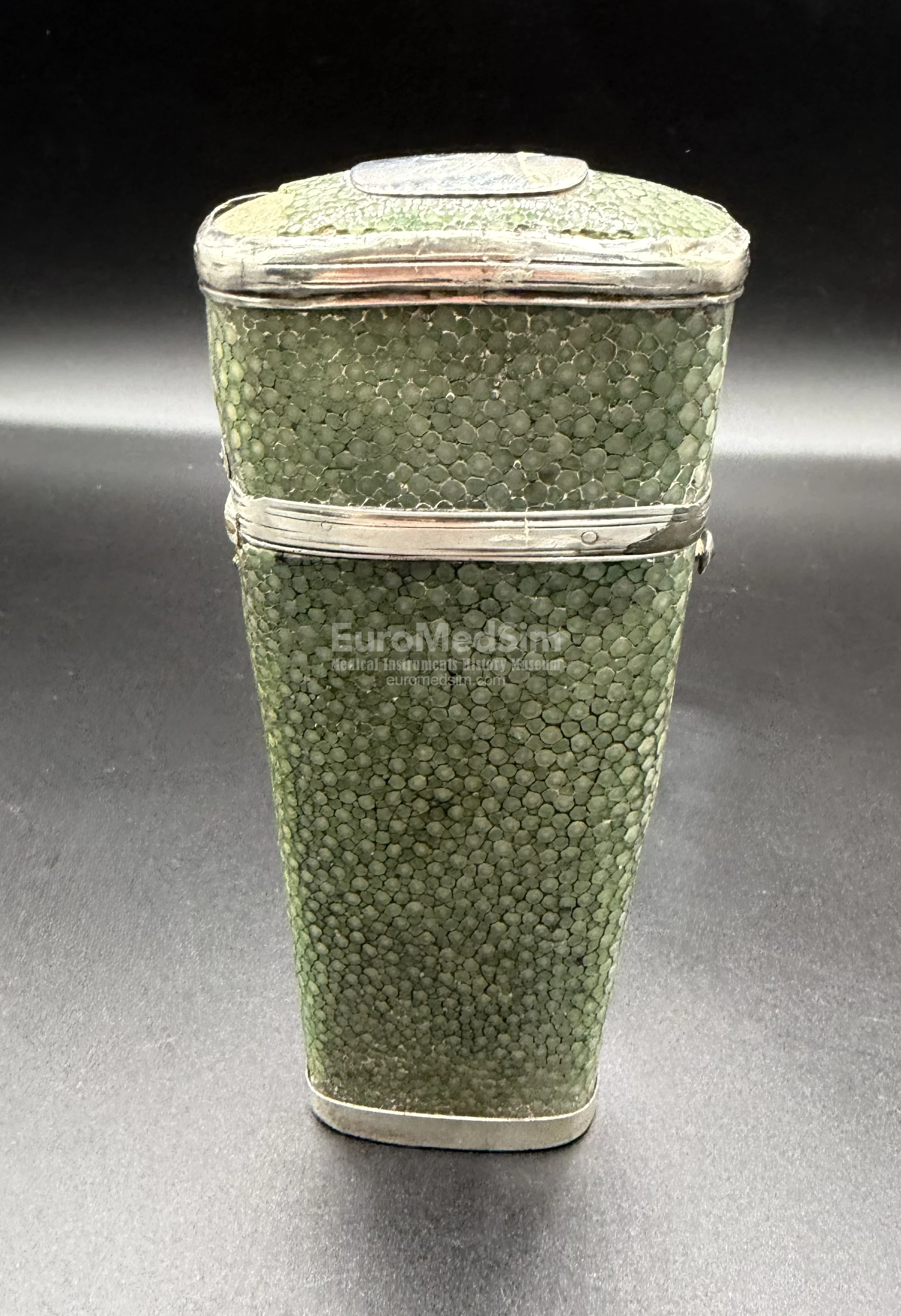

Shagreen Pocket Case for Surgical Instruments, England, c. 1800
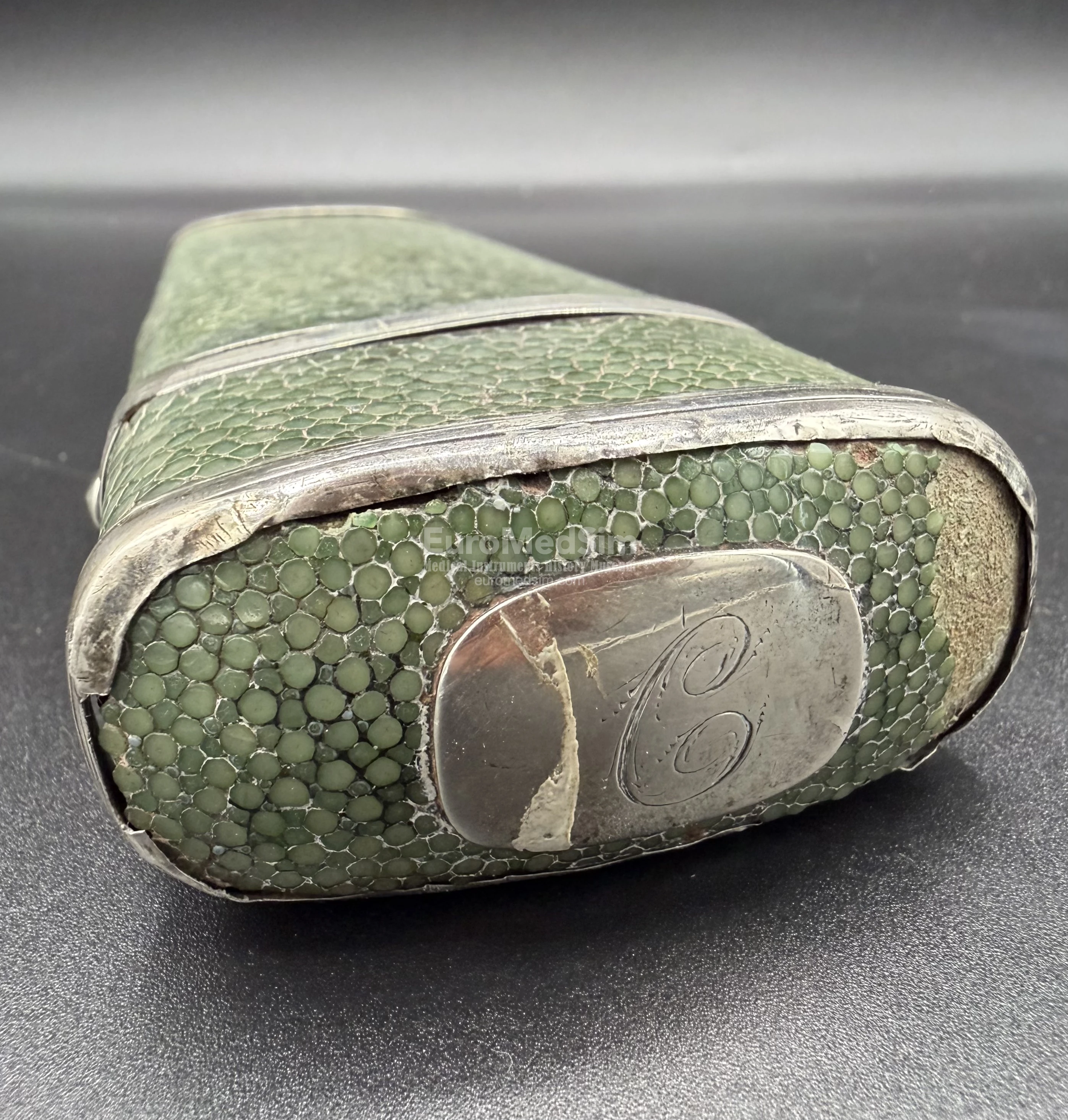
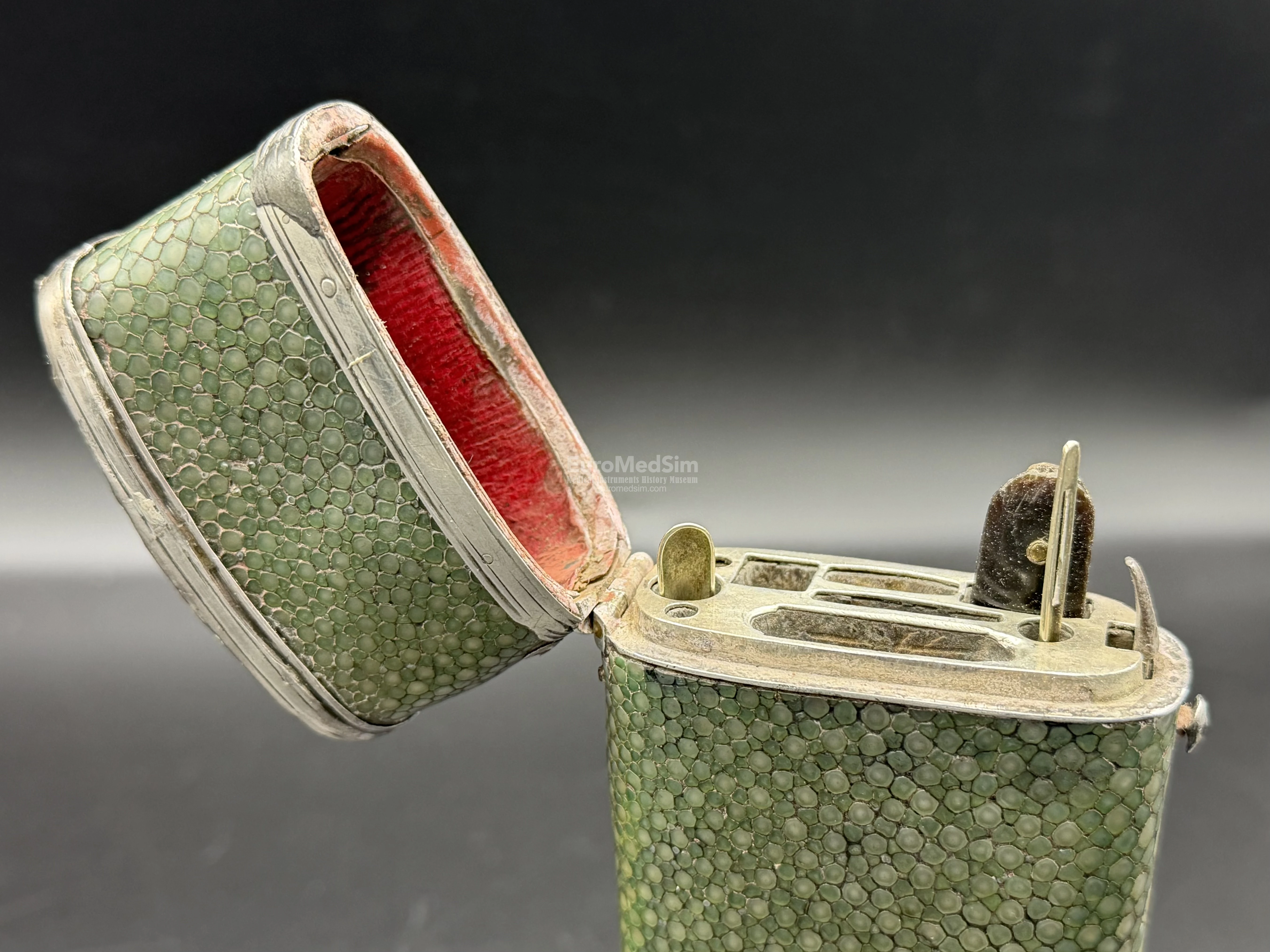
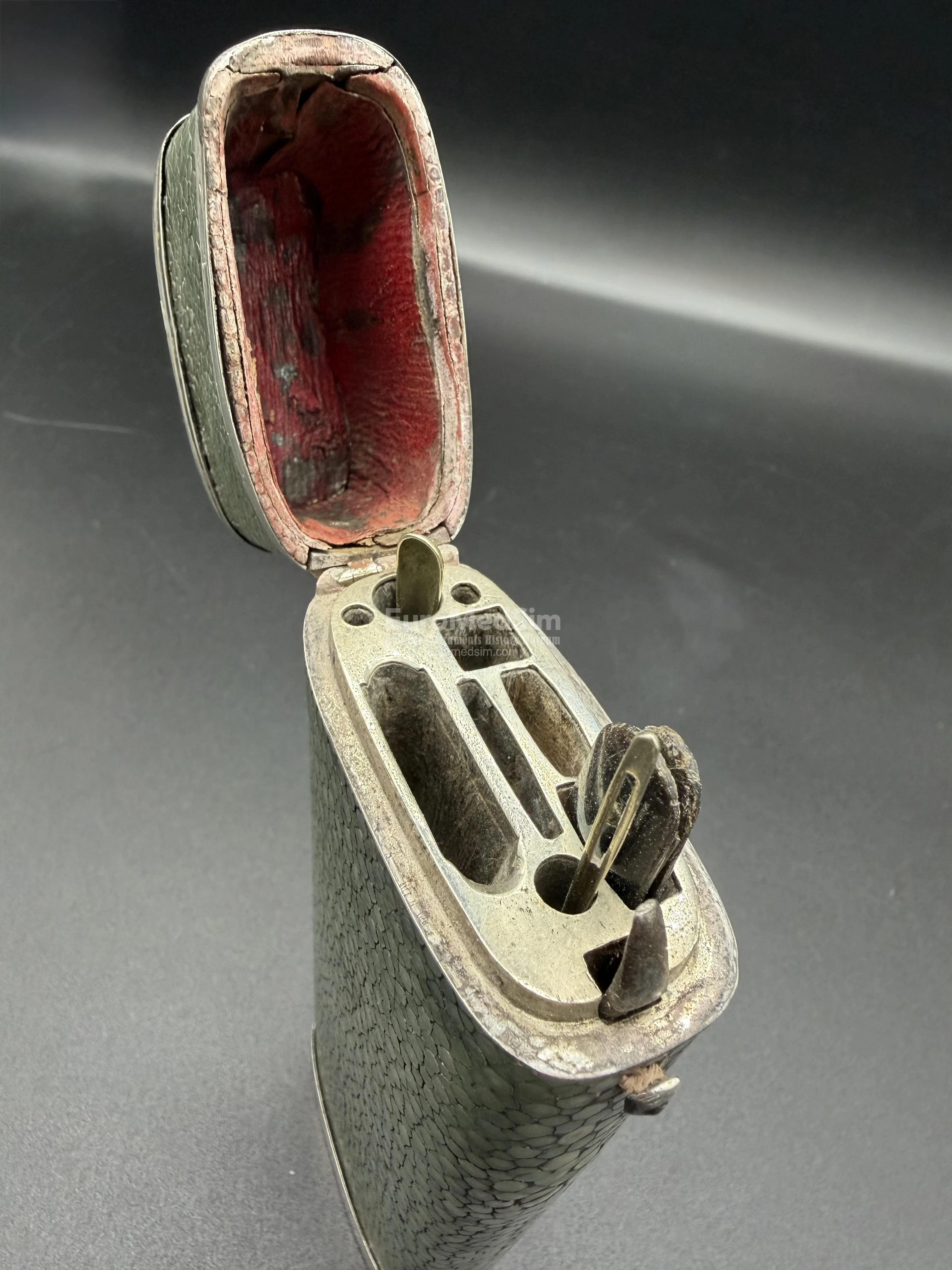
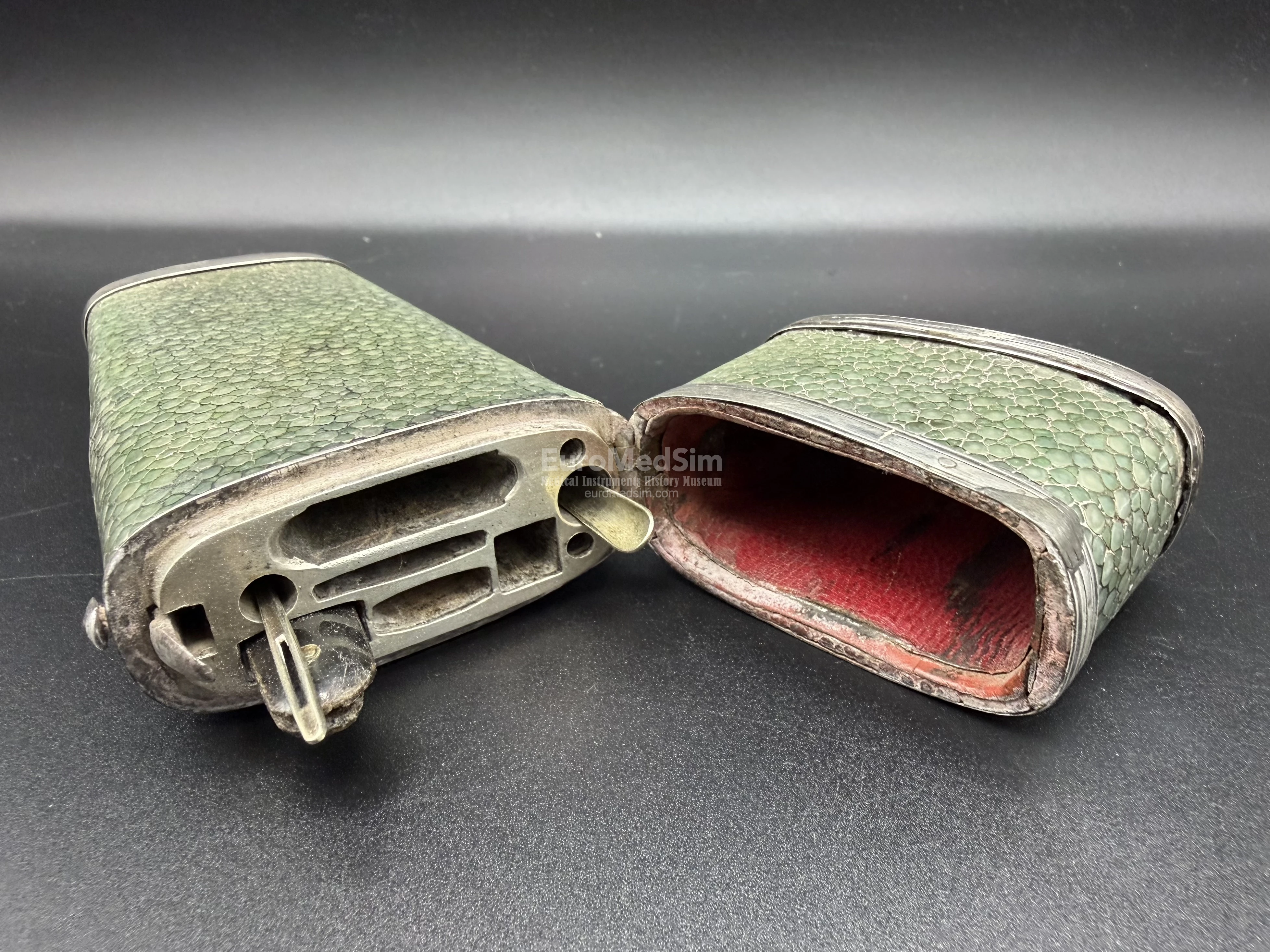
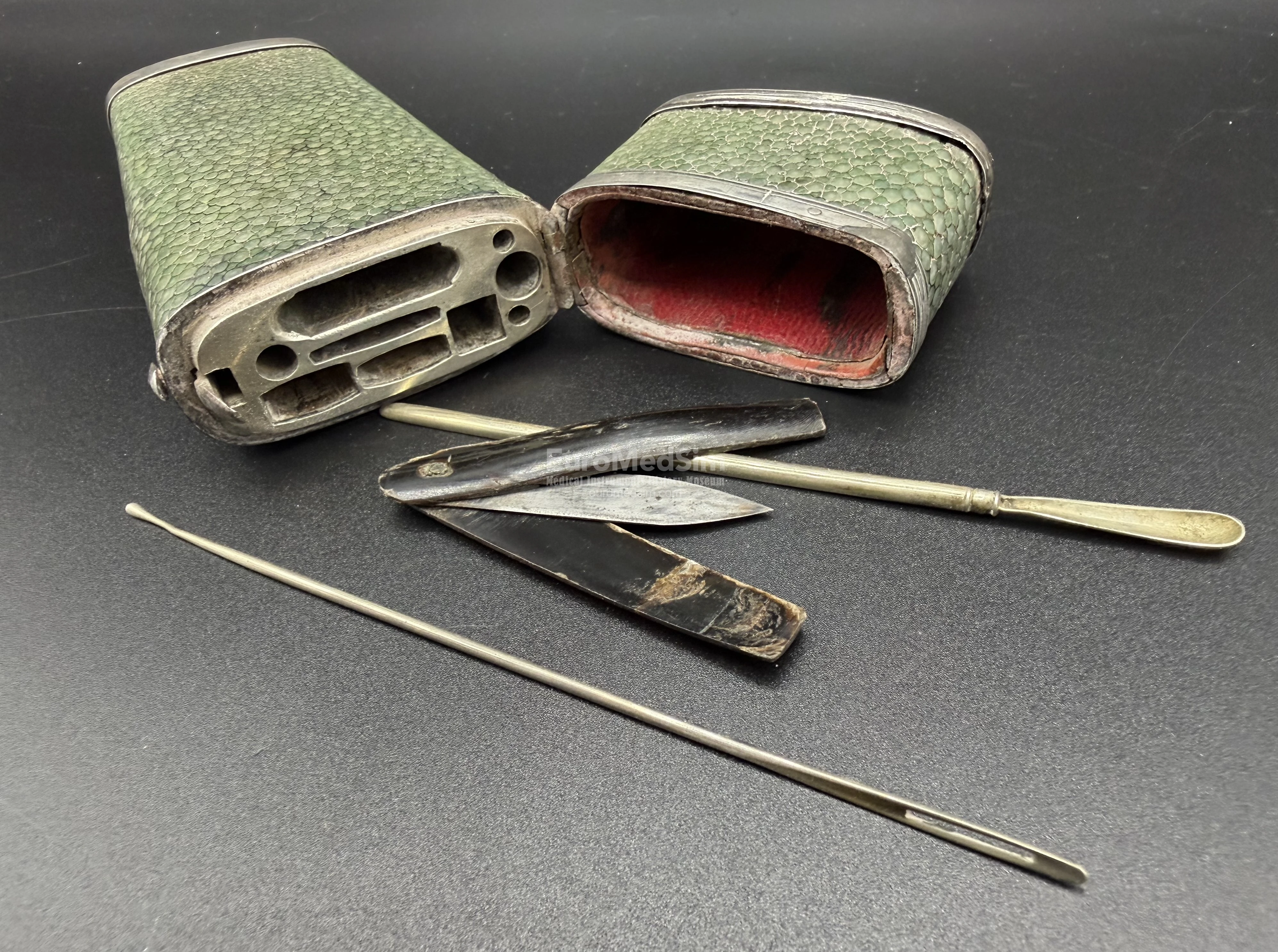
A Pocket Case for Surgical Instruments covered by green-stained shagreen, English, ca. 1800, with silver metal mounts, hinged cover engraved letter 'C', with slots for forceps, lancets, probes and others minor surgical instruments. A part of shagreen on the the lid is detached. The inside of the lid is lined with a paper-like material or calico dyed red.
Content
The original content of the case is not presented. Now it is filled with several later instruments: a lancet with handle made of brown horn, a spoon-probe and blunt needle with an eye.
Étui
In the 17th century, small, convenient portable toolkits boxes appeared, enclosed in round containers similar in size and shape to 20th-century lighters. Their height ranged from 5 to 15 cm depending on their contents. They were used to store and carry manicure accessories, personal hygiene items, sewing or drafting tools. Interestingly, they were called étui, meaning 'case' or 'cover', in both Germany and England, and this term has remained in use to this day. It comes from the Old French verb estuier — 'to keep, to guard, to keep in custody'. This everyday practice saw étuis also enter the field of medicine, becoming a convenient and familiar case for small surgical instruments in the arsenal of surgeons in work and travel.
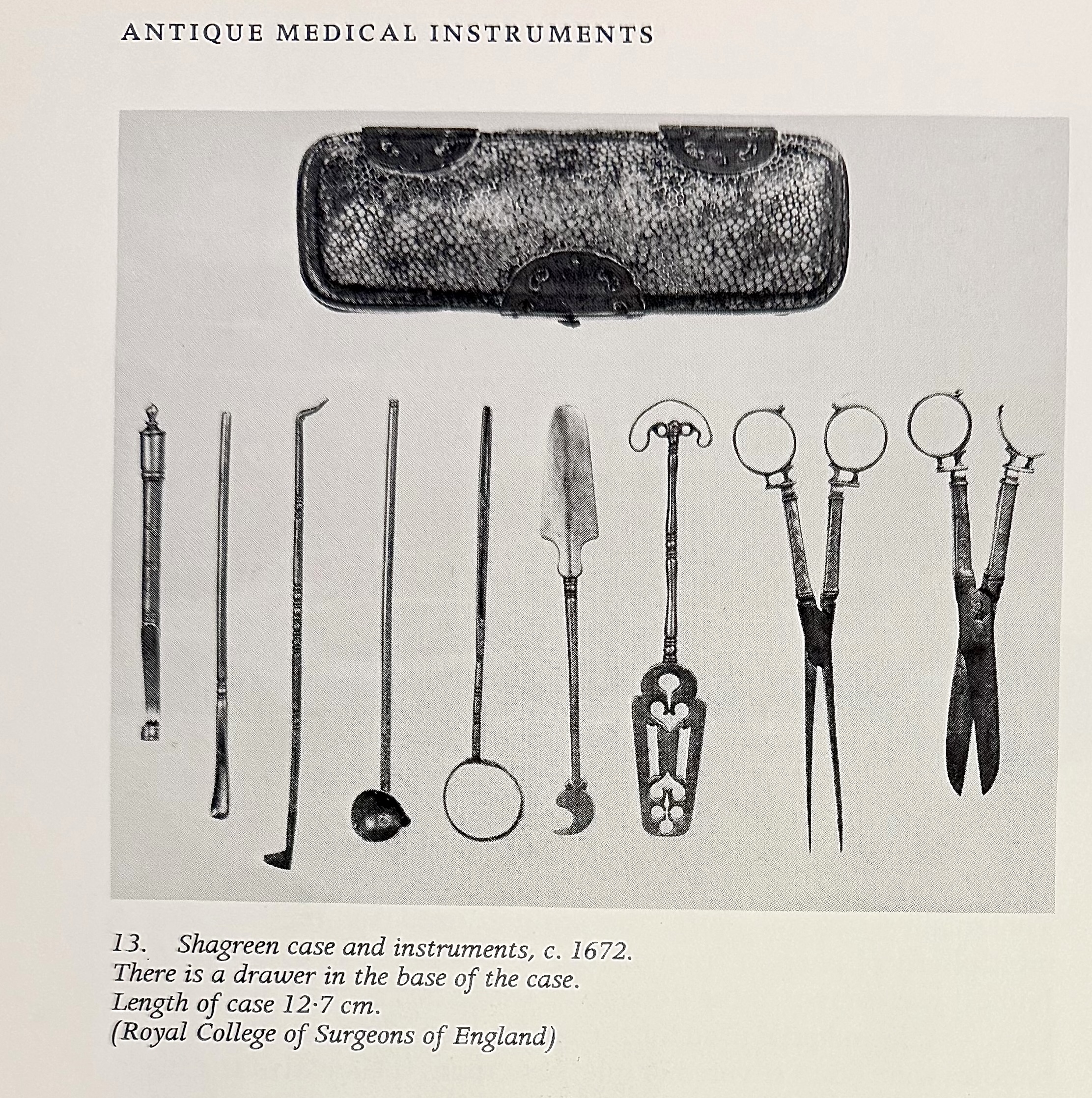
Shagreen instrument case, ca. 12.7 cm with surgical instruments. England, ca. 1672. Source: Bennion E., 1979, p. 62
Shagreen
This case is covered in grained shagreen made from horse or donkey leather, a feature that was quite common in surgical sets beginning in the 18th century. Shagreen’s characteristic bumpy texture was created artificially by pressing seeds into the softened leather from the inside and then sanding down the raised areas. The material was typically dyed dark green or black, giving the instrument cases a solemn, almost ceremonial appearance. Beyond its aesthetic appeal, shagreen was practical: its textured surface did not slip in the hands, it was highly resistant to wear, and it concealed the minor scratches that inevitably appeared during the transport of metal and sharp surgical instruments. Such cases served simultaneously as a box and a showcase of the surgeon’s skill—their owners often displayed them to patients as a testament to their professional status.
However, in the 17th and early 18th centuries, the term shagreen came to be applied to shark or ray skin as well, a practice popularized in France by Jean-Claude Galluchat. This material also became widely used in Europe, and due to certain visual and tactile similarities, confusion arose regarding the terminology. The term “shagreen” has come to refer to materials that, despite their outward similarity, differ radically in terms of manufacturing techniques and origin.
In his novel 'The Magic Skin', Honoré de Balzac reveals the price of unbridled indulgence and boundless desire: a man who gets everything he wants gradually loses what matters most—his life, which is confined by a magical skin. The excessive pursuit of pleasure and power destroys the individual and leads to inner emptiness. However, the text provides an almost scientific definition of the difference between these two materials, a classic, almost “scientific” comparison of two types of shagreen leather through the opposition of sea and land, fish and four-legged animals.:
“La différence, monsieur, entre le galuchat et le chagrin est la même qu’entre la mer et la terre, entre les poissons et les quadrupèdes.” (English translation: “The difference, sir, between galuchat and chagrin is the same as that between sea and land, between fish and quadrupeds.”)
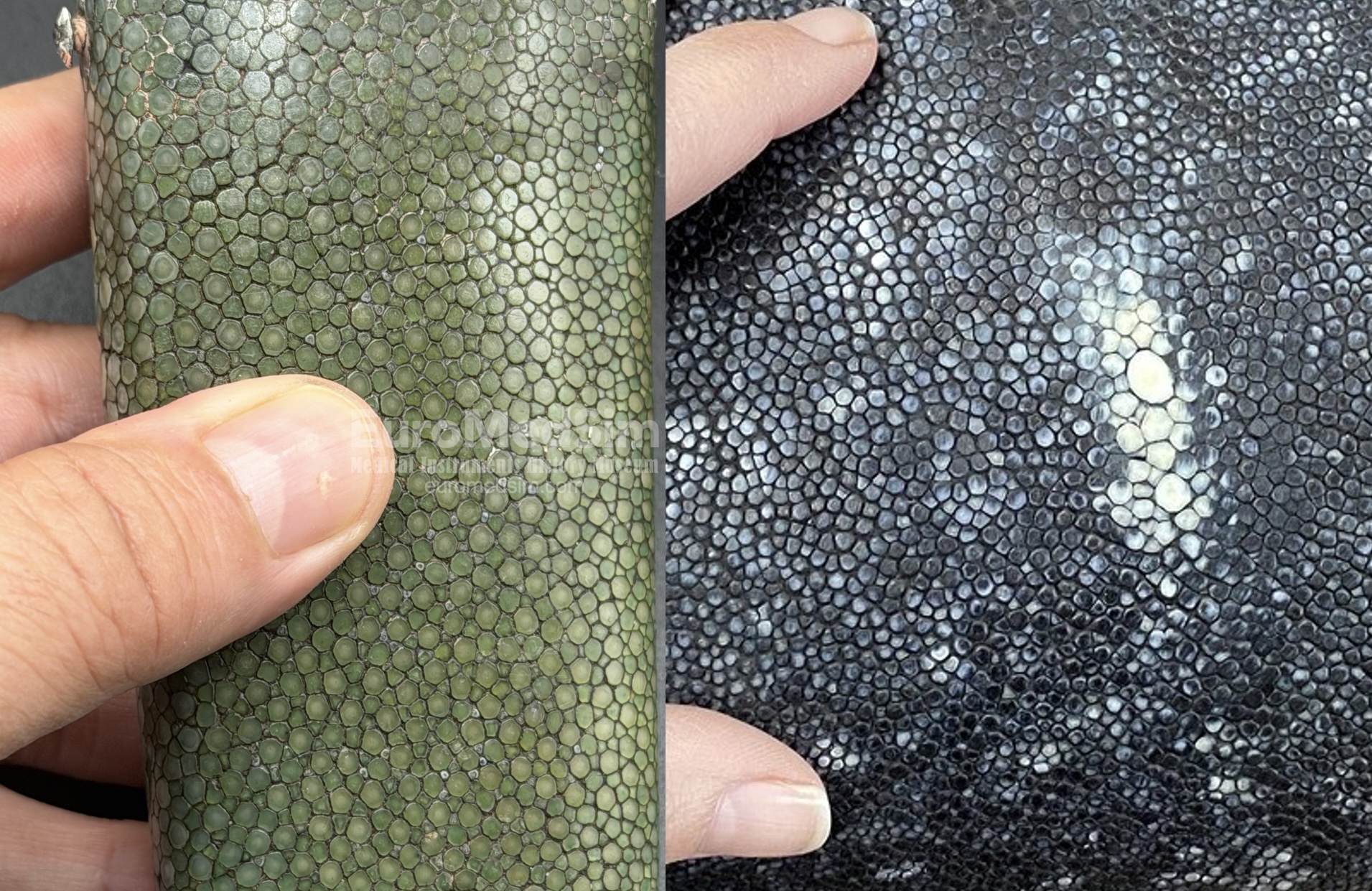
Left: Equine (horse) green shagreen leather, source: EuroMedSim. Right: ray shagreen (galuchat), source: CuirenStock.com
That said, it’s not all that difficult to tell them apart. Equine shagreen is softer and smoother to the touch; its raised grains are arranged in more or less even rows, as if uniformly carved and polished, with flat tops surrounded by grooves and indentations. Most often, artisans dye it in traditional green or red colours. At the same time, marine-derived shagreen has a natural texture, if not polished it is rough to the touch like coarse sandpaper, and very dense, rigid. White bumps like tiny pearls stand out against the black background. The surface of stingray leather shines and shimmers, while shark leather has larger and coarser scales.
Reference Objects
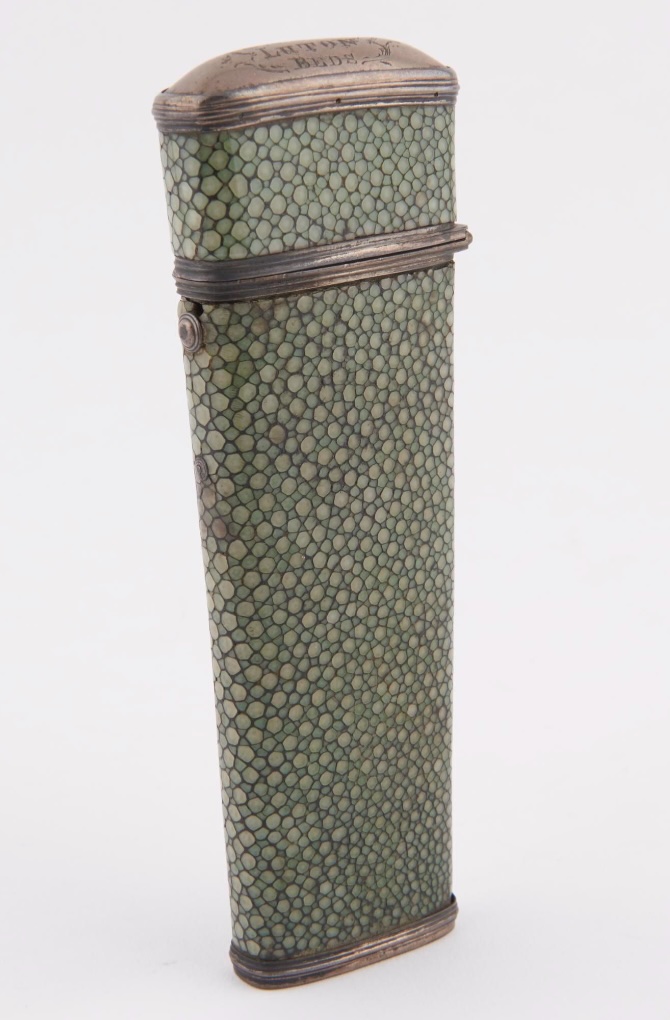
Pocket surgical instrument set, empty silver-mounted shagreen case only, inscribed "J. Kirby, Luton, Beds", English, 1701-1850. Source: Science Museum, London, UK
- Pocket surgical instrument set, empty silver-mounted shagreen case only, inscribed "J. Kirby, Luton, Beds", English, 1701-1850. Science Museum, London. collection.sciencemuseumgroup.org.uk/objects/co164621/pocket-surgical-instrument-set
- Pocket surgical instrument set, empty silver-mounted shagreen case only, English(?), 1701-1850. collection.sciencemuseumgroup.org.uk/objects/co175343/pocket-surgical-instrument-set
- Surgical Etui with instruments (ca. 1750) by Savigny at collectmedicalantiques.com, by Robert Greenspan, MD: https://collectmedicalantiques.com/galleries/cased-surgical-sets
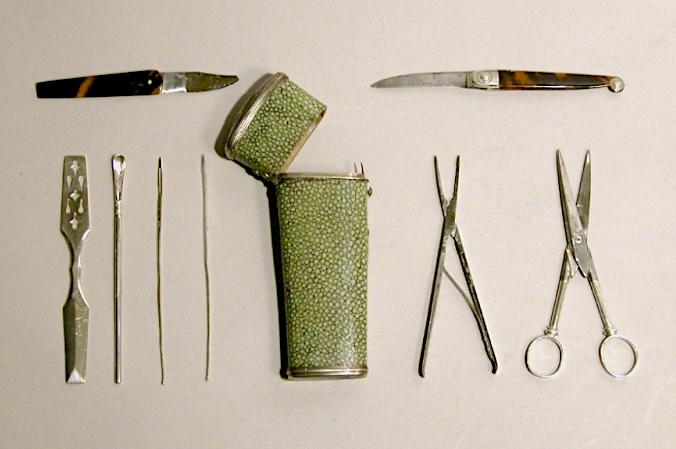
Surgical Etui with instruments (ca. 1750) by Savigny. Source: collectmedicalantiques.com, Robert Greenspan, MD
Provenance
Acquired in the English Salesroom in 2025. Offered at the auction under the description: "A green-stained shagreen Pocket Surgeon's Instrument Case. English, c.1800, with silver metal mounts, hinged cover engraved 'C', with slots for dressing forceps, lancets, elevator and others, with later lancet, spoon and blunt needle, part of lid detached and damaged, 15cm long."
References
- Bennion, Elisabeth. Antique Medical Instruments. 1st ed. London: Sotheby Parke Bernet; Berkeley: University of California Press, 1979.