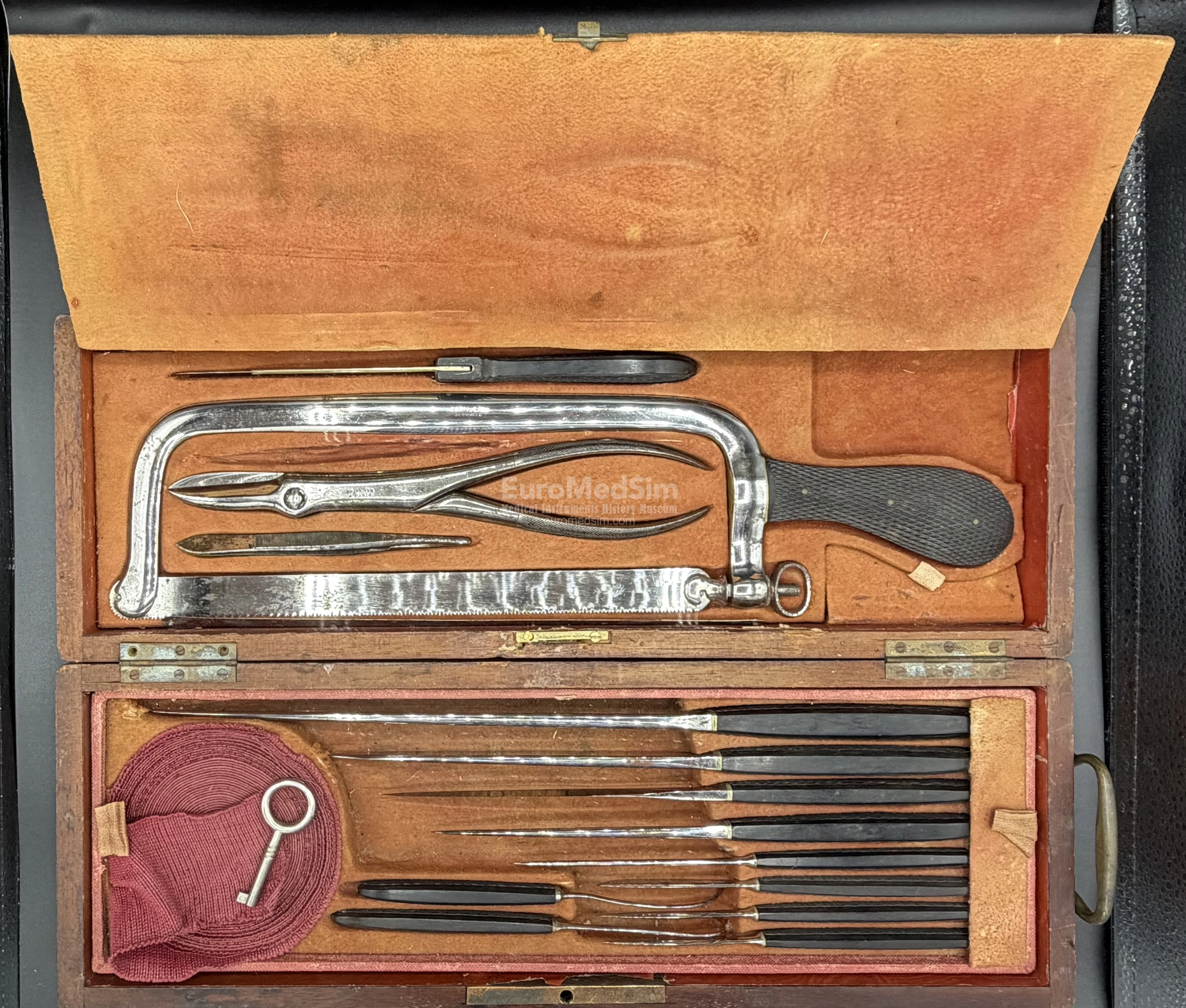
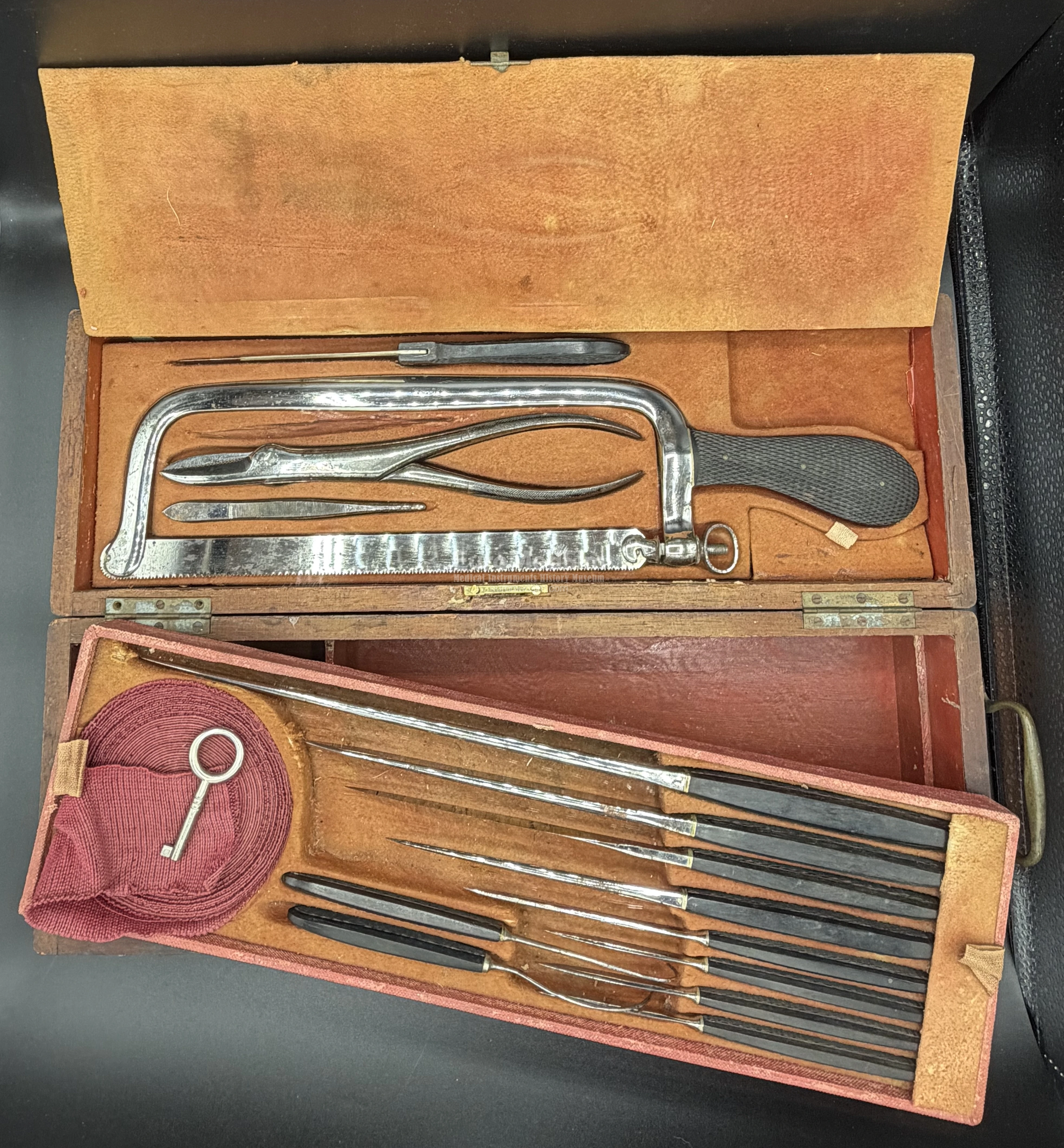
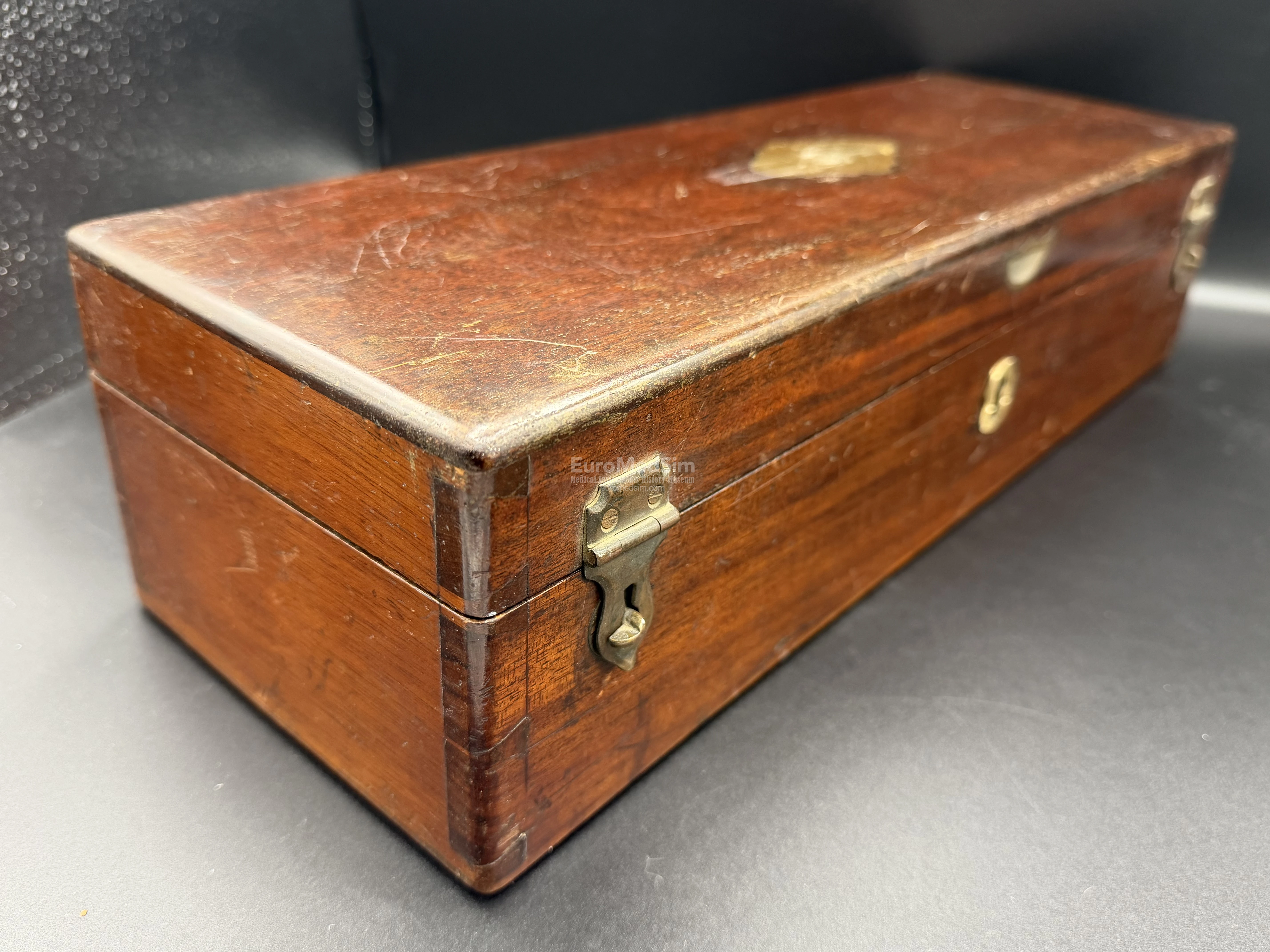

Amputation Surgical Cased Set, Charriére, France, XIX c.
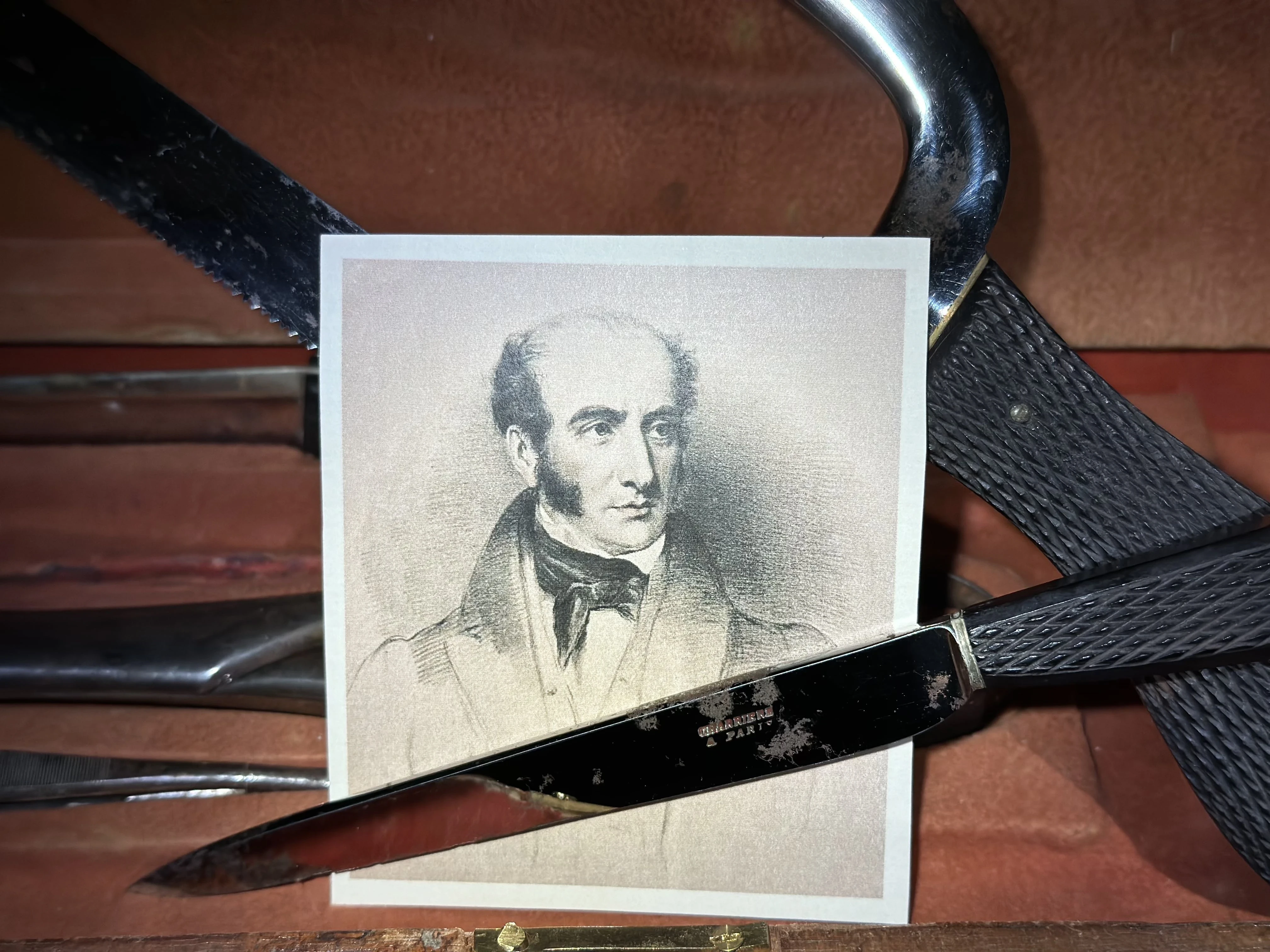
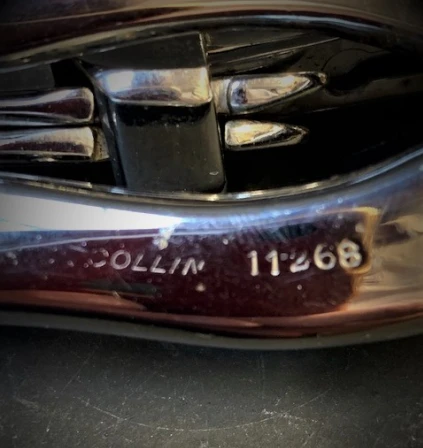
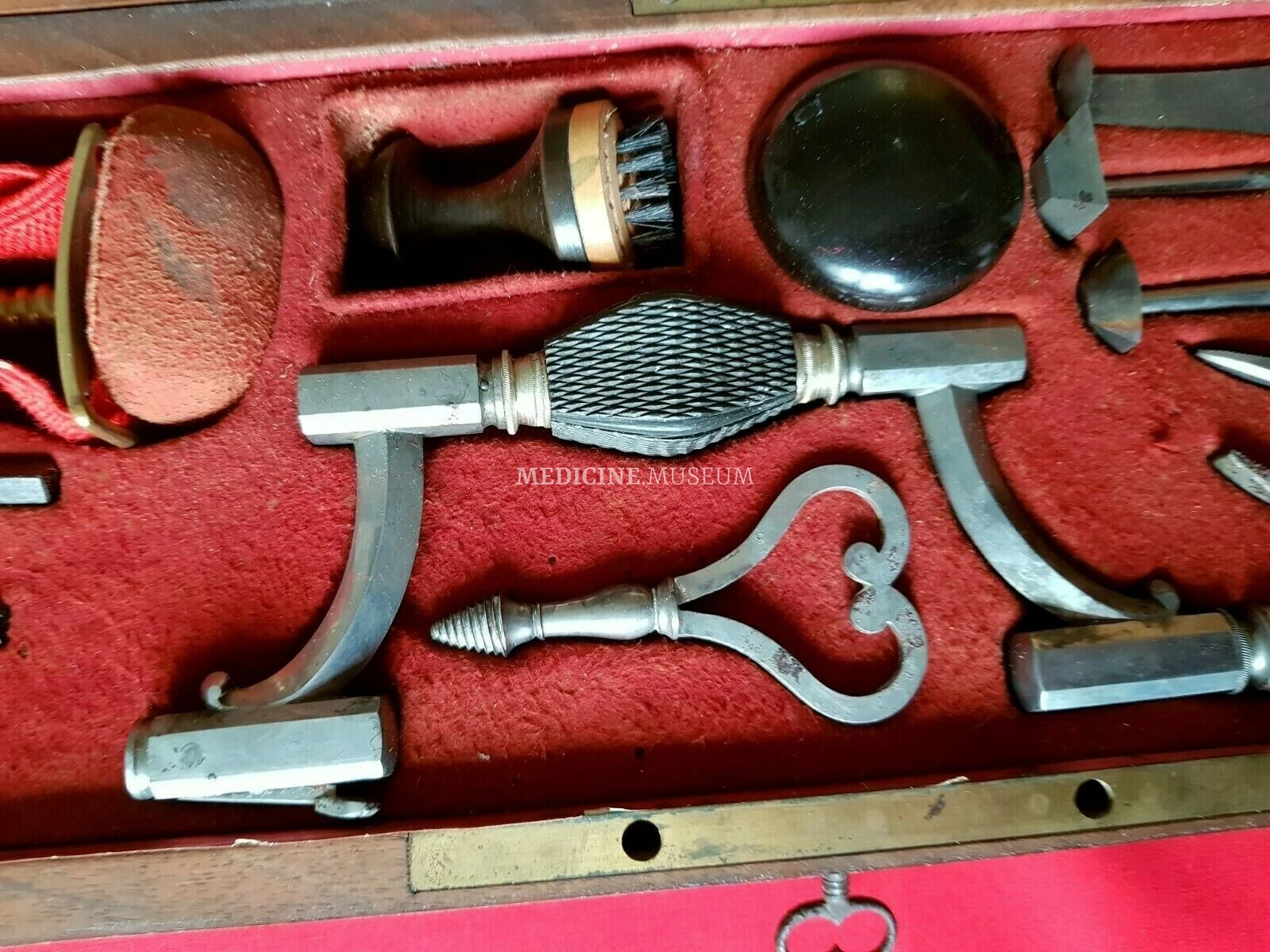
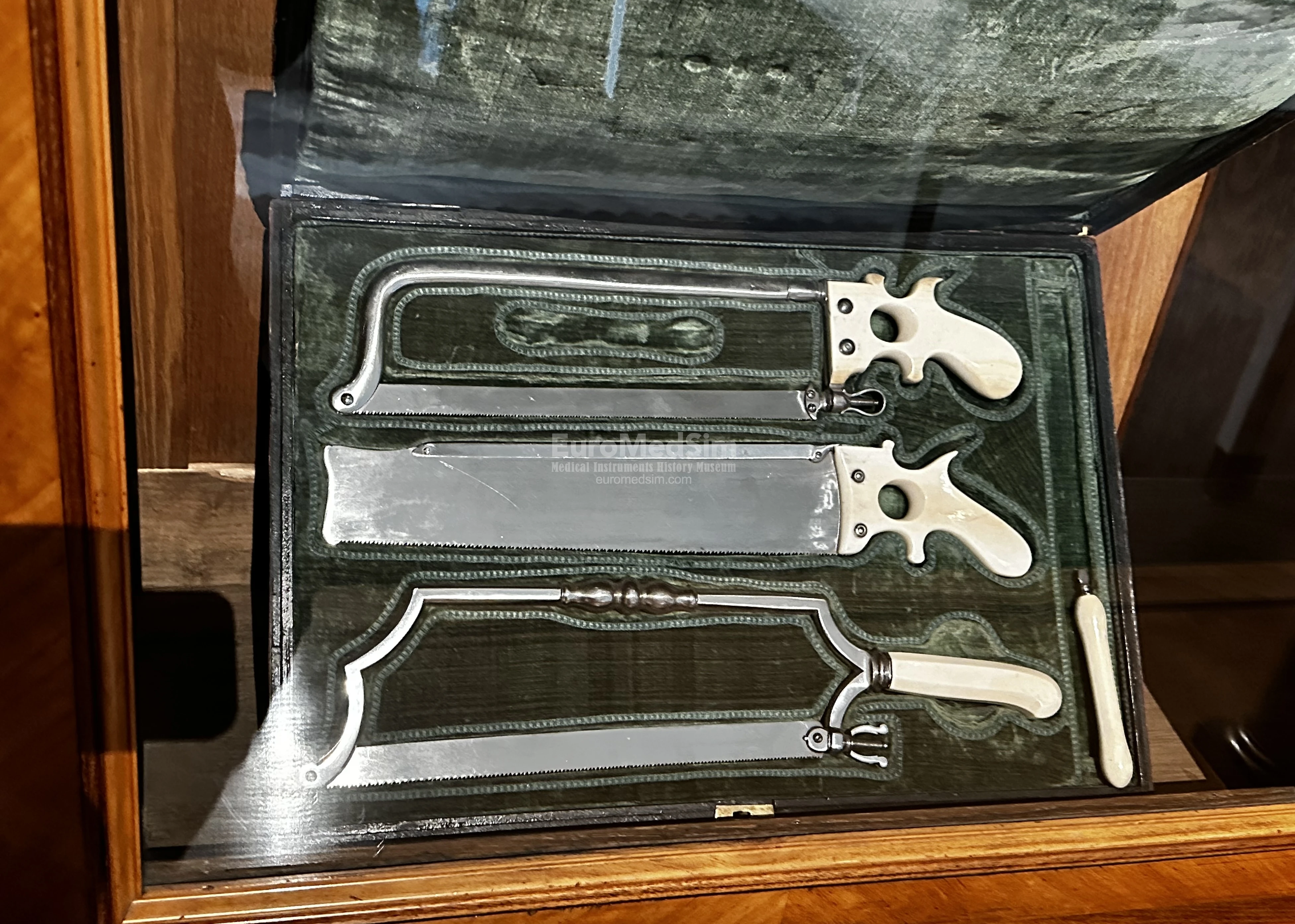
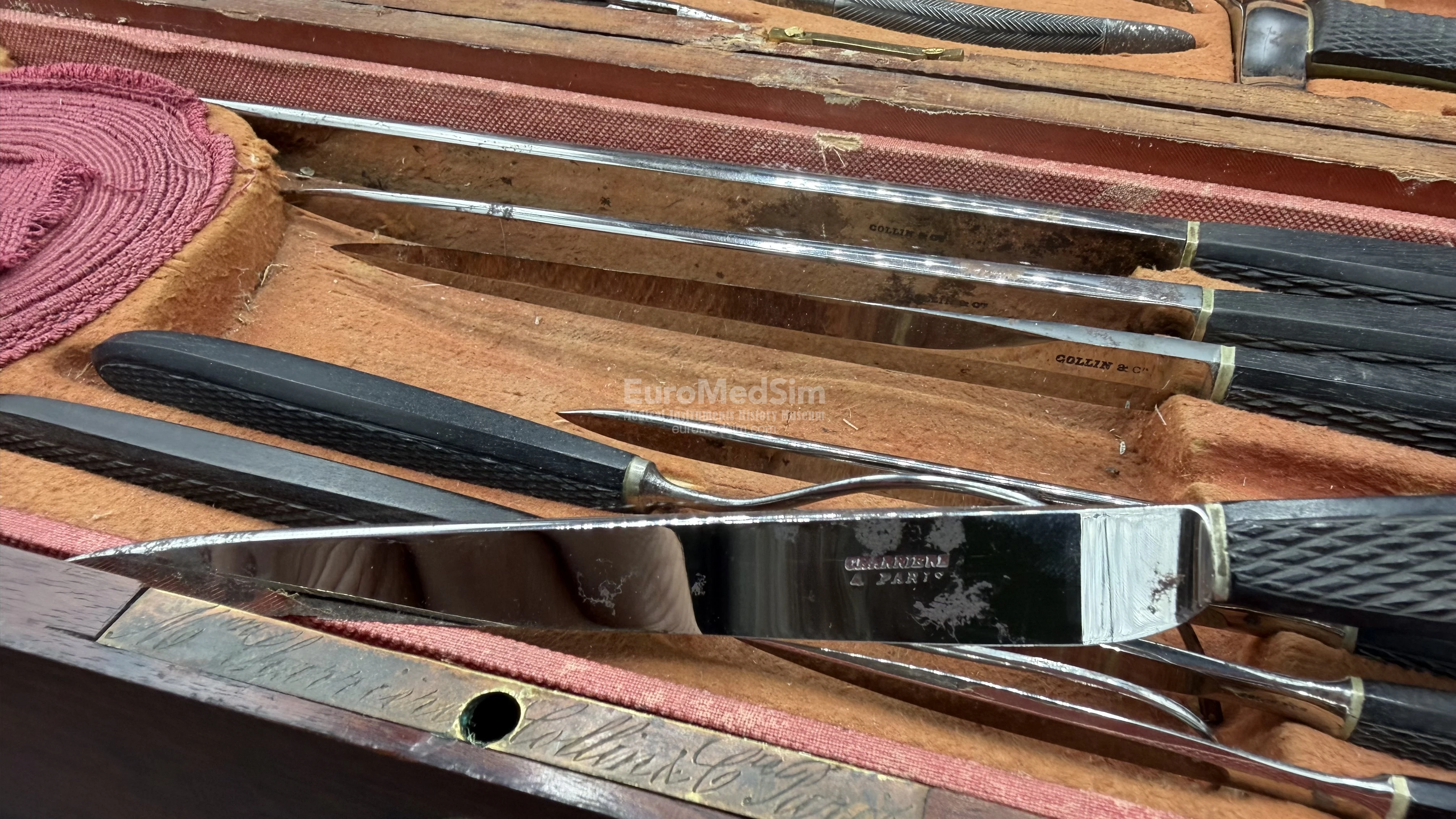
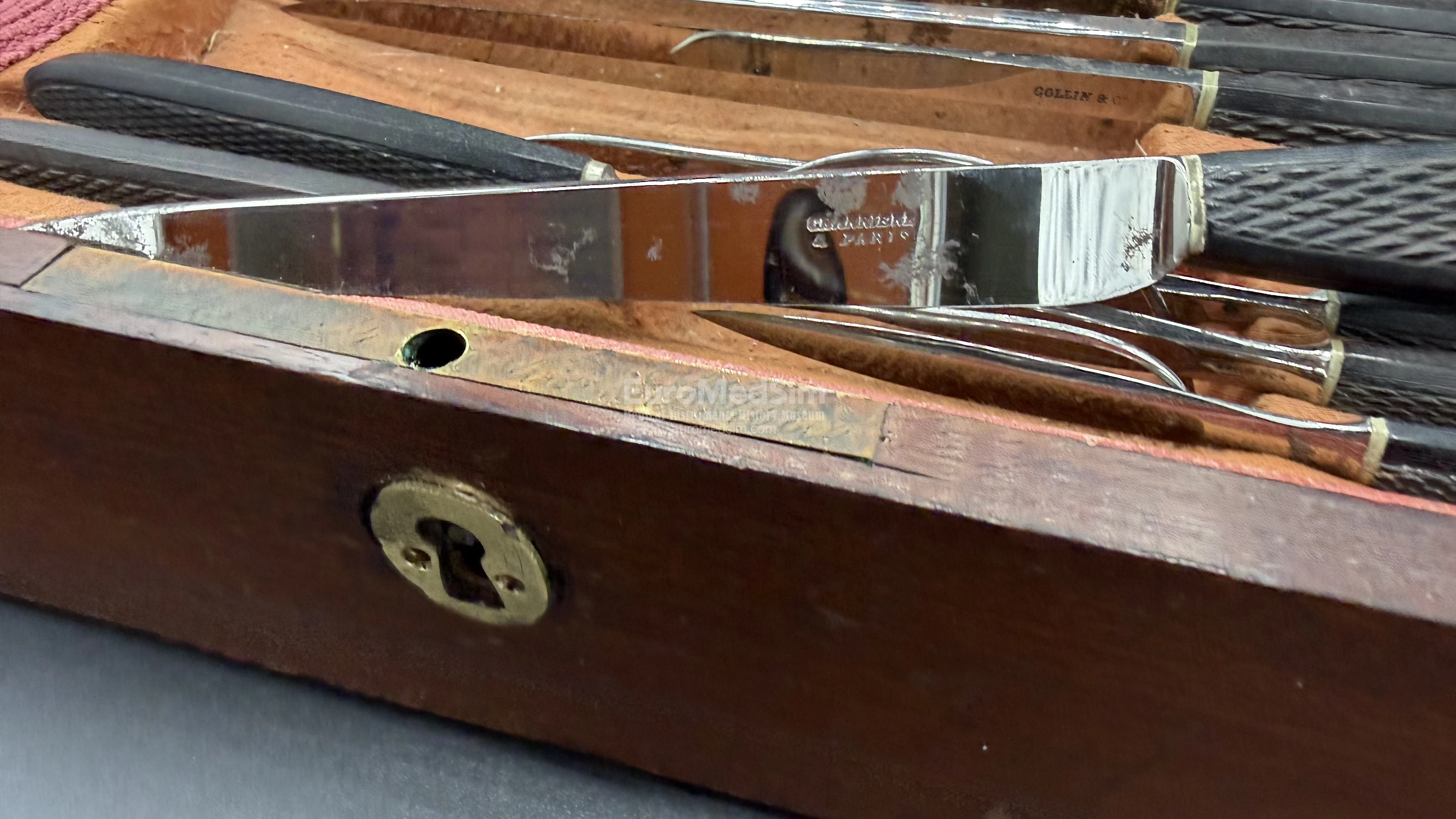
Amputation instrument case by Charrière á Paris / COLLIN & Cie, dated approximately 1871-1890. The case is complete with its set of eight knives, two Deschamps’ needles on handles, one large curved needle without a handle, large bow amputation saw with a spare blade, smaller metacarpal saw, powerful detachable bone forceps, small clamping forceps and red haemostatic band, a pair of forceps and a curved needle. All the instruments including saws have ebony handles. All instruments have markings of the house of Charrière: Charrière á Paris, COLLIN ET CIE Á PARIS or COLLIN & Cie.
The box is made of dark wood (mahogany). The compartment at the top of the box closes with a lid that locks with a latch. The recesses of the compartments are lined with red fabric. The lower compartment has a removable drawer. There is a key that fits the lock.
Content of the Set
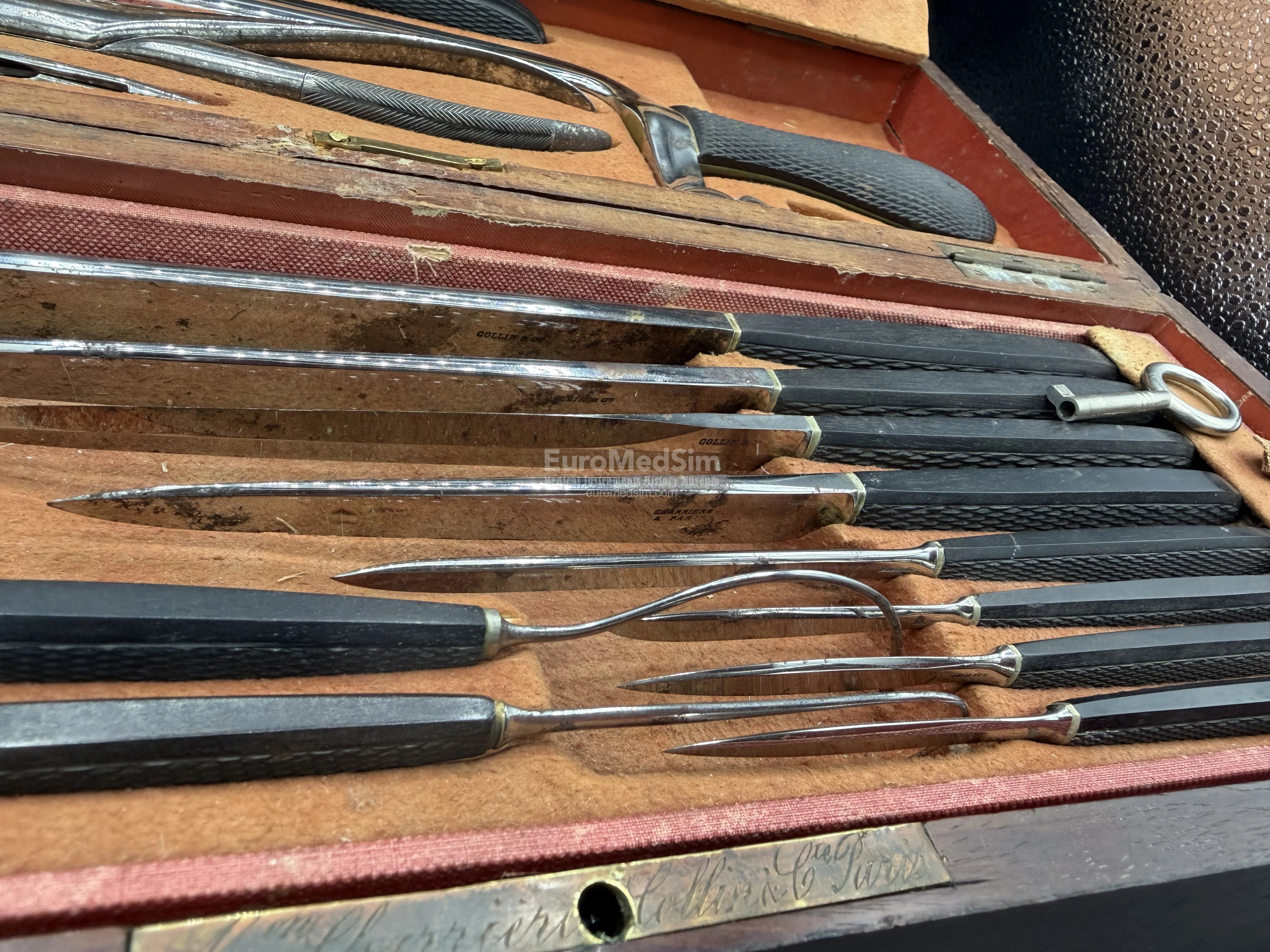
Mahogany box with bras plaque on the lead, has two compartments. On the inside of the box, the lock is engraved with calligraphic handwriting: Mers Charrière / Collin & Cie, Paris. The upper compartment has a red lid with a bronze latch. The box inside is lined with red velvet. Case contains the following instruments:
Upper compartment
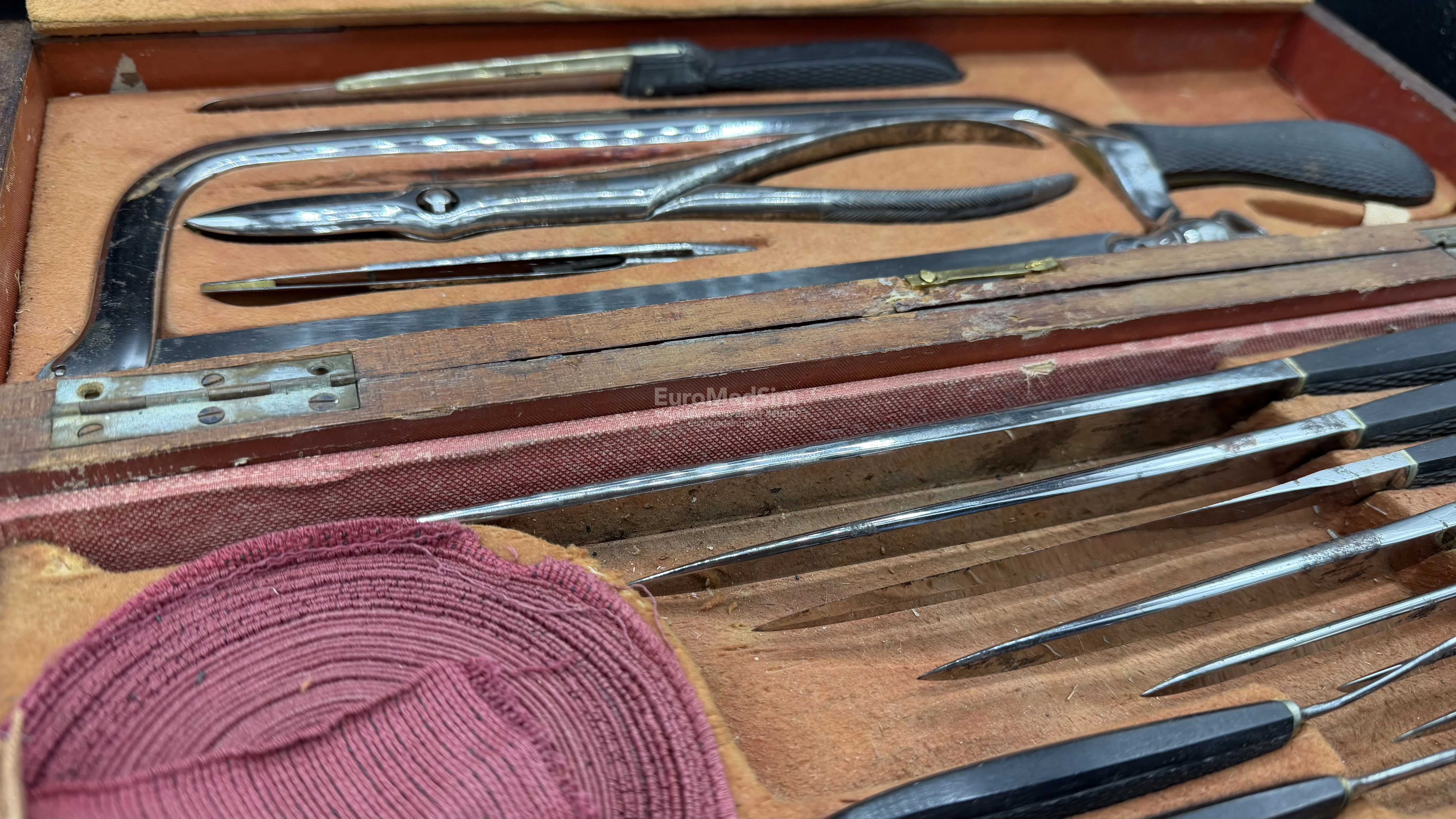
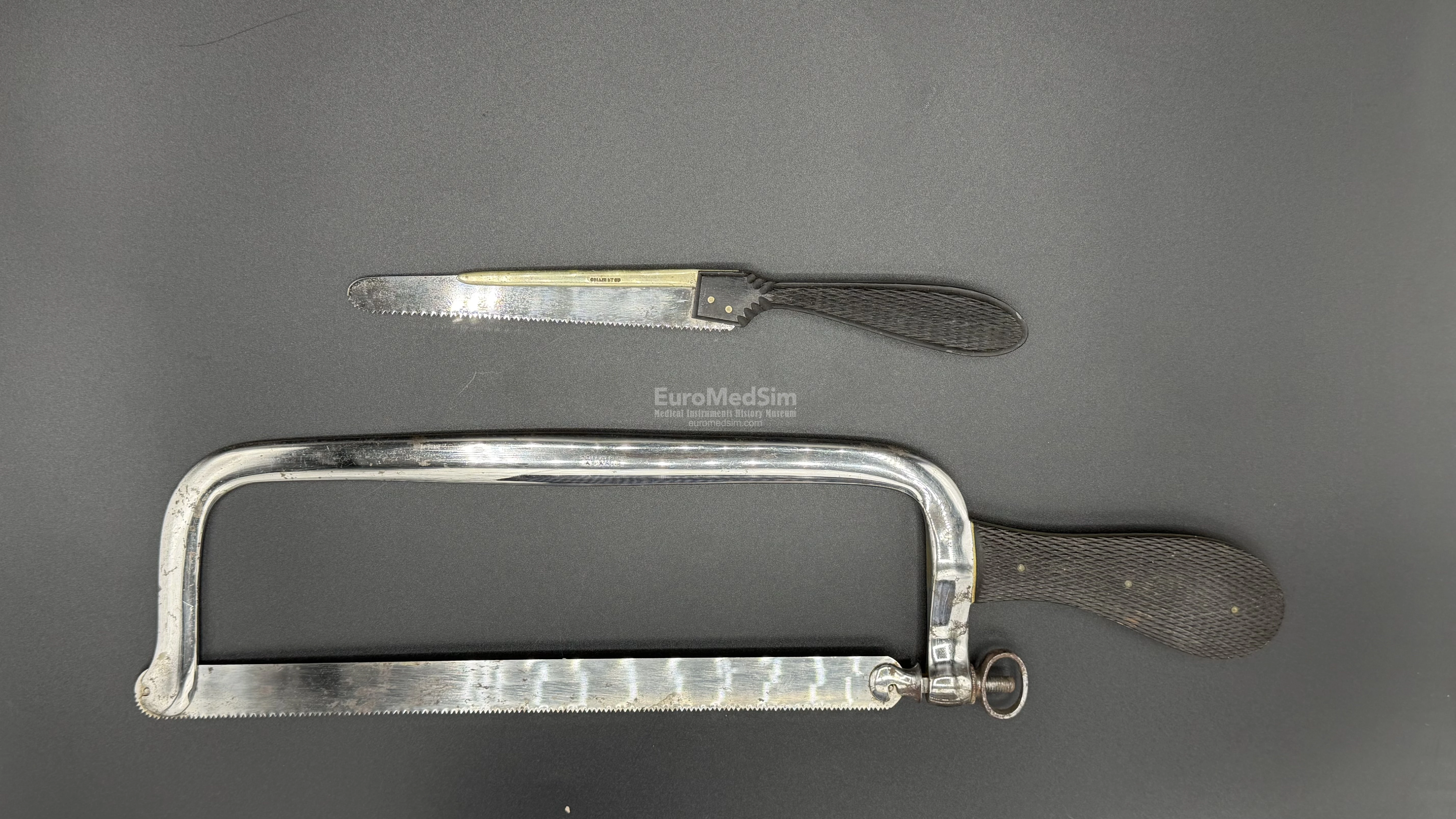
- Large bow saw of the Charriére type with chequer-griped ebony handle (marked COLLIN & CIE Á PARIS); spare thin blade;
- Metacarpal saw with chequer-griped ebony handle (marked COLLIN ET CIE);
- Сlamp-tweezers with lock;
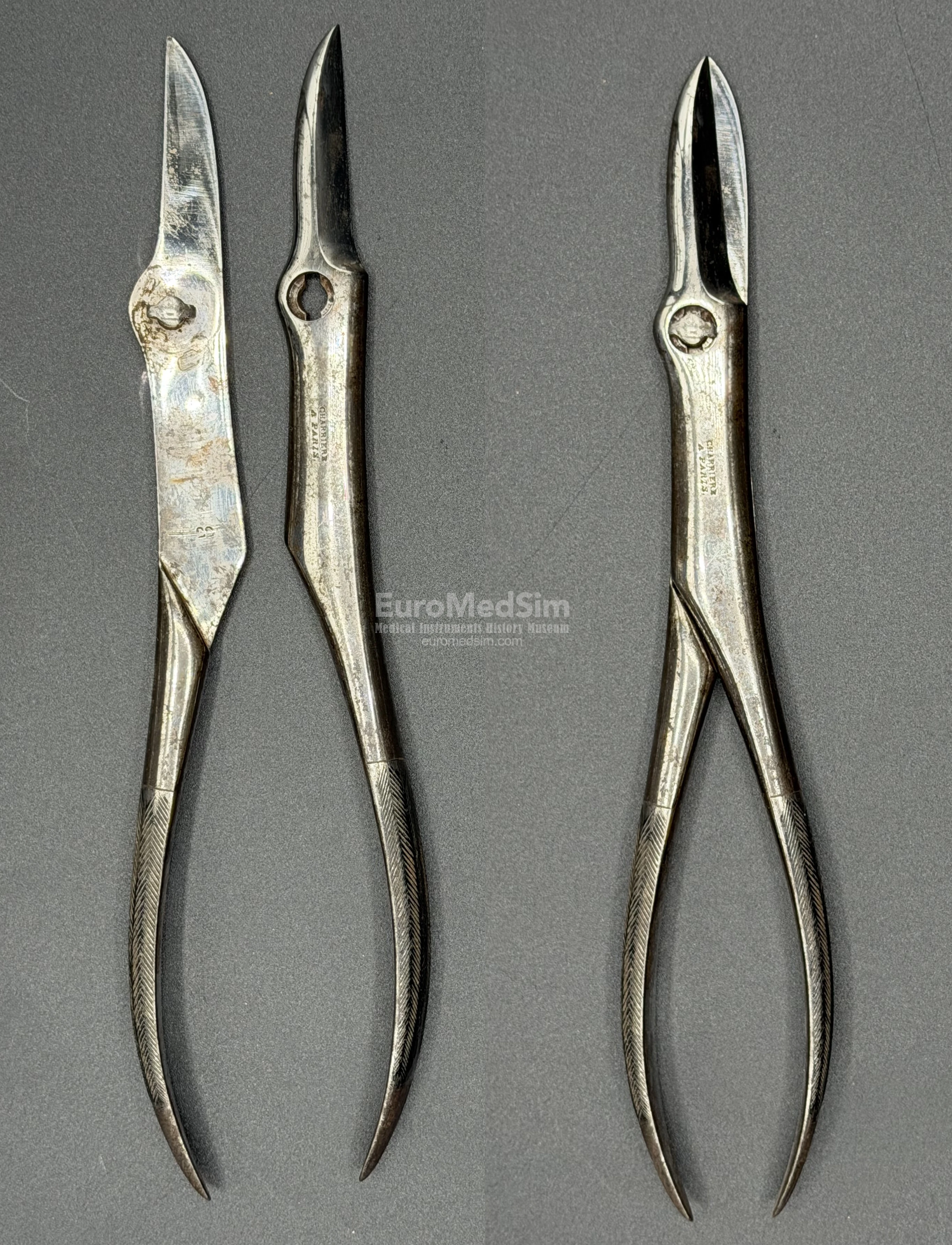
- Powerful detachable bone forceps (pliers);
- One slot for a small clamp-type tweezer is empty.
Lower compartment
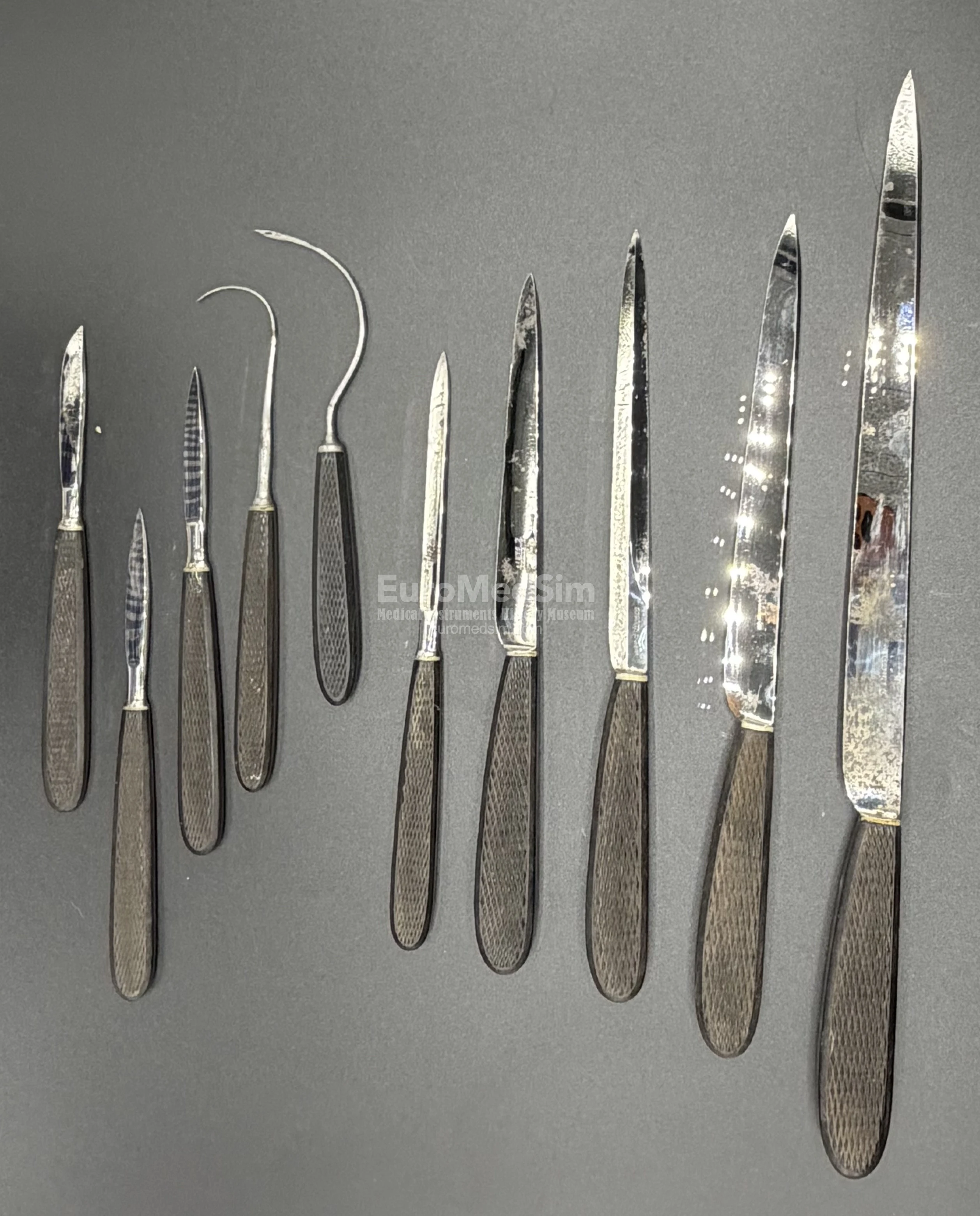
- Four large amputation knives (blade 12.2 to 23.5 cm) , all with octagonal, rounded, ebony, checkered octagonal handles (cross-shaped serrations);
- Tourniquet — a long, flat red fabric band without buckles, screws, or other fasteners;
- Two curved Deschamps’ ligature needle with long shaft, eye-pierced curved tip with black, chequered ebony handles;
- Four bistouri (scalpels) with blades ranging from 6.5 to 10 cm length, three of them with a single-sided sharpening and one lancet-shaped, with a double-edged sharpening. All are marked COLLIN & Sie.
Three Liston knives and one double-edged knife were designed for cutting soft tissue during amputations. The narrow blade of the Liston knife has only one edge, slightly convex, with a thick, bevelled back to easily pass through tissue. The tip is located on the axis of the blade. The width is almost the same up to the tip, which allows it to pierce without breaking or make incisions in the skin. The knives are:
- COLLIN & Sie knife with a 23.5 cm blade and a total length of 35 cm — for amputation of soft tissues of the thigh;
- COLLIN & Sie knife with a 16.5 cm blade (total length 27.3 cm) for soft tissues of the lower leg or arm;
- Charrière á Paris marked knife with a 12.2 cm blade (total length with handle 22.8 cm) for final stump formation;
- The fourth knife, marked COLLIN & Sie, is a double-edged amputation "catling" with a diamond-shaped cross-section of the blade, has a 14.3 cm blade (total length with handle 24.7 cm). This shape ensured easy advancement through soft tissue, such as between two bones, provided a cut in both directions, and helped to form flaps.
Dating
Since some of the tools are stamped with the COLLIN mark (the Charrière company was renamed to Collin in 1871 due to a change of ownership), the earliest date for the set is limited to 1871. As for latest dating, by the end of the 19th century, particularly from the 1890s onwards, leading French manufacturers of surgical instruments, such as Luer, Mathieu, Collin gradually ceased production of instruments with ebony handles and began offering all-metal and nickel-plated instruments to protect against corrosion and meet new requirements for asepsis in surgery. However, some ebony instruments were still used in military surgical kits until the late 1890s (compare with the description of an amputation kit from a military hospital in Guingamp, dated 1891, in which ebony handles were still present).
Provenance
Acquired in 2022 from a Parisian antique dealer specializing in medical and scientific instruments.