Pharmacy Laboratory with Two Men, Early 20th Century
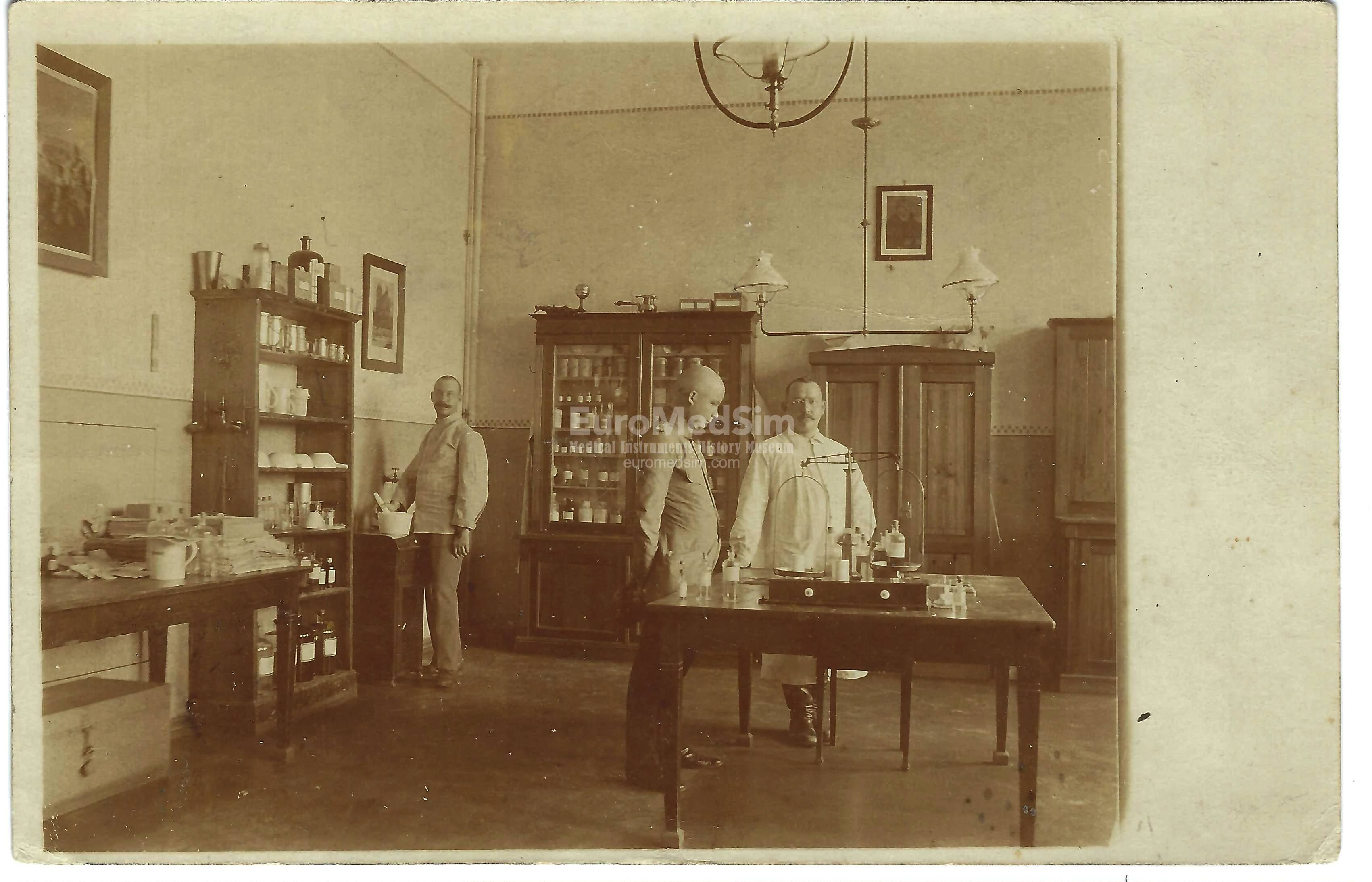
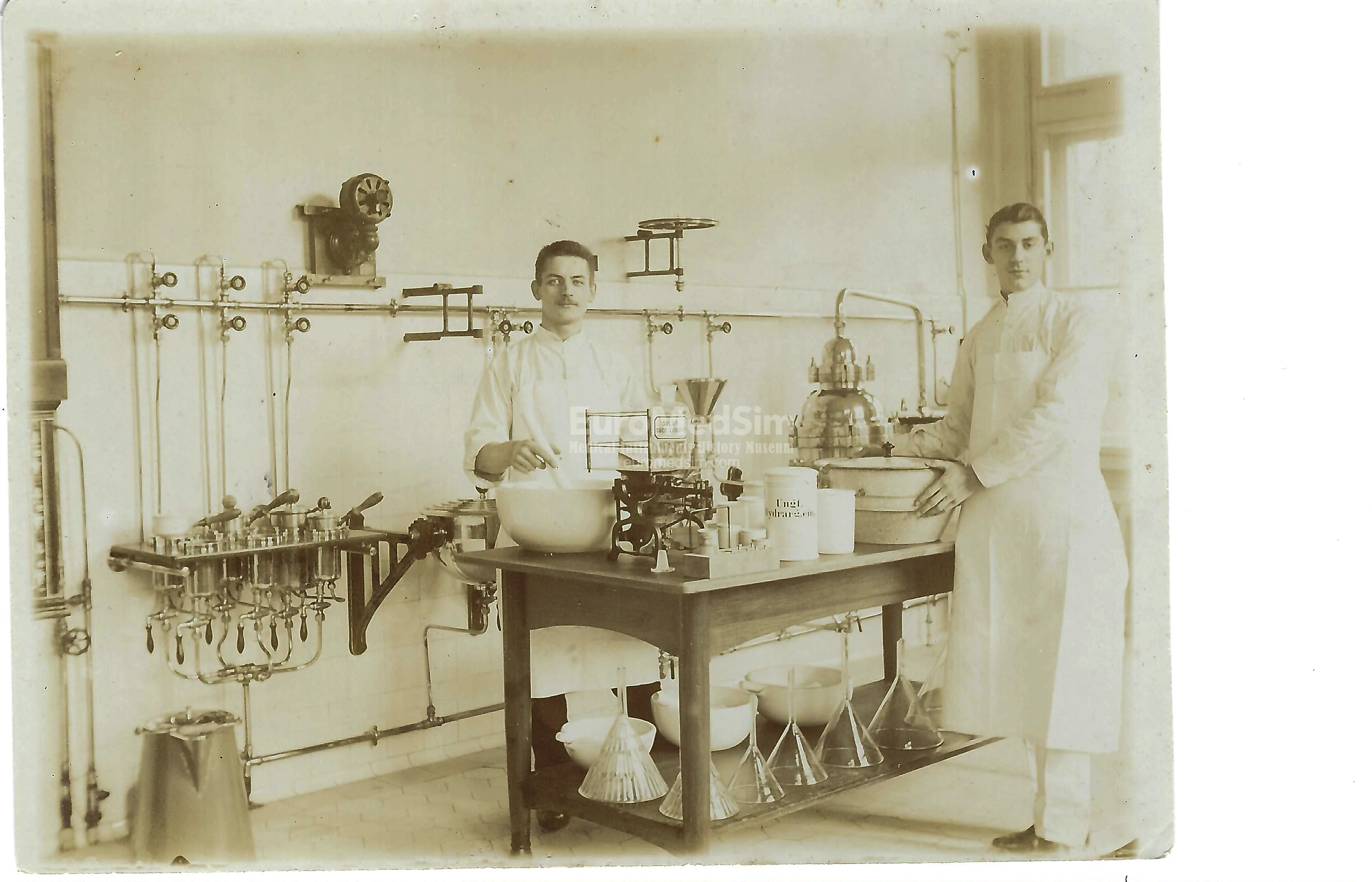
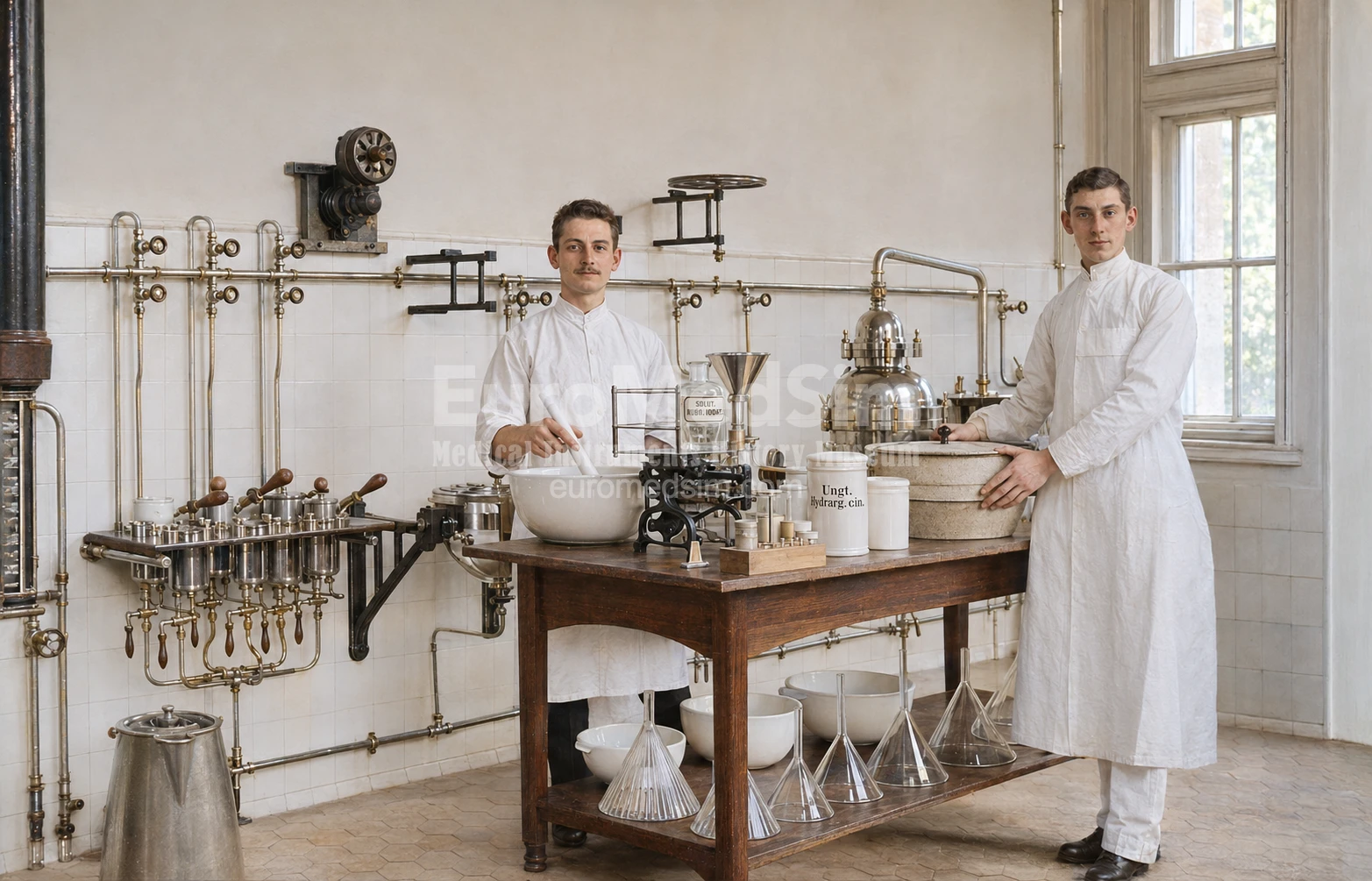
The photograph shows a bright laboratory with a tiled lower wall, exposed pipework and a substantial wooden worktable. A tall window on the right provides strong lateral illumination, reflected by the light clothing, pale vessels and polished metal surfaces.
Two men wear long, high-buttoned white work gowns with stand-up collars. The man near the centre, who has a small moustache, stands behind a large ceramic mixing mortar. The taller man on the right places his hands against a broad circular vessel. They may have been pharmacists, assistants or apprentices. Their deliberate positioning beside the equipment suggests a workplace portrait arranged for the camera.
The tabletop carries ceramic jars, one inscribed Ungt. Hydrarg. cin., a labelled glass bottle, a large metal funnel, smaller containers and a compact roller machine. Additional bowls and several large funnels, stored with their stems pointing upwards, occupy the lower shelf. At the left, a wall-supported installation holds several cylindrical vessels with individual controls and connecting pipes. Behind the man on the right stands a domed metal apparatus with clamped fittings and an overhead pipe connection.
The variety and scale of these objects suggest a room equipped for repeated preparation of medicines in quantities larger than a single prescription.
Equipment and Pharmaceutical Work
The roller machine near the centre is most plausibly an ointment mill. Its horizontal rollers and substantial metal frame resemble historical machines used to disperse ingredients and produce a smooth, uniform ointment. The German Pharmacy Museum documents comparable three-roller equipment for manual or belt-driven operation, including an example dated to around 1870. Such machinery brought mechanical assistance to a task otherwise performed by prolonged grinding and mixing in a mortar [1].
The installation on the left appears to be a bank of heating or water-bath stations, probably associated with preparing pharmaceutical liquids or extracts. Its precise construction cannot be established from the photograph. The domed apparatus at the rear may belong to the laboratory’s steam or distillation equipment, although its exact function and manufacturer remain unidentified. Historical pharmacy installations often combined several operations: a surviving apparatus of around 1900 in the German Pharmacy Museum incorporates infusion vessels, a still and a water bath within one assembly [2].
Together, the bowls, funnels, heating equipment and probable ointment mill indicate a preparation room where materials could be heated, mixed, filtered and processed. Whether it belonged to a community pharmacy, a hospital pharmacy or another pharmaceutical establishment cannot presently be determined.
The Mercurial Ointment Jar
One of the most informative details is the inscription on the large white jar near the front right of the table. It appears to read Ungt. Hydrarg. cin., an abbreviation of Unguentum hydrargyri cinereum: grey mercurial ointment.
This was an established pharmaceutical preparation made by thoroughly incorporating metallic mercury into a fatty base. The third edition of the Pharmacopoea Austriaca, published in 1820, lists it under both Unguentum hydrargyri cinereum and Unguentum mercuriale and specifies storage in a glass or porcelain vessel [3].
Mercurial ointments remained part of medical practice into the early twentieth century, notably in the treatment of syphilis by rubbing the preparation into the skin. A clinical paper published in 1919 discusses metallic-mercury ointment and contemporary attempts to replace it with calomel preparations [4]. The jar therefore connects the laboratory’s equipment with a recognisable medicinal product. The glass bottle next to it also has an abbreviated pharmaceutical label that begins with “Solut.” (Solutio), but the full text on it is not clear enough to be reliably deciphered.
The long white coats, mechanical equipment, ceramic stock jars and fitted pipework are consistent with a pharmaceutical workplace of the early twentieth century. A provisional date of c. 1900–1925 is reasonable, but these features do not establish a precise year: durable apparatus could remain in service for decades. The Latin labels likewise provide no secure national attribution.
The photograph is valuable for showing the practical infrastructure behind medicine preparation. The arrangement of vessels, storage space and fixed equipment records how a compact room accommodated several kinds of work. The two men give this technical interior a human presence, presenting themselves alongside the tools of their occupation.
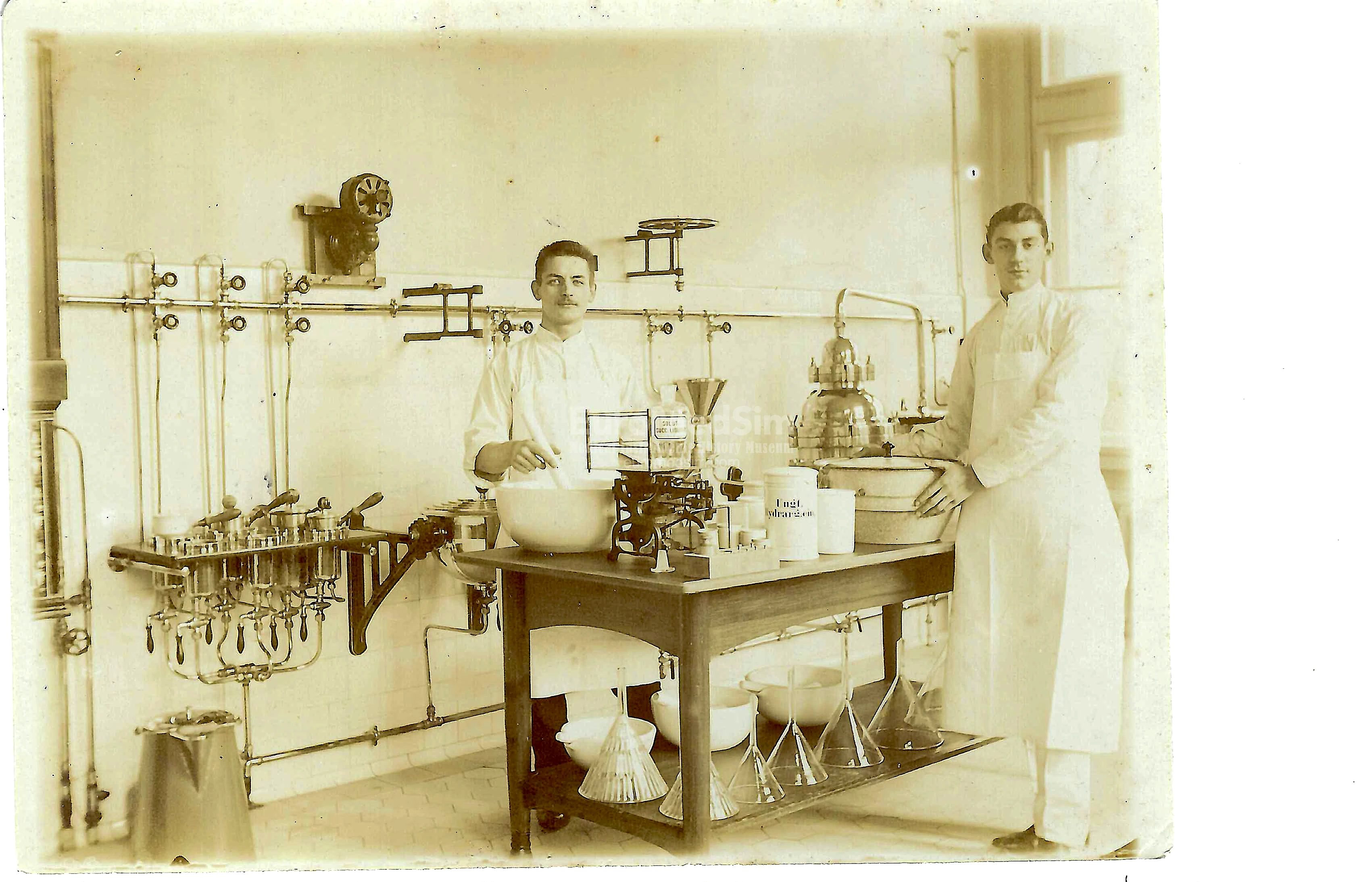
The photo shows a pale yellow-brown image with reduced contrast in the brightest areas, scattered dark specks, small surface marks and some edge and corner wear. Much of the equipment remains clearly distinguishable. The warm colour may reflect the original print, ageing or scanning conditions; it does not by itself establish an intentional sepia-toning process. The photograph was part of a collection purchased at a German auction that included photographs and postcards from German laboratories and pharmacies; therefore, it can be assumed that this photograph was also taken in Germany.
References
- Deutsches Apotheken-Museum. Salbe und Latwerge: Halbfeste Arzneiformen. Exhibition texts. Heidelberg: Deutsches Apotheken-Museum; Museum publication.
- Sachße C. Schwergewichtig: Neuzugänge im Bereich Dampfdestillen. Heidelberg: Deutsches Apotheken-Museum; Museum collection article.
- Pharmacopoea Austriaca. Editio tertia, emendata. Vindobonae: apud Carolum Gerold; 1820. p. 114. Digitised edition — Full-text link.
- Cole HN, Littman S. A clinical study on the use of calomel inunctions. JAMA. 1919;73(19):1409–1413. doi:10.1001/jama.1919.02610450005002.