Chemistry in the German Obersekunda Class
Chemistry in the German Classroom: Obersekunda Pupils in a Laboratory, 1913
Photographic postcard, apparently a real photo postcard, dated 1913, according to the handwritten inscription. Country: probably Germany according to the handwriting in German language; exact location unconfirmed. Monochrome photographic image on postcard stock; printed postal layout and handwritten inscription on the reverse; No postal use. Dimensions (HxW): 8,9 x 13,9 cm.
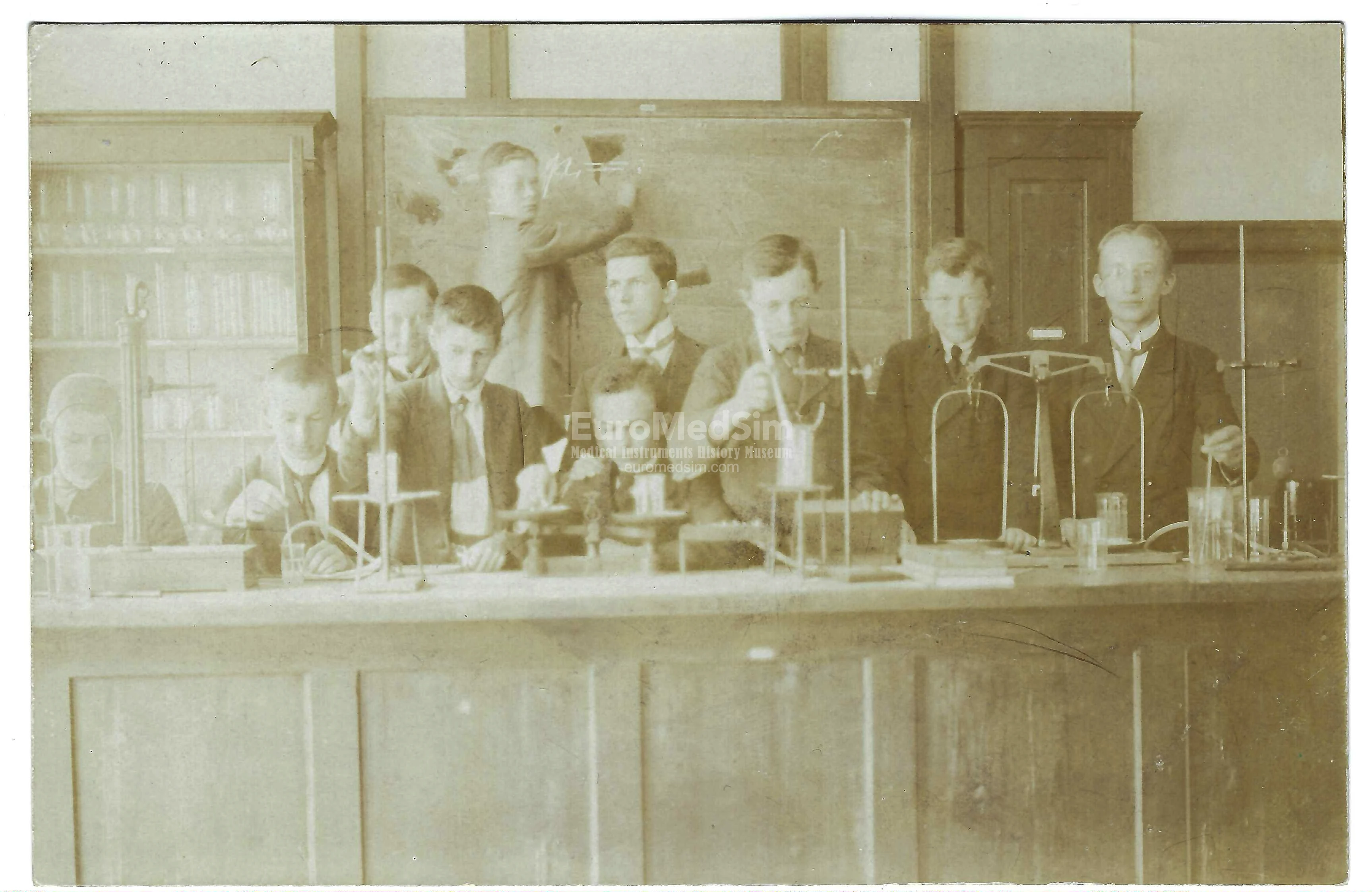
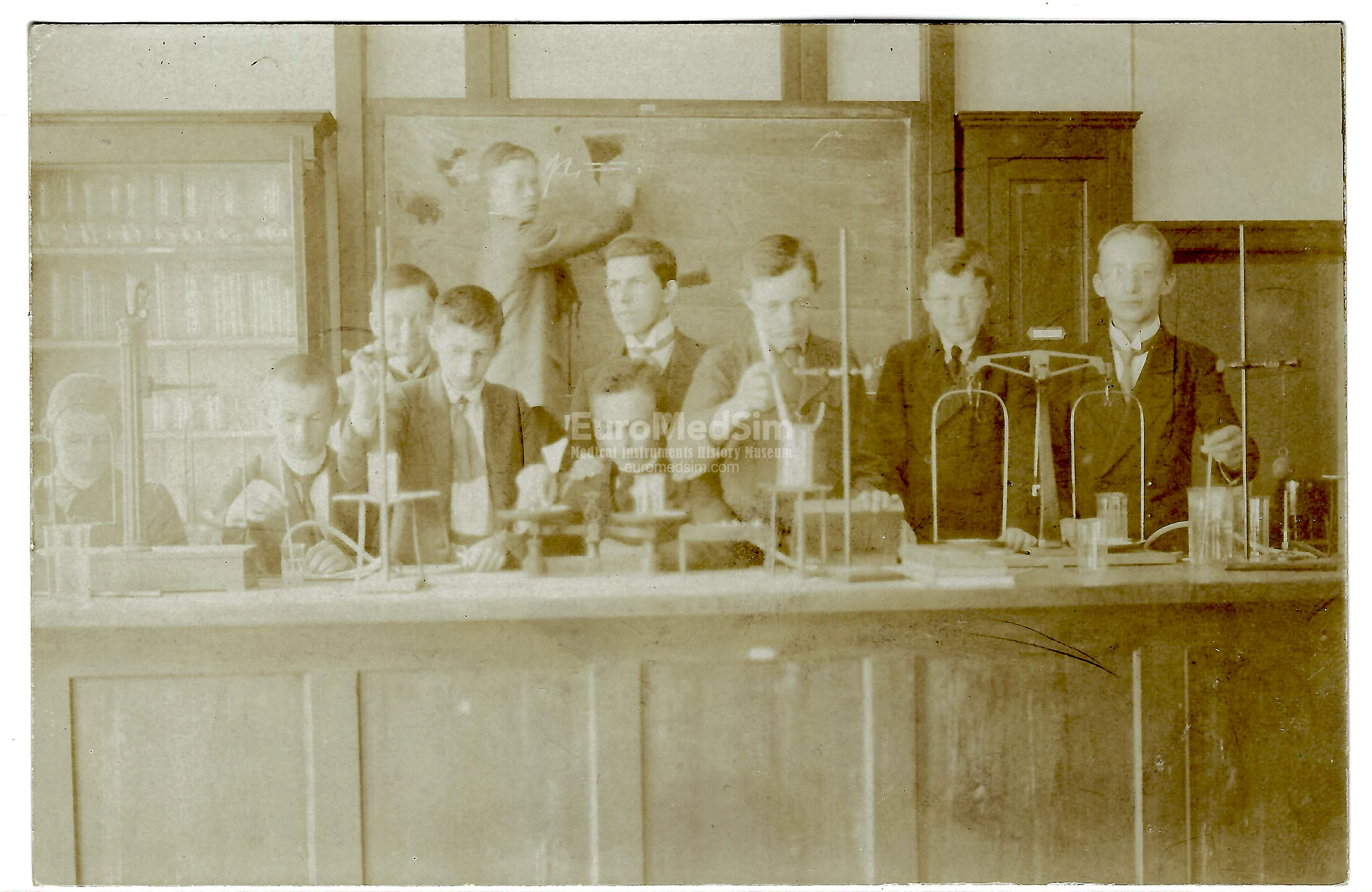
A photographic postcard depicting ten schoolboys gathered around a laboratory bench, with glass vessels, metal stands, balances and other apparatus arranged before them. A handwritten inscription on the reverse identifies the scene as work in a chemical laboratory and records the class designation Obersekunda and the year 1913. The school, location and individuals have not been identified.
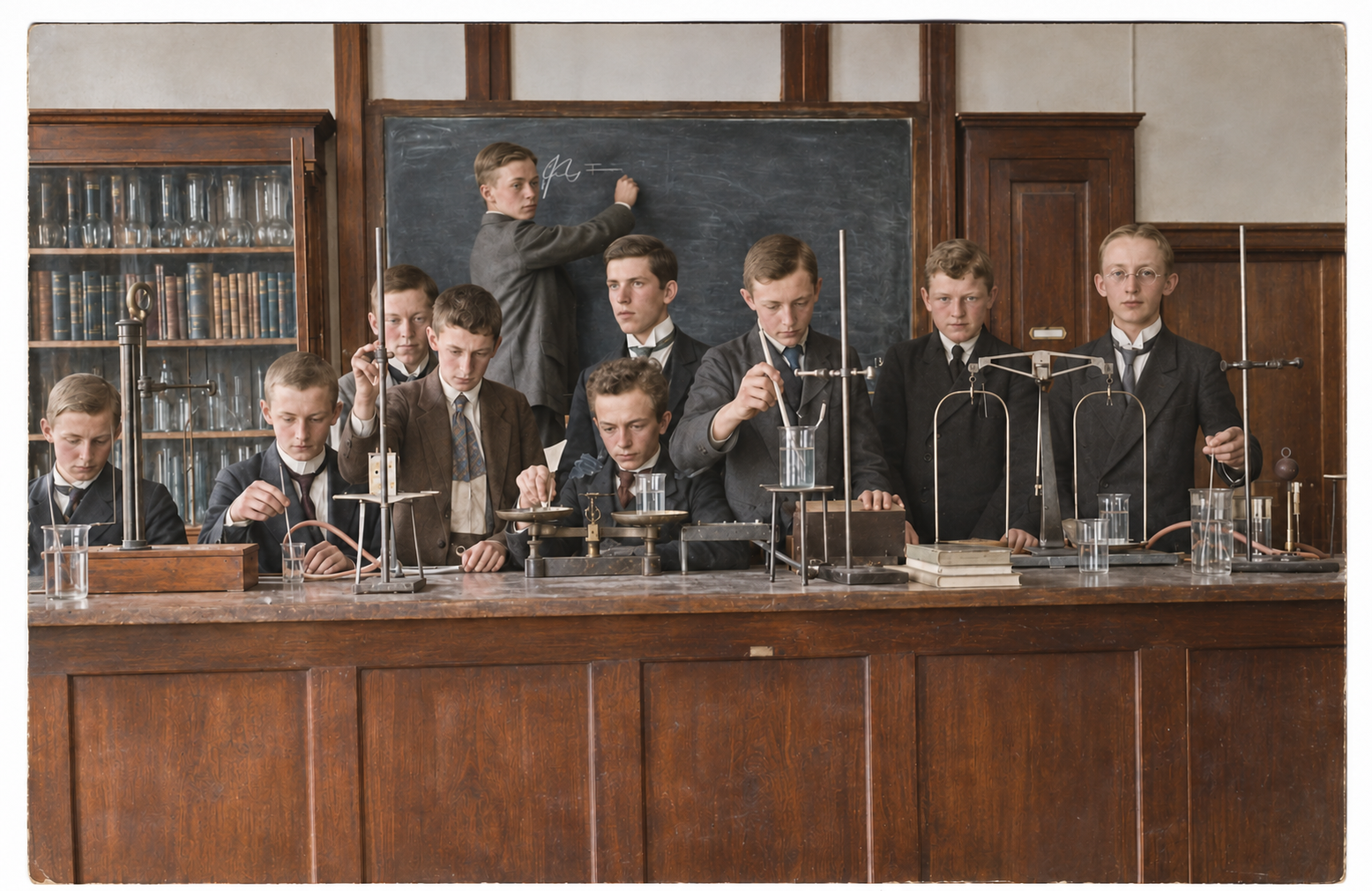
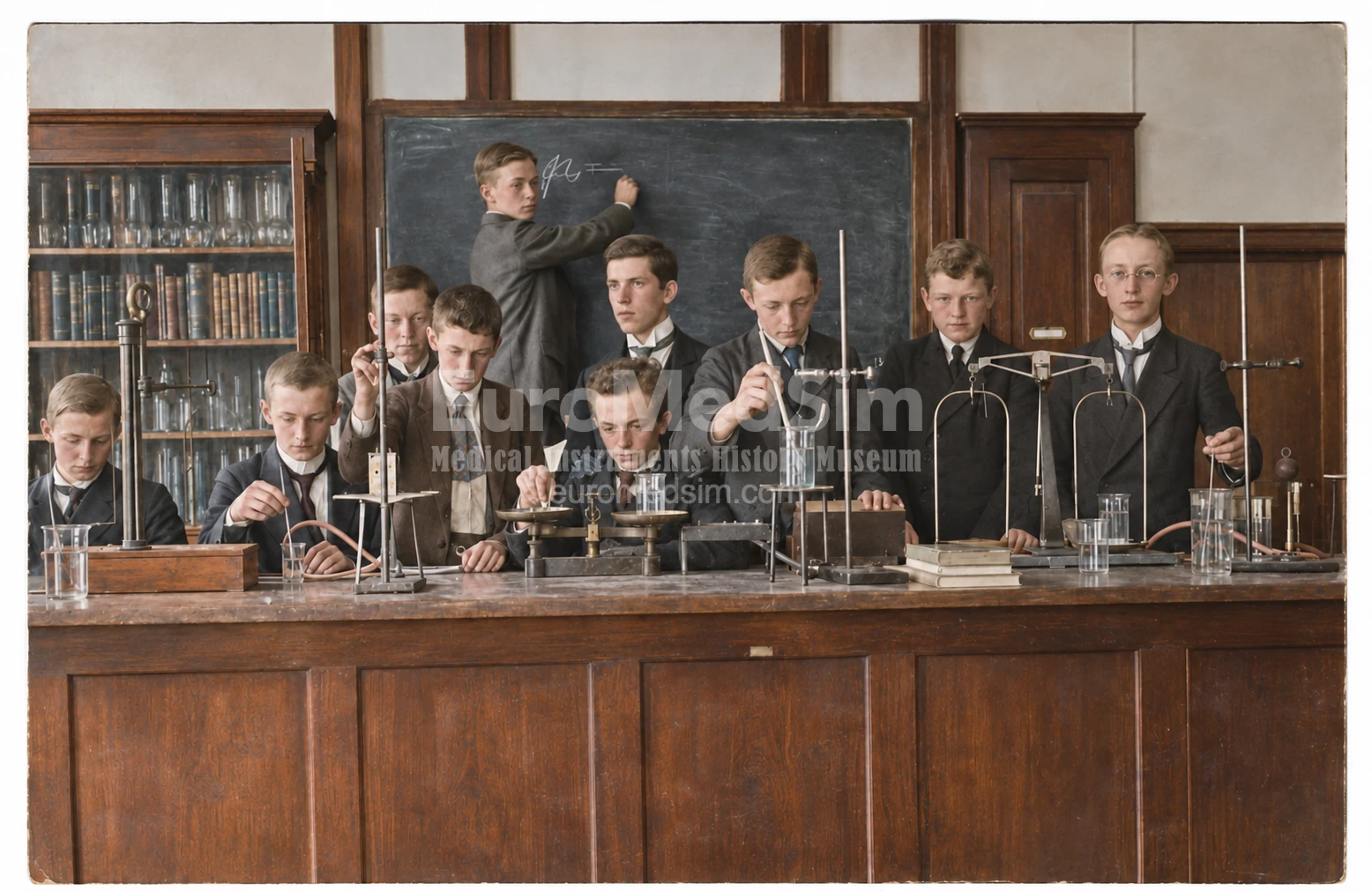
Obersekunda pupils in a chemistry laboratory, 1913. AI-assisted colour reconstruction of the original photographic postcard; colours and fine details are interpretive.
Description of the Front Side — Recto
The photograph presents a group of ten boys standing or sitting behind a substantial wooden laboratory bench. Their dark jackets, waistcoats, ties and high shirt collars give the scene the formality of a school group portrait, while their gestures suggest participation in practical scientific work.
Several pupils hold or manipulate laboratory equipment; others look towards the camera. At the back, one boy stands with his arm raised towards a blackboard, apparently writing or demonstrating something. The tall pupil at the far right wears small round spectacles, whose lenses catch the light.
The bench carries an assortment of glass vessels, metal stands with adjustable holders, tubing and weighing equipment. A prominent beam balance stands on the right. Smaller vessels and apparatus occupy the centre and left of the working surface. Although individual components can be distinguished, the photograph does not provide sufficient detail to identify particular experiments or substances.
Behind the group, a glazed cabinet contains rows of laboratory vessels. The blackboard, wooden fittings and closely arranged apparatus establish the setting as a room equipped for scientific teaching.
The composition appears deliberately arranged: the pupils demonstrate different activities while remaining visible to the photographer. It is therefore best understood as a commemorative class photograph staged around laboratory work, rather than an unobserved record of a lesson.
Description of the Reverse Side — Verso
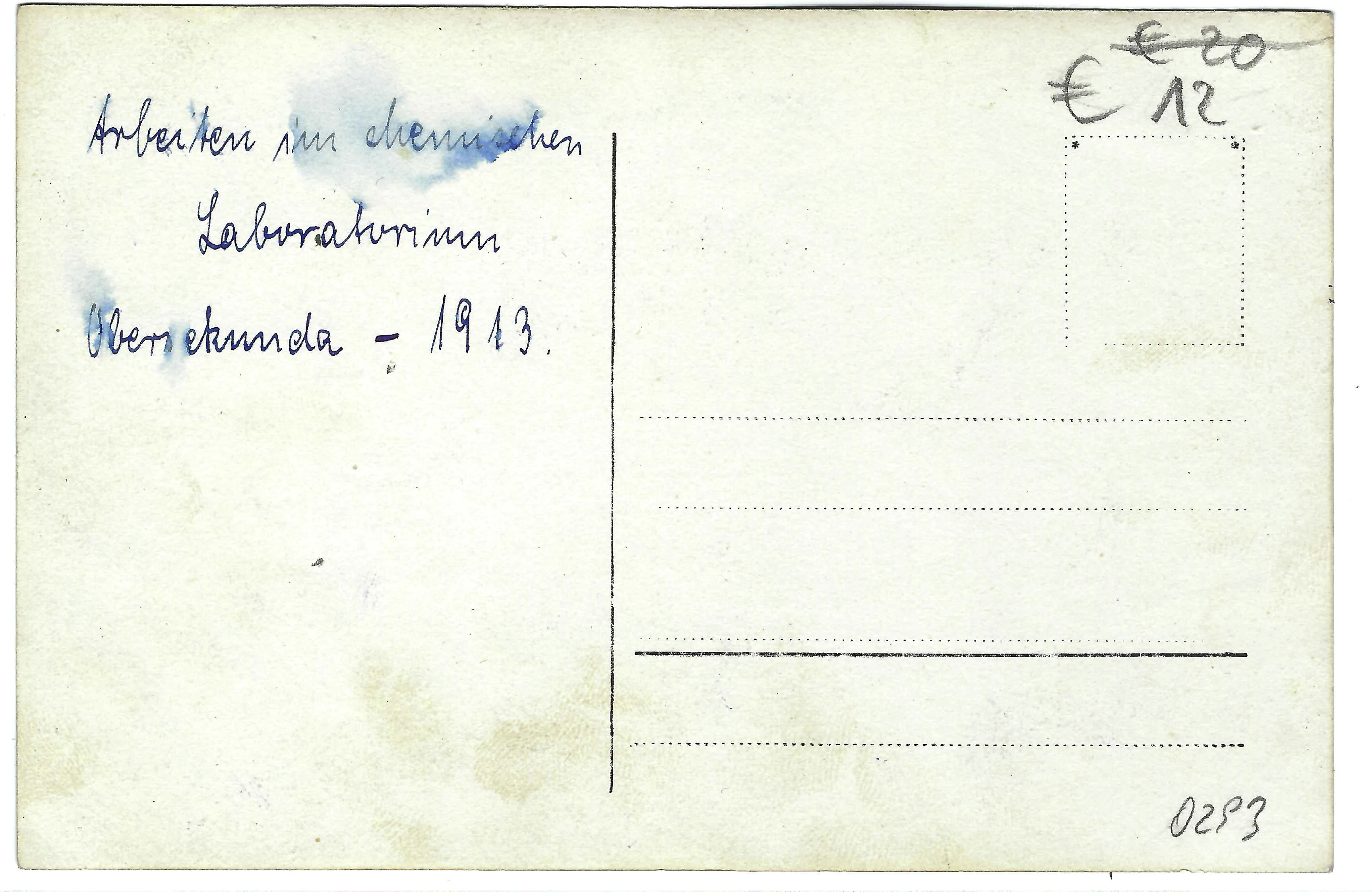
The reverse has a printed, vertically divided postal layout. The right-hand section contains address lines and a dotted rectangular space for a postage stamp. Neither an address nor a stamp or postal cancellation is present.
The left-hand section bears a handwritten German inscription in blue ink:
Arbeiten im chemischen
Laboratorium
Obersekunda – 1913.
English translation:
Practical work in the chemical laboratory.
Obersekunda class — 1913.
The inscription supplies the principal evidence for the subject and date. It does not name the school or town, and its author is unknown.
Later pencil annotations include a price of €12, an earlier crossed-out price and a numerical notation near the lower right corner — probably remarks of the later book-seller.
What Does “Obersekunda” Mean?
Obersekunda, commonly abbreviated O II, was a traditional class designation in the German secondary-school system. Obersekunda (pupils' age of 16-17 years) corresponded approximately to the modern eleventh school year and was followed by Unterprima and Oberprima, the final two classes leading towards the Abitur, final exam.
This inscription makes the identification of the group as secondary-school pupils substantially more secure than their appearance alone would allow. Their precise ages and the particular type of school remain unknown.
A School Photograph in Postcard Form
The object appears to belong to the tradition of the real photo postcard: a photographic print produced on stock with a postal layout on the reverse. Such cards provided a convenient format for personal portraits, school groups and photographs of everyday surroundings. The Smithsonian’s National Museum of American History describes this format as photographs made on thick photographic paper with postcard information preprinted on the back.
Here, the handwritten identification and absence of a printed commercial caption suggest a photograph intended primarily as a personal or school keepsake. The surviving card may have been retained by a pupil, teacher or family member, although its original ownership is not documented.
Condition
The original photograph shows pronounced fading and a warm yellow-brown discolouration, with reduced contrast across faces, clothing and equipment. Surface marks and scratches are visible, including a conspicuous curved mark in the lower right portion of the image.
The reverse shows age-related toning, minor soiling and localised blue ink smudging around the handwritten inscription. The postal layout and identifying text remain legible. This assessment is based on the supplied scans.
Digital Colour Reconstruction
An AI-assisted colour reconstruction accompanies the original scans as an interpretive illustration. It restores contrast and introduces plausible colours for clothing, skin, wooden furnishings and laboratory equipment. Colours and some fine details are reconstructed rather than historically verified.