St Barts Henry VIII Gatehouse Color Postcard
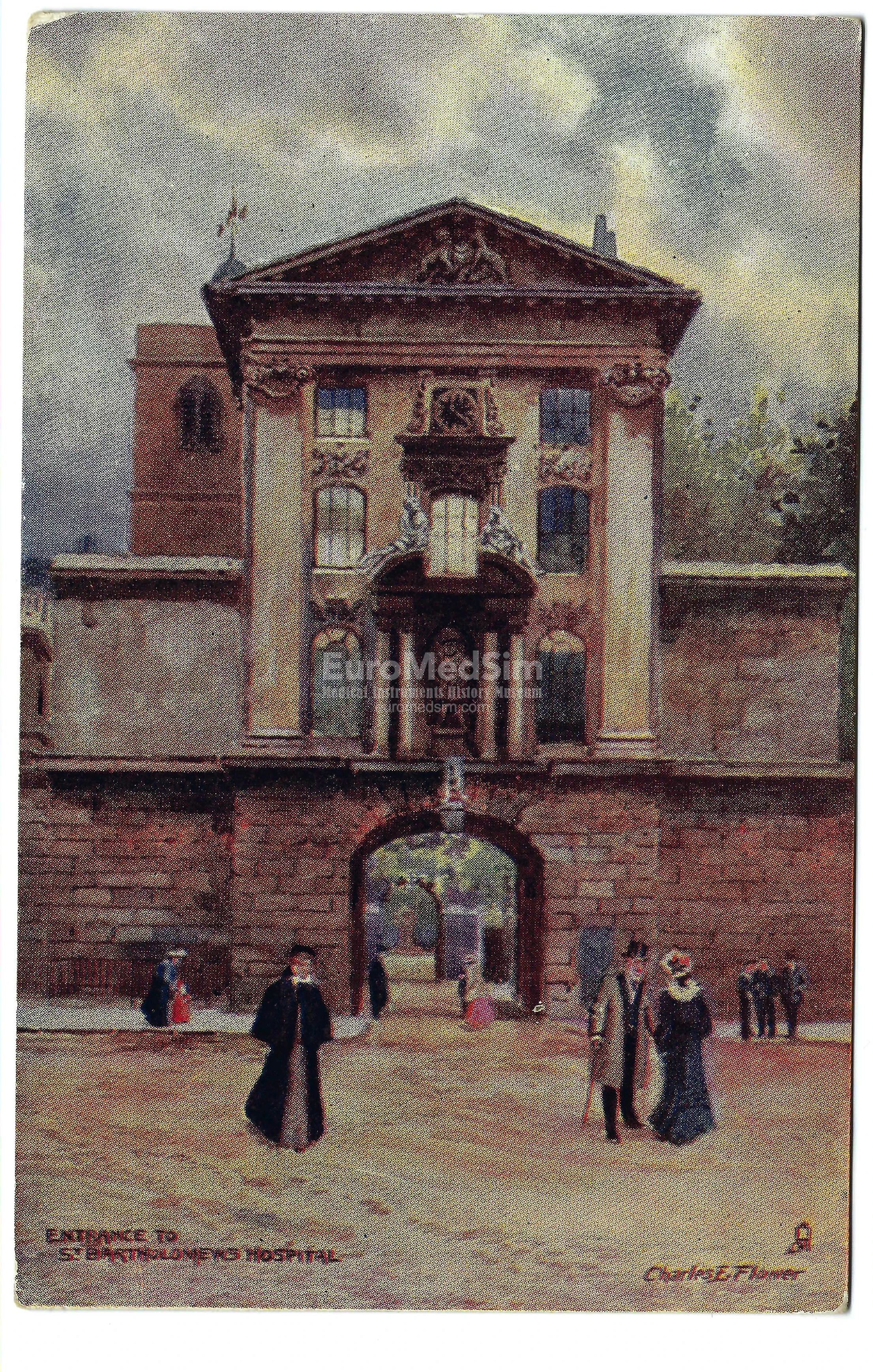
Entrance to St. Bartholomew's Hospital — Henry VIII Gatehouse, London
A hand-colored view postcard depicting the historic Henry VIII Gateway (Henry VIII Gatehouse), the principal entrance to St Bartholomew's Hospital at West Smithfield, London. Original title, as printed on the recto: Entrance to St. Bartholomew's Hospital. Artist: Charles E. Flower. Publisher: Raphael Tuck & Sons, London — "Art Publishers to Their Majesties the King & Queen." Series: "Aquarette," subseries "Old London Gateways," Postcard No. 0257. Material and technique: card stock; multi-color chromolithographic reproduction of a watercolour-style painting on the front; letterpress printing on the reverse. Language: English. Postal use: the card was mailed, bearing a King Edward VII half-penny green postage stamp cancelled with a London N.W. district postmark. Size: approximately 8.7 × 13.8 cm, close to the standard British postcard format of the early twentieth century.
Description of the front side — recto
The front of the card presents a view of the Tudor gatehouse forming the principal public entrance to St Bartholomew's Hospital, seen frontally from the open forecourt. The soft, slightly overcast sky and warm ochre tones of the stonework are typical of the "Aquarette" series' watercolour effect, distinct from the denser, oil-imitating finish of Tuck's "Oilette" line.
The foreground and the archway itself are animated with small figures rendered in a loose, impressionistic touch characteristic of Flower's street scenes: a clergyman in a long dark coat crossing the forecourt, a lady and gentleman in Edwardian dress conversing near the gate, and further figures passing beneath the arch and along the boundary wall.
St Bartholomew's has continued in medical use on the same site without interruption since its foundation, making it the oldest hospital in Britain still occupying its original ground. The postcard, produced at the height of the Edwardian "golden age" of the picture postcard, captures the gateway as it appeared to visitors and patients of the period, animated by pedestrians in the dress of the day.
The caption is printed in red lettering in the lower left corner of the image:
ENTRANCE TO ST. BARTHOLOMEW'S HOSPITAL
The artist's signature appears in the lower right corner, together with the small Tuck monogram device:
Charles E. Flower
Description of the reverse side — verso
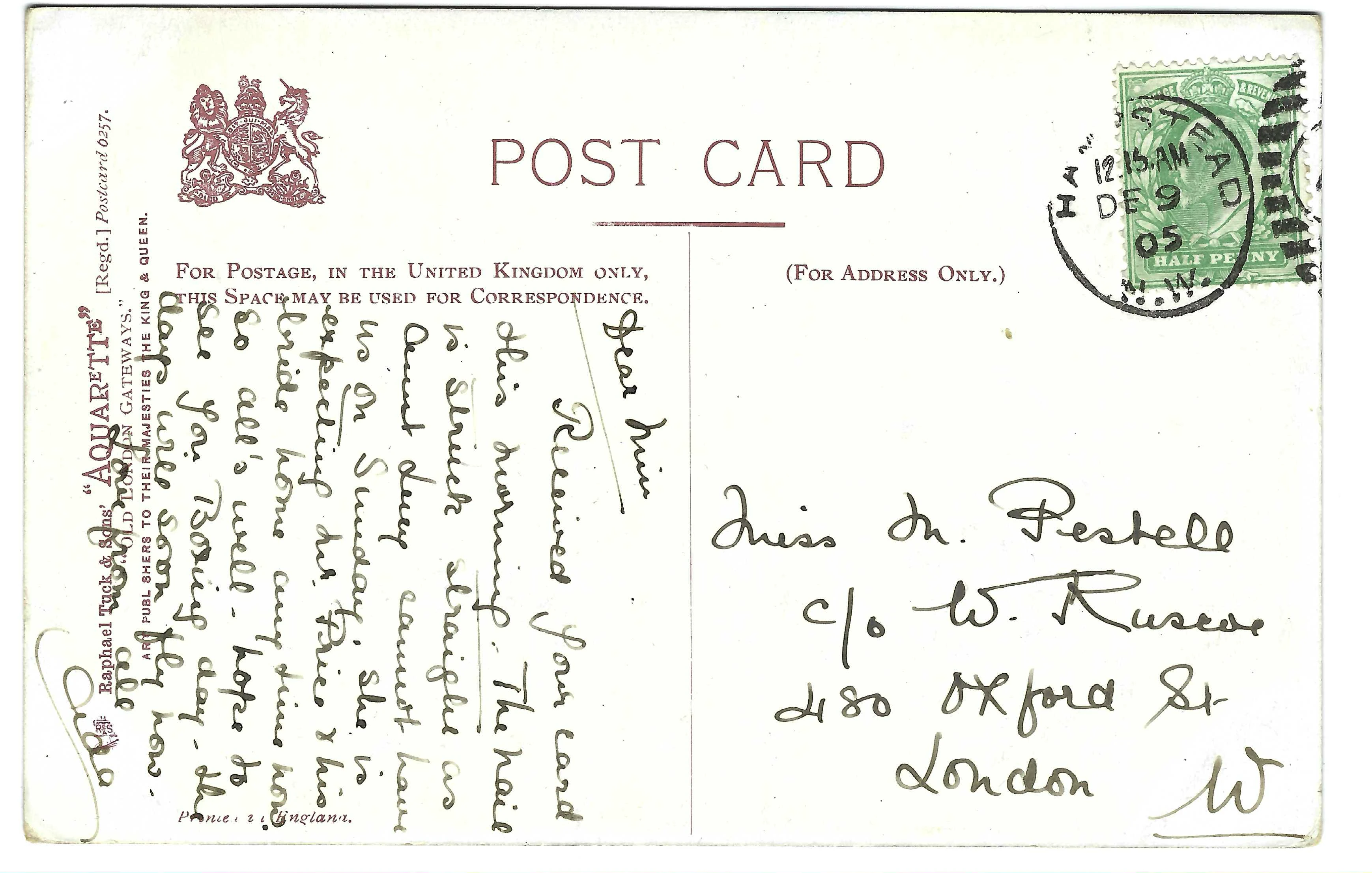
The reverse is divided by a thin vertical rule into two fields, in accordance with the divided-back postcard format then current in Britain: the left-hand field for correspondence, the right-hand field reserved "For Address Only."
Printed at the top center, in carmine ink, is the royal coat of arms of the United Kingdom (lion and unicorn supporters, with motto scrolls), above the word:
POST CARD
Beneath the address panel is printed:
(FOR ADDRESS ONLY.)
Along the left margin, printed vertically, is the publisher's imprint:
Raphael Tuck & Sons' "AQUARETTE" [Regd.] Postcard 0257.
"OLD LONDON GATEWAYS."
ART PUBLISHERS TO THEIR MAJESTIES THE KING & QUEEN.
Printed in England.
Beneath the horizontal rule, printed instructions read:
FOR POSTAGE, IN THE UNITED KINGDOM ONLY, THIS SPACE MAY BE USED FOR CORRESPONDENCE.
The correspondence field is filled with a handwritten message in ink, beginning "Dear Miss —," acknowledging receipt of a card and continuing with several lines of personal news, closing with a signature at the lower left.
The address field bears the recipient's name and address, written in a different, more legible hand:
Miss M. Restell
c/o W. Russell
180 Oxford St.
London W.
In the upper right corner is affixed a green King Edward VII half-penny postage stamp, cancelled by a circular date-stamp reading:
[London] N.W. — 12.15 AM — DE 9 05
Dating the Postcard
The postmark provides a firm date for the card's use: it was posted on 9 December 1905 from a north-western London district office, shortly after midnight. This postal cancellation establishes a secure terminus ante quem for the printing of the card itself, which must therefore date from 1905 or earlier. Given that Raphael Tuck & Sons' "Aquarette" series and its "Old London Gateways" subseries belong to the firm's output of the mid-1900s — contemporary with, though distinct from, the better-documented "Oilette" line — a publication date in the range of circa 1903–1905 is most consistent with the available evidence.
The most reliable indicator for the terminus post quem for the card is the statement on the publisher's imprint, "Art Publishers to Their Majesties the King & Queen." This particular royal warrant was employed during the reigns of successive monarchs, and only following the death of Queen Victoria in 1901. The similar "Old London Gateways" series card by the same artist and publisher, Entrance to Lincolns Inn, has been dated to about 1902 by the Museum of Fine Arts, Boston.
This provides the main chronological window:
- The earliest possible date is after 22 January 1901, which aligns with the death of the Queen Victoria and following reign of King Edward VII (1901-1910).
- The latest possible date it determined by the post cancellation on 9 December 1905.
Condition
The card is in good, legible condition consistent with postal use and an age of over a century. The recto retains bright, well-preserved color and sharp printing detail. The reverse shows light overall toning of the card stock, expected foxing consistent with age, and a corner crease. The postage stamp and postmark are clear and fully legible. The handwritten message and address remain legible throughout, though portions of the correspondence are written in a rapid cursive hand that resists full transcription.
Together, the recto and verso of this postcard preserve both an artist's record of one of the City of London's most historic surviving gateways and a small fragment of Edwardian everyday correspondence — a reminder that such "view cards" served simultaneously as inexpensive art reproductions and as the ordinary currency of daily written communication in the years before the telephone became commonplace.
The Henry VIII Gateway of St Bartholomew's Hospital
The gateway depicted on this card is the historic public entrance to St Bartholomew's Hospital at West Smithfield, in the City of London. The hospital was founded in 1123 by Rahere, a courtier of King Henry I, as part of an Augustinian priory dedicated to St Bartholomew. Following the dissolution of the monasteries, the hospital was refounded by King Henry VIII in December 1546, under an agreement granting it to the Corporation of London — a debt of gratitude later commemorated by the statue of the king set above the main gate, traditionally said to be the only public statue of Henry VIII surviving in London.
The governors of St Bartholomew’s decided in 1701 that the north gate required rebuilding. By 1702, they had struck a deal with John Strong, a junior mason from the celebrated Strong family (who were at that very time labouring alongside Sir Christopher Wren at St Paul’s Cathedral), to erect a splendid new gatehouse for the handsome fee of £550.
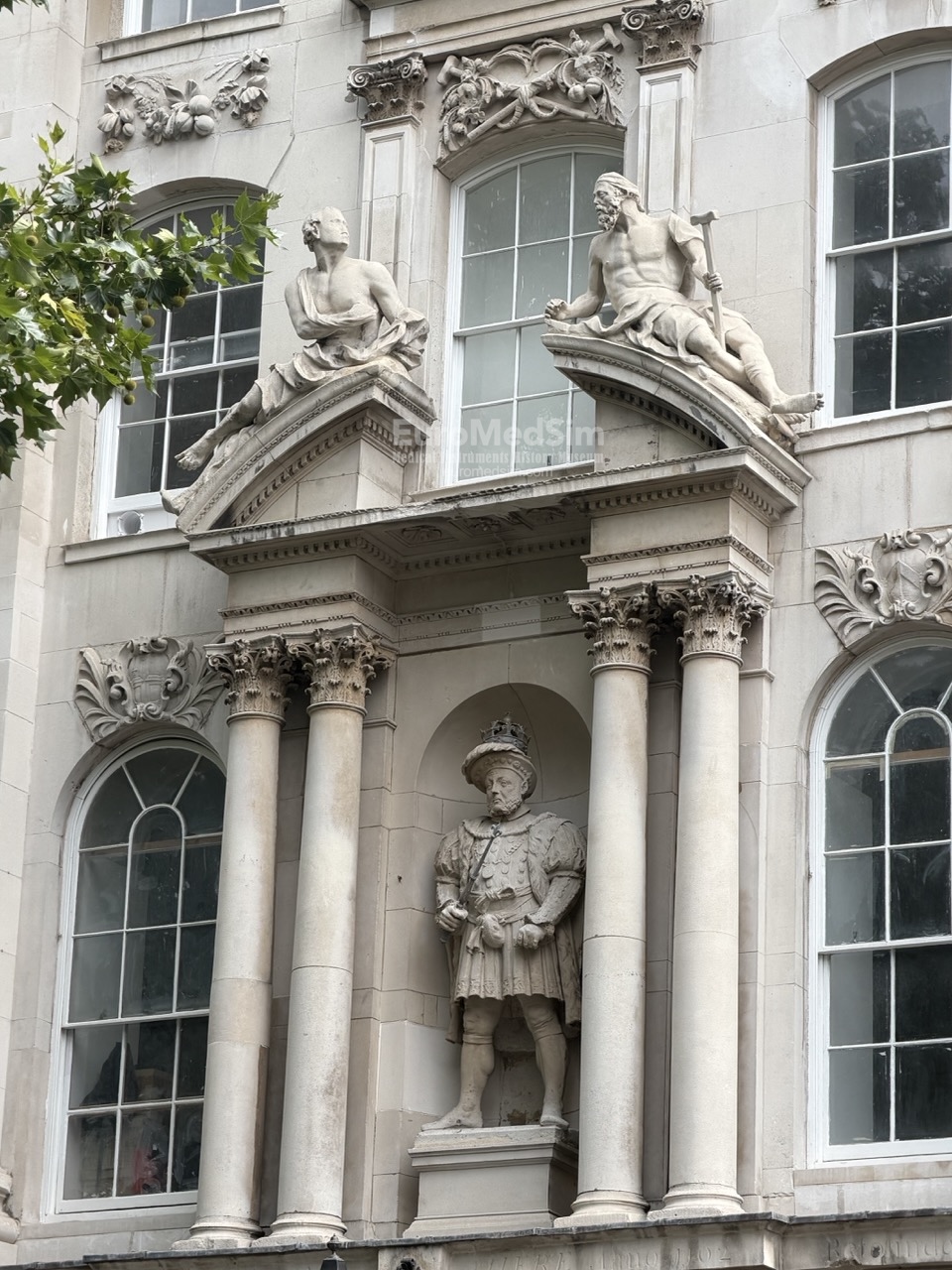
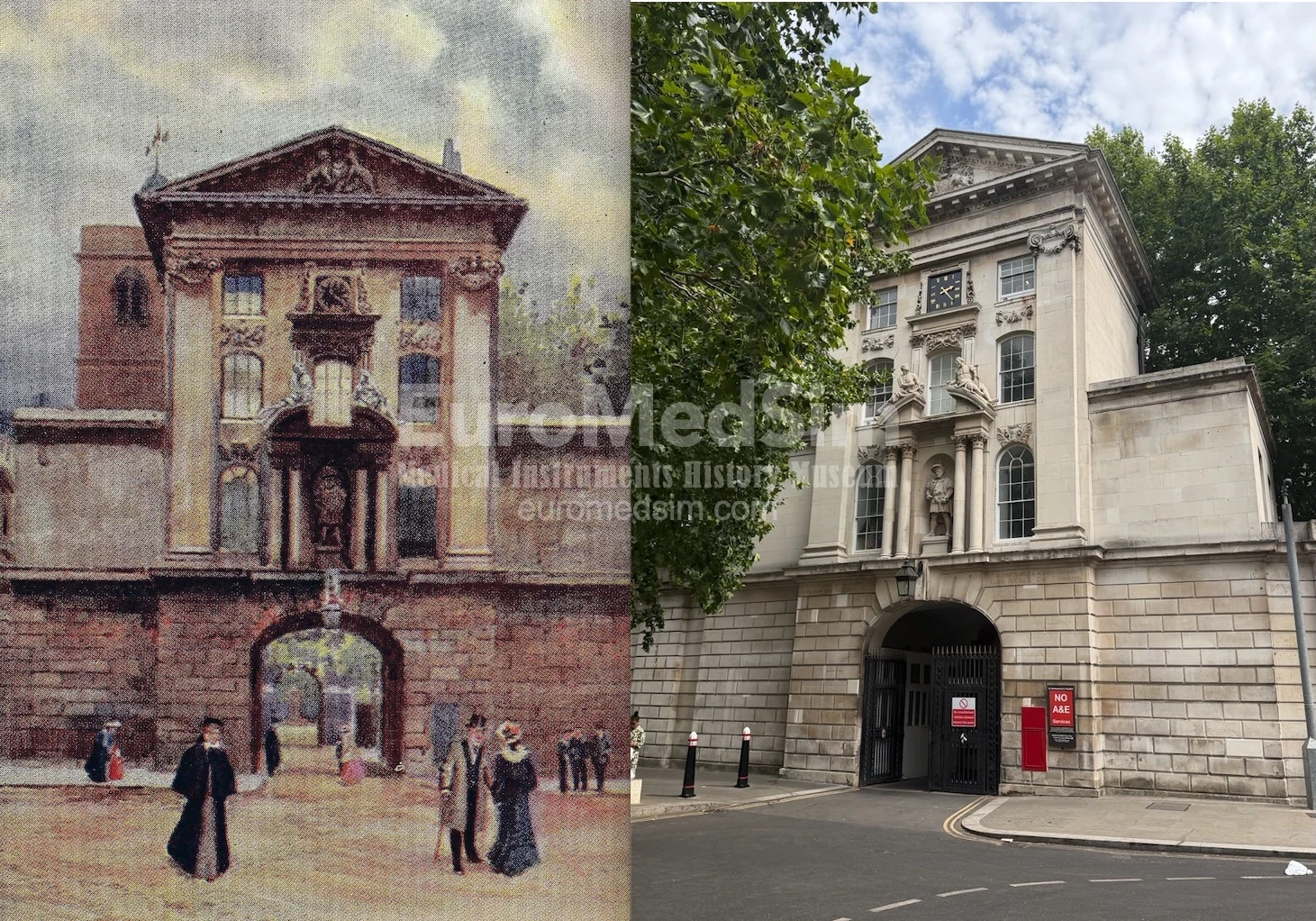
The gateway of the historic public entrance to St Bartholomew's Hospital at West Smithfield was designed in 1702. The statue of the King Henry VIII, who refounded the hospital in December 1546, stands in a niche above the arch.
The gatehouse itself stands at the western edge of the hospital precinct, adjoining the churchyard of St Bartholomew-the-Less. Its present form — the rusticated arch and pedimented upper storey shown on the postcard — dates largely from a rebuilding of 1702, though it incorporates earlier fabric associated with the medieval priory gate. Beyond the gateway lies the hospital's principal courtyard, laid out by the architect James Gibbs in the 1730s and enclosed by ranges of the same period, of which the Great Hall — famous for its staircase paintings by William Hogarth — forms part.
The gateway is composed of a rusticated stone archway at ground level, surmounted by a pedimented upper storey carried on paired Corinthian pilasters. Within the pediment a heraldic device is set in relief, flanked by decorative strapwork. Below the pediment, in a canopied niche above the arch, stands a carved figure occupying the place traditionally given to the statue of the King Henry VIII. As mentioned earlier, it features the only public outdoor statue of King Henry VIII in London, placed above the main arch to honour him for re-founding the hospital in 1546.
Either side of the gateway a low brick precinct wall extends toward the edges of the composition, punctuated by a corner turret at the left that suggests the adjoining line of St Bartholomew-the-Less. Sash windows with divided lights are set into the gatehouse's upper facade, and a mansard roof with a single chimney rises behind the pediment.
Raphael Tuck & Sons and the "Aquarette" Series
Raphael Tuck & Sons, styled "Art Publishers to Their Majesties the King and Queen," was among the most prolific and commercially successful postcard publishers of the late Victorian and Edwardian eras. Alongside its celebrated "Oilette" line — miniature reproductions imitating oil paintings, with a characteristic textured, canvas-like finish — the firm issued the "Aquarette" series, in which original watercolour-style paintings were reproduced by chromolithography in softer, more translucent tones appropriate to the medium being imitated.
The "Old London Gateways" subseries, of which the present card (No. 0257) formed part, depicted surviving historic gates, gatehouses, and entrances of the City of London, painted by the topographical artist Charles E. Flower (1871–1951), one of Tuck's most prolific contributors, who produced several hundred such views over his career for the firm.
Reference
Ann Robey, ed., St Bartholomew’s Hospital: 900 Years (Barts Heritage, 2025)