St Thomas's Hospital — Postcard sent on July 23, 1914: the day of the ultimatum to Serbia
St. Thomas’s Hospital, London, Postcard
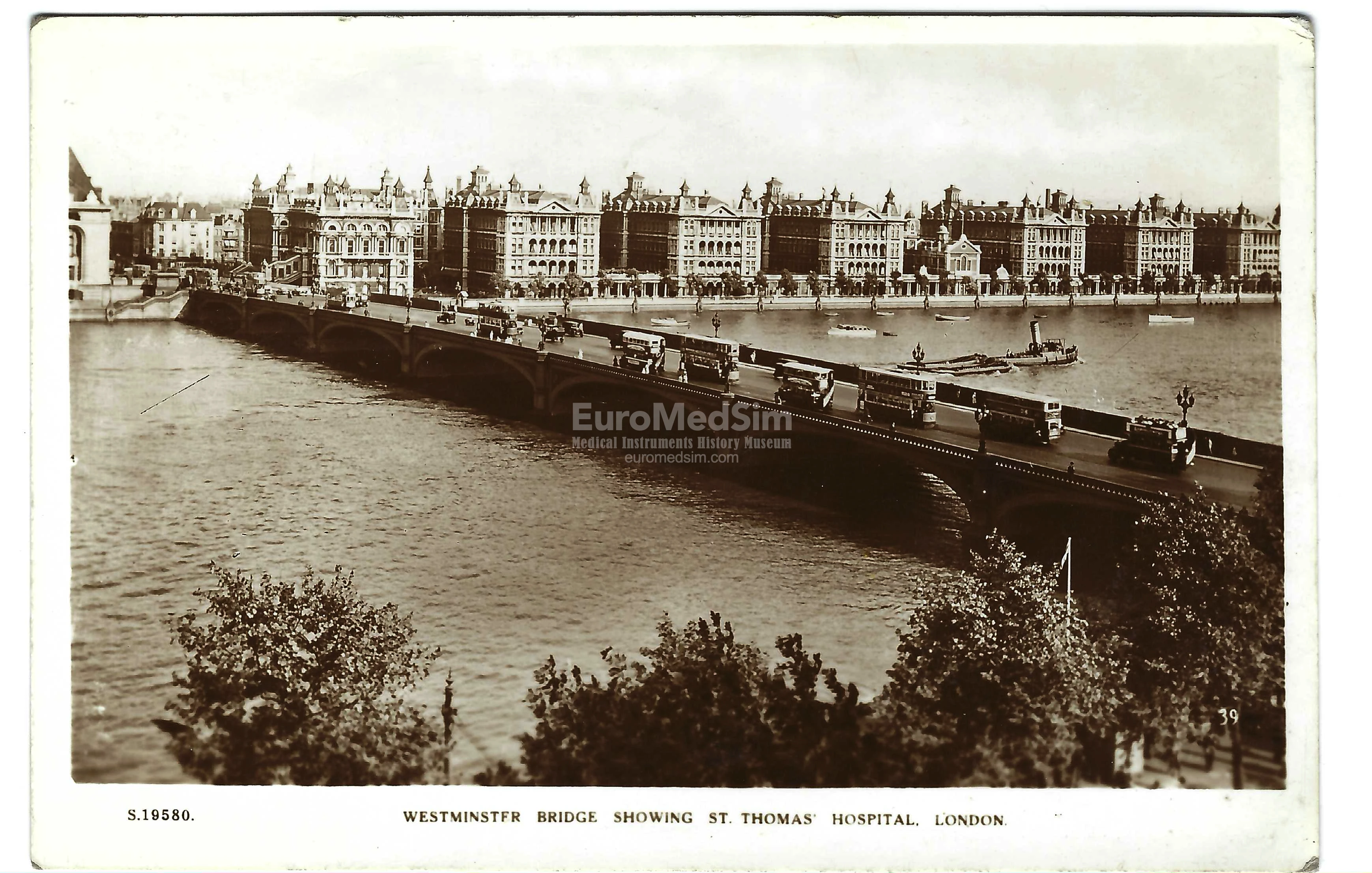
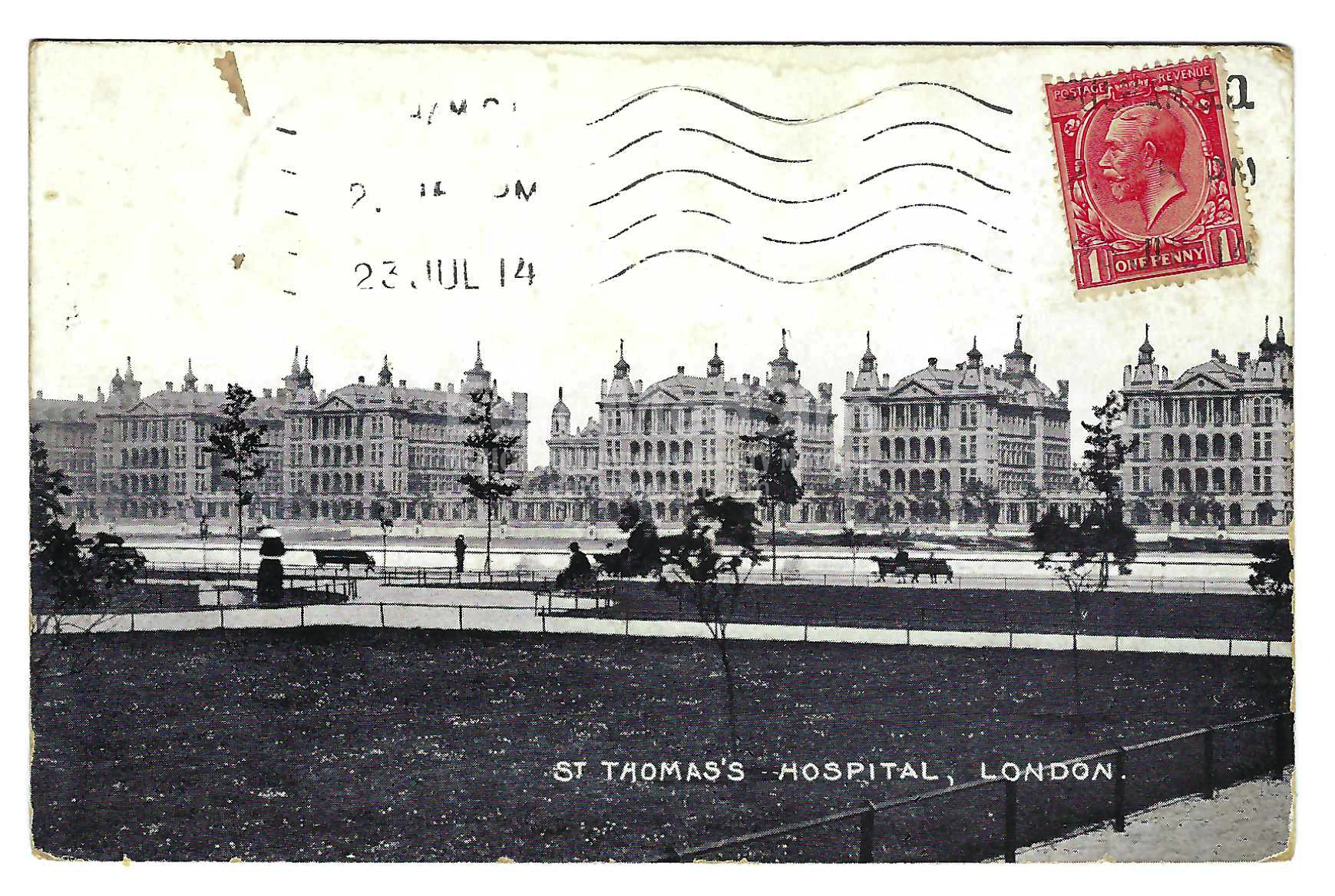
Black-and-white photographic postcard showing the historic riverside buildings of St. Thomas’s Hospital in London, viewed across the River Thames from the Westminster side, c. 1910–1914; postally used 23 July 1914. The postcard was published by W. Straker Ltd., London. The printed title on the front reads:
ST THOMAS’S HOSPITAL, LONDON
The British postal cancellation on the front is dated 23 JUL 14. The card was addressed to Bessines in the French département of Haute-Vienne and bears a French receiving postmark apparently dated 24 July 1914. The object is particularly interesting because the postal date places an ordinary tourist postcard within an extraordinary historical moment. 23 July 1914 was the day on which Austria-Hungary delivered its ultimatum to Serbia, one of the decisive events of the July Crisis that led to the First World War. Britain formally entered the war on 4 August 1914. Nothing in the postcard itself suggests the approaching catastrophe. Its handwritten message is concerned with school prizes, the pleasure of visiting London and the hope of meeting again after the holidays. This contrast between everyday private life and the political events unfolding at precisely the same moment gives the postcard unusual documentary and emotional value.
Description of the front side — recto
The front presents a panoramic view of the nineteenth-century complex of St. Thomas’s Hospital extending along the opposite bank of the Thames. The hospital buildings form a continuous architectural rhythm across the upper half of the image. Their tall pavilion blocks, steep roofs, chimneys, small towers and lower connecting structures are clearly distinguishable. The composition demonstrates the characteristic pavilion organisation of the Victorian hospital rather than presenting St. Thomas’s as a single monumental building.
Between the hospital and the river lies the Albert Embankment, with young trees, benches, pedestrians and several vehicles or carriages visible along the riverside promenade. The Thames occupies much of the foreground, creating a broad horizontal separation between the viewer and the hospital. The photograph appears to have been taken from the Westminster side of the river, looking east or south-east towards Lambeth. The elevated riverside façade of St. Thomas’s dominates the view and illustrates how conspicuous the hospital complex was within the monumental landscape around Westminster.
Printed near the lower centre of the photograph in white capital letters is the title:
ST THOMAS’S HOSPITAL, LONDON.
A red One Penny “Postage & Revenue” stamp bearing the portrait of King George V is affixed unusually to the upper right corner of the picture side rather than in the printed stamp box on the reverse.
The stamp is cancelled by a London machine postmark extending across the sky with horizontal wavy lines. The date is clearly readable as:
23 JUL 14
The time designation is only partly legible. The placement of the stamp and cancellation directly over the photographic image transforms the recto from a simple topographical view into a visible record of the postcard’s actual journey.
Description of the reverse side — verso
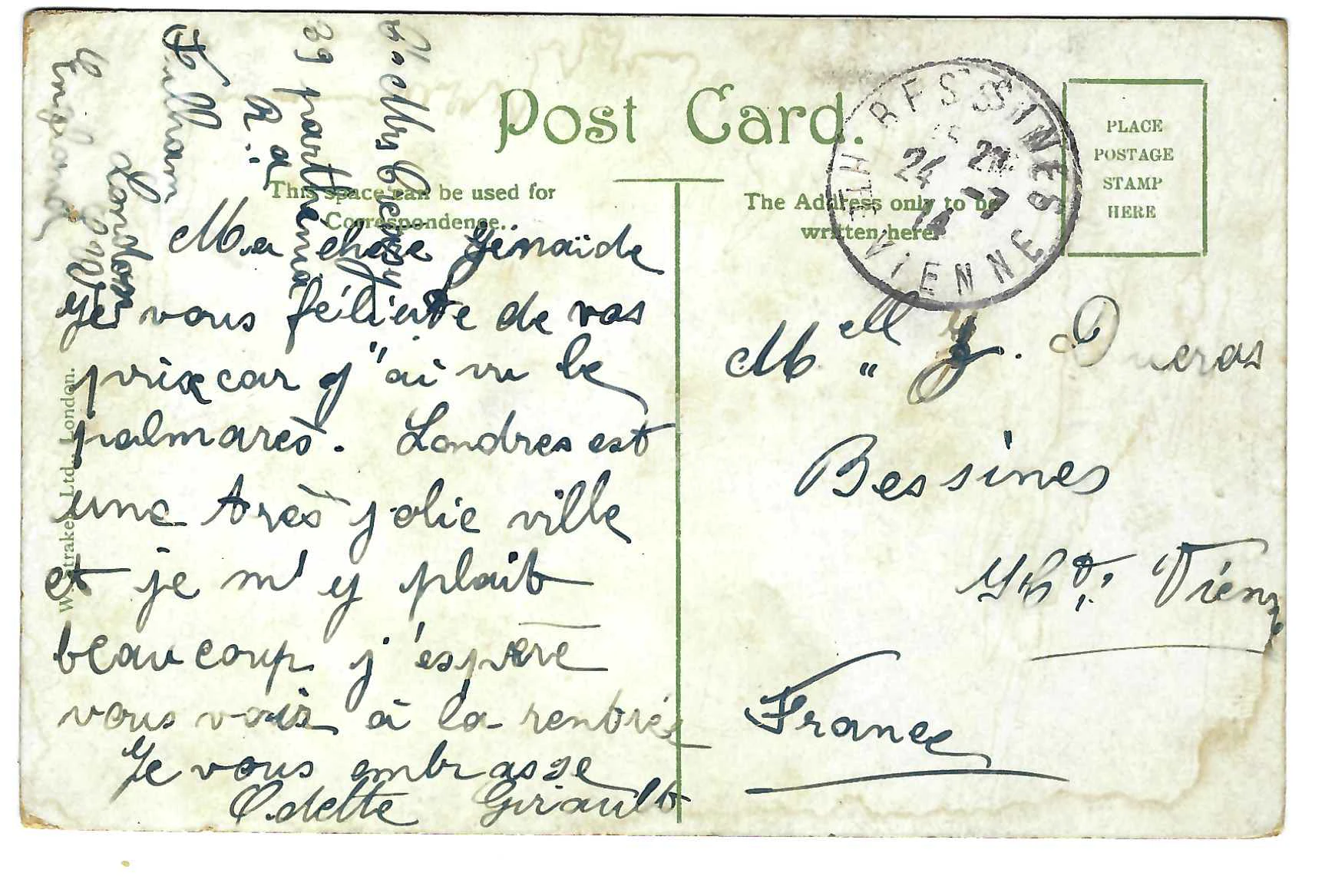
The reverse has the conventional divided-back format of an early twentieth-century postcard, printed in pale green ink.
At the top appears the heading:
Post Card
The left-hand section is designated for the message and bears the printed instruction:
This space can be used for Correspondence.
The right-hand section is reserved for the address:
The Address only to be written here.
In the upper right corner is a rectangular frame marked:
PLACE POSTAGE STAMP HERE.
Interestingly, this box remains empty because the sender placed the postage stamp on the photographic side of the postcard.
Along the left edge is the publisher’s imprint:
W. Straker Ltd., London.
W. Straker was an established London publisher and stationer whose photographic and topographical postcards survive in several institutional collections. The British Museum, for example, catalogues a London postcard published by W. Straker, while Historic England records W. Straker postcards from the early twentieth century.
The reverse is extensively handwritten in French. The destination is:
Bessines
Hte Vienne
France
The circular French receiving postmark also reads BESSINES / HTE-VIENNE. The date appears to be 24 July 1914, suggesting that the postcard reached its destination approximately one day after being posted in London.
The abbreviated address “Bessines, Hte Vienne” is historically appropriate. The commune was still officially known simply as Bessines in 1914; the name "Bessines-sur-Gartempe" was formally adopted only in 1919.
The French handwritten message is largely legible. A probable transcription is:
Ma chère Germaine,
Je vous félicite de vos prix car j’ai vu le palmarès. Londres est une très jolie ville et je m’y plaît beaucoup. J’espère vous voir à la rentrée. Je vous embrasse.
Odette Giraud
Some elements of the names are difficult to read with complete certainty and should therefore be treated as a probable rather than definitive transcription. An English translation would be: "My dear Germaine, Congratulations on your prizes, as I have seen the prize list. London is a very pretty city and I like it very much. I hope to see you when school resumes. With love, Odette Giraud."
The reference to the palmarès is particularly characteristic of French educational culture of the period. In this context the term refers to the published or announced list of pupils receiving prizes or distinctions at the end of the academic year. The message therefore appears to have been written during a summer visit to London by a French-speaking sender shortly after the end of the school year.
Dating the Postcard
Unlike an unused postcard that must be dated by its photographic style, publisher or printing technique, this example provides direct postal evidence. The London cancellation gives a secure terminus ante quem of 23 July 1914: the card must have been printed and purchased no later than that date. The one-penny stamp is also consistent with international postcard postage. The British foreign postcard rate had been fixed at 1 penny from 1 October 1891, remaining at that level until 1921.
W. Straker Ltd., London
The publisher’s name is printed vertically on the reverse as W. Straker Ltd., London. W. Straker was active in the London stationery, printing and postcard trade during the early twentieth century. Surviving examples include photographic and halftone views of major London landmarks. Historic England records a W. Straker postcard of Kensington Gardens dated approximately 1900–1910, while the British Museum holds a W. Straker view of the British Museum attributed to around 1920. These examples show that W. Straker was producing and distributing London topographical postcards across the period in which the present St. Thomas’s Hospital card was mailed. No photographer’s name or specific series title is visible on this card, and an attribution to a particular photographer should therefore not be made without additional evidence.
St. Thomas’s Hospital and the Pavilion Plan
The buildings represented on the postcard belong to the great Victorian St. Thomas’s Hospital complex constructed on the Lambeth bank of the Thames. The hospital had left its historic Southwark site in 1862 after the property was required for railway expansion. New buildings were subsequently constructed opposite the Palace of Westminster. Queen Victoria laid the foundation stone in 1868 and formally opened the new hospital in 1871.
The complex was designed by architect Henry Currey according to the pavilion principle that had become central to nineteenth-century hospital reform. Six principal ward pavilions were separated from one another and connected by lower corridors. The arrangement was intended to improve ventilation and allow greater separation between groups of patients. Florence Nightingale was one of the most influential advocates of this approach to hospital architecture and hygiene. The postcard also belongs to the history of professional nursing. St. Thomas’s was the institution in which Florence Nightingale established the Nightingale Training School for Nurses in 1860, helping to make the institution internationally important in the development of systematic nurse education — the Florence Nightingale Museum can be found today at the site of the hospital.
The broader architectural composition is sometimes described as seven principal blocks when the administrative elements of the complex are included alongside the six ward pavilions. This explains why historical descriptions of St. Thomas’s occasionally refer to either six pavilions or seven buildings. The postcard shows this pavilion system particularly clearly. The repeated blocks and the spaces between them can be understood as an architectural system rather than simply as a decorative river frontage.
St. Thomas’s Hospital on the Eve of the First World War
The date of the postcard gives the hospital view an additional historical significance. The card left London on 23 July 1914. On that same day Austria-Hungary presented its ultimatum to Serbia. Austria-Hungary declared war on Serbia on 28 July, and Britain entered the European conflict on 4 August. Later in 1914, St. Thomas’s Hospital was requisitioned for military purposes as the 5th London General Hospital. Additional accommodation was created on the site for military casualties.
The postcard therefore records the hospital at the very end of its pre-war existence. When the sender wrote enthusiastically that “London is a very pretty city and I like it very much,” neither the wording nor the image gives any indication of how profoundly the lives of Londoners, the hospital and the recipient’s own country would change within the following weeks. This precise coincidence between postal history and European history is one of the most important features of the object.
Condition
The postcard is in satisfactory to good condition for a postally used object of its age. The photographic front retains considerable architectural detail, although the image shows moderate age-related fading, surface wear and reduced contrast. Minor abrasions and areas of soiling are visible, particularly near the upper left edge. The corners and edges show handling wear consistent with postal use.
The red one-penny stamp remains well preserved and its portrait and denomination are clearly legible. The machine cancellation is somewhat faded but the essential date 23 JUL 14 remains readable.
The reverse shows general age toning, scattered staining and handling marks. More pronounced discoloration is visible near the lower and right-hand edges. The handwritten French message remains substantially legible. The French receiving postmark is partly superimposed on the printed postal instructions but can still be identified as originating from Bessines, Haute-Vienne.
Despite its signs of use, the postcard preserves all of its principal documentary elements: photographic image, publisher’s imprint, postage stamp, British dispatch cancellation, French receiving cancellation, address and personal correspondence.