Westminster Bridge and St. Thomas’ Hospital in London
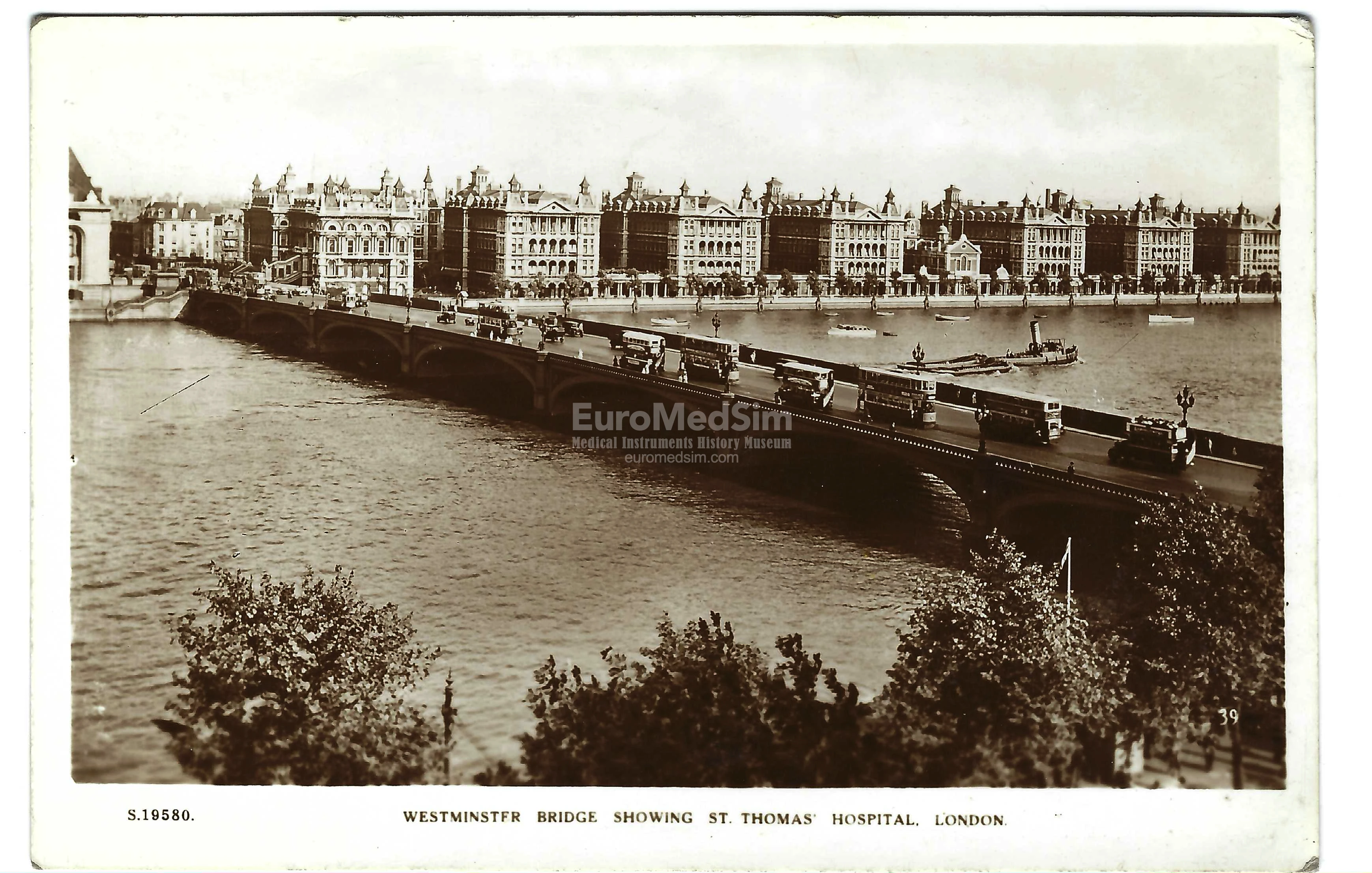
Westminster Bridge and St. Thomas’ Hospital in London, Scenic photographic postcard, presumably from the 1930s. Original title: Westminster Bridge showing St. Thomas’ Hospital, London. Series: Bridge House Real Photo Series (1930s–1940) by publisher W. H. Smith & Son, London. Catalog number: S.19580, image number: 39. Material and technique: cardboard; black-and-white photographic print with a warm brownish tone; letterpress printing on the reverse side. Language: English. Postal use: the postcard was not mailed; no stamp, postmark, address, or personal message is present. Size: 8.9 × 13.7 cm — practically the standard British size for scenic postcards from the first half of the 20th century: 3½ × 5½ inches, or approximately 8.9 × 14.0 cm.
Description of the front side — recto
The front side features a panoramic view of Westminster Bridge across the Thames and the sprawling complex of St. Thomas’ Hospital, located on the south bank of the river.
The photograph was taken from a high vantage point on the Westminster side of the Thames, from the area around the Palace of Westminster. The bridge cuts diagonally across the image: starting from the lower right corner of the frame, it extends toward the opposite bank. This composition allows the photographer to simultaneously capture the bridge’s structure, traffic on it, the river, and nearly the entire historic facade of the hospital.
There is bustling city traffic on the bridge. Numerous double-decker London buses, passenger cars, and individual pedestrians are clearly visible. The buses are traveling in both directions, creating a traffic scene characteristic of central London during the interwar period. Decorative lanterns in the Neo-Gothic style are mounted along the parapet. Their design was coordinated with the architecture of the nearby Palace of Westminster. A small steam tugboat or river workboat is visible on the Thames, next to which is a long, low barge. Closer to the opposite bank, several small boats are visible. The water surface occupies a significant portion of the composition and emphasizes the hospital’s location directly on the embankment.
In the background is the original St. Thomas’ Hospital complex. Its buildings form a long, regular line along Albert Embankment. They share a similar architectural style: tall rectangular facades, arched windows, corner turrets, steep hipped roofs, decorative spires, and numerous chimneys. Lower connecting galleries are visible between the individual hospital wings. In the photograph, the complex still retains its nearly intact pre-war appearance. It is precisely this feature that gives the postcard its special documentary value: some of the hospital buildings depicted were destroyed during the bombings of World War II.
The caption is printed in the lower white frame:
S.19580. WESTMINSTER BRIDGE SHOWING ST. THOMAS’ HOSPITAL, LONDON.
In the lower right corner of the photograph itself is a small number:
39
Most likely, this is the negative number or the image number within the publisher’s series.
Description of the reverse side — verso
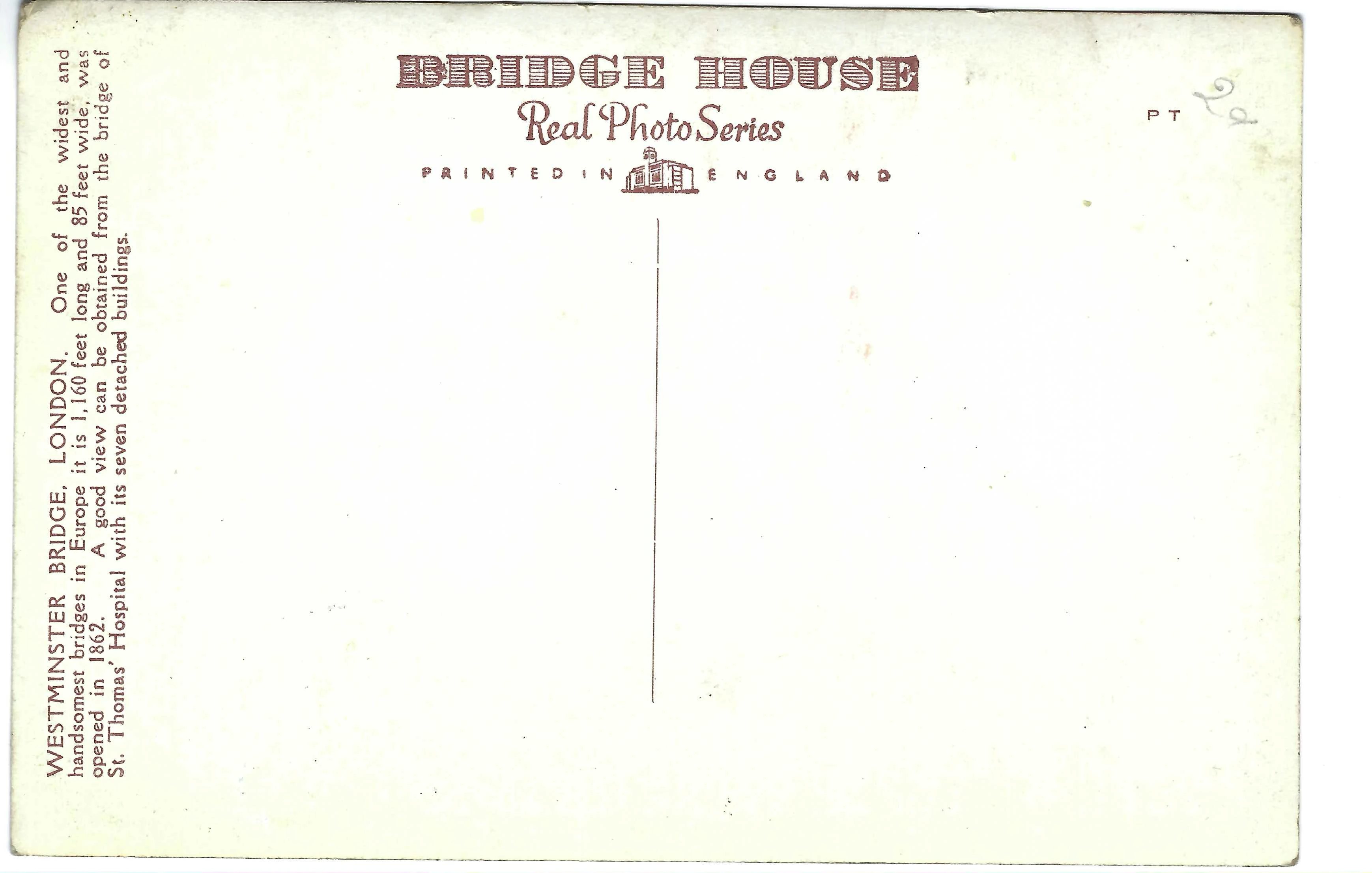
The reverse side is divided into two parts by a thin vertical line: the left section was intended for a message, and the right section for the address and postage stamp. The postcard was not filled out and was never mailed.
A vertical description of the image is printed along the left edge of the card: "WESTMINSTER BRIDGE, LONDON. One of the widest and handsomest bridges in Europe it is 1,160 feet long and 85 feet wide, was opened in 1862. A good view can be obtained from the bridge of St. Thomas' Hospital with its seven detached buildings." The words “seven detached buildings” refer to the hospital’s pavilion-style layout. The buildings were perceived as separate structures, although they were actually connected by longitudinal corridors and galleries.
In the upper center, the series name is printed in brown-red ink:
BRIDGE HOUSE
Real Photo Series
PRINTED IN ENGLAND
Between the words Printed in and England is a small logo in the shape of a building — the "Bridge House" of the publishing company W. H. Smith & Son.
In specialized postcard catalogs, the Bridge House Real Photo Series is associated with the company W. H. Smith & Son and is dated primarily to the middle 1930s–1940. The name Bridge House apparently referred to the London production division of W. H. Smith, which was engaged in the manufacture and distribution of printed materials and stationery. This attribution remains plausible, although the publisher’s full name is not printed on the postcard itself.
In the upper right corner, the letters are printed as follows:
P T
Dating the Postcard
Since the postcard was never mailed, it is impossible to determine the date based on the postmark. The estimated date is based on several indicators:
- the design of the Bridge House Real Photo Series, which is generally attributed to the 1933–1935 to September 1940 (sometimes to 1950);
- the types of buses and cars on the bridge, characteristic of interwar London;
- the intact, undamaged appearance of the St. Thomas’ Hospital complex.
In September 1940, the hospital was hit directly several times during air raids on London. The bombings continued until 1944, and by the end of the war, three hospital wings had been destroyed. Since the postcard shows the complex without any visible signs of wartime damage, the original photograph should be dated from 1933 till before September 1940. The second half of the 1930s is the most likely period, although theoretically an earlier negative could have been used for subsequent editions of the postcard.
Westminster Bridge
The modern Westminster Bridge was opened in 1862. It was designed by engineer Thomas Page. The bridge is constructed primarily of cast iron and rests on granite abutments and piers. It consists of seven gently sloping segmental spans. The Neo-Gothic railings, decorative panels, and lanterns were designed so that the bridge’s architecture would harmonize with nearby Westminster Palace. The structure currently holds Grade II* listed status.
The postcard clearly illustrates the bridge’s significance not only as an architectural monument but also as one of central London’s most important transportation arteries. The numerous buses demonstrate the intensity of traffic between Westminster and the south bank of the Thames even before World War II.
St. Thomas’ Hospital
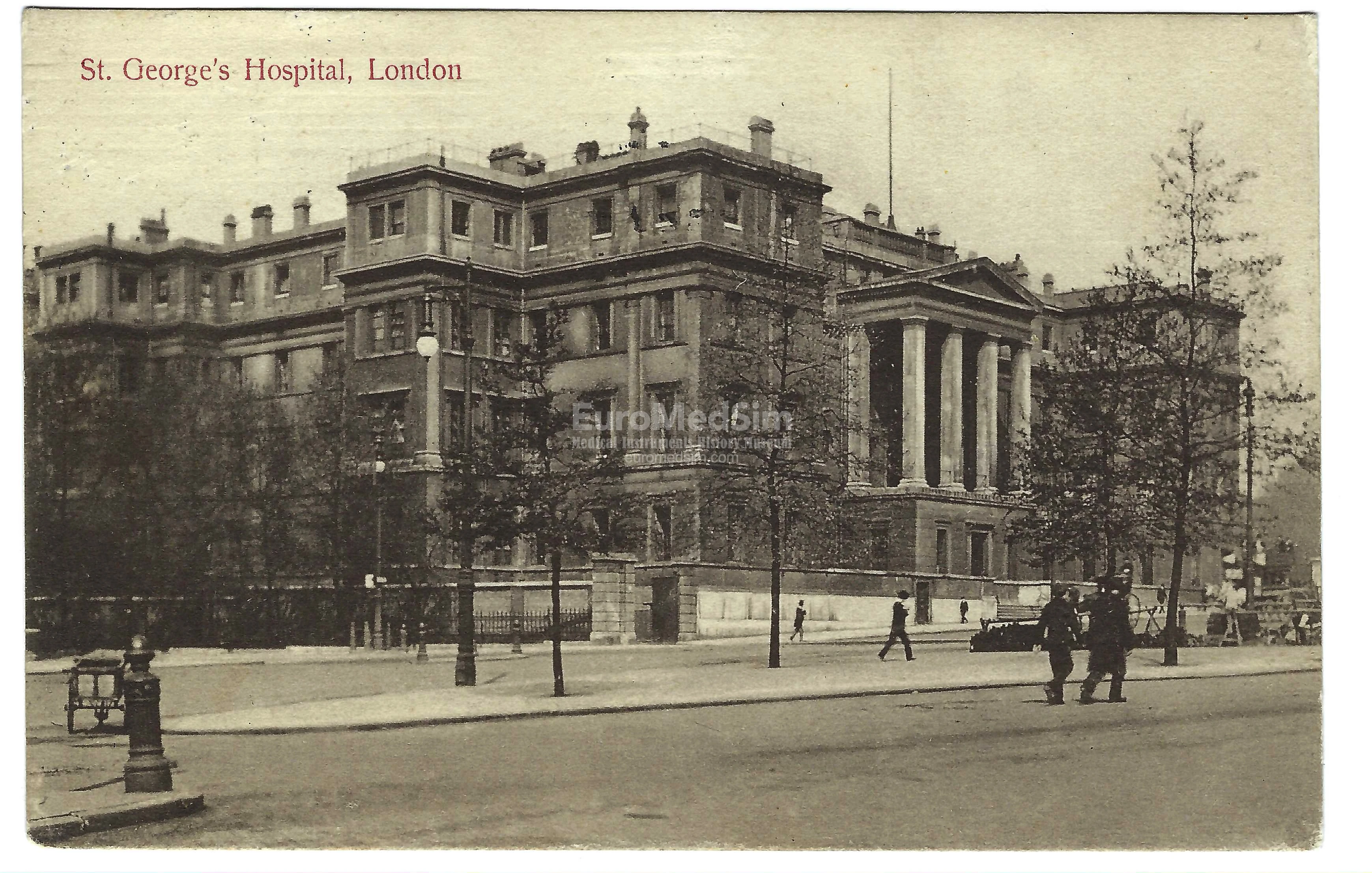
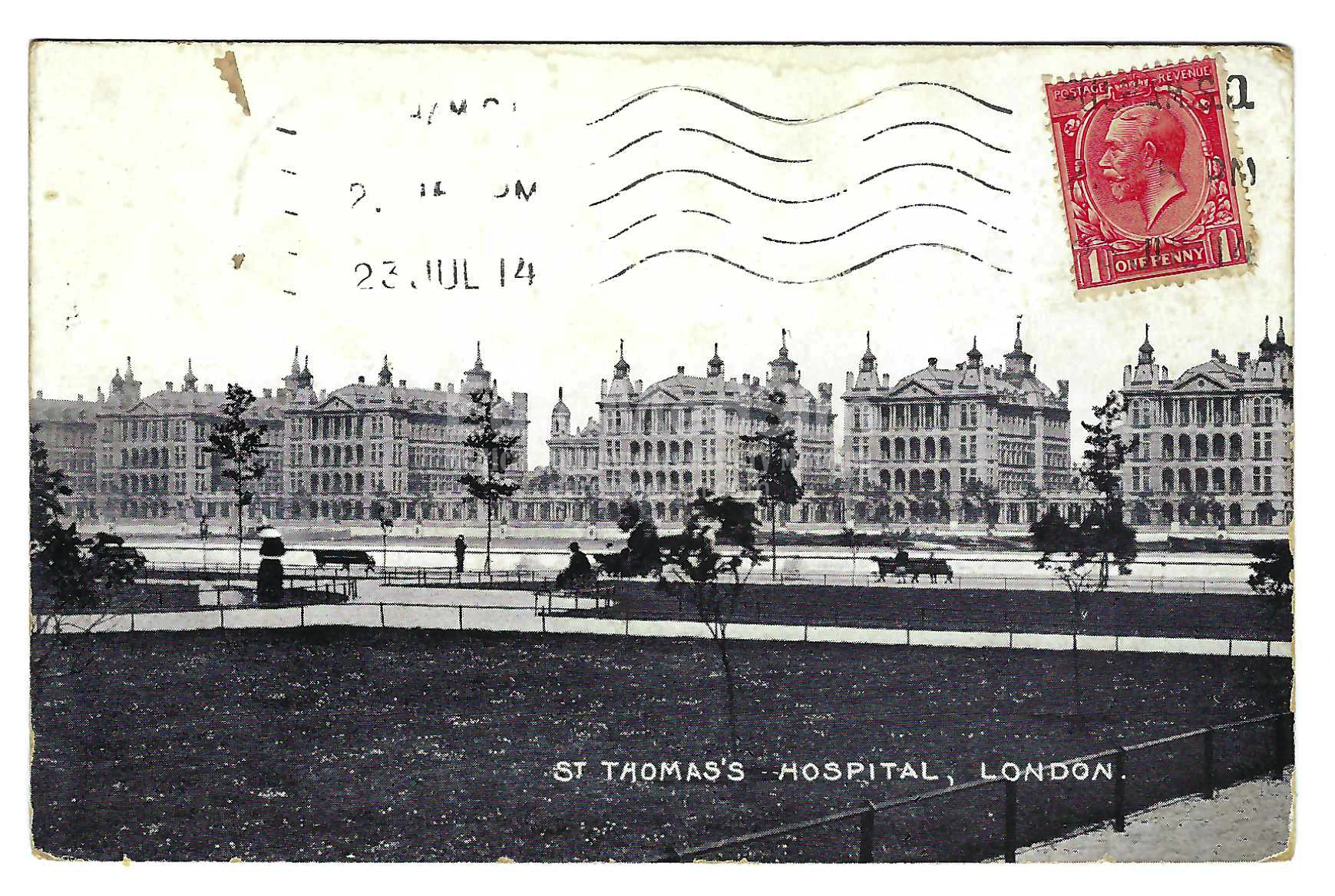
The history of St. Thomas’ Hospital dates back to the 12th century. For many centuries, it was located in Southwark, not far from London Bridge. In 1862, the old complex had to be vacated due to the construction of a railway line to Charing Cross Station. After a temporary relocation to Surrey Gardens, a new site was selected for the hospital in Lambeth—on the banks of the Thames, opposite the Palace of Westminster.
The cornerstone for the new complex was laid in 1868, and it was officially opened by Queen Victoria in 1871. The design was developed by architect Henry Currie. The original complex was an elongated, symmetrical structure facing the river. The hospital pavilions were arranged parallel to one another, with open courtyards between them. Longitudinal corridors connected the patient wards with administrative, medical, and service areas.
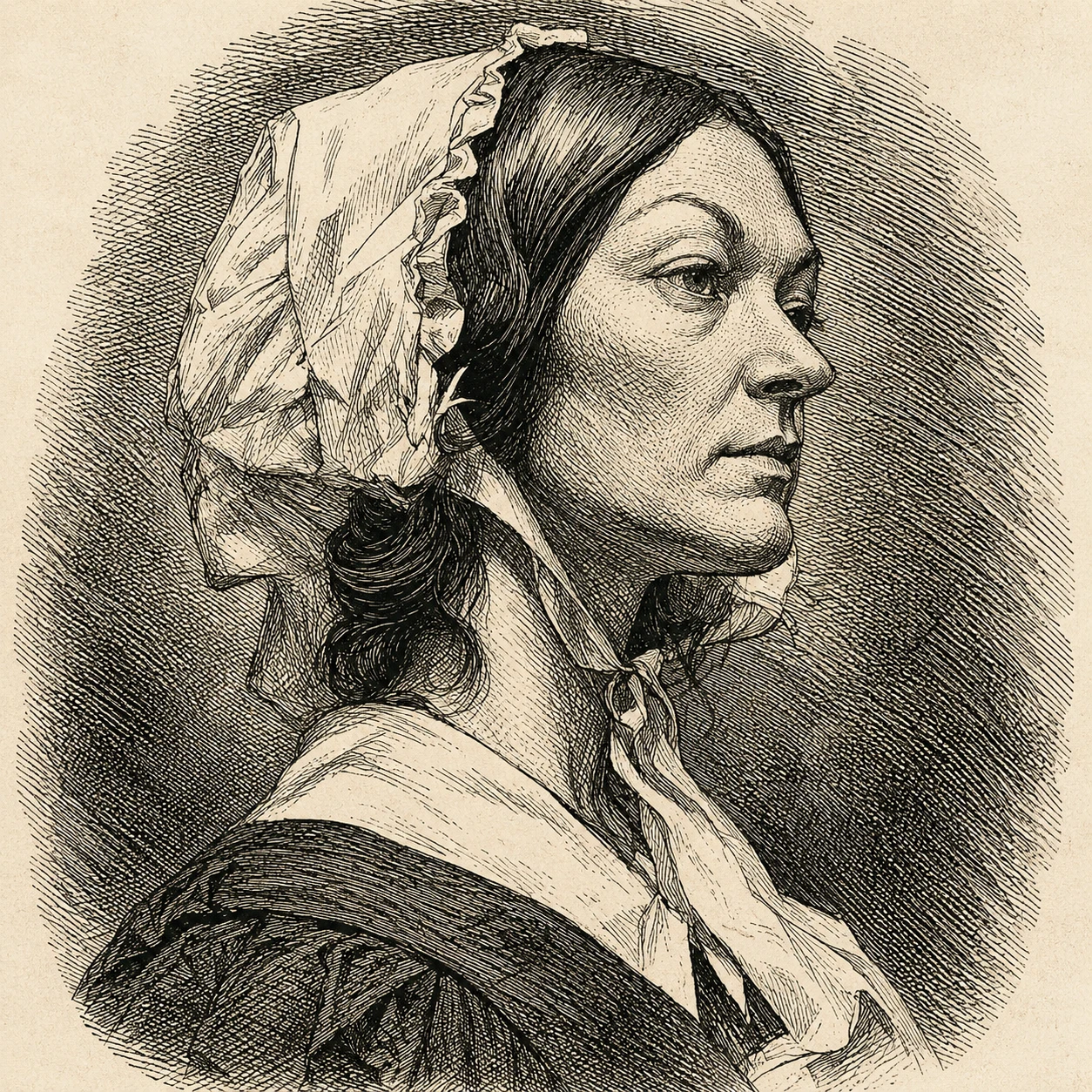
The layout of the new hospital was significantly influenced by the ideas of Florence Nightingale. She advocated for placing patient rooms in separate pavilions to ensure natural lighting, cross-ventilation, and spatial separation of patients. This structure was intended to reduce the spread of infections and improve sanitary conditions. The completed complex consisted of seven interconnected blocks and was originally designed to accommodate approximately 600 patients.
St. Thomas’ Hospital’s connection to the history of professional nursing education is particularly significant. In 1860, Florence Nightingale founded her school for the training of nurses at the hospital, which became one of the most important models of systematic nursing education.
Destruction During World War II
The hospital’s proximity to London’s government center made it particularly vulnerable during air raids. The first severe direct hit occurred on the morning of September 9, 1940; further strikes followed on September 13 and 15. The administrative building, outpatient facilities, kitchen, dining hall, pharmacy, and other parts of the complex were destroyed or damaged. Despite the destruction, the hospital continued to admit patients and the wounded throughout the war.
By the end of the war, three historic ward buildings had been destroyed. Subsequently, modern buildings were erected on the northern part of the site, and the expansive, symmetrical panorama depicted on the postcard ceased to exist in its original form. Of the seven pavilion buildings opened in 1871, only three have survived to the present day.
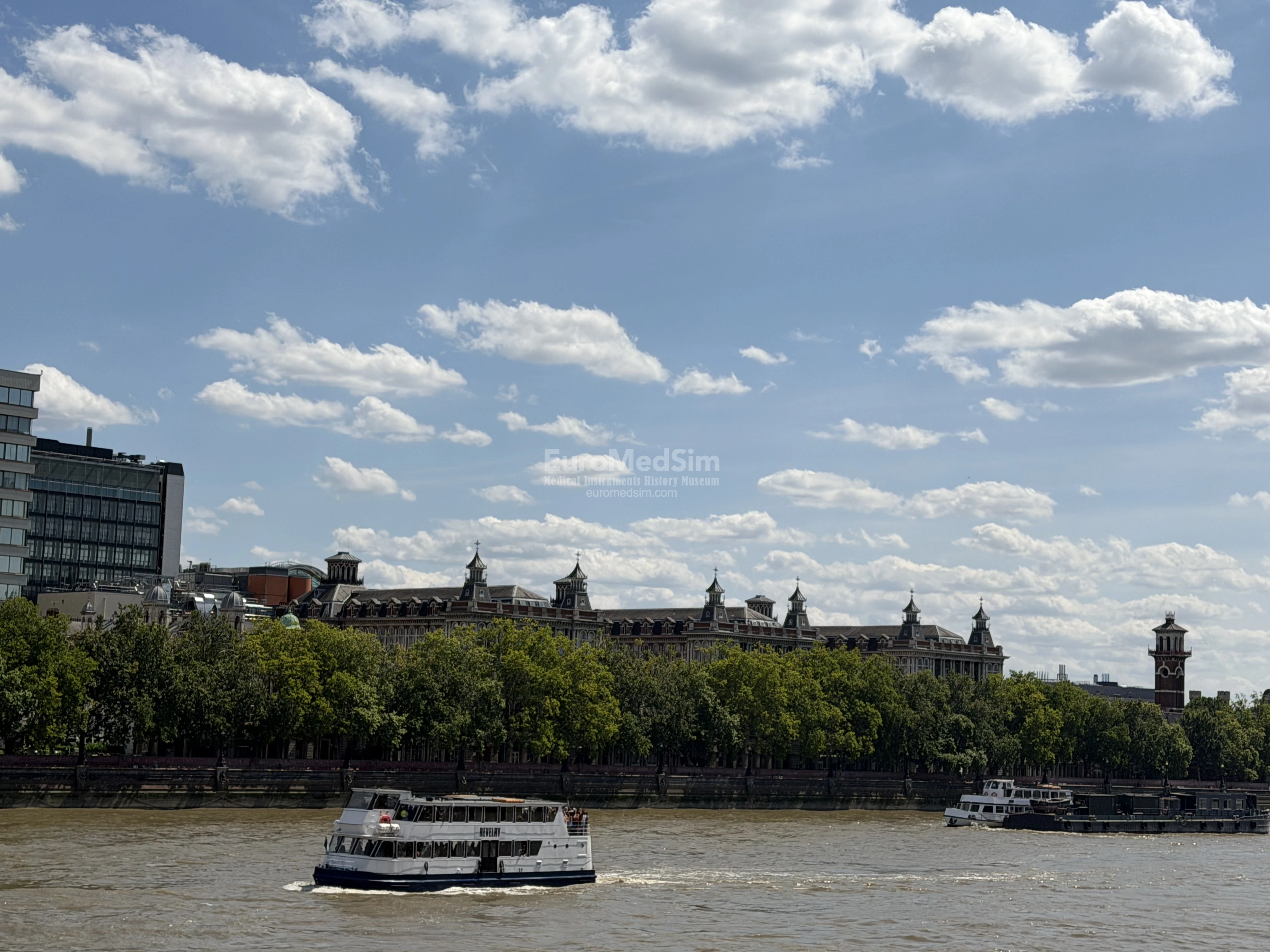
Todays view from Themes. On the right are the historic 19th-century wings; on the left are the hospital's modern buildings. Source: EuroMedSim Museum
Thus, the current postcard captures not merely an urban view, but a lost chapter in the history of one of Britain’s most important medical and educational institutions. Of particular value is the panoramic view of the hospital’s entire complex prior to the destruction of 1940–1944. It reveals the spatial organization of the facility: the repeating hospital pavilions, connecting wings, open spaces between the buildings, and the extensive riverfront façade.
Condition
The card is in good to satisfactory condition. The photograph retains a high level of detail and fairly pronounced contrast. There is moderate yellowing of the cardboard and a general warm brownish tint to the print.
There is slight wear along the edges. The right corners are more severely damaged: a small crease is visible in the upper right corner, and in the lower right corner there is a fold and partial deformation of the cardboard. On the reverse side, there are isolated small spots, faint traces of soiling, and later pencil markings. No significant tears or losses of the image are observed.