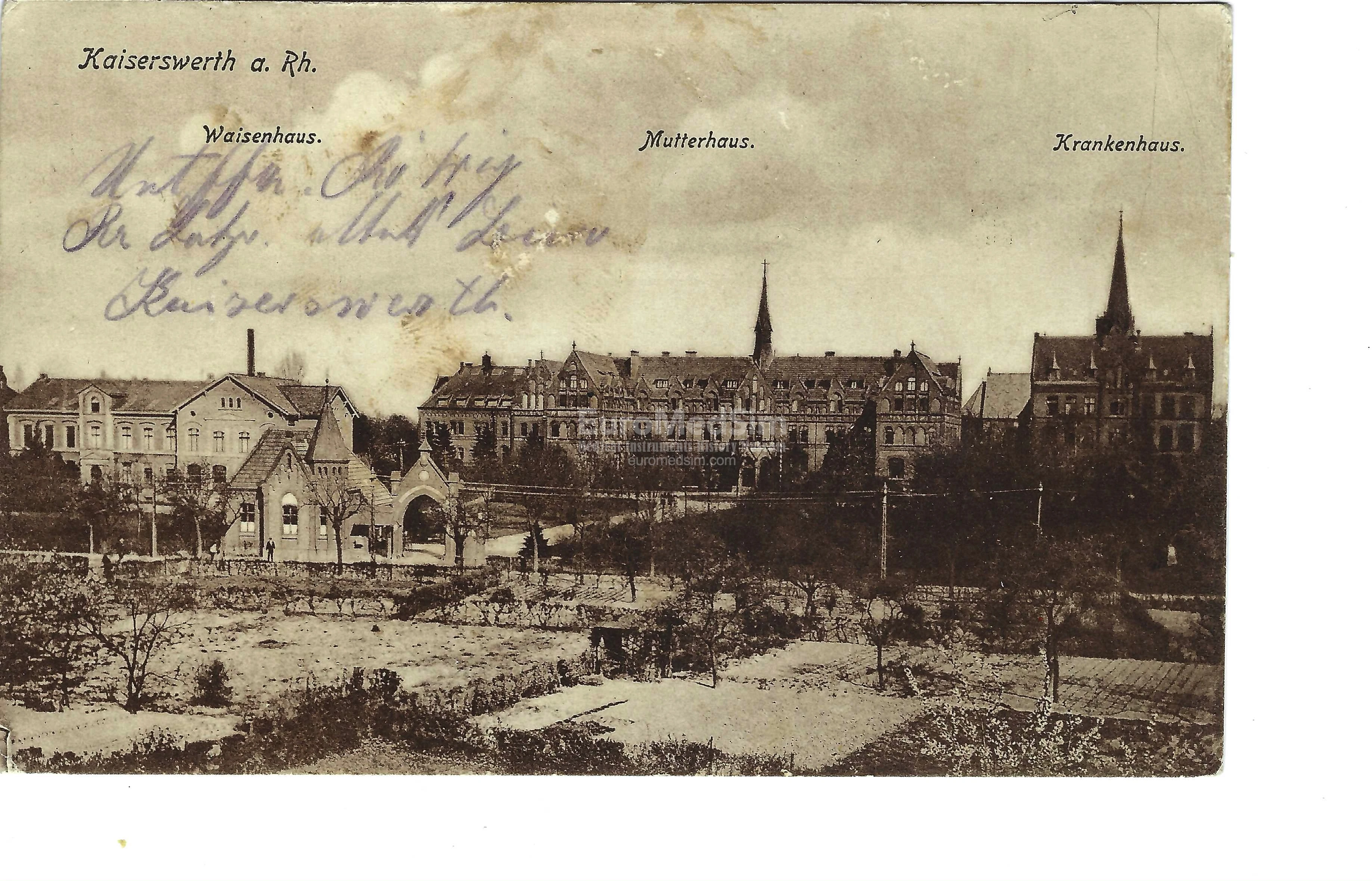
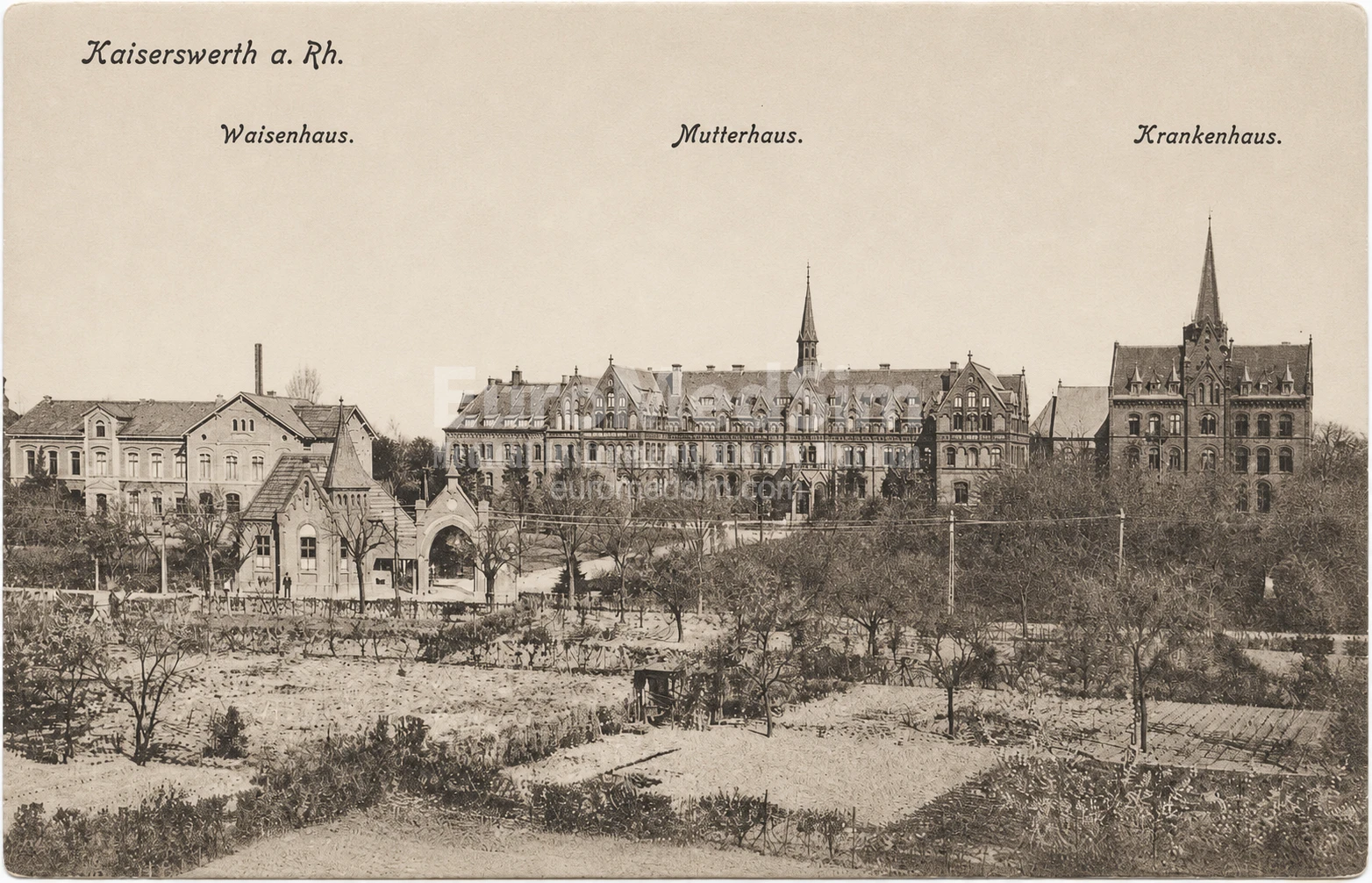
Kaiserswerth a. Rh. Weisenhaus, Mutterhaus, Krankenhaus
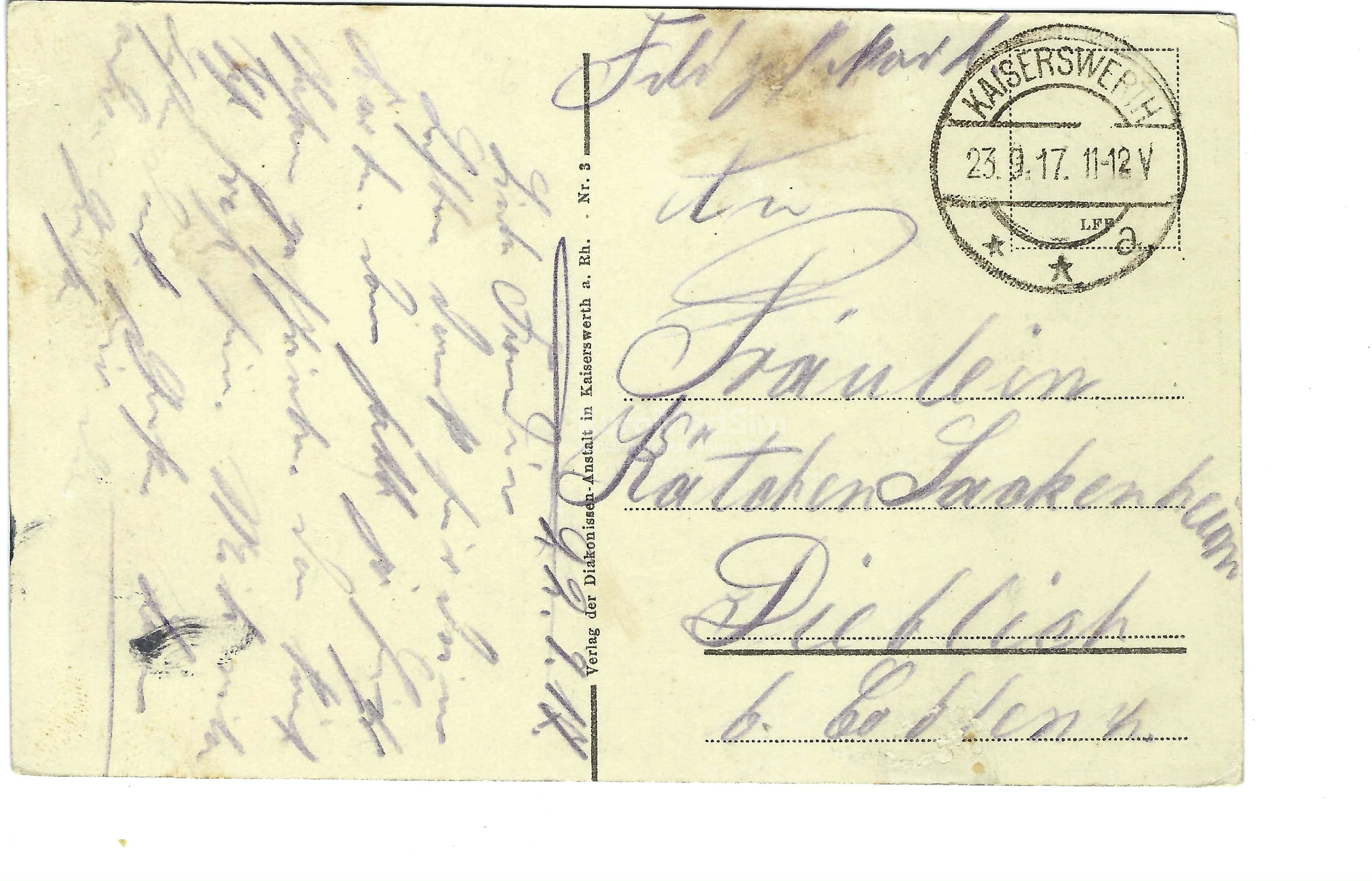
A divided-back photographic postcard printed in monochrome sepia on cream-coloured card stock. The card bears handwritten correspondence in violet pencil or ink and a circular postal cancellation dated 23 August 1917.
Recto
The picture side presents a panoramic view of an institutional complex surrounded by gardens, cultivated plots, paths, trees and low fencing. Several substantial historic buildings extend across the middle ground. The structures are identified by printed captions placed in the open sky above them: Waisenhaus (Orphanage) on the left, Mutterhaus (Mother-House) in the centre and Krankenhaus (Hospital) on the right. The central and right-hand buildings have elaborate façades, steep roofs and prominent pointed towers. In the left foreground stand smaller buildings and an arched entrance gateway. The upper-left corner carries the printed title Kaiserswerth a. Rh. (Kaiserswerth on Rhine, todays a Northern district of Düsseldorf, Germany). A brief handwritten message in faded violet script has been added across the sky above the orphanage building.
Verso
The reverse is divided vertically into correspondence and address sections. A printed line along the central division reads Verlag der Diakonissen-Anstalt in Kaiserswerth a. Rh. Nr. 3. (Publishing-House of the Diaconate Institute in Kaiserswerth on Rhine, #3). The left half contains a densely written personal message in faded violet pencil, partly written diagonally and crossed by additional strokes; several passages are now difficult to decipher. The right half bears the recipient’s address in large cursive handwriting, including the place name Düsseldorf. A circular Kaiserswerth postmark occupies the upper-right corner and records the date 23.8.17 and the time 11–12 V. The cancellation overlaps the rectangular postage-stamp area; no stamp is present which can be related to the military tome postage.
The card shows general signs of age and postal use, including surface yellowing, scattered brown stains, fading of the handwriting, minor abrasions, soiling and wear along the edges and corners.
Kaiserswerth Diaconate
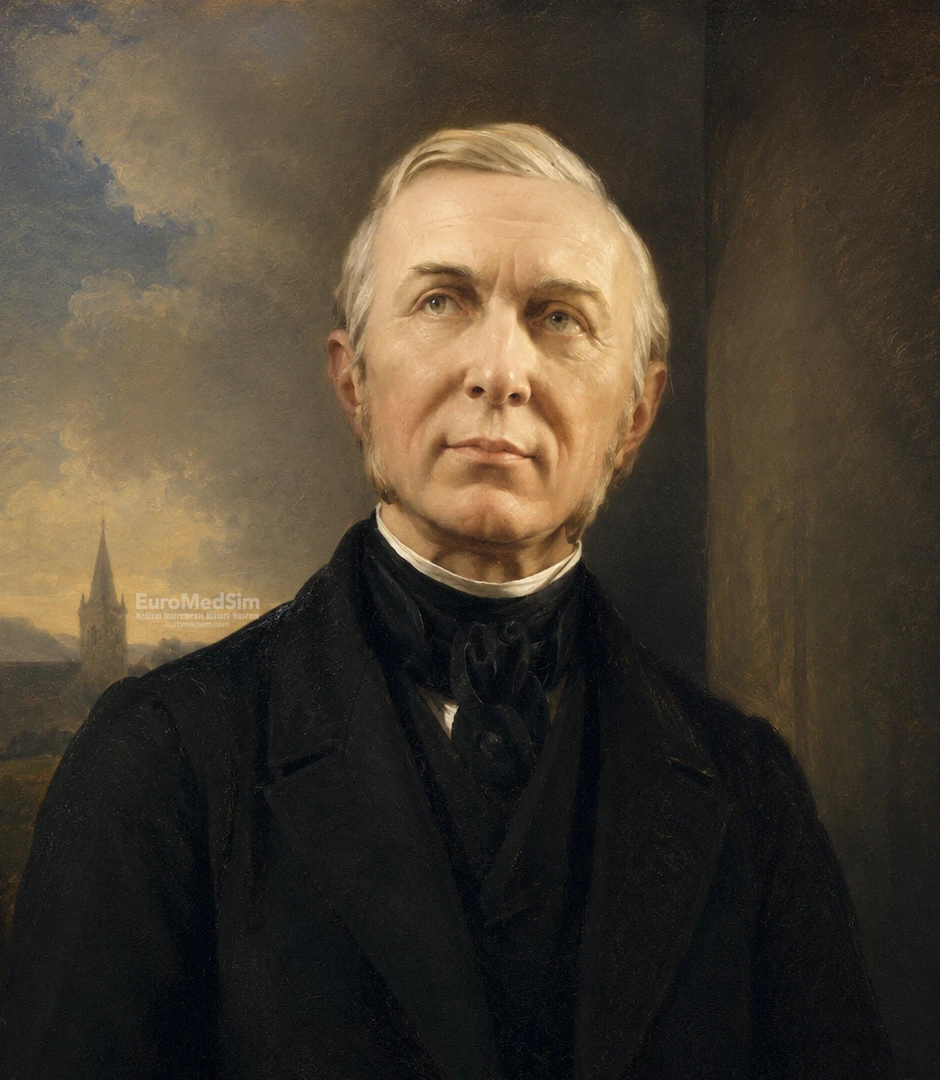
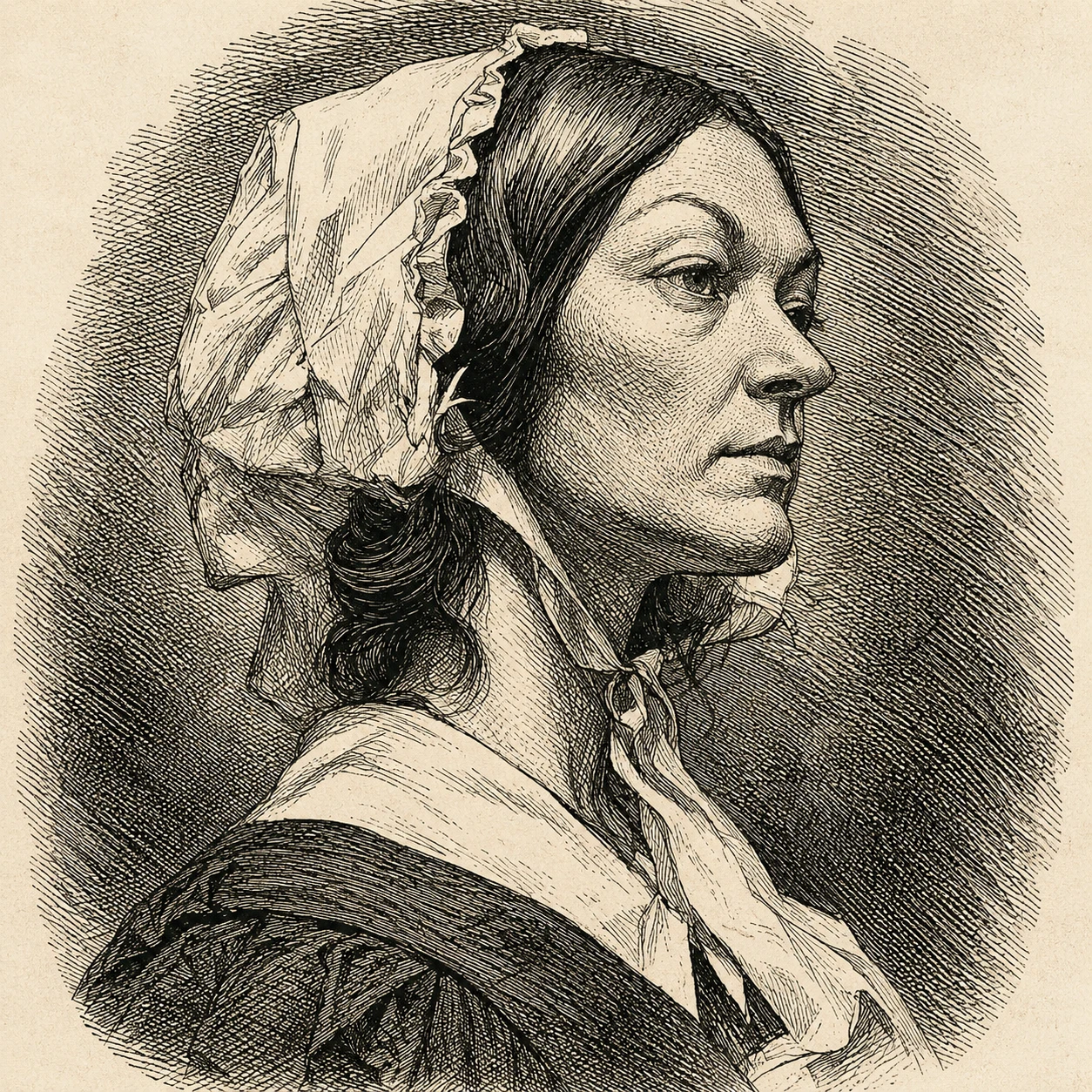
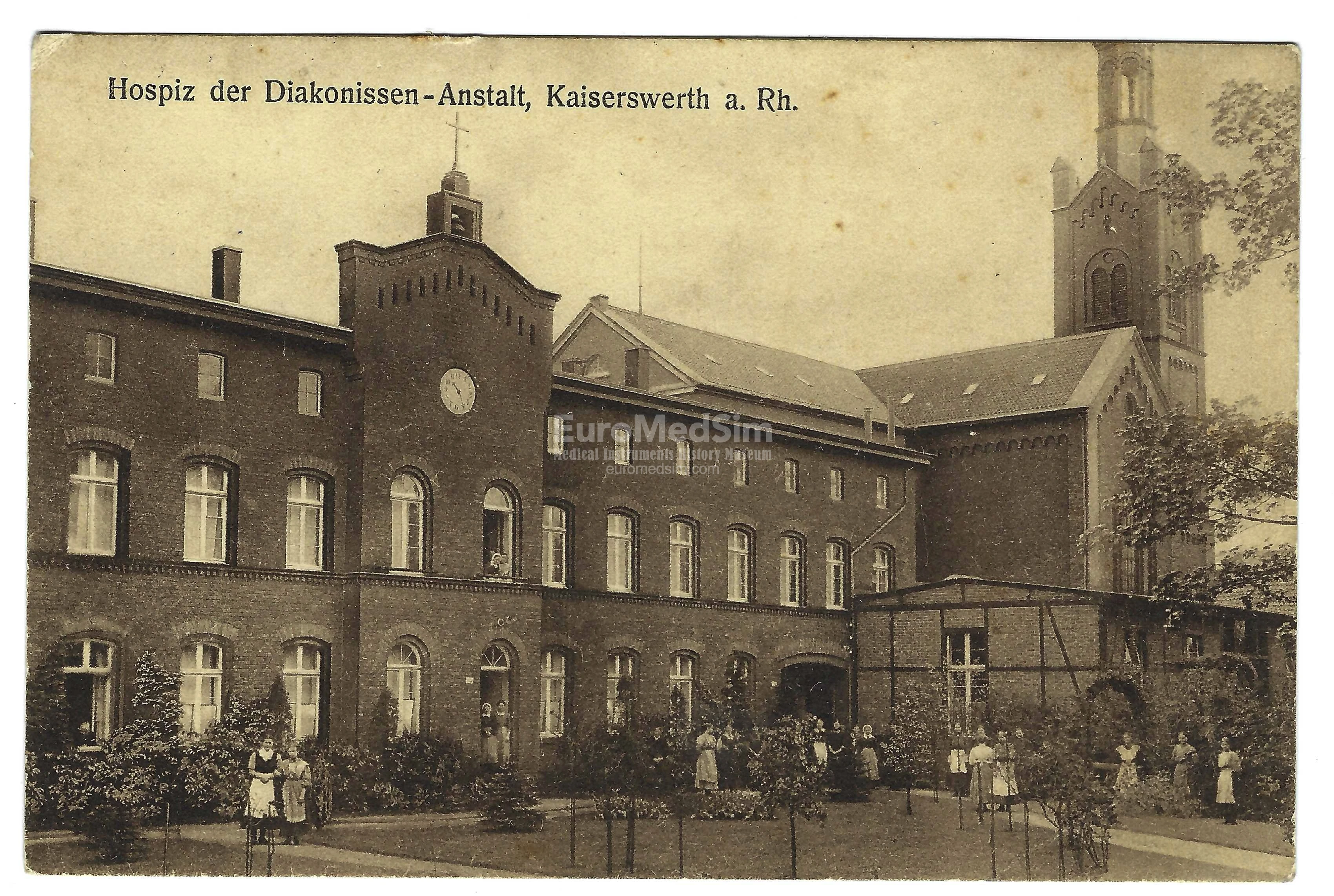
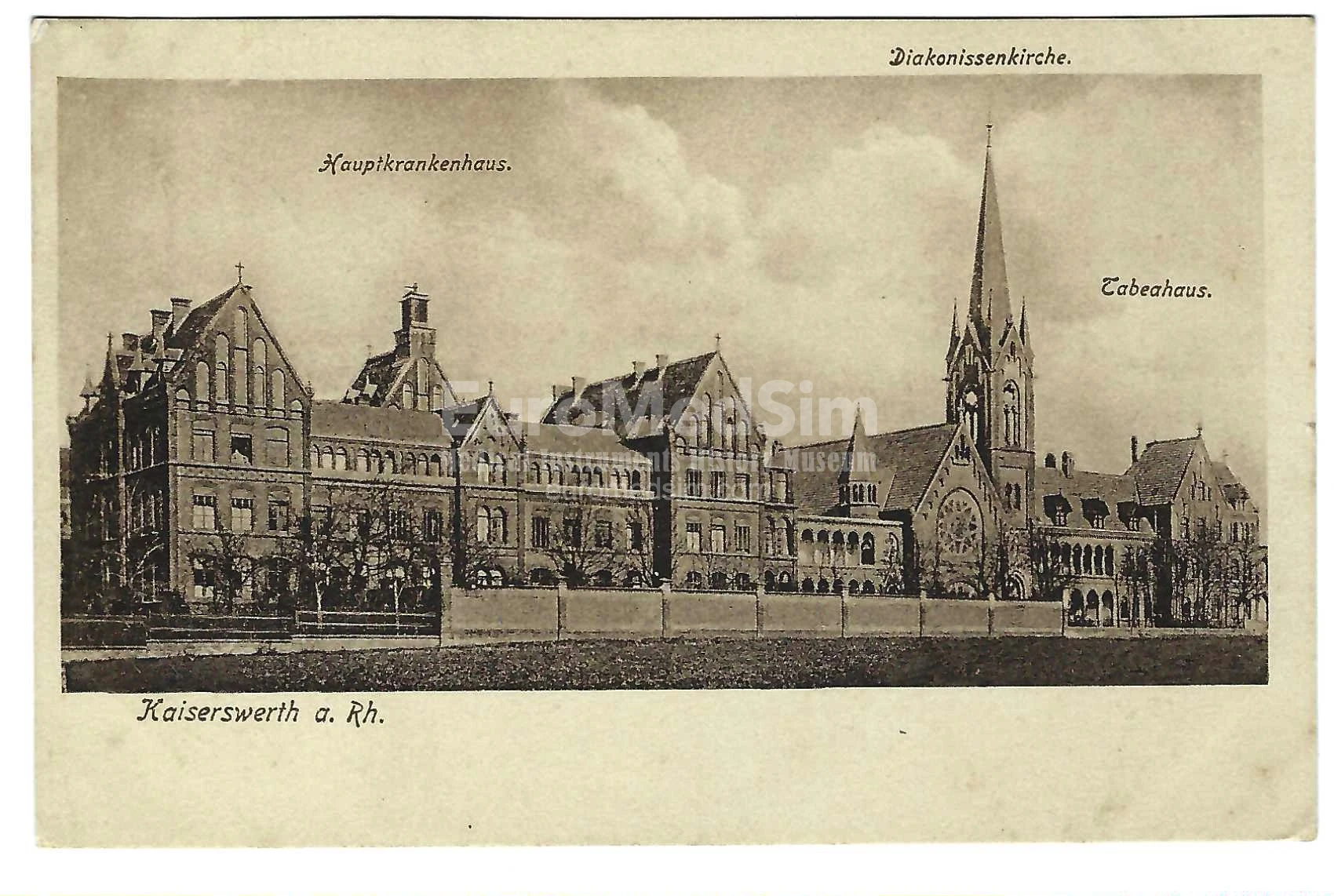
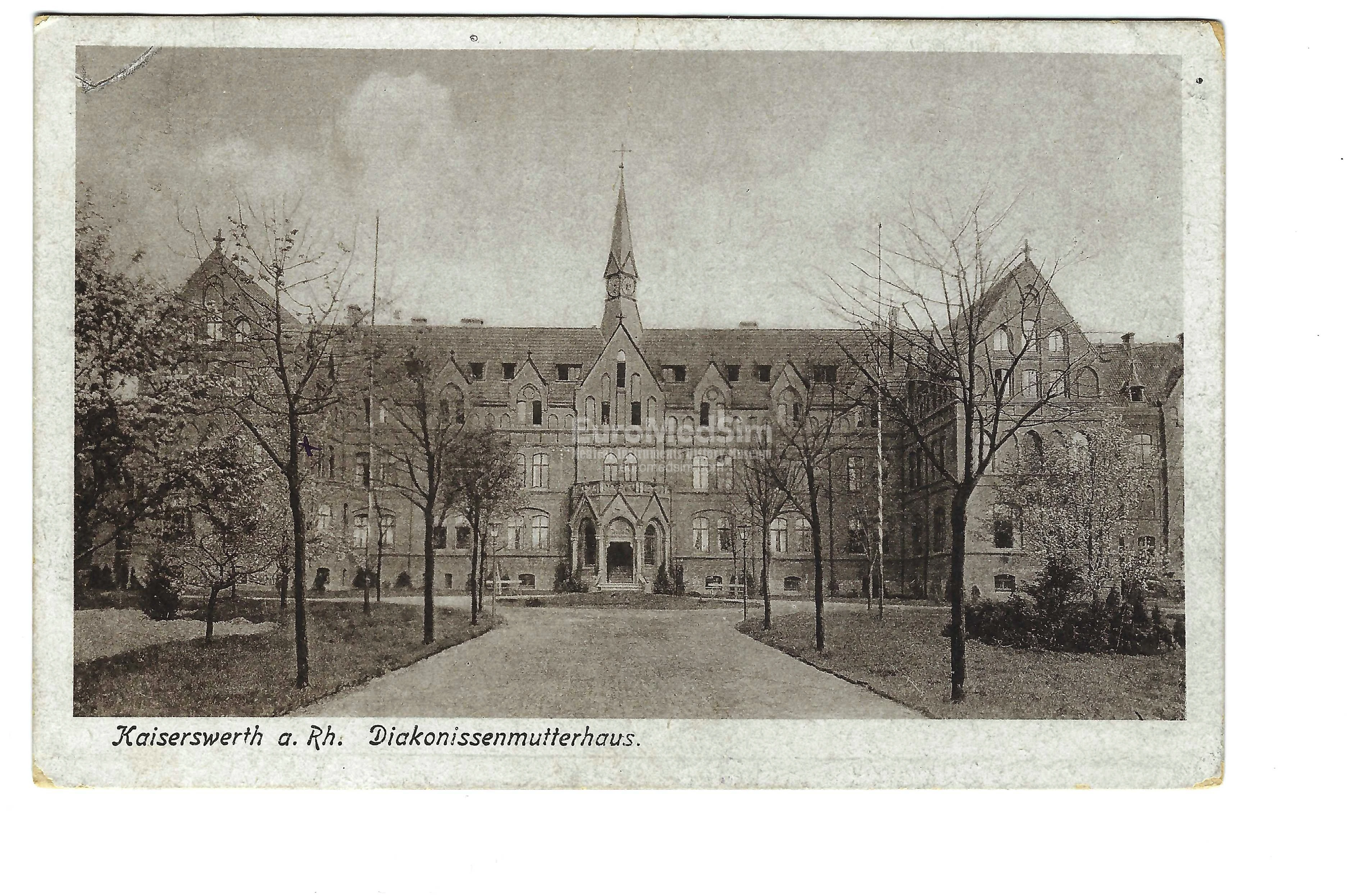
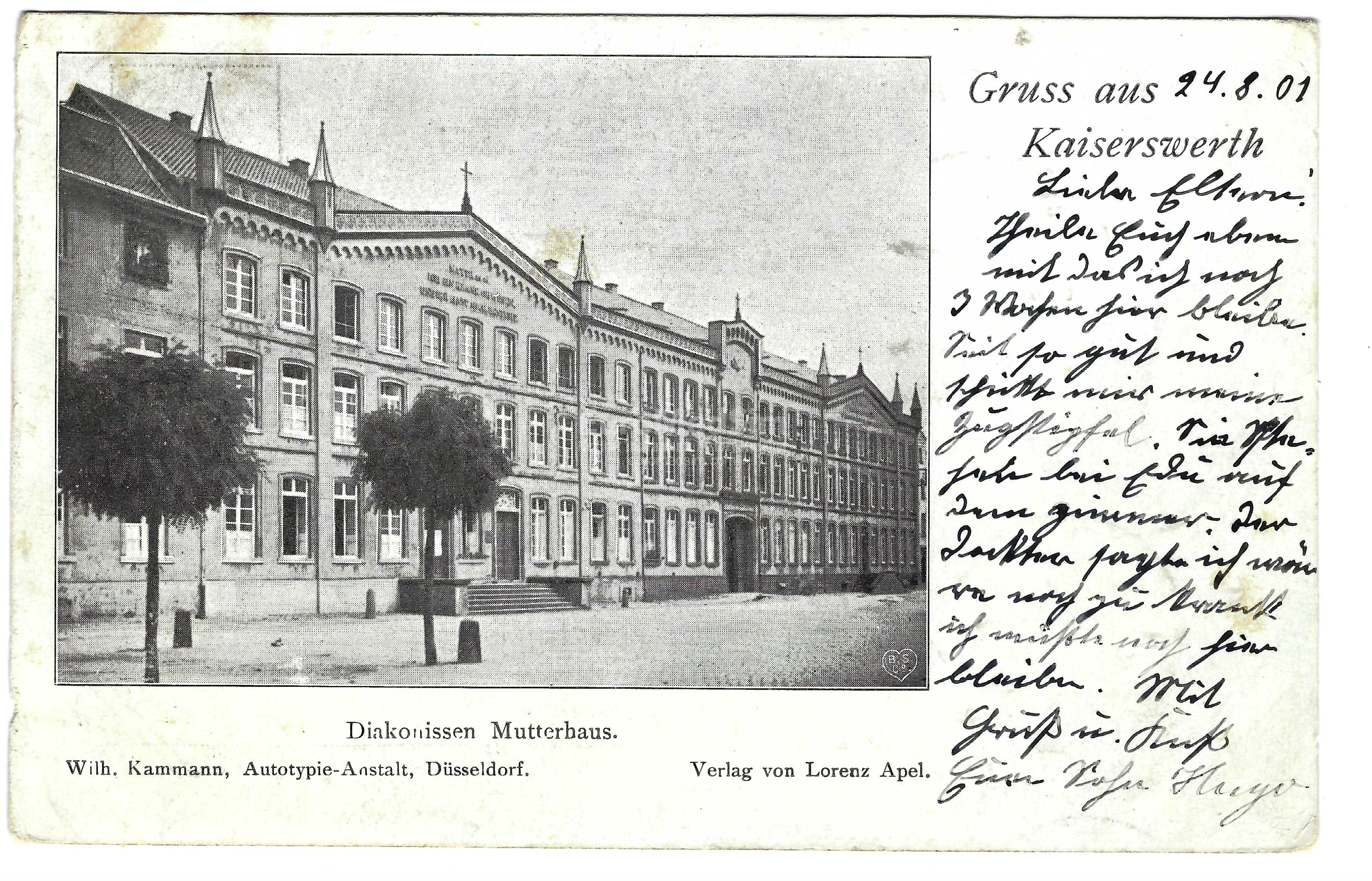
The Kaiserswerth Diaconate, an Evangelical community of sisters of mercy founded in 1836 by Pastor Theodor Fliedner and his wife, Frederieke Fliedner. Starting with the purchase of a single house, the institution quickly grew into a multifunctional complex that included a hospital, a kindergarten, a school for nursery teachers, an orphanage, a correctional facility for women, and a teachers’ seminary. The main house was named “Mutterhaus” (“Mother House”), where the hospital was located and where the deaconesses lived and were trained. Among his most famous students was Florence Nightingale, the founder of nursing in Great Britain. She visited here twice and, in 1851, spent three months gathering material for her first book and developing ideas that would later be put into practice during the Crimean War.