St Thomas Hospital, Parliament and Westminster Bridge aerial view
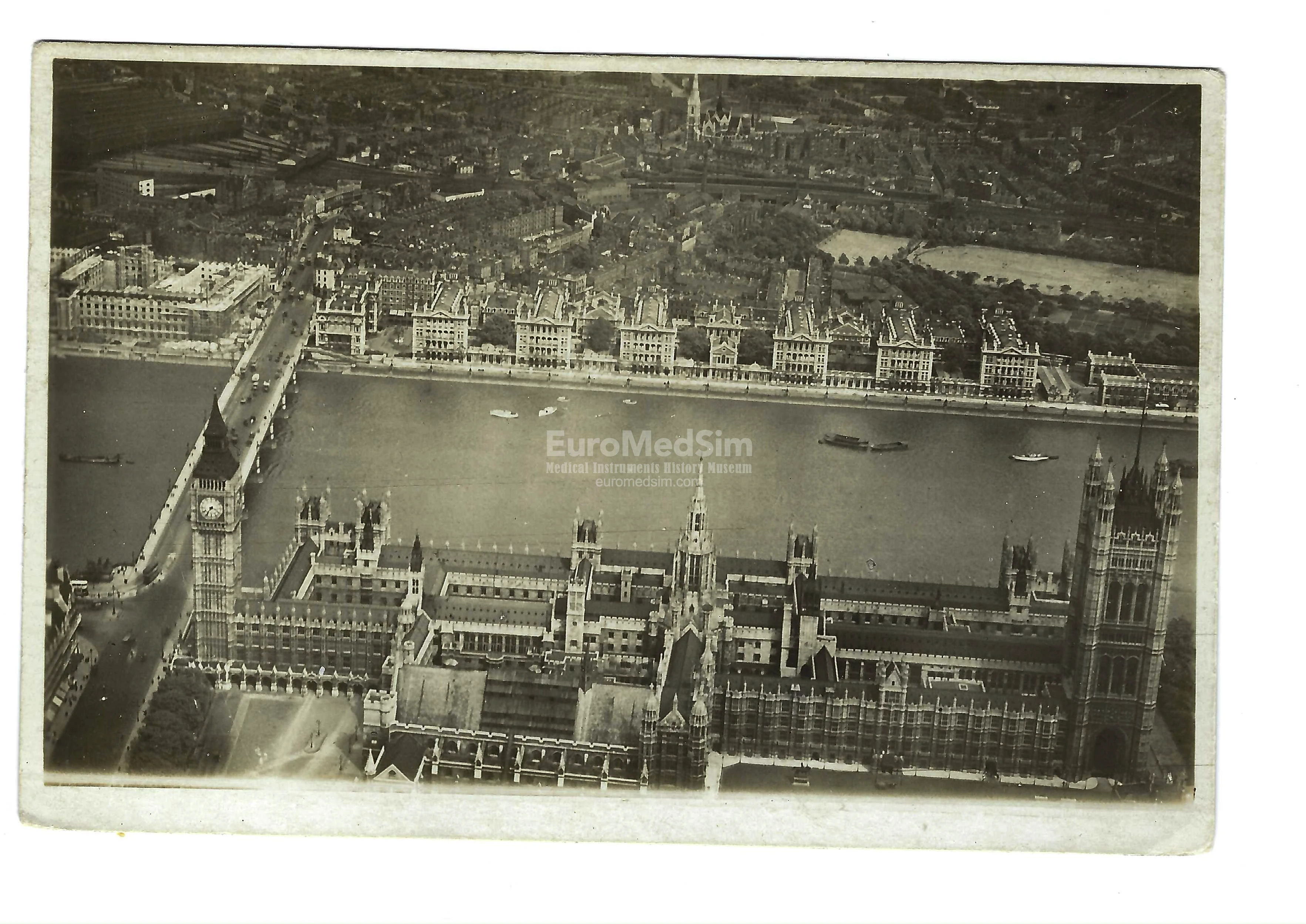
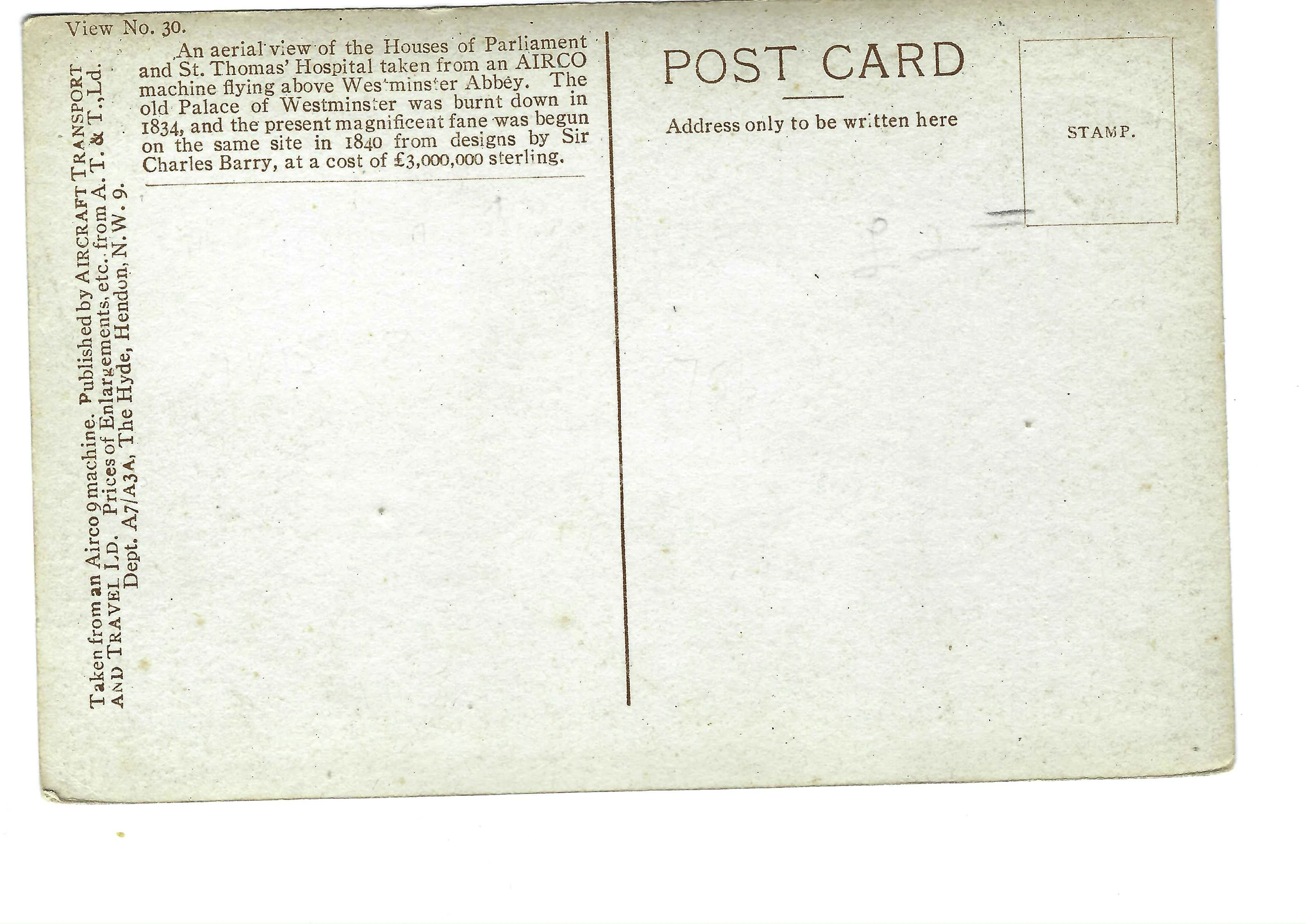
Aerial View of the Houses of Parliament, Westminster Bridge and St. Thomas’ Hospital in London, photographic postcard, presumably 1919–1920. Original printed description: “An aerial view of the Houses of Parliament and St. Thomas’ Hospital taken from an AIRCO machine flying above Westminster Abbey.” The postcard is numbered View No. 30 and was published by Aircraft Transport and Travel Ltd., whose address is given as The Hyde, Hendon, N.W.9. Material and technique: Cardboard; black-and-white photographic print; typographic printing on the reverse. Postal use: Unused
The object is particularly interesting because it combines three histories in a single image: the architectural history of St. Thomas’ Hospital, the monumental landscape of Westminster, and the emergence of British civil aviation and commercial aerial photography immediately after the First World War.
Description of the front side — recto
The front of the postcard presents an oblique aerial photograph of Westminster taken from the west, according to the printed caption from an aircraft flying above Westminster Abbey. The Palace of Westminster occupies the foreground, with the Clock Tower — today known as the Elizabeth Tower — beside Westminster Bridge on the left and the Victoria Tower rising prominently on the right. Beyond the Palace lies the River Thames, while the original nineteenth-century complex of St. Thomas’ Hospital stretches along the opposite bank.
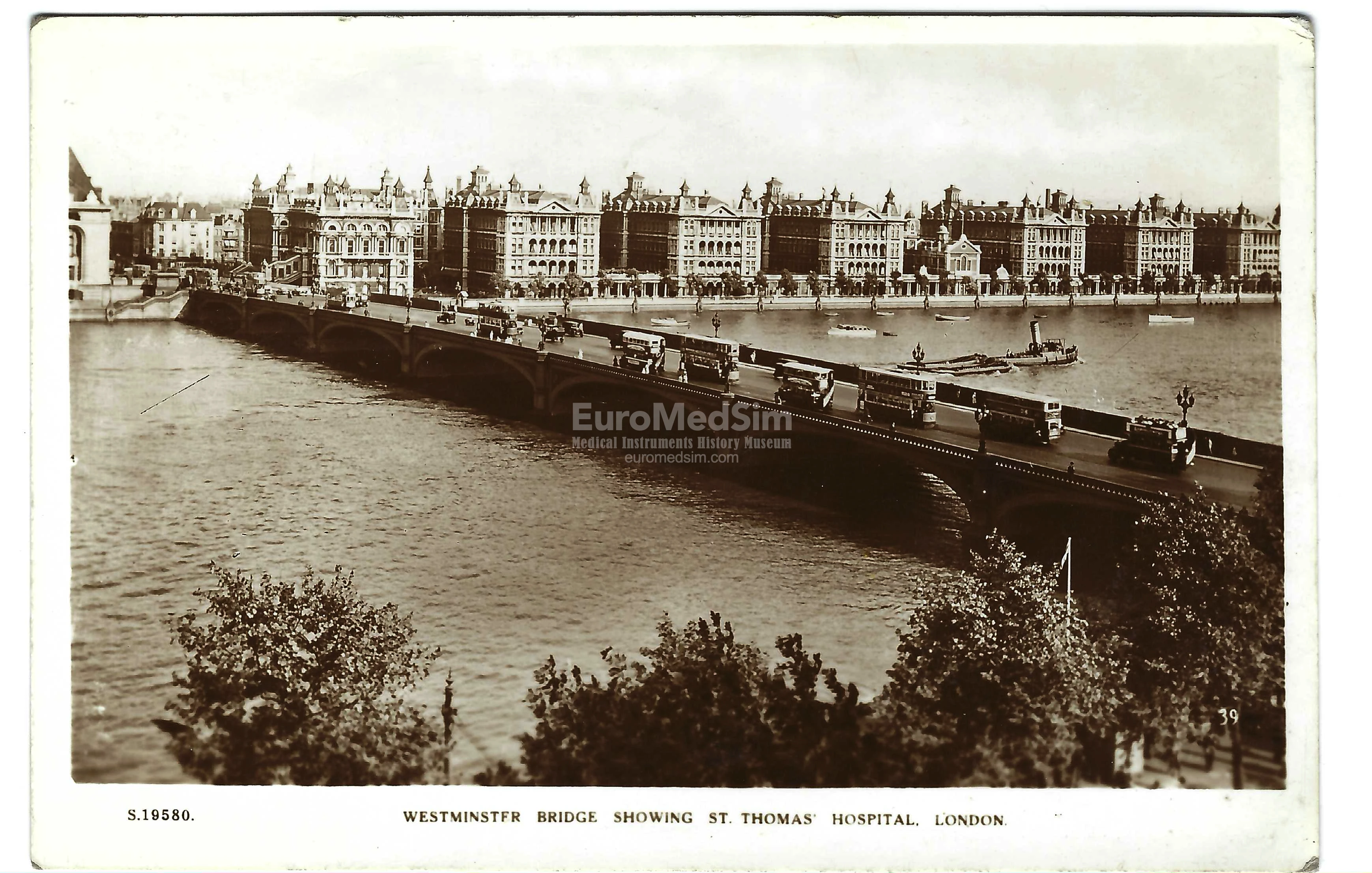
Westminster Bridge crosses the Thames diagonally on the left side of the photograph. Several vessels can be distinguished on the river. Behind them, the long riverside frontage of St. Thomas’ Hospital reveals with unusual clarity the rhythm of its pavilion-plan architecture: repeated tall ward blocks, intervening open spaces and lower connecting structures.
The elevated viewpoint is the most distinctive feature of the postcard. Unlike conventional London postcards photographed from street level or from the opposite bank of the Thames, this view places both Parliament and the hospital within a single urban composition. The hospital is therefore seen not simply as an individual building but as a large medical complex occupying an important position in the monumental landscape of central London.
Description of the reverse side — verso
The reverse is divided vertically. The right-hand portion is reserved entirely for the postal address and bears the headings:
POST CARD
Address only to be written here
STAMP.
No handwriting, address, postage stamp or postmark is present, indicating that the postcard was never mailed.
In the upper left corner appears the number View No. 30, followed by the printed description:
An aerial view of the Houses of Parliament and St. Thomas’ Hospital taken from an AIRCO machine flying above Westminster Abbey. The old Palace of Westminster was burnt down in 1834, and the present magnificent fane was begun on the same site in 1840 from designs by Sir Charles Barry, at a cost of £3,000,000 sterling.
Along the left edge, printed vertically, is the publisher’s information:
Taken from an Airco 9 machine. Published by AIRCRAFT TRANSPORT AND TRAVEL LD. Prices of Enlargements, etc., from A. T. & T., Ld. Dept. A7/A3A, The Hyde, Hendon, N.W. 9.
The unusual word “fane” in the description is not a printing error. It is an archaic literary term normally meaning a temple or sacred edifice and is used here rhetorically for a magnificent monumental building.
The offer of “Enlargements” is also noteworthy. It suggests that the postcard formed part not merely of a souvenir trade but of a commercial aerial-photography operation in which customers could order larger photographic copies of individual views.
The Publisher and the “Airco 9”
Aircraft Transport and Travel Ltd. was one of the pioneering companies of early British civil aviation. In February 1919 the company was already operating an express air service between Folkestone and Ghent. On 25 June 1919 a de Havilland DH.9 belonging to Aircraft Transport & Travel was chartered for a business flight from Hendon to Dublin, and on 25 August the company inaugurated the first scheduled daily international air service between London and Paris.
The postcard’s expression “Airco 9 machine” almost certainly refers to an aircraft of the Airco/de Havilland DH.9 family. Airco’s aircraft designed under Geoffrey de Havilland received the familiar “DH” type numbers. After the Armistice, a number of DH.4 and DH.9 military aircraft were modified for carrying passengers and freight and entered the rapidly developing civil aviation market. Airco’s factory was located at The Hyde, Hendon — exactly the address printed on this postcard.
The photograph therefore belongs to a remarkable transitional period when aircraft developed for the First World War were being adapted to peaceful uses: passenger transport, freight, surveying and aerial photography. Commercial oblique aerial photography was itself emerging as a new field in Britain at precisely this time; Historic England records the first photograph in the Aerofilms collection as dating from 26 July 1919 and shows another Airco DH.9B being used by aerial photographers that summer. This does not mean that the present postcard was produced by Aerofilms, but it illustrates the technological and commercial environment in which the Aircraft Transport and Travel series appeared.
Dating the Postcard
The card was never mailed, so no postal cancellation provides a precise date. Its dating must therefore rely on the publisher, aircraft terminology and historical context.
Civil flying in Britain was formally restored from 1 May 1919 under the Air Navigation Regulations of 1919. During the same year Aircraft Transport & Travel was operating DH.9 aircraft from Hendon and rapidly expanding commercial services. The continued prominence of the Airco name and the publisher’s address at The Hyde place the postcard within this immediate post-war phase of British aviation. A cautious museum attribution would therefore be c. 1919–1920, with 1919 being particularly plausible.
A surviving View No. 27, depicting Piccadilly and the Green Park, carries virtually the same publisher’s inscription — including “Taken from an Airco 9 machine” and the A.T. & T. address at The Hyde — confirming that the present card belonged to a numbered series of aerial views of London.
The Palace of Westminster
The explanatory text on the postcard recalls the destruction of the old Palace of Westminster in 1834. The fire began on 16 October 1834 and destroyed the Houses of Lords and Commons and much of the old palace, although Westminster Hall survived.
A competition for the new Palace was held in 1836 and won by Charles Barry. Construction began in 1840, with the first stone laid on 27 April of that year. The work continued for more than thirty years.
The postcard states that the new Palace was constructed “at a cost of £3,000,000 sterling.” This should be understood as the publisher’s contemporary description rather than a precise modern historical accounting. According to the UK Parliament’s own history, Barry initially estimated £724,986, while the eventual project cost exceeded £2 million.
St. Thomas’ Hospital and the Pavilion Plan
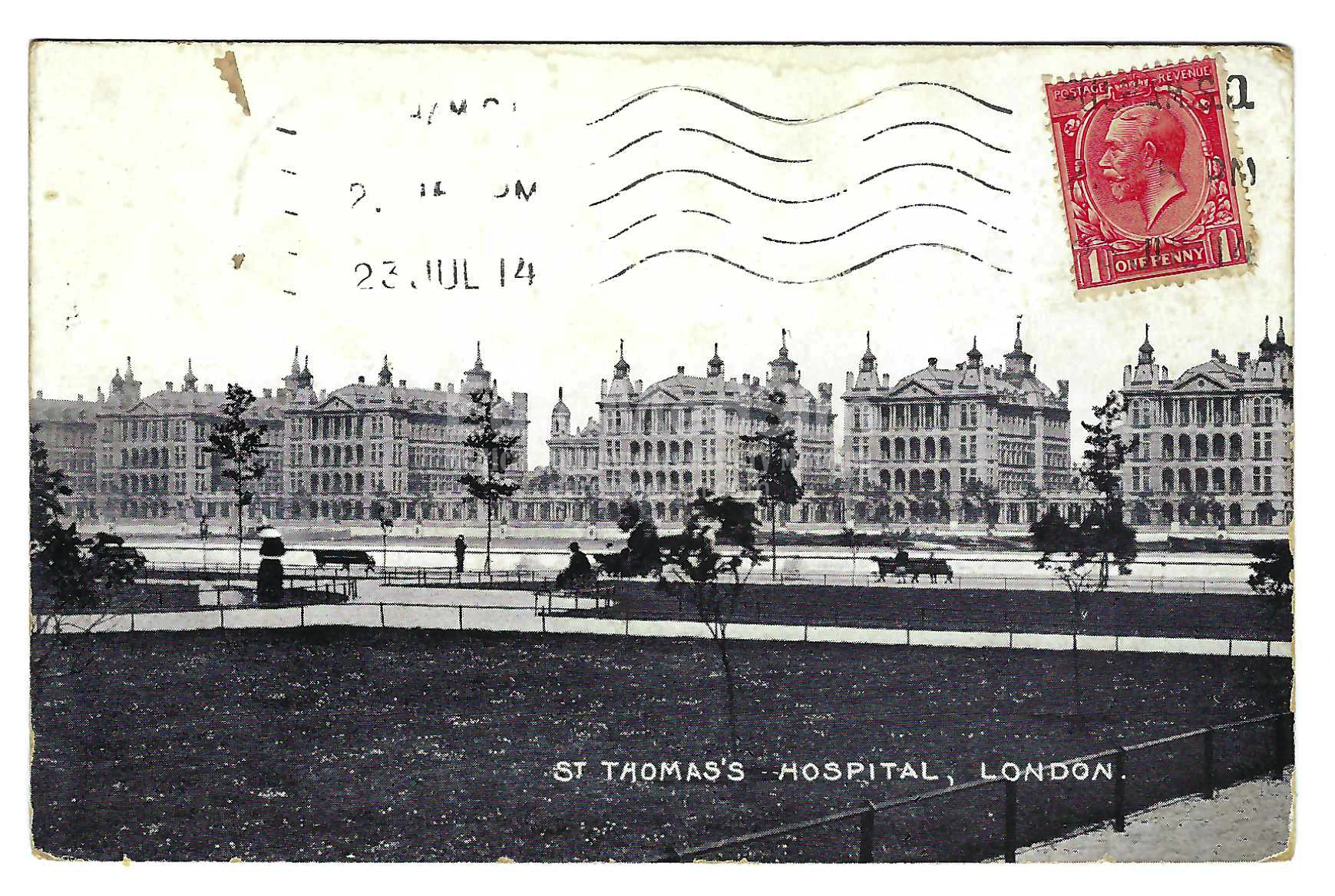
The hospital visible across the Thames is the great Victorian St. Thomas’ complex established on its present Lambeth site after the old hospital in Southwark was displaced by the enlargement of London Bridge railway station. Its riverside position opposite the Palace of Westminster made it one of the most conspicuous hospital complexes in nineteenth-century London.
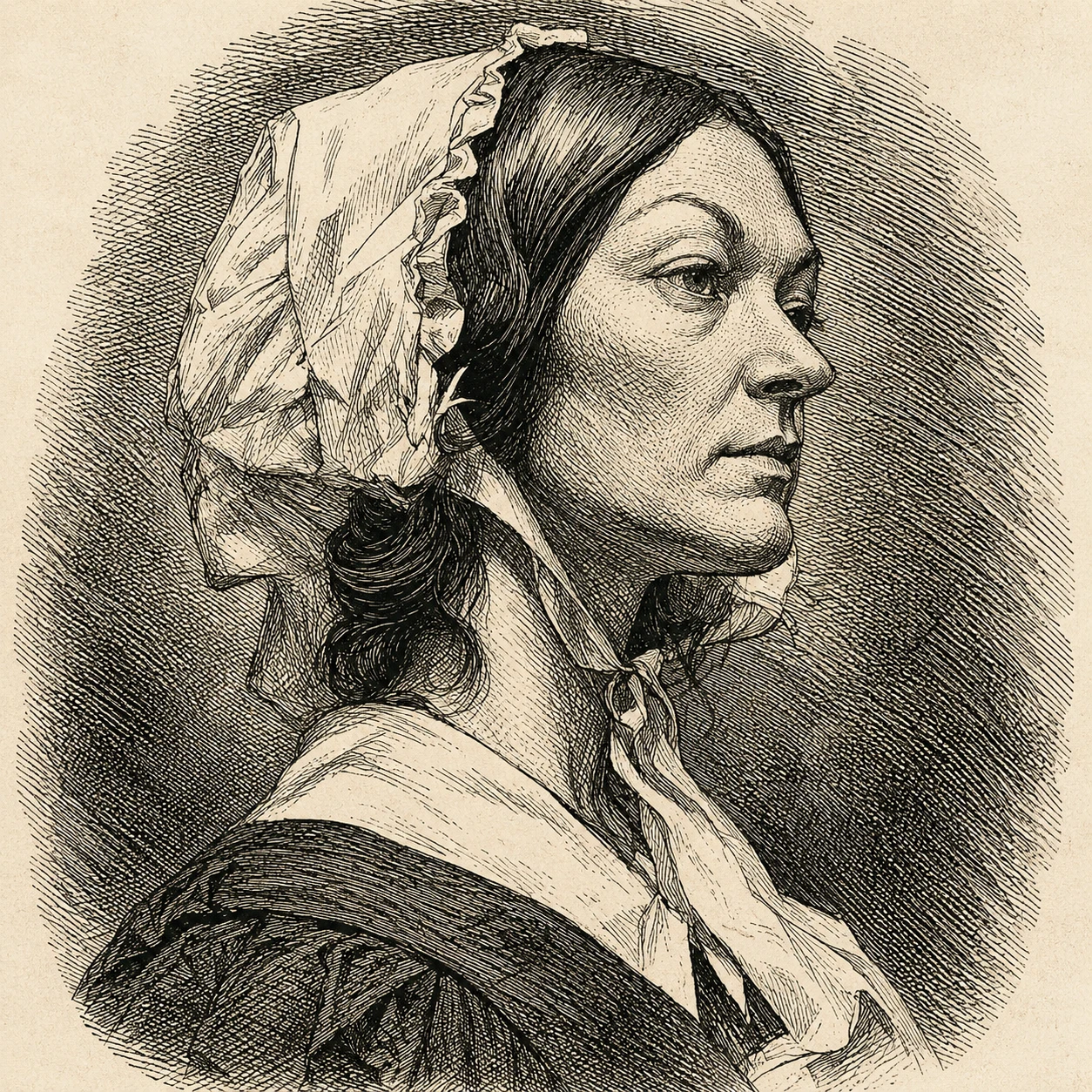
Its architecture embodied the pavilion principle that became central to nineteenth-century hospital reform. Historic England describes the original hospital as accommodating 588 beds in six ward pavilions, with long open wards cross-ventilated through large sash windows. Florence Nightingale strongly championed this approach, in which air, natural light and spatial separation were regarded as fundamental elements of hospital hygiene.
The Florence Nightingale Museum describes the broader composition as seven large separate buildings connected by walkways — a difference in counting that reflects whether the ward pavilions alone or the principal buildings of the whole complex are being enumerated.
St. Thomas’ also occupies a foundational place in the history of professional nursing education. In 1860 Florence Nightingale established the Nightingale Training School at St. Thomas’ Hospital, which became an internationally influential model for systematic nurse education.
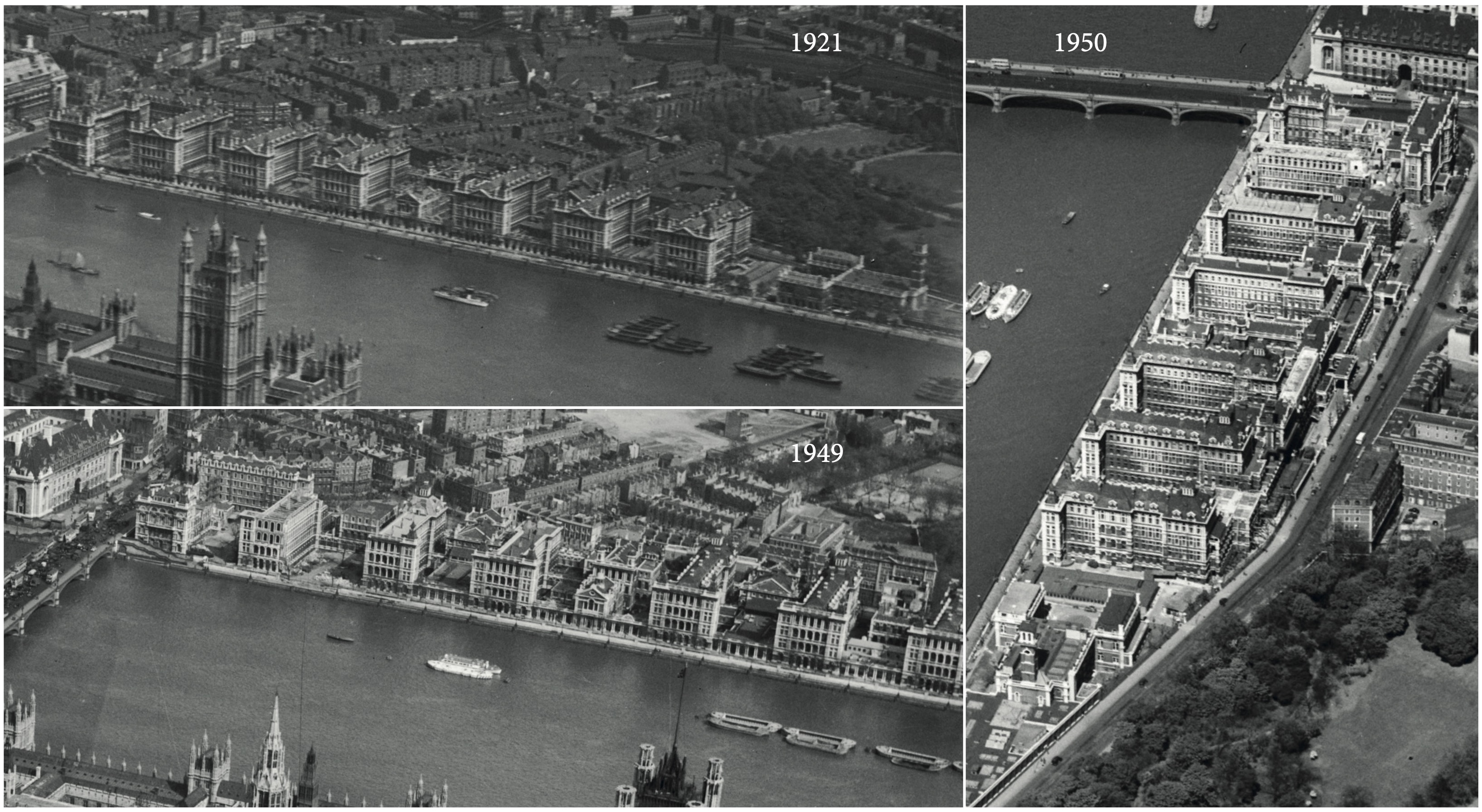
Comparative three aerial photographies of St Thomas Hospital in London — from 1921 to 1950. One can see that three North Pavilions (left at the 1949 and top at 1950 views) look different after the World War II. Source: Britain from Above (https://www.britainfromabove.org.uk)
Documentary Value
From the standpoint of medical history, the principal value of the photograph lies in its unusually clear aerial representation of the historic pavilion hospital as an integrated architectural system. The repeated ward blocks, their spacing, the connecting axes and the relationship between the hospital and the river are considerably easier to understand in this aerial view than in conventional street-level photographs.
The postcard is therefore more than a souvenir of London. It records a moment when nineteenth-century hospital architecture, represented by St. Thomas’, was being photographed by one of the newest technologies of the twentieth century. A hospital shaped by Nightingale-era principles of ventilation, separation and environmental hygiene is seen from an aircraft belonging to the first generation of British commercial aviation.
The juxtaposition is particularly striking: the Palace of Westminster represents Victorian political architecture; St. Thomas’ represents Victorian reform of the hospital; and the aircraft from which the photograph was taken represents the emerging technological world of the post-First World War period.
Condition
The postcard is in good to satisfactory condition. The photographic image remains detailed and legible, although the print shows the moderate loss of contrast and warm age toning typical of an early photographic postcard. Minor surface marks and small areas of soiling are visible.
The reverse shows general age-related toning and scattered small spots. There is slight wear and deformation at the corners and along the edges, but no major tears or substantial losses are visible. The printed inscriptions remain clear and almost completely legible.
The card has not been postally used, preserving the publisher’s original typography and explanatory text without later handwriting or postal markings.