Westminster Hospital in London
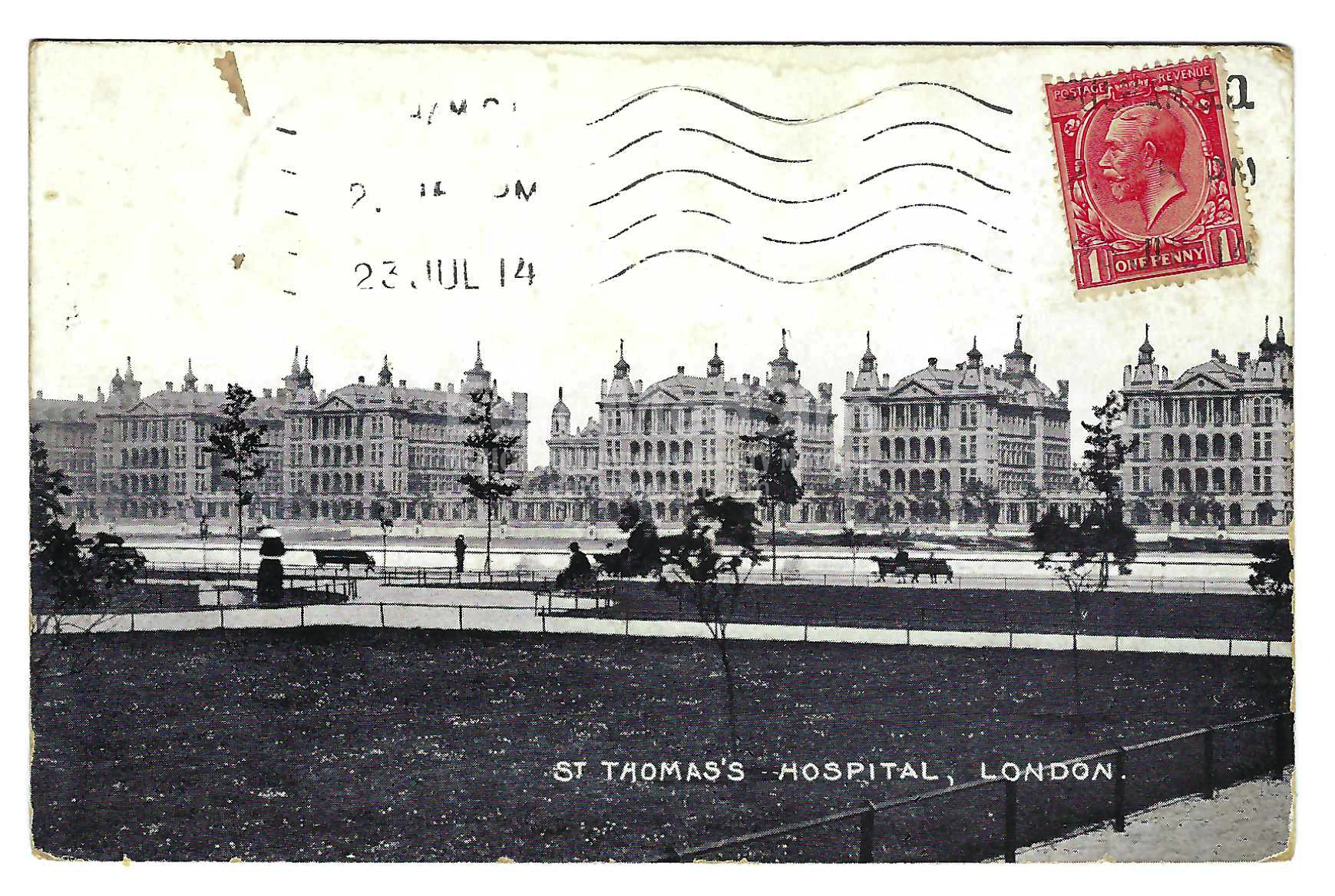
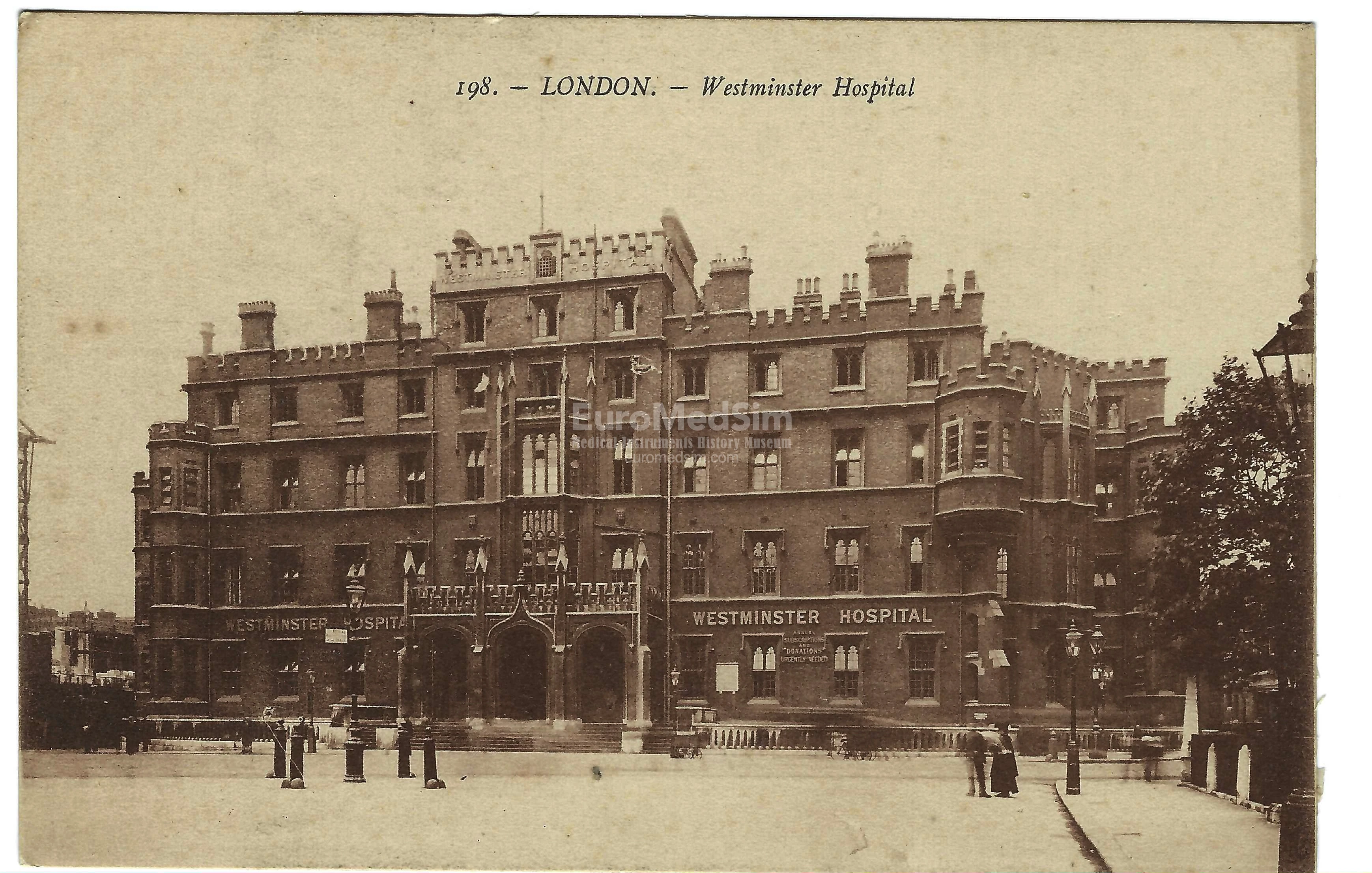
A postcard showing the old Westminster Hospital in Broad Sanctuary, directly opposite Westminster Abbey. The hospital had occupied this site since 1834. The imposing castellated Gothic building seen here was substantially rebuilt in 1895, giving the institution an architectural presence more reminiscent of a medieval civic palace than a modern hospital. Its address was usually given simply as Westminster Hospital, Broad Sanctuary, Westminster, London SW — later SW1.
Westminster Hospital remained at Broad Sanctuary until 1938, when it moved to new premises near Horseferry Road. The old building was later damaged by fire in 1950 and subsequently disappeared during redevelopment of the area. Today, the hospital’s former site corresponds approximately to the open space immediately in front of the Queen Elizabeth II Centre, on the north side of Broad Sanctuary, facing Westminster Abbey.
The postcard preserves a view of a hospital that once stood at the very heart of Westminster — a building now completely absent from one of London’s most familiar urban landscapes.
Westminster Hospital: A Pioneer of Charitable Medicine
In 1719, a London banker named Henry Hoare and three friends set out to do something no one in England had quite done before: fund a hospital entirely through voluntary charity, open to the poor and needy of Westminster. Their initiative, launched with a modest personal donation, gave rise to what became known as Westminster Hospital — the first voluntary hospital in London and, according to the institution's own historical tradition, the world's first hospital funded entirely by charitable giving.
Humble Beginnings
The hospital's first home was not a hospital at all, but a rented house in Petty France, where it opened in 1720 with just ten beds under the name "Infirmary for the Sick and Needy." Its founding mission was simple and radical for the time: to provide poor sick people with food and medical care during illness, extending help even to prisoners and foreigners — groups largely excluded from formal medical charity elsewhere in the city.
The institution's success inspired a wave of imitators. Westminster helped inaugurate the great wave of voluntary hospitals that transformed eighteenth-century London. Guy's, St George's and the London Hospital followed in the decades that followed, establishing charitable hospital medicine as a major part of the city's medical landscape.
Growth, Relocation, and Medical Education
As the hospital grew, it moved several times, each move reflecting its expanding ambitions. A grander building rose beside Westminster Abbey in 1834 — the same year the hospital formally established its own medical school, founded by the surgeon George Guthrie. Although medical students had trained at Westminster since the 1730s, the formal establishment of the school in 1834 placed the hospital firmly among London's teaching institutions, producing generations of physicians and surgeons.
The hospital continued to evolve into the twentieth century. A clinical laboratory was opened by Lord Lister in 1899, symbolically linking Westminster to the new era of laboratory medicine and antiseptic surgery. Westminster Hospital remained at Broad Sanctuary until 1938. Its replacement, a purpose-built hospital complex near Horseferry Road, opened in stages, with the new main hospital formally opened by King George VI in April 1939.
Surviving the Blitz
During the Second World War, Westminster Hospital remained operational throughout, even as London endured sustained bombing. The Horseferry Road building was struck by bombs in 1940 and shaken by a nearby landmine explosion in 1941, yet remarkably suffered no fatalities among patients or staff, and continued to treat the sick and wounded of the capital through the war's darkest years.
Legacy
Westminster Hospital finally closed in 1992, ending more than 270 years of continuous institutional history. The following year, its services and traditions became part of the newly opened Chelsea and Westminster Hospital on Fulham Road, which brought together several historic London hospitals.
The Broad Sanctuary site is now largely an open space in front of the Queen Elizabeth II Centre — Westminster Hospital's true legacy lies in an idea rather than a structure: that healthcare could be sustained not by royal patronage or church endowment alone, but by the voluntary generosity of ordinary citizens. That idea, first tested in a rented house in Petty France three centuries ago, quietly reshaped the landscape of British medicine.