
Opera, Bücher und Schrifften, so viel deren zur Handt gebracht...
Opera, Bücher und Schrifften, by Philippus Theophrastus Paracelsus, Strassburg, 1603
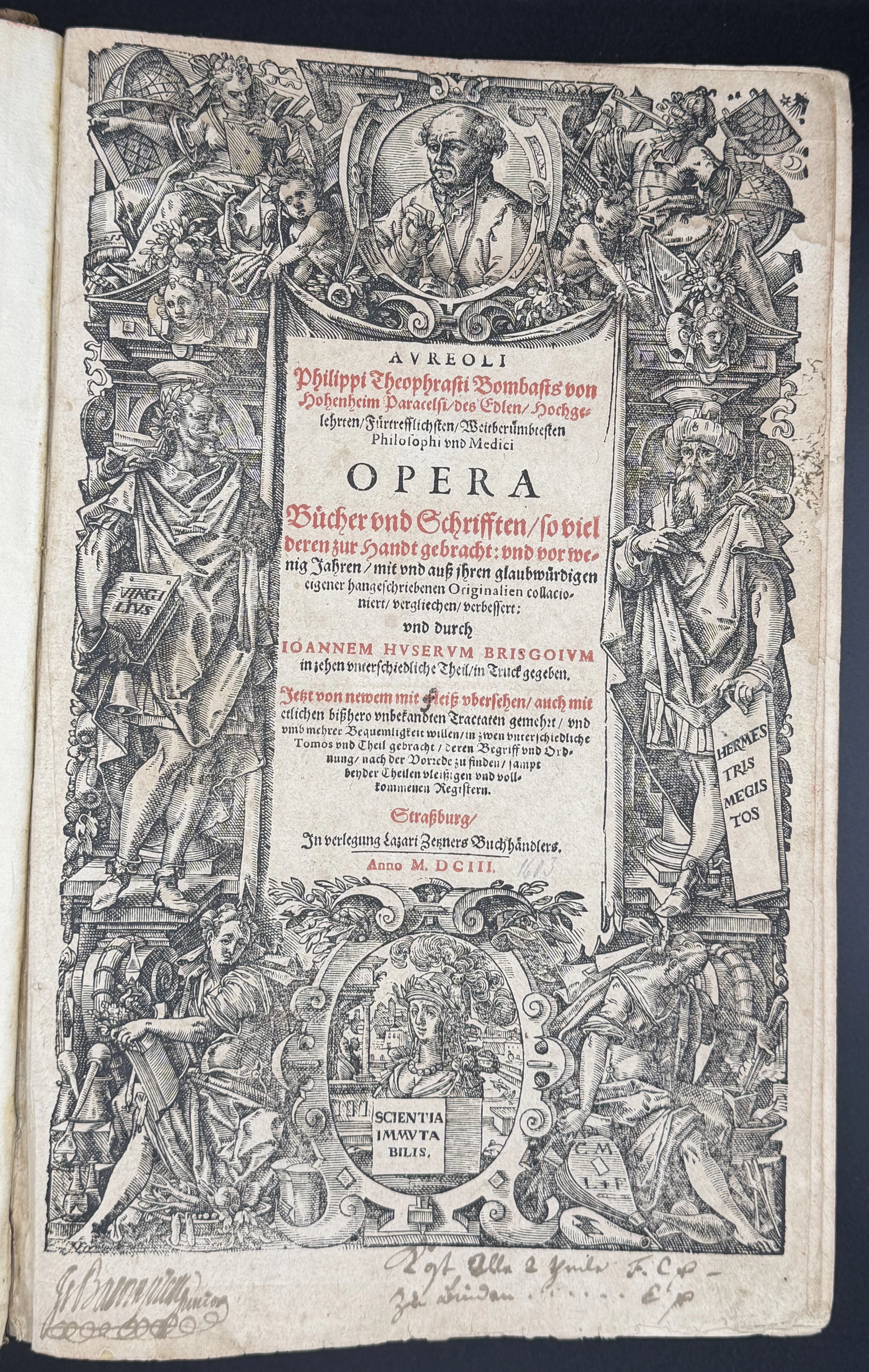
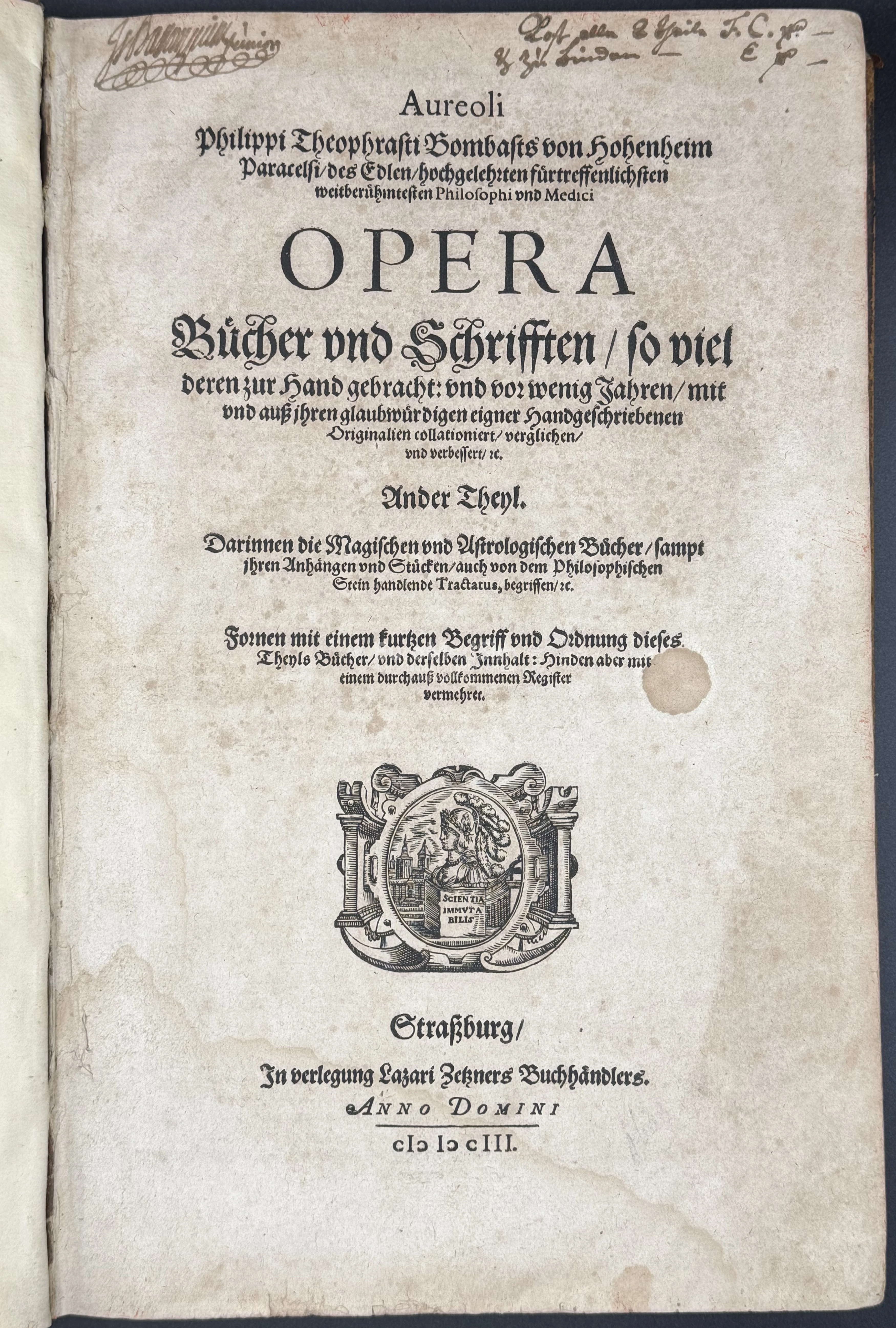
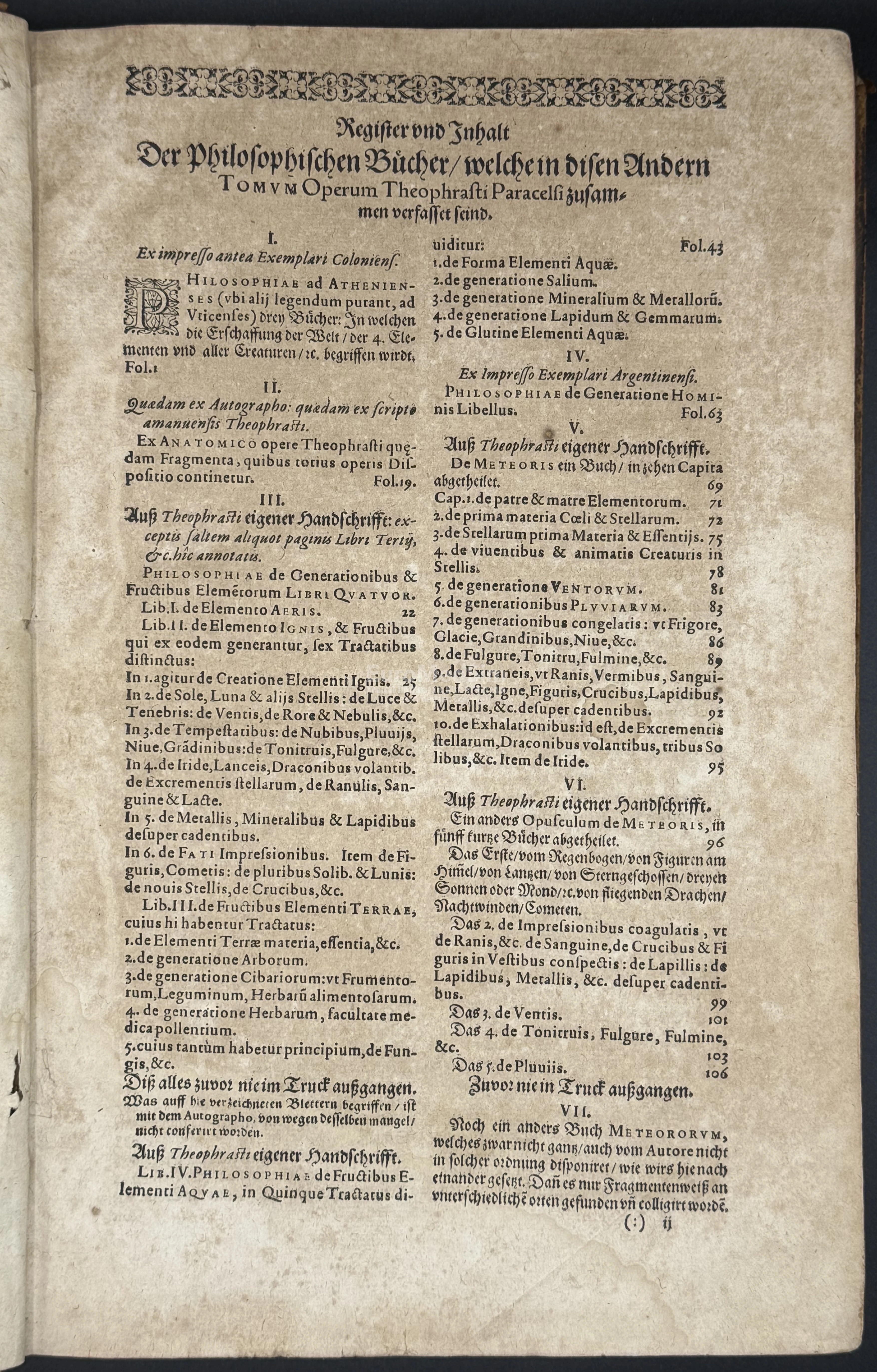
Paracelsus, Philippus Theophrastus. Opera, Bücher und Schrifften, so viel deren zur Handt gebracht: und vor wenig Jahren mit und ihren glaubwürdigen eigener handgeschriebenen Originalien collacioniert / vergliechen / verbessert: und durch IOHANNEM HVSERVM BRISGOIVM in iehem unterschiedliche Theil / in Fruct gegeben ("Works, Books, and Writings, as many as could be gathered: and a few years ago collated / compared / corrected with their reliable original manuscripts in his own handwriting: and published by Johann Huser Brisgoi in various parts"). Edited by Ioannem Huserum Brisgoium. Published in Straßburg, Holy Roman Imperium, by Lazarus Zetzner Buchhandlung (Strassburg, Lazar Zetzner, Booking trade), 1603. With: Opera ... Ander Theyl. Strasbourg, Lazarus Zetzner, 1603. 2 works in 2 volumes. First Strassburg's Edition.
Complete edition of the works of Paracelsus, the famous physician and alchemist, who is regarded as an important innovator in the natural sciences due to his wide-ranging interests and research. First Strasbourg edition and, at the same time, first folio edition, based on the first German complete edition, published in 10 volumes by Johann Huser.
Description and Condition
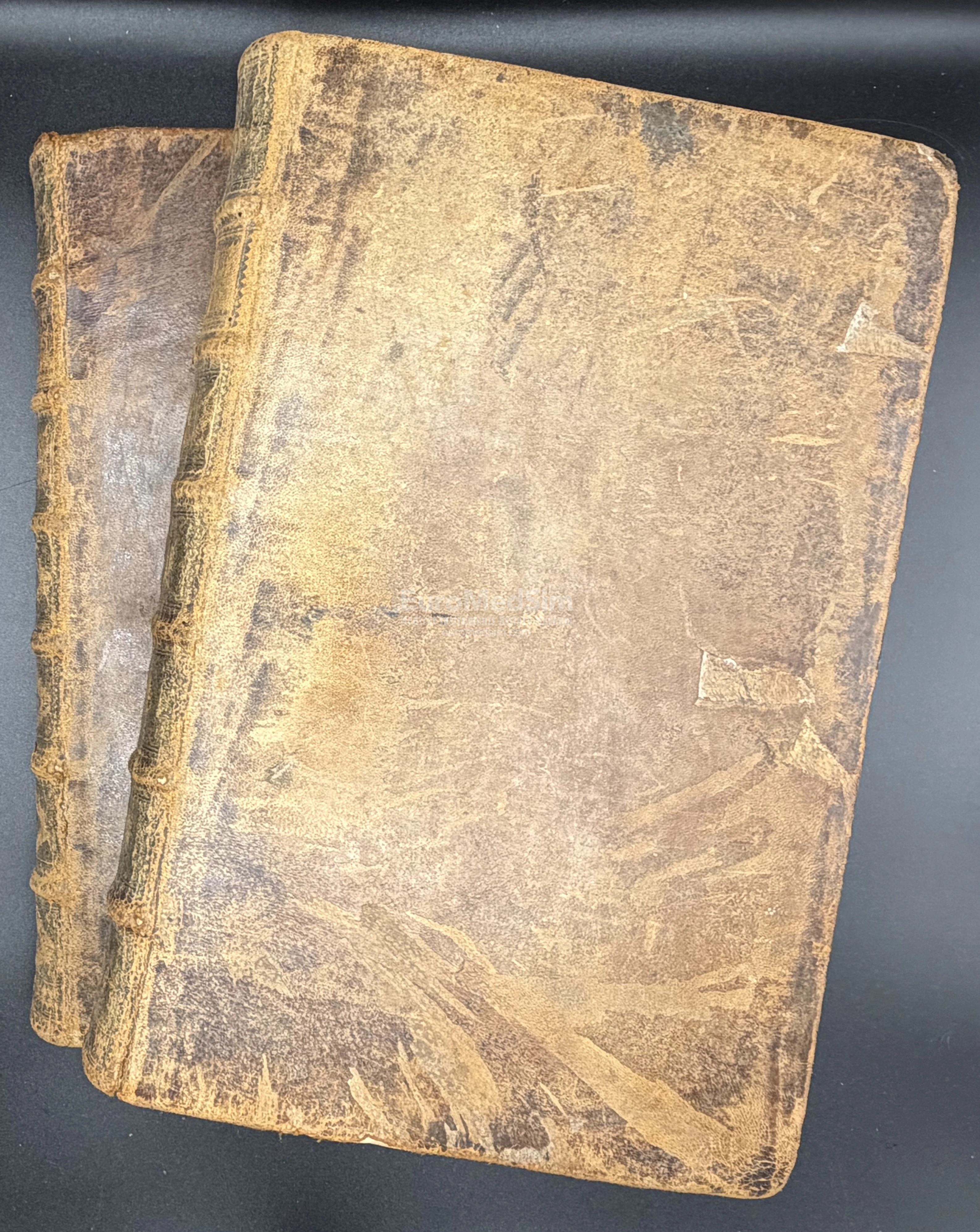
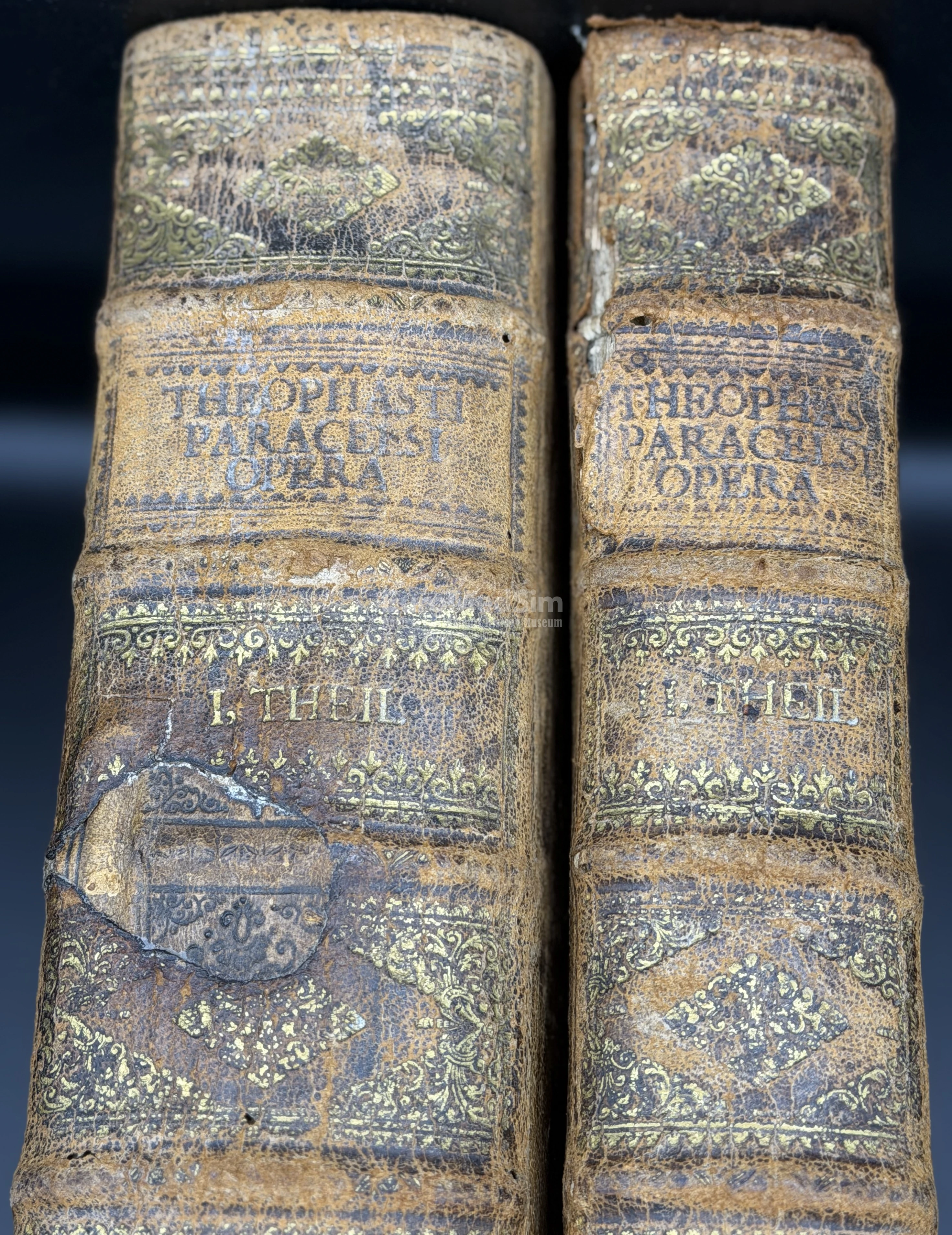
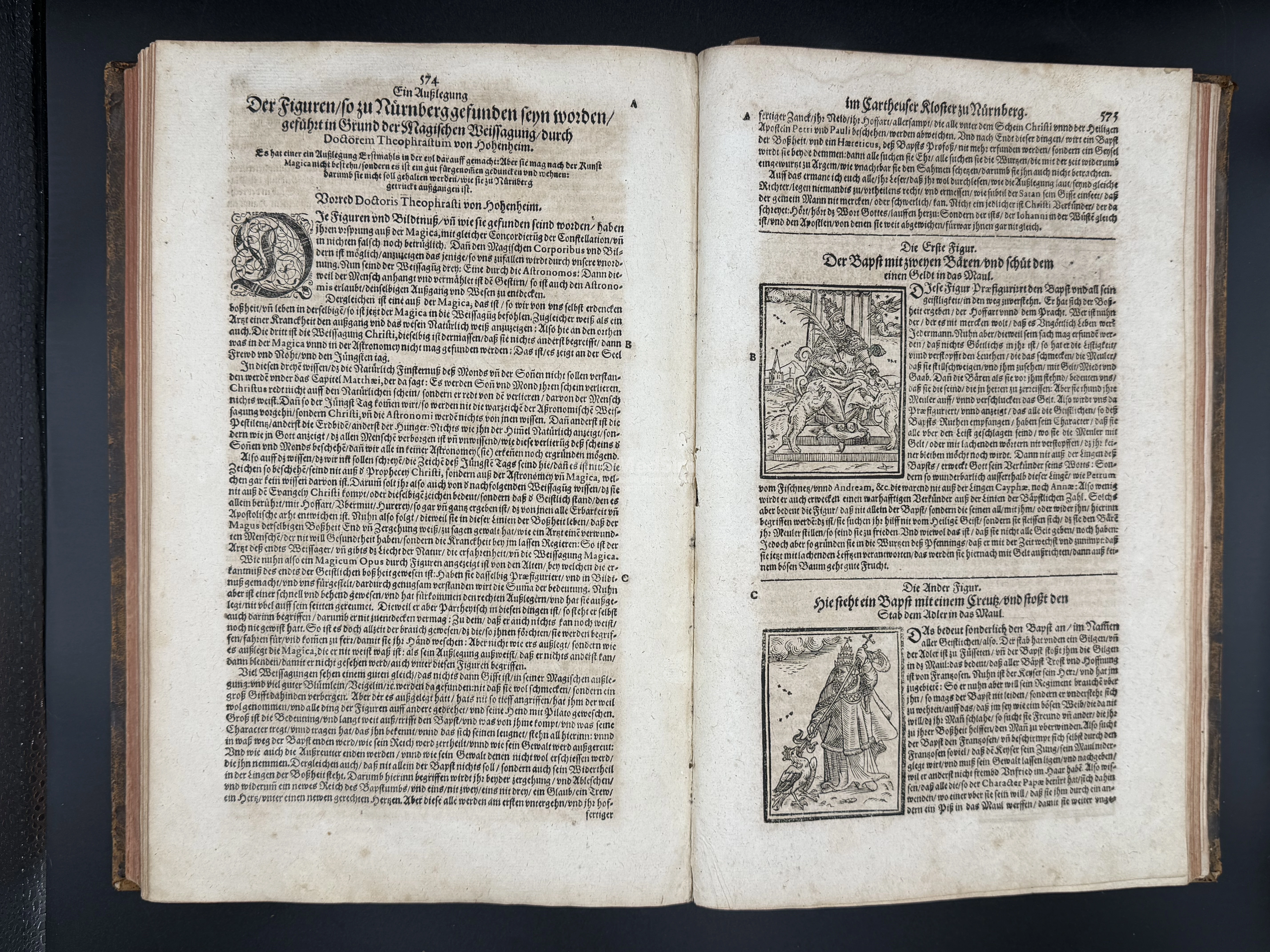
Binding: Contemporary leather bindings. 32.5 × 20.5 cm. Illustrations: With a wide woodcut title border, 32 figurative and numerous schematic woodcut illustrations in the text.
Colation: 6 leaves, 1127 pp., 24 (orig. 26) leaves; 4 leaves, 687 (of 691) pp., 6 leaves.
Condition: 2 text leaves at the end of the work replaced with copies, 2 index leaves missing, 3 text leaves with small edge tears (with minor text loss), somewhat browned and foxed, Vol. 1 has some larger ink stains on the top edge and spine (partly invisibly backed) and small tears on the bottom edge; the last index page has a tear and is completely backed. Binding is scuffed; one spine is torn at the outer joint and has a small loss on the upper head. The first volume: dimensions HxWxD: 32.4 x 22.0 x 6.8 cm, weight 2701 g. The second volume: dimensions HxWxD: 32.5 x 22.0 x 5.0 cm, weight 1818 g. Total weight of the both volumes 4519 g.
Provenance
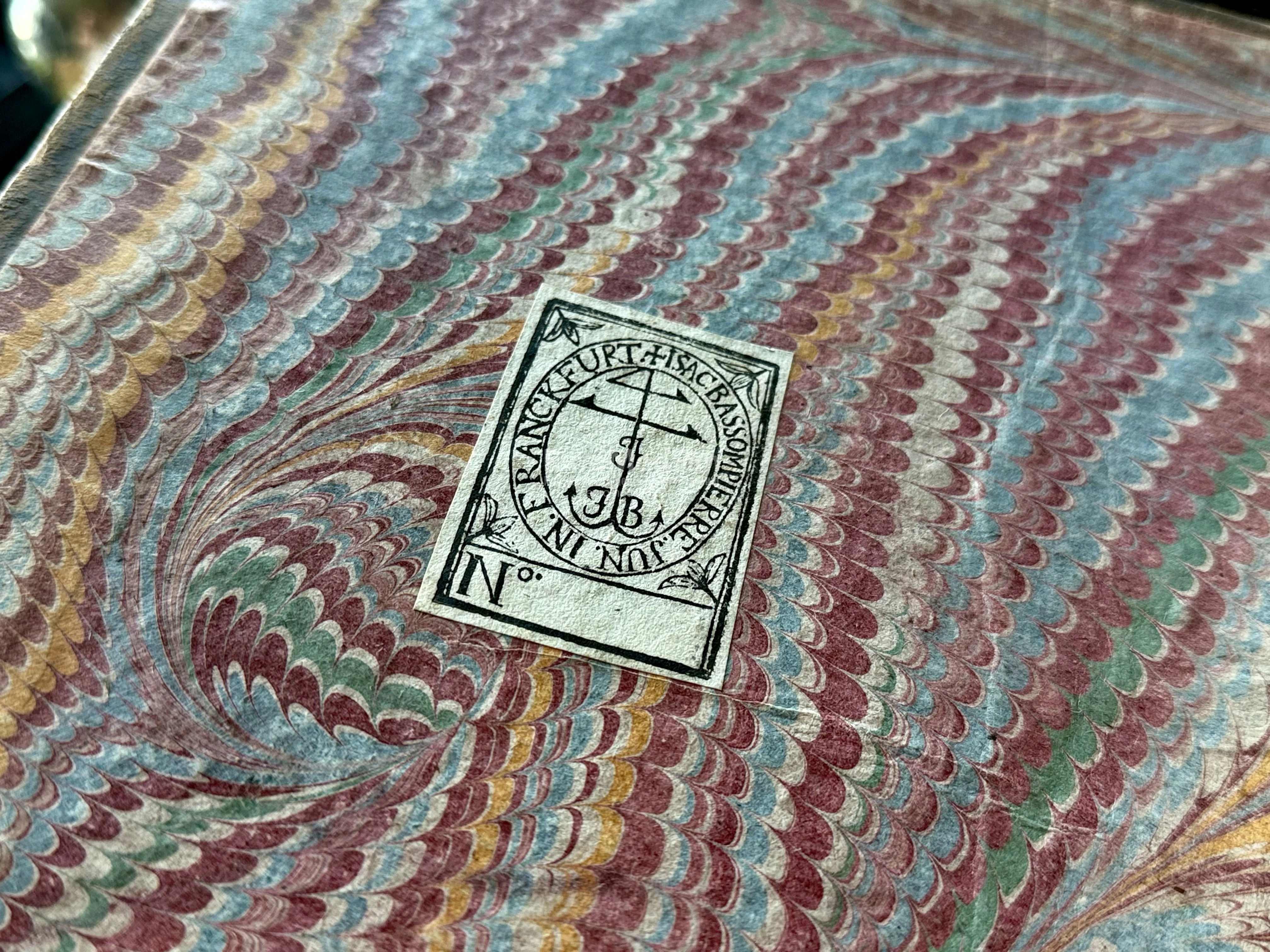
Title page with entries in 2 different handwritings (illegible). - Ex-libris of Isaac Bassompierre Jr. in Frankfurt (see Note on Bassompierre below)
Acquired from through Ketterer Kunst GmbH Auctions House, Hamburg, Germany, May 2023.
Literature
Sudhoff 256-257. - Krivatsy 8557. - Wellcome 4807-08. - VD 17, 12:168467C and 12:168390P.
Symbol, Matter, and Warning: Paracelsus’s Prophetic Cycle
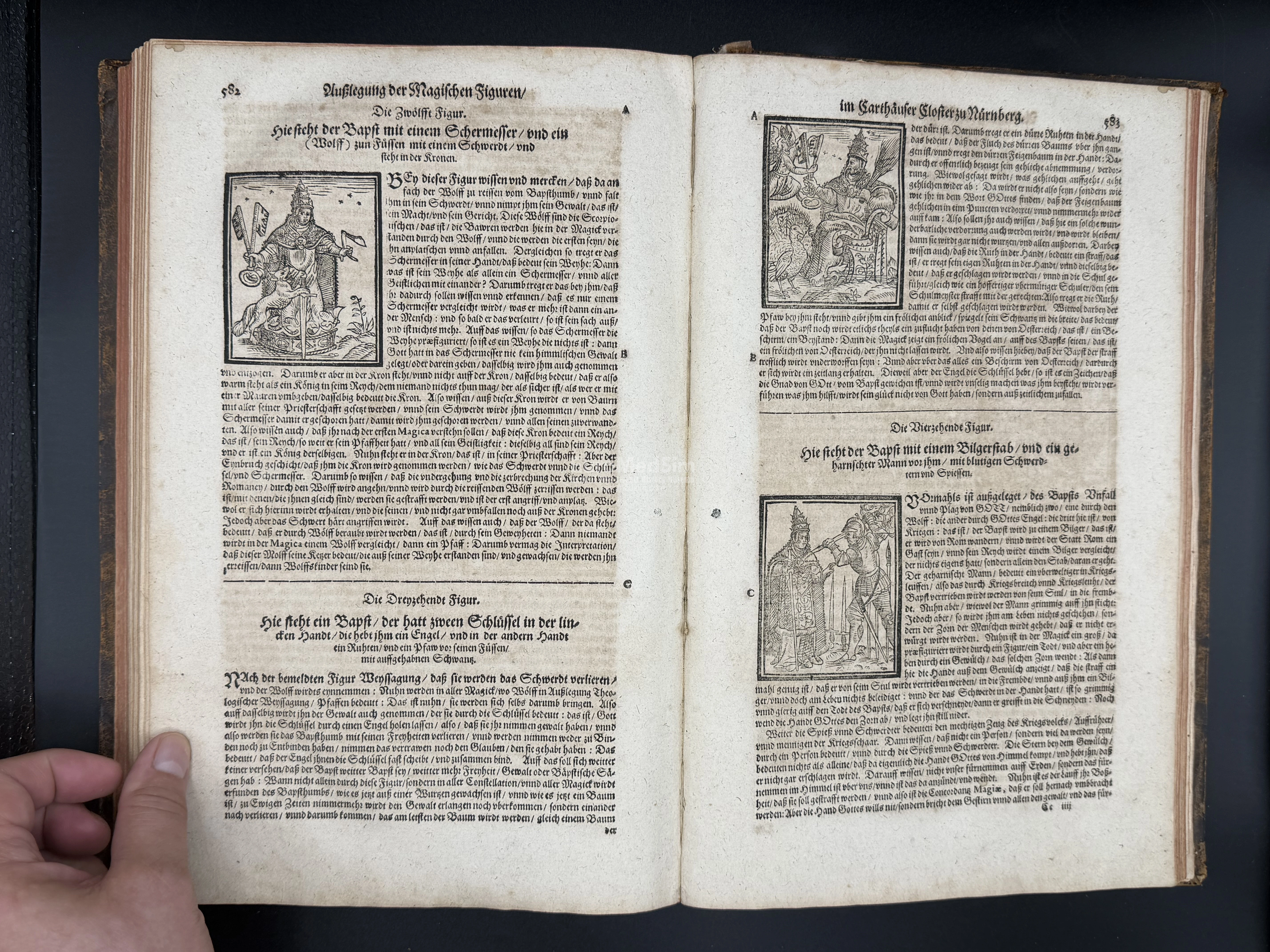
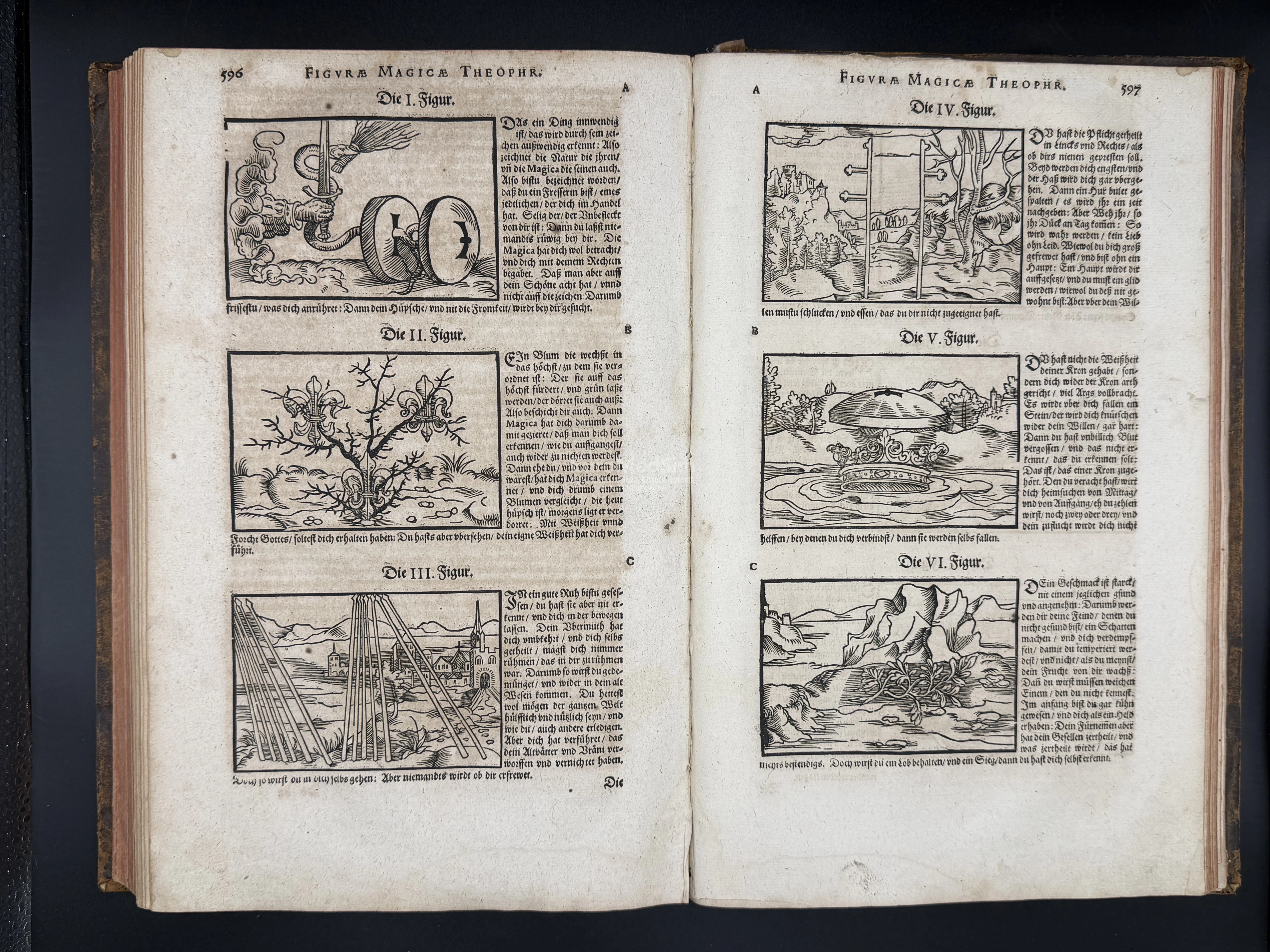
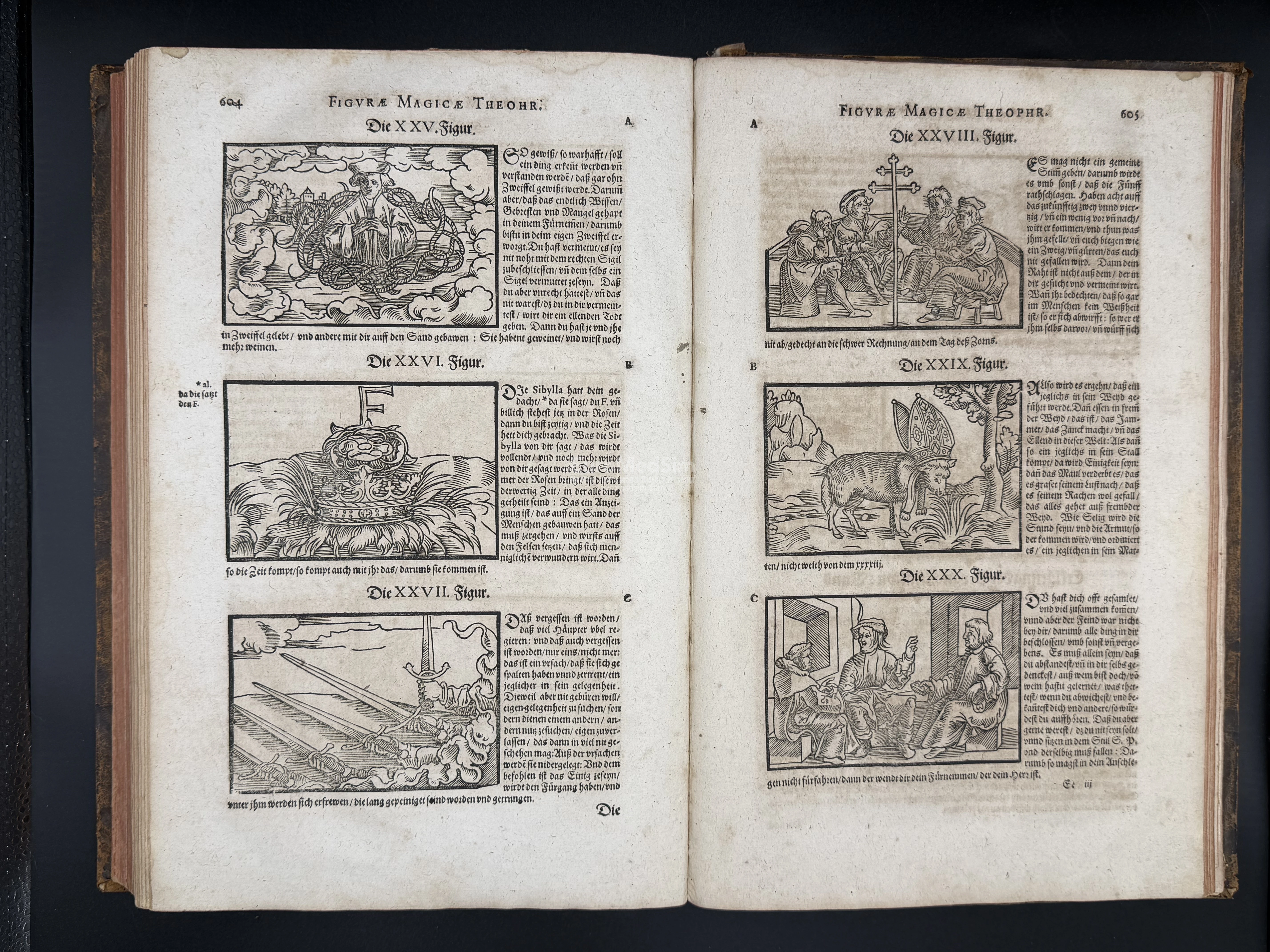
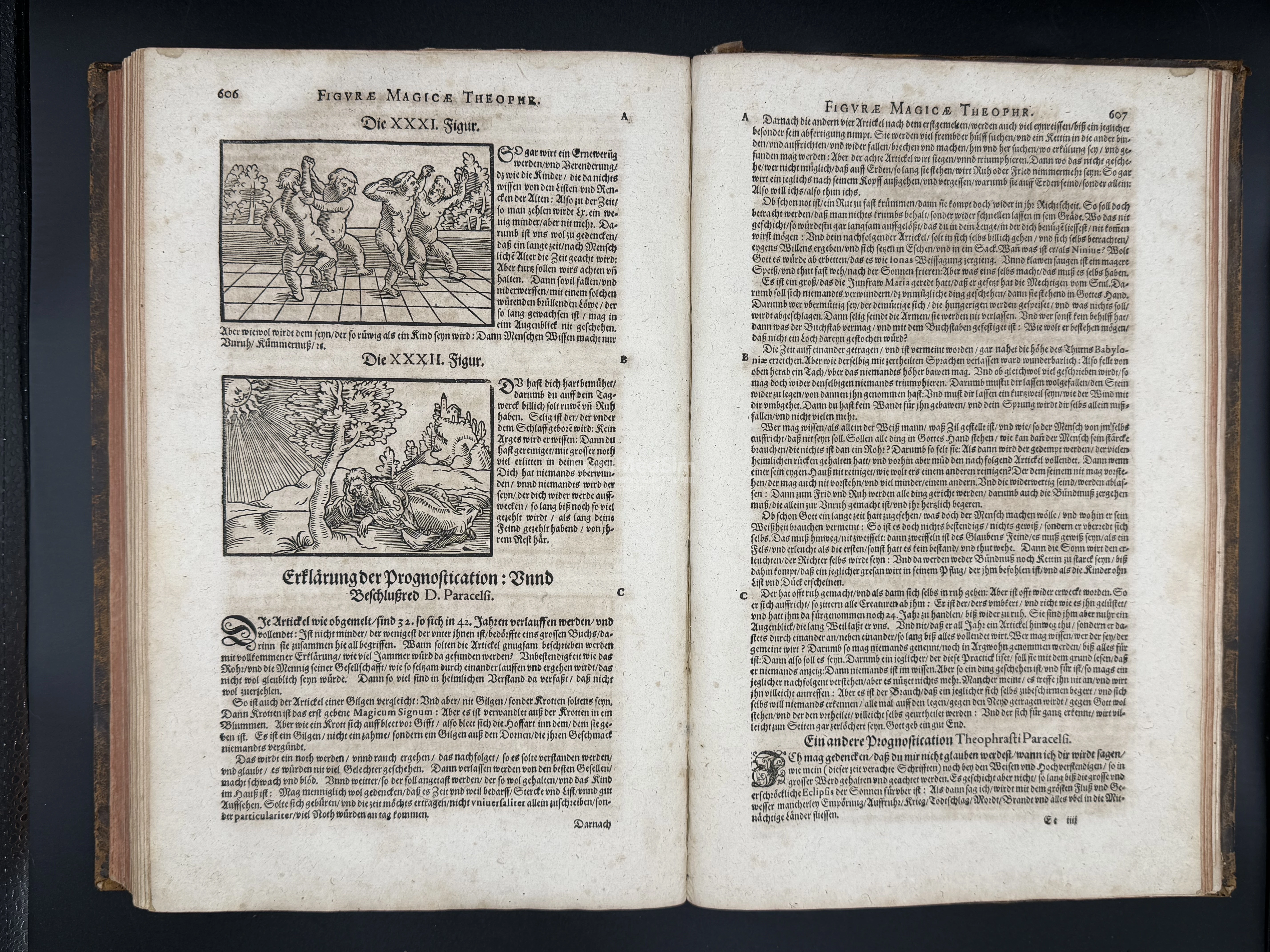
This page marks the beginning of Paracelsus’s so-called prophetic cycle, a series of 32 emblematic figures in which images and text form a unified system of prediction and interpretation. The Paracelsus’s prophetic cycle — Prognostication auff xxiiii. Jar zukünfftig, first printed in German in Augsburg in 1536; in later editions, the cycle is known as Prognosticatio eximii doctoris Theophrasti Paracelsi. Unlike linear prophecy, where the future is described directly, here meaning is revealed through symbols: objects, gestures, and strange combinations of images require deciphering. Such a cycle can be understood as a visual hermeneutics of history: Paracelsus presents the world not as a sequence of random events, but as a space of signs where political, moral, and cosmic processes are already marked by external signs. Therefore, each figure is not an illustration of a ready-made thesis, but an independent enigma in which the viewer must discern the hidden order of the future.
The first engraving depicts a small scene set within a landscape: among the trees and a fence stand two large circular structures resembling millstones or discs with slits. A snake winds its way in front of them; nearby, a hand holding a sword appears, emerging as if from a cloud or billowing smoke. One of the objects resembles a broom, a whisk, or a bundle of rods. The entire composition looks not like a domestic scene, but like an emblem: the objects exist here primarily as signs requiring interpretation. The title “Die I. Figur” immediately sets the order of reading: before us is the first figure in a prophetic or symbolic series.

The first figure from Paracelsus’s prophetic cycle is constructed as an enigmatic emblem: the viewer is presented not with a sequential narrative, but with a scene in which every object becomes a sign. This principle is explicitly stated in the text accompanying the image: “Was ein Ding inwendig ist,” that is, what a thing is on the inside, “das wird durch sein zeichen außwendig erkannt”—is recognized from the outside through its sign. Thus, the image invites us not merely to look, but to decipher: the external form must reveal the inner essence.
The central image is two millstones. They can be understood as forces in a tense relationship: top and bottom, power and the people, stable order and the movement of destruction. The millstone itself symbolizes not only labor and the processing of matter, but also pressure, grinding, and the inevitability of mechanical action. If one millstone moves against the other, the image that emerges is not one of creative labor, but of social or cosmic conflict.
The snake in this composition is not a mere ornament. It is a harbinger of hidden danger, a force that acts in a winding, indirect, yet destructive manner. In its mouth is a bundle of rods or a broom—a sign of punishment, coercion, and purification through violence. Therefore, the serpent here combines two meanings: treachery and retribution. It not only brings disorder but also carries an instrument of discipline, as if destruction itself becomes a form of judgment.
The sword emerging from the cloud reinforces this motif. It belongs not to a specific person, but to an almost impersonal, otherworldly hand. This may be a sign of supreme authority, historical retribution, or a punishing force that directs earthly events. Particularly significant here is the phrase: “Also zeichnet die Natur die ihren,” as well as its continuation: “und die Magica die seinen auch.” Nature and magic appear here as forces that impose special marks on things and people. These marks are not random: they indicate a hidden quality, danger, or destiny.
It is particularly important that the text next to the figure speaks not so much of the technique of divination as of moral discernment. Outward beauty, attractiveness, or apparent correctness may conceal danger. The bottom line reads: “dein hüpsche / und nit die Frommkeit / wird bey dir gesucht”—they seek beauty in you, not piety. This phrase shifts the symbolic scene onto a moral plane: the sign warns of the seduction of the external and the need to see what lies beneath the surface.
Therefore, this page is not merely an illustration of a prophecy, but a lesson in hermeneutics. Paracelsus’s world is structured like a book of symbols: things possess external signs because they possess an inner nature. The viewer’s task is not to trust first impressions, but to read the signs. The snake, the sword, the millstones, and the rods form a visual warning of hidden violence, conflict, and the deceptiveness of outward appearances. In such a system of thought, a person’s fate depends on the ability to correctly recognize these signs.

Pages 600-601 present six figures. The Fig. XV depicts three empty crowns without heads. There is nothing so good that it might not also become bad. “Ohn ein Haupt” (without a head) a kingdom, a church, or a community loses its proper or becomes dangerous.
Note on Bassompierre
Isaac de Bassompierre Jr. (Frankfurt am Main, fl. mid-18th century) was a Frankfurt Bürger und Handelsmann (merchant and citizen) belonging to the de Bassompierre family, a Huguenot dynasty of Lorraine origin that had settled in the Rhine region following the religious persecutions of the late sixteenth and early seventeenth centuries. His father, Isaac de Bassompierre Sr. (1619–1677), was born in Frankenthal and died in Hanau; the family subsequently established itself in Frankfurt am Main, where it engaged in trade and commerce. Isaac Jr. is documented in Frankfurt archival records in connection with an inheritance settlement dated 1 February 1759, in which he appears among the principal heirs following his father's death. The de Bassompierres were part of the wider community of Reformed (Calvinist) merchant families of French and Walloon descent who played a significant role in Frankfurt's commercial life throughout the seventeenth and eighteenth centuries.
This Strasbourg 1603 folio of Paracelsus most likely reached Isaac de Bassompierre Jr. through family inheritance. The de Bassompierres were a Huguenot merchant dynasty with strong ties to the Rhine region, where Strasbourg served as a major centre of Reformed scholarship and book production. Paracelsian medicine held a particular appeal in Calvinist intellectual circles, and a folio of his collected works would have been a natural acquisition for an educated merchant family of the early seventeenth century. Passed down through generations alongside other valuables — as documented in the family's 1759 estate records — the volume found its permanent home in the library of one of Frankfurt's prominent Huguenot trading families.