Kaiserswerther Diakonie Pflegemuseum (Museum of Nursing)
Kaiserswerther Diakonie
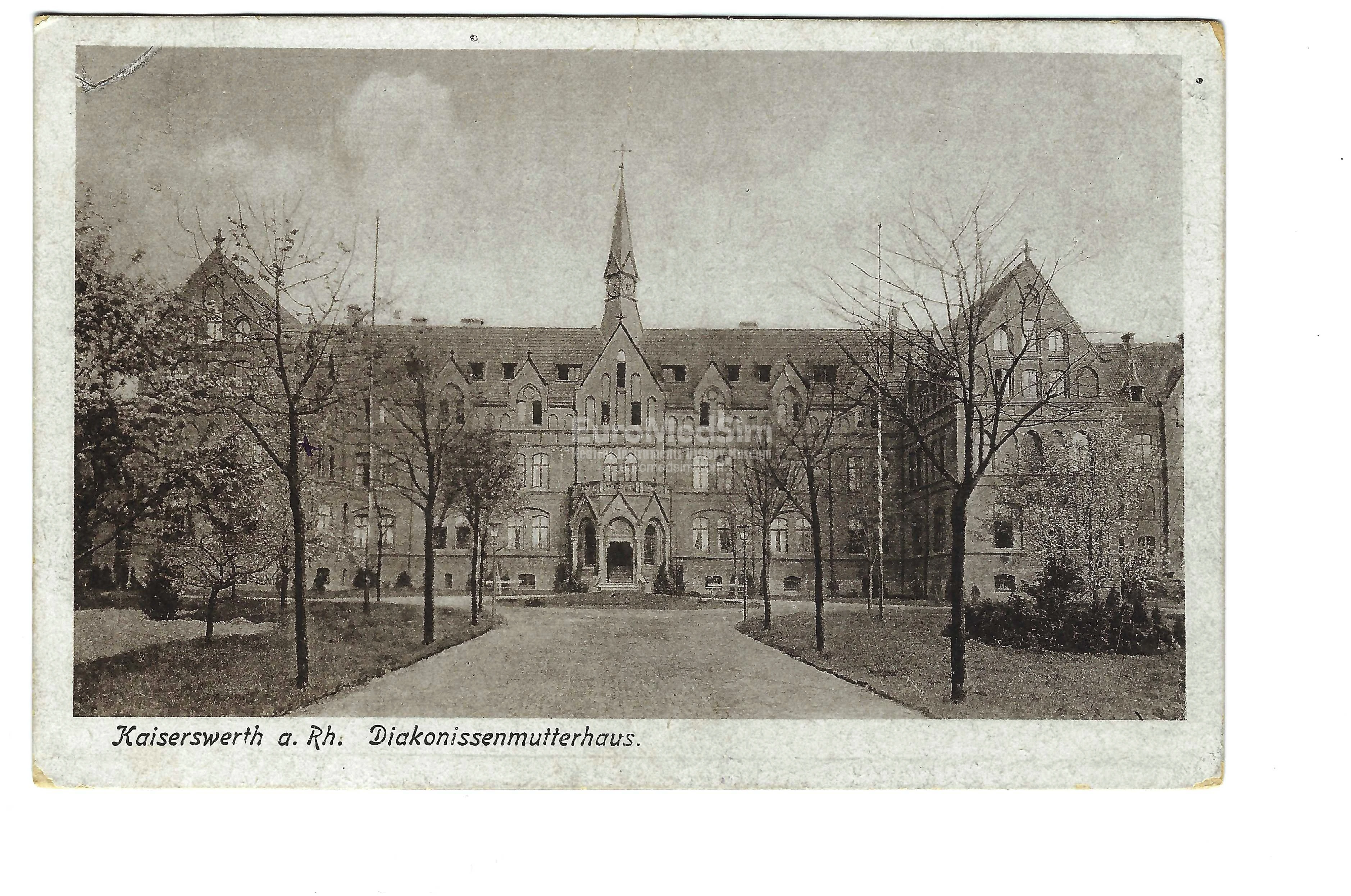
The Kaiserswerth Diaconate (Diakonie) is an Evangelical community of sisters of mercy founded in 1836 by Pastor Theodor Fliedner and his wife, Frederieke Fliedner. After the purchase of the main house of the Petersen manufactory they established what would later become the Diaconess Institute there. Starting with the purchase of a single house, the institution quickly grew into a multifunctional complex that included a hospital, a kindergarten, a school for nursery teachers, an orphanage, a correctional facility for women, and a teachers’ seminary. Thus, the name “Stammhaus” (Main house) became particularly apt, as this building is also the main house of today’s Kaiserswerther Diakonie. In 1843, they ware also able to create a church space, which is now the Stammhauskirche (today, the Kaiserswerther Diakonie’s church serves as a cultural church), and the central building has taken on a new name—Mutterhaus— Mother House, where the deaconesses lived and studied.
The main goal of the diaconate was not merely charity, but the professional training of women in caring for the sick, raising children, and teaching. Candidates underwent a lengthy probationary period (ranging from six months to three years), during which they lived in the community, observed strict discipline, and acquired practical skills. After their ordination, they became full-fledged deaconesses, working in hospitals, shelters, and other institutions; in the event of illness or old age, they could return to the Mother House, which served as a reliable support for them. The sisters did not receive a salary in the conventional sense, but were provided with room, clothing, and food—this weeded out those seeking personal gain and attracted only those sincerely devoted to the cause.
The Kaiserswerth Hospital was designed with great attention to comfort and propriety: the wards were small, the men’s and women’s sections were separate, and the men were cared for by specially trained orderlies to avoid any awkwardness. However, the hospital’s primary function was educational—it served as a training ground for nurses, not merely a medical facility.
The reputation of the diaconate quickly spread throughout Europe. One of its most famous students was Florence Nightingale, who visited the Kaiserswerth institution twice and completed a three-month internship in 1851. She described her training in a book, praising the dedication of Fliedner and his staff, who had created such an effective institution with limited resources. Later, during the Crimean War, Nightingale applied the skills she had acquired on the battlefield, and upon returning to England, she founded the first secular nursing school, thereby reforming the entire system of patient care.
Thus, the Kaiserswerth diaconate became not only a model for many Protestant countries but also an important source of inspiration for the creation of the modern nursing system. By the end of the 19th century, similar communities had emerged throughout Europe, America and Russia, and the legacy of Kaiserswerth lives on in church social work. Today, the Diaconate remains an active institution, and it houses a Pflegemuseum (Museum of Nursing) and a 4-stars Hotel Mutterhaus .
Florence Nightingale — famous pupil of Kaiserswerth
The fame of the Diaconate spread rapidly throughout all the German states and beyond. Florence Nightingale, who is revered in English-speaking countries as nothing less than the “Founder of Nursing” visited Kaiserswerth twice. She first arrived in 1850 to get to know the community, and returned in 1851 to begin her full-fledged training, spending about three months at the Deaconess Hospital. The decision was not an easy one for her: coming from a wealthy aristocratic family, she defied her family’s wishes to pursue a career as a nurse. In Kaiserswerth, she acquired her first systematic nursing skills, and this experience proved to be a defining moment for her.
Nightingale recorded her impressions and in the same 1851 year published the book "The Kaiserswerth Institution on the Rhine for the Practical Training of Deaconesses", which became her first publication . The book contains numerous detailed descriptions of the Diakonie’s activities and expresses sincere admiration for the pastor and his colleagues, who managed to establish such a training and practical institution in such a short time and with limited financial resources.
In 1854, during the Crimean War, Nightingale applied the knowledge she had gained on the battlefields. In Scutari, Turkey, she and her team of 38 nurses encountered appalling unsanitary conditions, where ten times as many soldiers were dying from disease as from wounds. Using methods that were simple yet revolutionary for the time—strict cleanliness, regular ventilation, and a nutritious diet—she managed to halve the mortality rate in the hospitals. Upon her return to England in 1860, she founded the Nightingale School at St. Thomas’s Hospital in London, where nursing became, for the first time, a fully-fledged secular profession with scientifically grounded training. Thus, the experience at Kaiserswerth—both positive and negative—directly influenced the creation of the modern nursing system, which spread far beyond the borders of Britain.
So, Nightingale wrote about history of the Diaconate in the following words: "M.Fliedner a pastor of the Kaiserswerth protestant community "formed ... in 1826, the first German society for improving prison discipline. He soon perceived how desolate is the situation of the woman, who, released from prison, but often without the means of subsistence is, as it were, violently forced back into crime... he began his work in September, 1833, in a small summer-house in his garden... The Infant school was the next branch of the Institution, which was added in May, 1836, under a first-rate infant schoolmistress, Henrietta Frickenhaus… In October, of the same year, induced partly by the general feeling of the great deficiency of good nurses, partly by regret at seeing how much good female power was wasted, and also by the fact that the volunteers, who had come forward for the first Institution, warted a further field for the education of their faculties, Pastor Fliedner established a hospital (with one patient, one nurse, and a cook)... The nurse, now the Deaconess Reichardt ... (was) invaluable in conducting the devotions of the male patients, who look up to her as a mother, and in instructing and advising the probationers and younger Deaconesses. During the first year, the number of nurses thus volunteering, had increased to seven, but these were submitted to a probation of six months... From fifteen to eighteen patients were now received, so that the number of those nursed during the first year, in the Institution, amounted to sixty, besides twenty-eight at their own homes. The hospital having been established chiefly as a school for training the Deaconesses, all kinds of sick were received, though the proportion of recoveries thus afforded a less brilliant list at the close of the year.
Behind the present hospital is a large enclosed court, with outbuildings; and again, behind that, a walled garden, of about an acre, fit for the use of the patients. Beyond, lies a row of small. houses, which Pastor Fliedner has hired, and in which the different branches of his Institution were established, as they arose. First, on the right, is the Infant School, which numbers about forty children, and almost as many young women, training for infant schoolmistresses. Next to the infant school is the Penitentiary. Here the Institution, which sprung, in 1833, from the small beginning in the summer-house, was transplanted. It has now a large garden and field behind, stretching beyond the infant school, with farm yard and outbuildings.Thirdly, comes the Orphan Asylum, where two families, twelve in each, of orphans, -chiefly the daughtersof clergymen, missionaries, schoolmasters, and other respectable parents, live with their respective Deaconesses. These take the entire care of the children committed to their charge, sleep with them, eat with them, and instruct them in household work.
Next to the infant school is the Penitentiary. Here the Institution, which sprung, in 1833, from the small beginning in the summer-house, was transplanted. It has now a large garden and field behind, stretching beyond the infant school, with farm yard and outbuildings. Thirdly, comes the Orphan Asylum, where two families, twelve in each, of orphans, -chiefly the daughtersof clergymen, missionaries, schoolmasters, and other respectable parents, live with their respective Deaconesses. These take the entire care of the children committed to their charge, sleep with them, eat with them, and instruct them in household work.
This Institution is meant to become a nursery ground for future Deaconesses and teachers. Connected with it is the Seminary (Norinal school) for industrial, day, and infant schoolmistresses, who here receive a practical education in learning to teach (passing through the orphan asylum, the infant school, the parish day school, and the children's wards in the hospital), a theoretical education from a first-rate master, and some excellent female teachers, in every branch of knowledge necessary to them, and a religious education from the pastor himself, and an assistant clergyman."
"We see by these details, how, with small funds, without a competition of architects, or vast plans for a "new and convenient" erection, using only the means and the buildings near at hand, the present Institution grew and flourished. It is impossible not to observe how different was this beginning from the way in which institutions are generally founded a list of subscribers with some royal and noble names at the head-a double column of rules and regulations-a committee of great names begin (and end) most new enterprises. The regulations are made without experience. Honorary members abound, but where are the working ones? The scheme is excellent, but what are the results?
Pastor Fliedner began his work with two beds under a roof, not with a castle in the air, and Kaiserswerth is now diffusing its blessings and its Deaconesses over almost every Protestant land. We have seen its beginning; let us now turn to its present state."
The Hospital And Mother-House Of The Deaconesses
The next chapter of her book was devoted to the description of the current state. She wrote: "The hospital contains above 100 beds, and is divided into four departments for men, for women, for boys, and for children, which last includes girls under seventeen, and boys under six years of age. The wards are all small. This gives, it is true, more trouble, but also, far more decency and comfort. None of the female wards have more than four beds. When an examination takes place, or when a particular case requires it, the patient can thus easily have a ward to herself. In no private house is decorum more observed than in this hospital, and the influence this continues to exercise upon the patients after their return home, can well be believed.
The male wards are served by men-nurses, of whom there are five, who have been educated in the hospital, and are under the authority of the sisters. After 8 P.M., no sister goes into the men's wards; the men-nurses sleep in the wards, and sit up in case of need. Even in the boys' ward the sister does not sleep. No sister is called upon to do anything for a male patient but that which, in a private house, a lady would perform for a brother. Everything else is done by the men-nurses, who, brought up in this atmosphere, have always been found faithful and careful. The most fastidious could find nothing to object to in the intercourse which takes place between patient, surgeon, and sisters.
But we are not describing the Hospital as a hospital, but as a Training School for the Deaconesses. Probation is its grand principle... A period of from one to three years is allowed for probation. As nothing is offered to the sisters, neither the prospect of saving money, nor reputation, nothing but the opportunity of working in the cause for which Christ worked and still works; so, if this does not appear to be their ruling principle, they are dismissed, however painful to the Pastor. They are also at liberty to leave any day. The probationary sister receives nothing for six months, but food and lodging; after that, a small salary. The Deaconesses, that is, those who, after their probation, have received a solemn blessing in the church, are paid, but only sufficient to keep them in clothes.
Board, lodging, and the Deaconess's upper dress are given to them. There is therefore no pecuniary inducement to come to this work; but a provision is secured for those who have become ill or infirm in the service, to whom the "Mother-house" always opens her arms. "You have been wounded with honour in the field," as the Pastor said one day to a Deaconess, about to undergo a painful operation. No establishment can subsist, which does not offer this prospect to those who have disinterestedly spent the best years of life in its service. And it is beautiful to see the attachment which the Deaconesses of Kaisersworth feel to their " Mother-house."
The Institution stands in the place of a parent to the Deaconesses, who have been sent out to other establishments, such as Hospitals, Poor-houses, &c. It has the right of recalling them, without giving any reason to the directors who have, on the other hand, the right of dismissing sisters and of asking for others... The Deaconess has a vote on the reception of a new sister into the Institution, and in the choice of a superintendent."
Literature References
Nightingale, Florence. The institution of Kaiserswerth on the Rhine, for the practical training of deaconesses, under the direction of the Rev. Pastor Fliedner, embracing the support and care of a hospital, infant and industrial schools, and a female penitentiary. London : 1851. Full-text link
Schmidt, Jutta. Beruf: Schwester: Mutterhausdiakonie im 19. Jahrhundert. Frankfurt am Main : Campus, 1998.