Military Hospital Pharmacy in Thorn
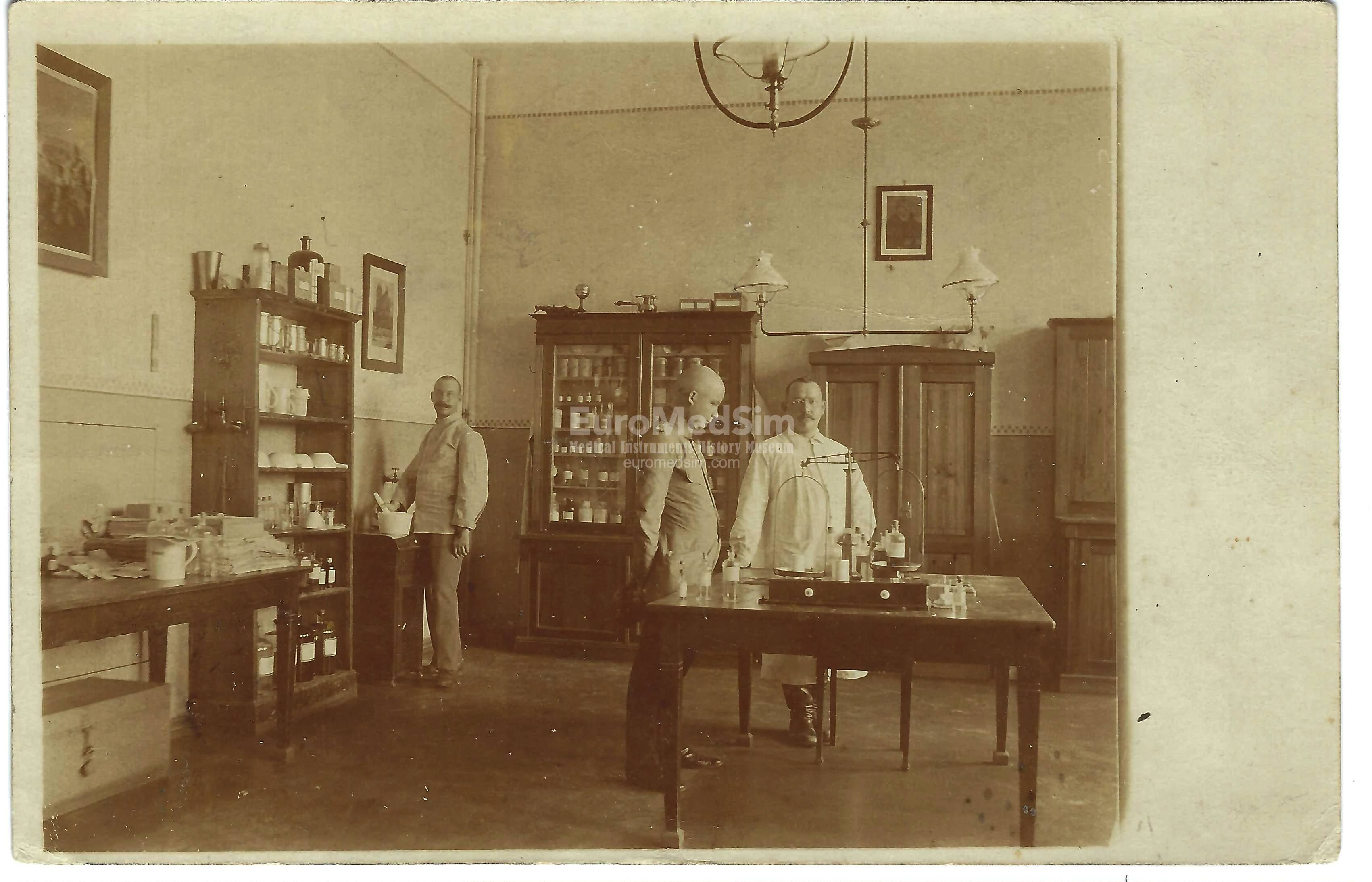
This postcard depicts a pharmacy associated with the military hospital service in in German Thorn (now Toruń, Poland) during the First World War. Its identification rests on the combination of the photograph, the handwritten place-name, the hospital handstamp and the sender’s account of his employment. He explicitly calls the room his Offizin, the pharmacy’s dispensing and compounding area, and describes serving two very large military hospitals and a smaller one.
Thorn was the German name of the city now known as Toruń in Poland, UNESCO Heritage city. In 1915 it belonged to Prussia within the German Empire and was an important fortress and garrison town. Its extensive military infrastructure provides the setting for the hospital pharmacy recorded here.
Description of the Front Side — Recto
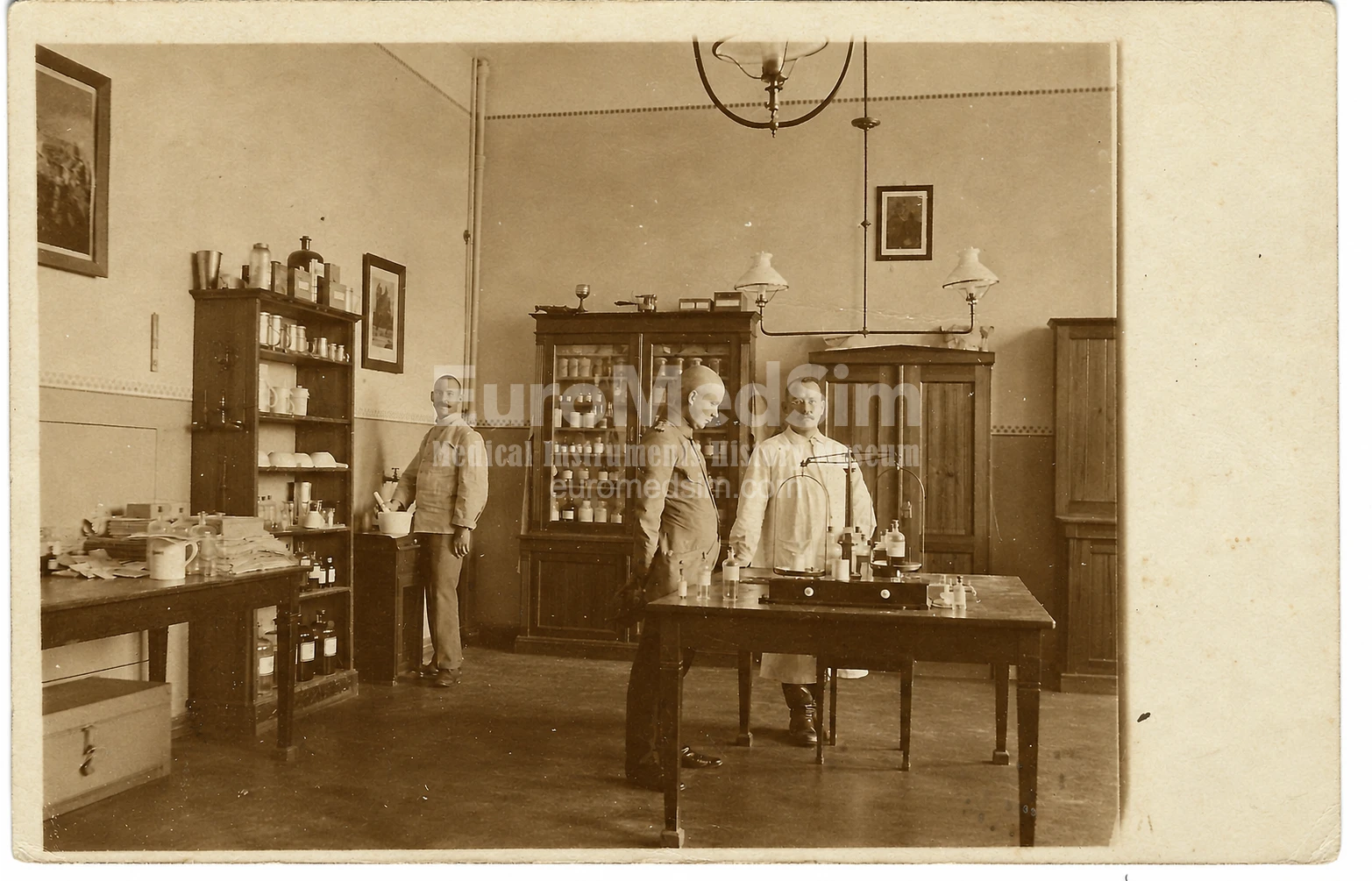
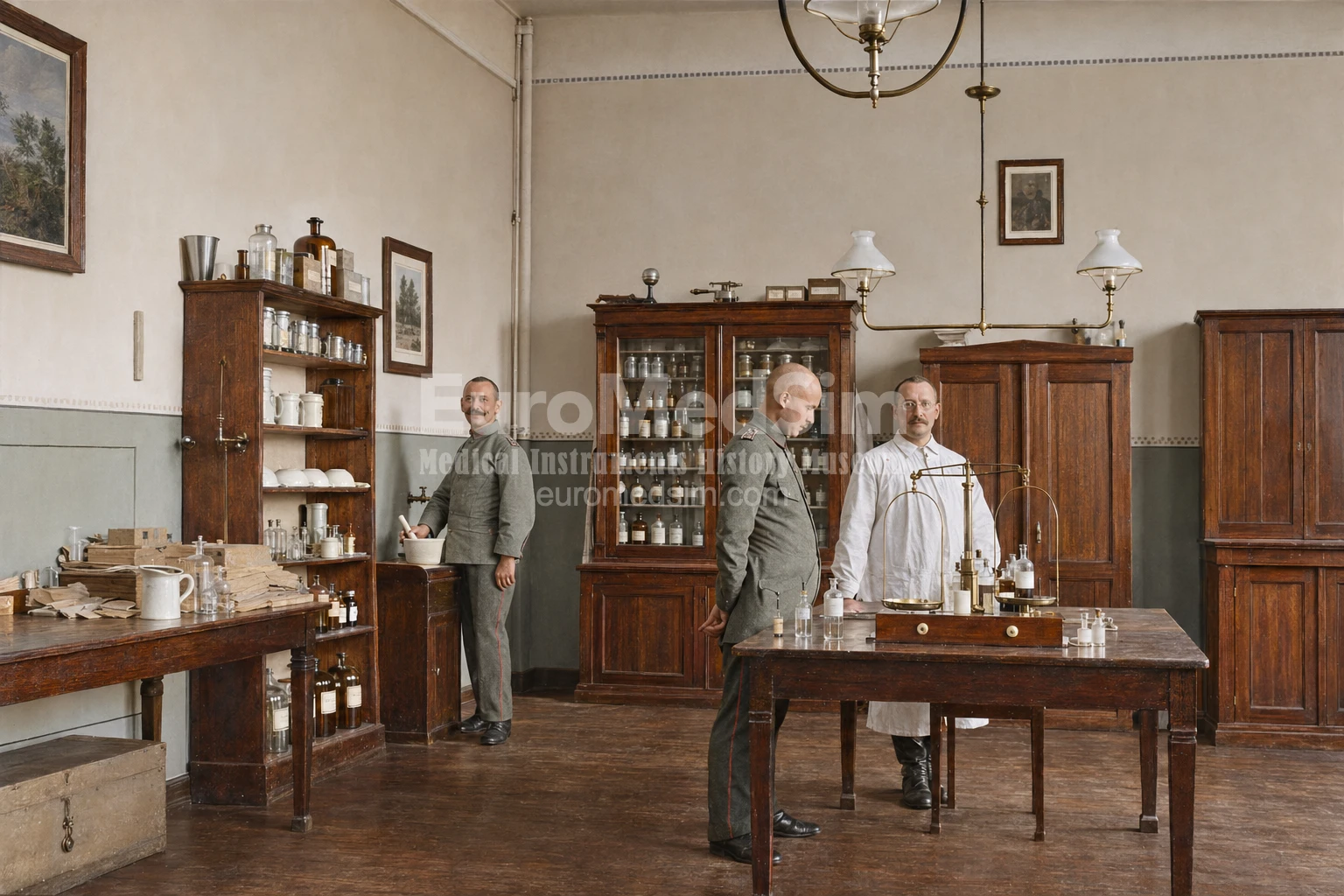
The photograph shows a spacious room with high ceilings, wooden flooring, tall storage furniture and substantial worktables. Three men occupy different positions within the pharmacy. At the left, a moustached man in military uniform holds a mortar with a pestle. A second uniformed man stands in the centre, turned towards the foreground table, with his hands behind his back. On the right, a moustached man wearing spectacles and a white working coat stands behind a large balance. Their individual names and precise ranks cannot be established from the photograph.
The equal-arm balance is the principal instrument in the foreground. Its two suspended pans hang above a rectangular wooden base fitted with drawers. Bottles, cylindrical containers and small vessels are arranged around it. Together with the mortar, the balance illustrates two central operations of pharmacy practice: weighing ingredients and preparing compounded medicines.
An open shelving unit at the left contains white ceramic vessels, bottles and bowls, with larger labelled bottles stored below. A tall glazed cabinet against the rear wall holds further rows of jars and bottles. Their labels are too small to support reliable identification of individual substances. The left workbench carries additional glassware, papers and a jug.
Pipe-fed pendant lamps with glass shades hang above the working area. Framed pictures and narrow decorative wall borders soften the otherwise practical interior. The photograph records an established, furnished workplace with substantial storage and preparation facilities. Although the message also mentions bacteriological duties, their equipment and location cannot be determined from this view.
Description of the Reverse Side — Verso
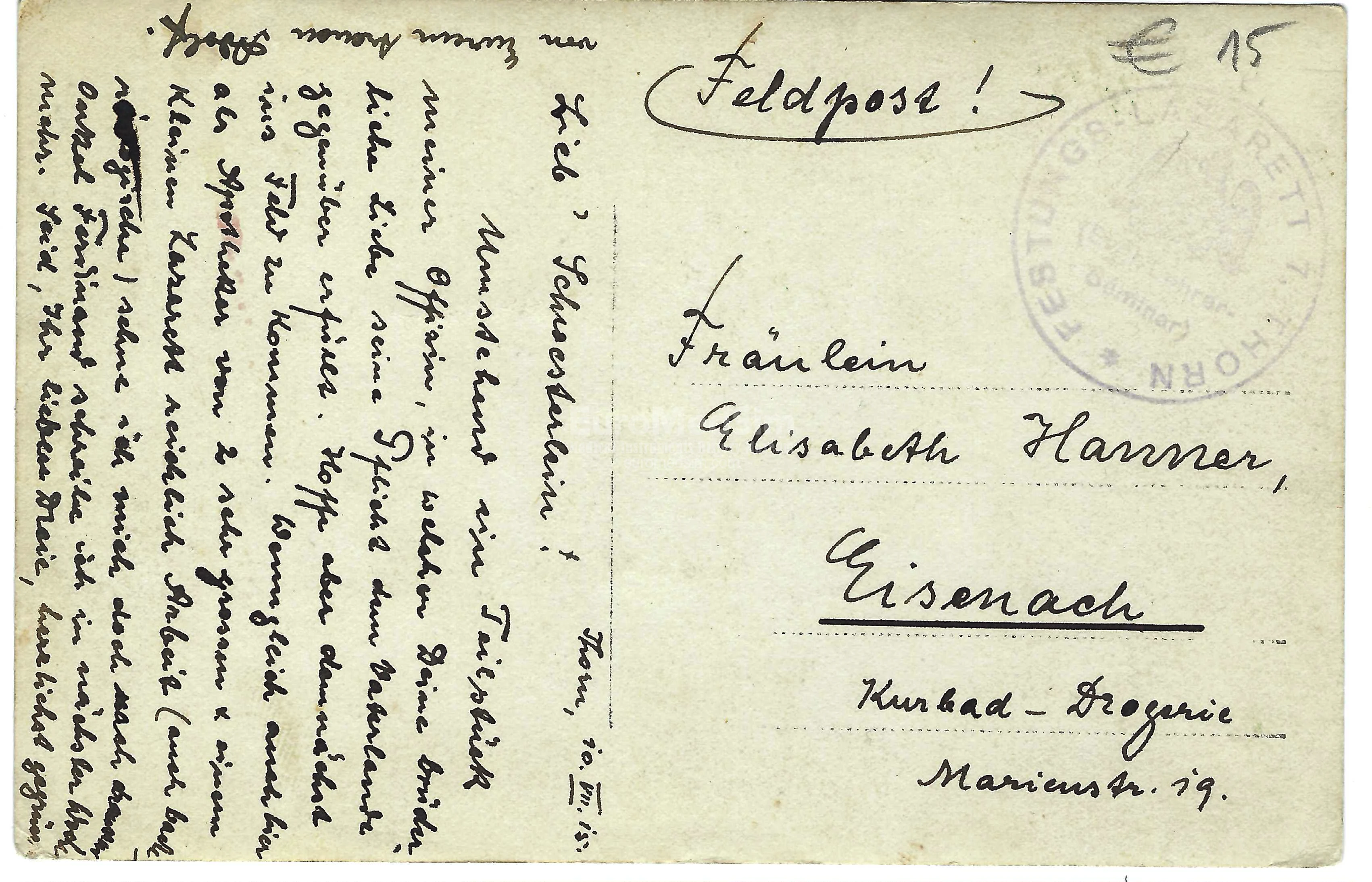
The reverse is divided between correspondence on the left and the address on the right. The message is written at right angles to the address. Above the address appears the emphatically underlined heading Feldpost! — military mail.
The recipient is Elisabeth Hammer, addressed as Fräulein, in Eisenach. The remaining address reads Kurbad-Drogerie, Marienstr. 19. This is a transcription of the card; it does not by itself establish the recipient’s occupation or her relationship to the business.
A faint circular violet handstamp includes the words Festungs-Lazarett and Thorn, identifying the fortress hospital. Its inner wording is insufficiently clear for a complete transcription. The pencilled €15 in the upper corner appears to be a much later sale-price annotation, unrelated to the original correspondence. The dateline appears to read Thorn, 10. VII. 15, interpreted as 10 July 1915. The place, year as well as signature Adolf are clear readable. The text on the postcard is written vertically on the left side and the last line is upside down.
Thorn, 10.VII.15.
Lieb’ Schwesterlein!
Umstehend ein Teilstück
meiner Offizin, in welcher Deine brüder-
liche Liebe seine Pflicht dem Vaterlande
gegenüber erfüllt. Hoffe aber demnächst
ins Feld zu kommen. Wenngleich auch hier
als Apotheker von 2 sehr grossen & einem
kleinen Lazarett reichlich Arbeit (auch bakte-
riologische) sehne ich mich doch nach draussen.
Onkel Ferdinand schreibe ich im nächsten Briefe
mehr. Seid, Ihr lieben Drei, herzlichst gegrüsst,
von Eurem treuen Adolf.
Translation:
Thorn, July 10, 1915.
Dear little sister!
Here is a glimpse of
my pharmacy, where your brother’s
love fulfills his duty to the fatherland.
But I hope to get into the field soon. Even though here
as the pharmacist for two very large and one
small military hospital, I have plenty of work (including bacte-
riological work), I do long to be outside.
I’ll write more to Uncle Ferdinand in my next letter.
Warmest regards to all three of you,
from your faithful Adolf.
Address and postal remarks
Feldpost!
Fräulein
Elisabeth Hammer,
Eisenach
Kurbad-Drogerie
Marienstr. 19.
Circular handstamp reading шnscription around the edge of the stamp ‘FESTUNG-LAZARETT THORN’, with a faint central figure, possibly an eagle, and an indistinct inner inscription tentatively read as ‘Evan.Lehrer. Seminar’.
The affectionate opening, Lieb’ Schwesterlein!, addresses the recipient as the writer’s "dear little sister". The connection between photograph and message is explicit:
Umstehend ein Teilstück meiner Offizin …
“On the other side, a section of my dispensary …”
The most informative passage describes his workload. In a lightly normalised transcription, the legible wording includes:
… als Apotheker von 2 sehr grossen und einem kleinen Lazarett reichlich Arbeit (auch bakteriologische) …
“… plenty of work as pharmacist to two very large military hospitals and one small one, including bacteriological work …”
Despite these responsibilities, he hopes soon to go into the field and writes that he longs to get out there. He also mentions writing to Uncle Ferdinand and ends with affectionate greetings to three family members.
The reference to bacteriological work is particularly valuable. It documents the sender’s participation in laboratory duties alongside pharmacy service, although it does not specify the tests he performed. His desire for a field posting also gives the orderly interior a personal context: the writer presents his current service as useful and demanding, while expressing a wish to serve closer to military operations.
Historical Context
German military pharmacists during the First World War undertook a broad range of duties. These included supplying medicines and dressings, preparing pharmaceutical products, checking the quality of materials and carrying out chemical examinations. Their work supported hospitals and medical units through both practical preparation and the organisation of supplies.[2]
The breadth of the profession is reflected in the contemporary collection edited by Gustav Devin, published in 1920. Its contents include separate sections on hospital pharmacies and chemical examination services, alongside medical depots and pharmacy work in operational areas.[3] The postcard offers an individual account within this wider professional history: one pharmacist describes responsibilities spanning three hospitals and bacteriological work.
The inner inscription on the hospital handstamp, Evan. Lehrer. Seminar., abbreviates Evangelisches Lehrerseminar — the Evangelical teacher-training college. Independent confirmation of this institution’s connection with military medical care appears in the documentary biography of Fritz Dasecke, published by the Stiftung Sächsische Gedenkstätten. It records his admission on 18 July 1916, following a severe gunshot wound, to the Festungslazarett „Evangelisches Lehrerseminar“ in Thorn. On 18 August he was transferred to Reserve Hospital II in Leipzig.[4]
The matching designation strongly supports the interpretation that the seminary’s premises accommodated a military hospital or a branch of Thorn’s fortress hospital service. The postcard associates this designation with 1915, while the independently documented patient history confirms its use in 1916. The precise location of the photographed pharmacy nevertheless remains uncertain: the sender describes responsibility for three military hospitals, so the dispensary could have served several establishments from another location.
The postcard combines a detailed view of a pharmacy interior with testimony from someone who worked there. The inscription supplies information that the photograph alone could not establish: the city, the year, the writer’s profession, the number of hospitals he served and his additional laboratory duties. A workplace photograph becomes a means of showing a sister where her brother is serving and explaining what he does. The balance, mortar and medicine cabinets record the material setting of wartime pharmacy; the message preserves the professional responsibilities and aspirations of one of its practitioners.
Condition
Warm brown toning, scattered spots, small surface abrasions and wear along the edges and corners. The photograph retains substantial detail in the furniture, vessels and clothing. The reverse is yellowed and lightly spotted; most handwriting remains readable, while the institutional handstamp is faint. A passage in the message contains an ink correction or overwriting. This assessment is based on the scans.
References
- City of Toruń. Z historii miasta.[cited 2026 Nov 27].
- Vongehr F. Zur deutschen Militärpharmazie im Ersten Weltkrieg. Wehrmedizinische Monatsschrift. 2018;62(8):276–83.
- Devin G, editor. Die deutschen Militärapotheker im Weltkriege: ihre Tätigkeit und Erfahrungen. Berlin: Julius Springer; 1920. doi:10.1007/978-3-642-50895-0.
- Stiftung Sächsische Gedenkstätten. Fritz Dasecke (1892–1946). Dokumentationsstelle Dresden. [cited 2026 Nov 28].