Laboratory Group at the Chemical Institute, Frankfurt, 1919
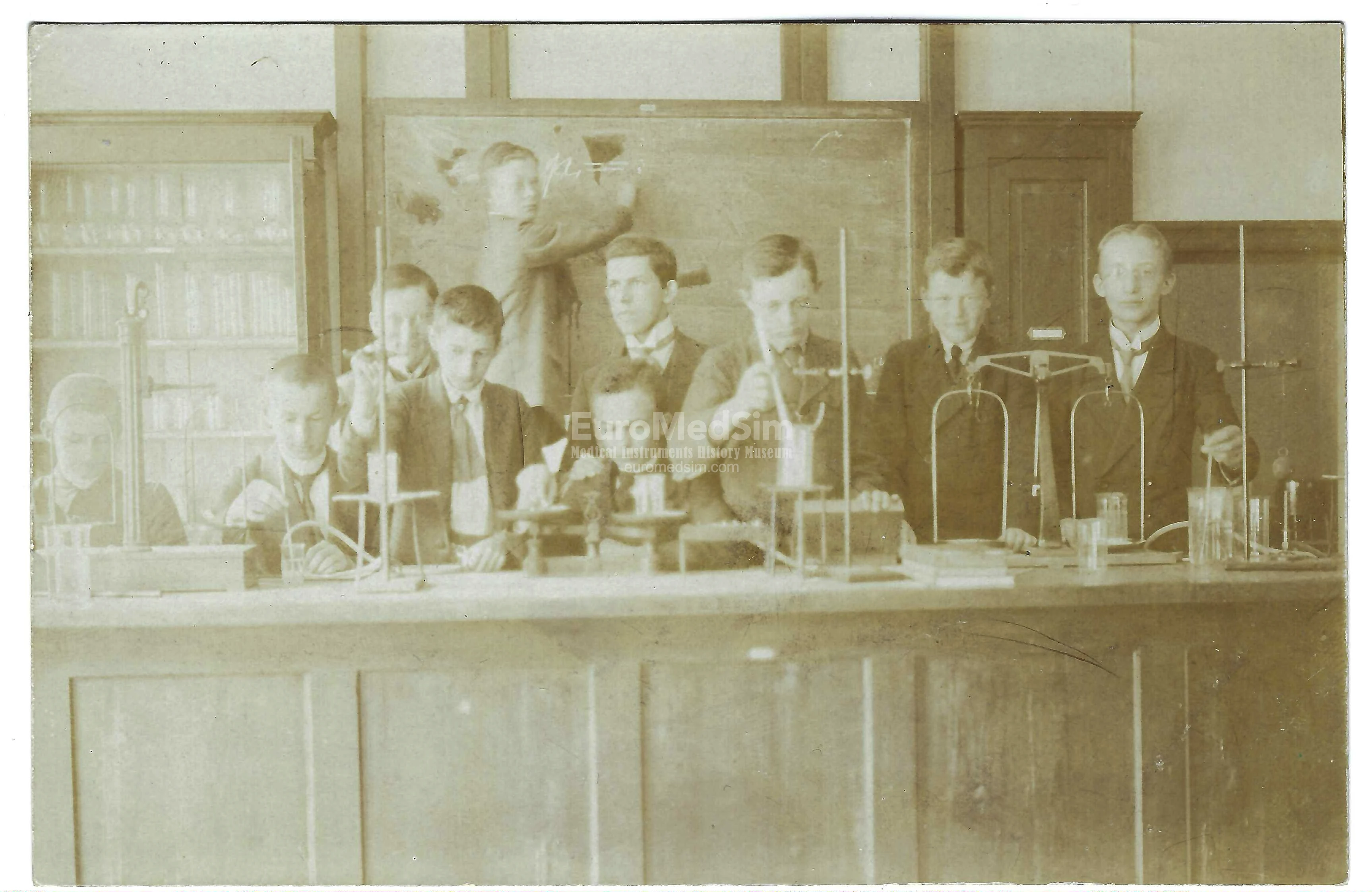
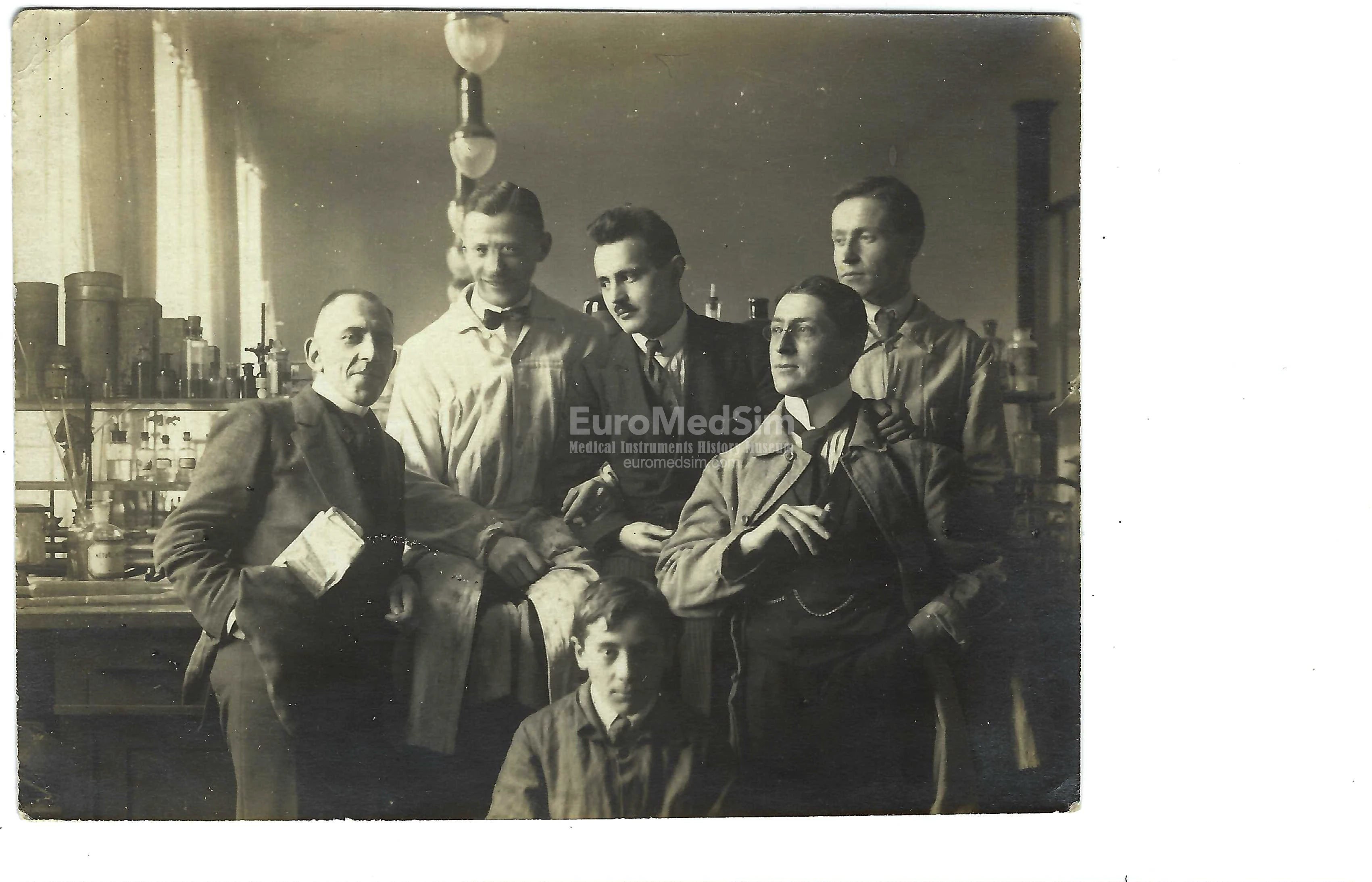
Dated 8 December 1919 on the reverse, this photograph shows six male figures in a laboratory identified by a handwritten inscription as the Chemical Institute in Frankfurt. Reagent bottles, glass apparatus and working clothes preserve the material and social setting of early twentieth-century chemistry. The photograph probably relates to the University of Frankfurt, whose chemical institute occupied new premises in 1919.
Description of the front — recto
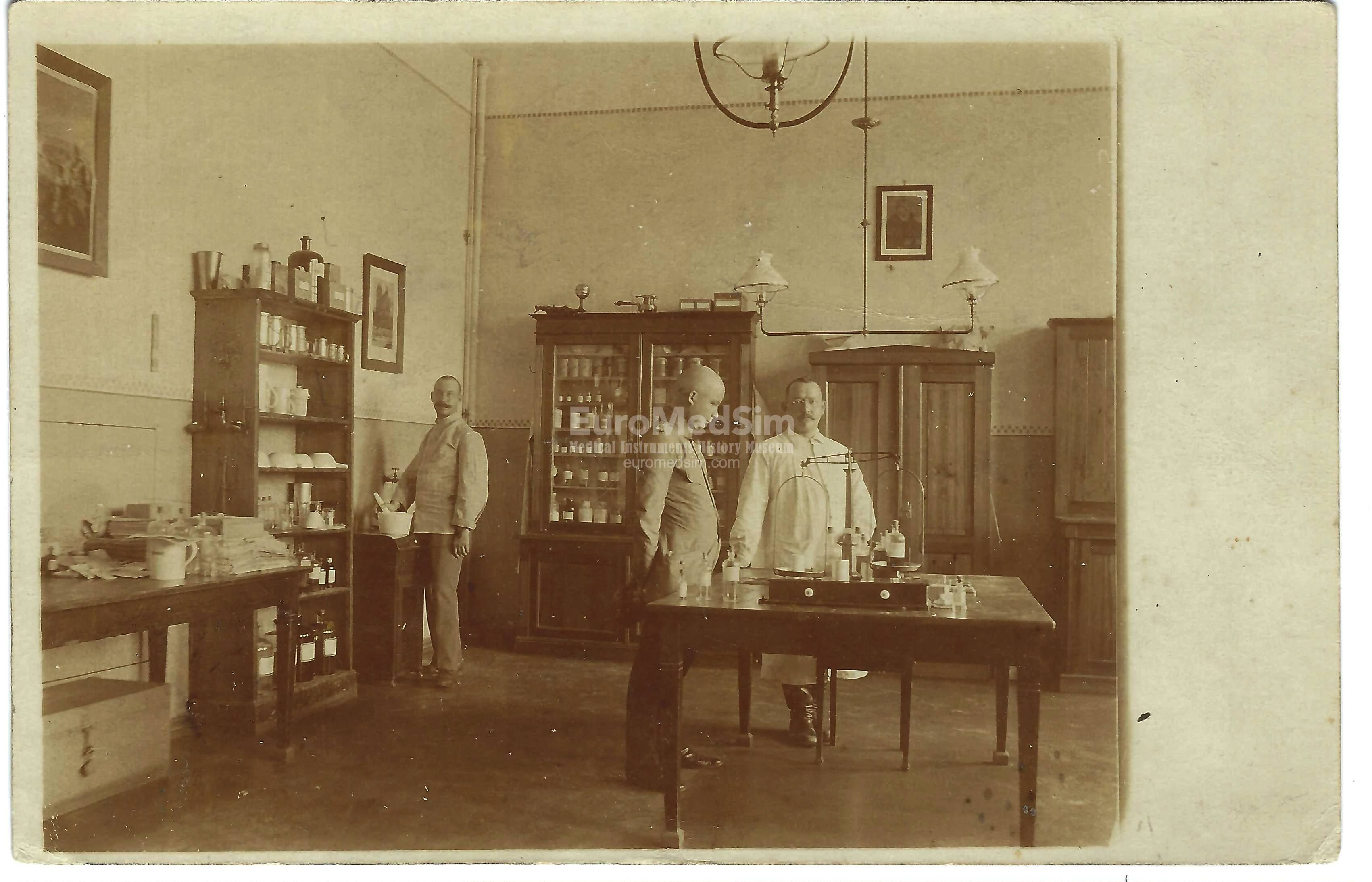
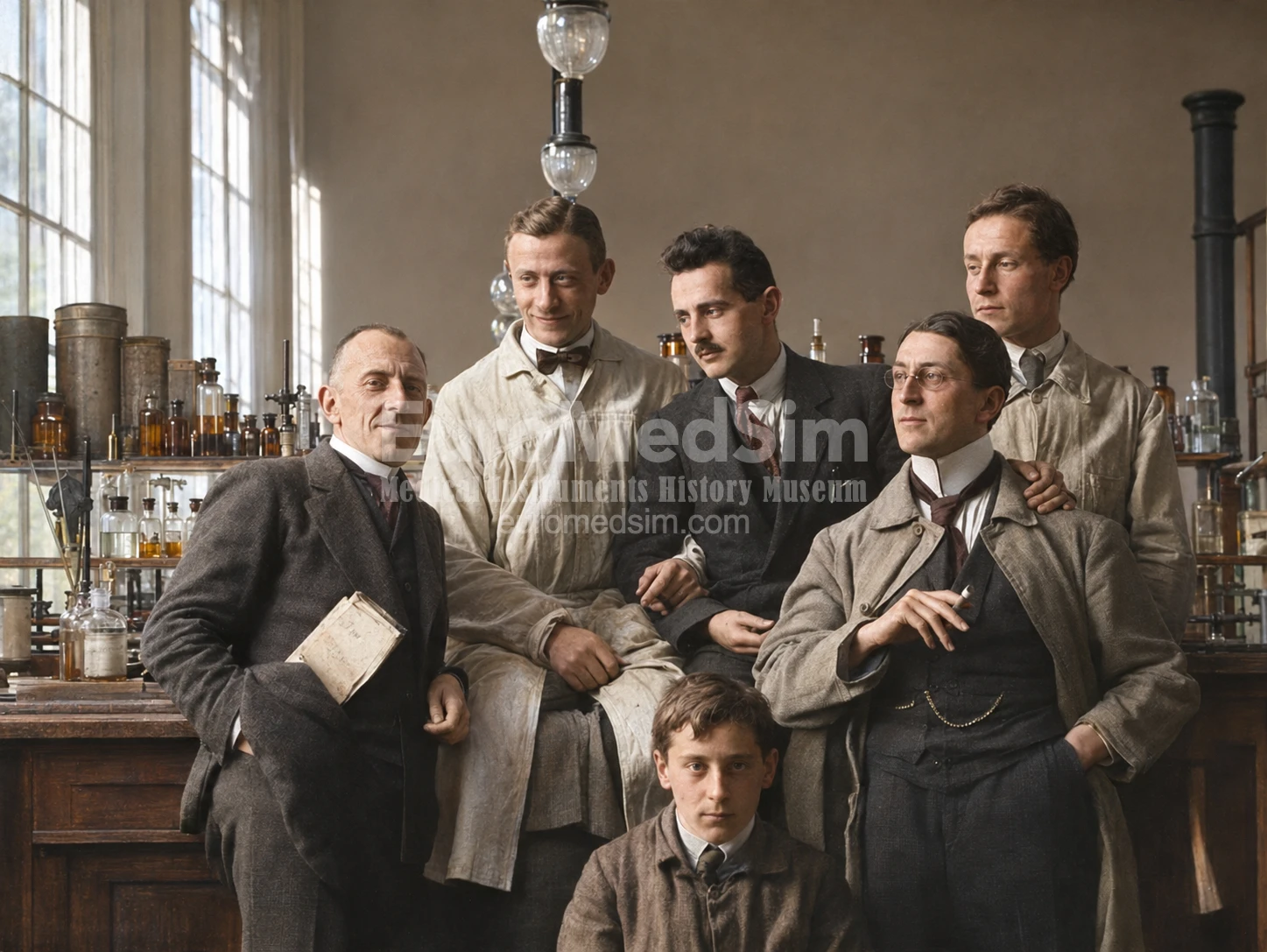
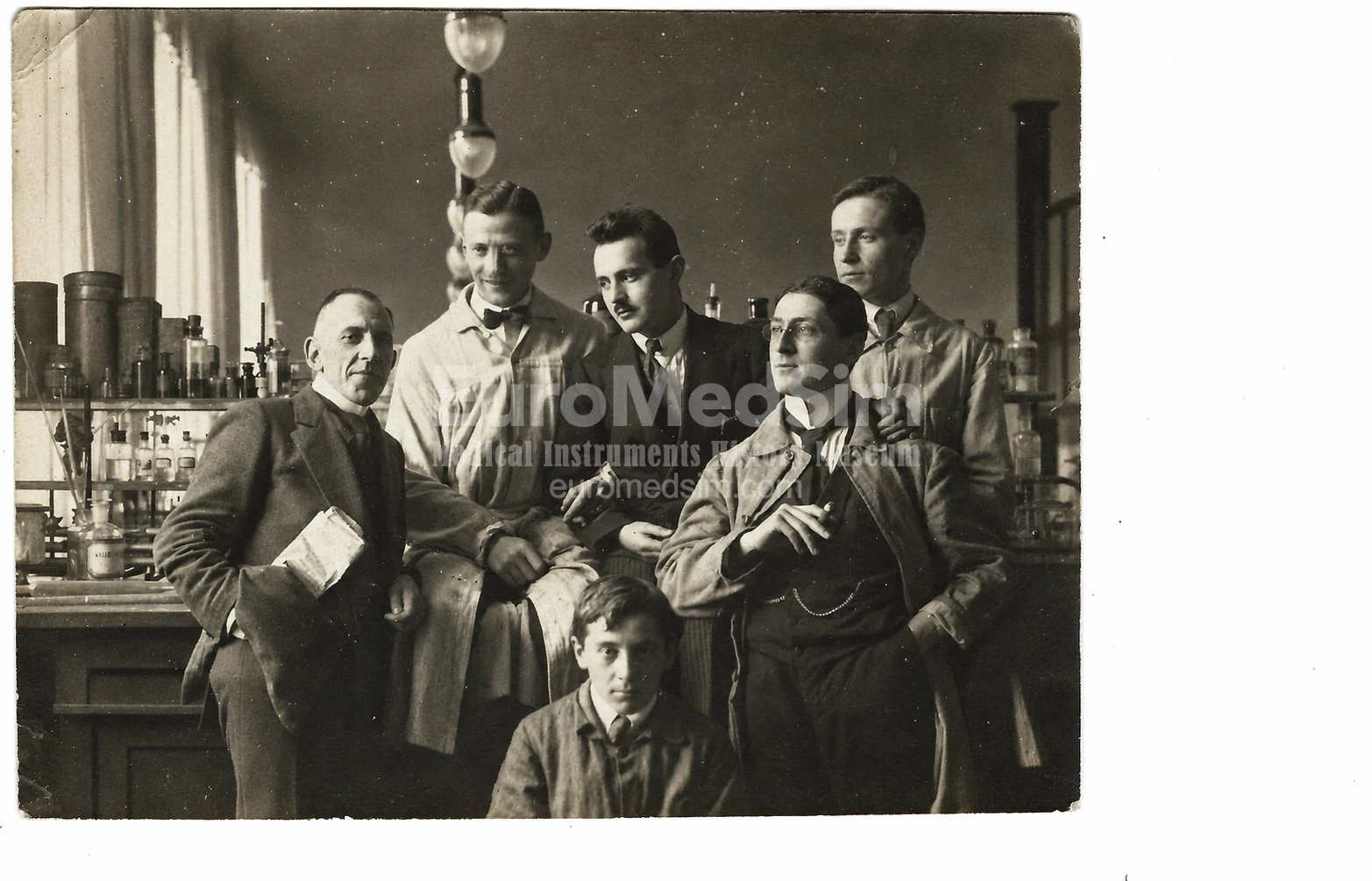
The photograph presents six male figures gathered closely together in a chemical laboratory: five men and a younger boy or adolescent at the bottom centre. Two men occupy the foreground, with three others grouped behind them. Their relaxed poses, slight smiles and the hand resting on the right-hand man’s shoulder give the portrait an informal, collegial character.
The man on the left holds what appears to be a book or notebook. The bespectacled man on the right wears a light laboratory coat over a dark waistcoat, with a watch chain visible across his front. Other members of the group wear either laboratory coats or ordinary jackets, with ties and a bow tie. These differences may reflect varied activities or positions within the laboratory, but the photograph does not establish anyone’s professional rank.
Tall windows on the left illuminate a bench crowded with stoppered bottles, jars, glass tubes and metal supports. A conspicuous vertical glass apparatus, formed by a succession of enlarged chambers, rises behind the group. Its exact function cannot be established from the image. Additional bottles and fittings extend across the background, while a tall dark pipe or flue is visible on the right.
Description of the reverse — verso
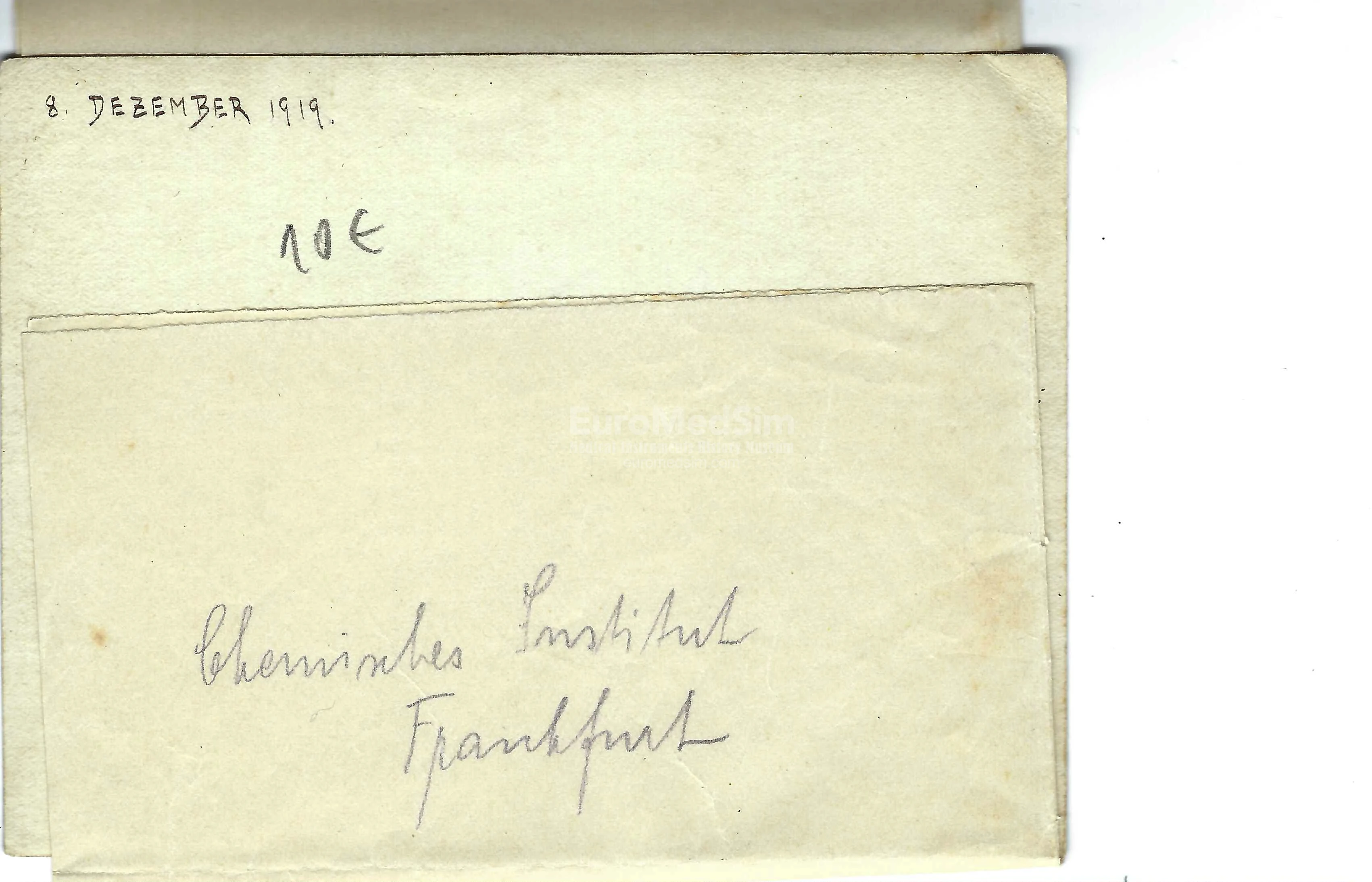
Two handwritten inscriptions provide the essential documentary information. At the upper left, the date reads:
8. DEZEMBER 1919 (“8 December 1919”)
The larger inscription below reads:
Chemisches Institut / Frankfurt (Chemical Institute / Frankfurt)
The date and institutional caption appear in different styles of handwriting; their authorship and the time at which each was added are unknown. The date is the principal basis for cataloguing the image as 1919.
A separate pencilled notation appears to read “10 €”, probably a later bookinist’s price. A faint rectangular outline is also visible on the reverse. No photographer’s imprint, printed postcard layout, address, postage stamp or postal cancellation is visible in the supplied scan.
The Chemical Institute in Frankfurt
The inscription most plausibly refers to the chemical institute associated with the University of Frankfurt am Main and the Physikalischer Verein (Physical Society). The association’s institutional history records that its chemical laboratories occupied premises in the Robert-Mayer-Straße from 1907 and moved in 1919 into a building erected by the university on the opposite side of the street.[1] The contemporary annual report confirms that the institute moved into its new building at the beginning of 1919 and was thereafter administered by the university.[2]
If this institutional attribution is correct, the photograph dates from the first year of occupation of those premises. The inscription and interior alone, however, do not establish the particular room or building beyond doubt.
Frankfurt’s chemical institute has a direct connection with pharmaceutical history through the work of Martin Freund and Edmund Speyer. Their research on the opium alkaloid thebaine led to the synthesis of oxycodone in 1916, three years before the date inscribed on this photograph.[3,4]
This connection places the laboratory within a scientific environment relevant to the development of medicines. It does not identify the people portrayed or associate the apparatus shown with that particular research project.
The photograph preserves both the working environment and the social character of an early twentieth-century laboratory. Bottles, glassware, bench fittings and laboratory coats document its material culture, while the closely arranged group conveys a sense of familiarity among the sitters. It record of the people and practical surroundings of experimental chemistry, a discipline fundamental to pharmaceutical research and medical science. The handwritten place and date give the otherwise anonymous portrait a useful historical anchor.
Condition
The image retains substantial detail in the faces, clothing and laboratory equipment. Visible signs of wear include softened corners, edge abrasion, a diagonal crease near the upper left corner and scattered surface marks. The print has a warm overall tone. The reverse shows yellowing, light spotting and wear around the edges.
References
- Sandstede G. Beiträge des Physikalischen Vereins zur Entwicklung von Technik und Naturwissenschaft. Section 15: Beiträge zur Chemie und Physikalischen Chemie [Internet]. Frankfurt am Main: Physikalischer Verein.
- Physikalischer Verein. Chemisches Institut: 1. April 1919 bis 31. März 1925. In: Jahresbericht 1919–1925. p. 117–118. Digitised report and transcription.
- Initiative Stolpersteine Frankfurt am Main e.V. Edmund Speyer; Saly Speyer. In: 12. Dokumentation 2014. Frankfurt am Main: Initiative Stolpersteine Frankfurt am Main; 2014. p. 48.
- Freund M, Speyer E. Über die Umwandlung von Thebain in Oxycodeinon und dessen Derivate. Journal für praktische Chemie. 1916;94(1):135–178. doi:10.1002/prac.19160940112.