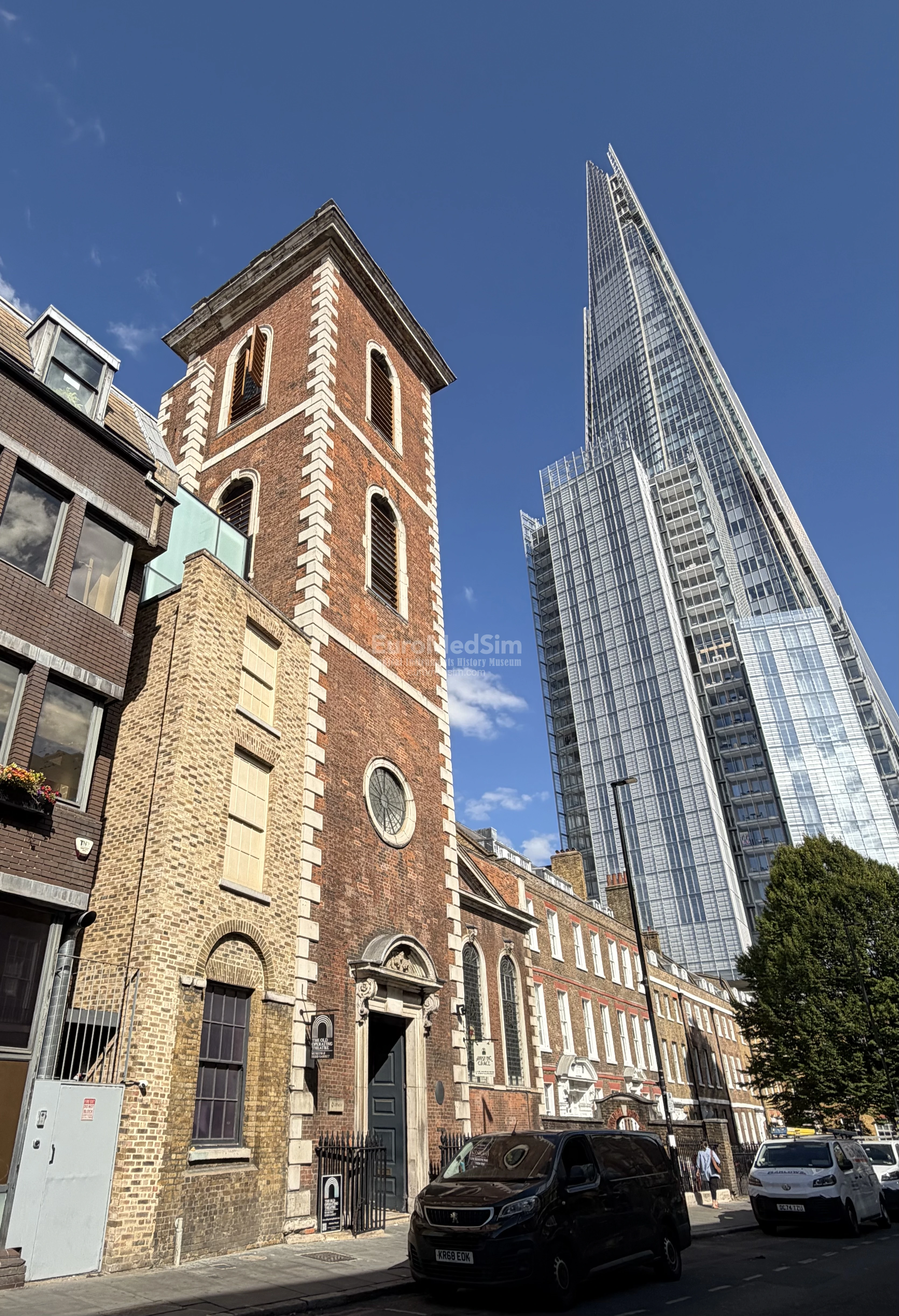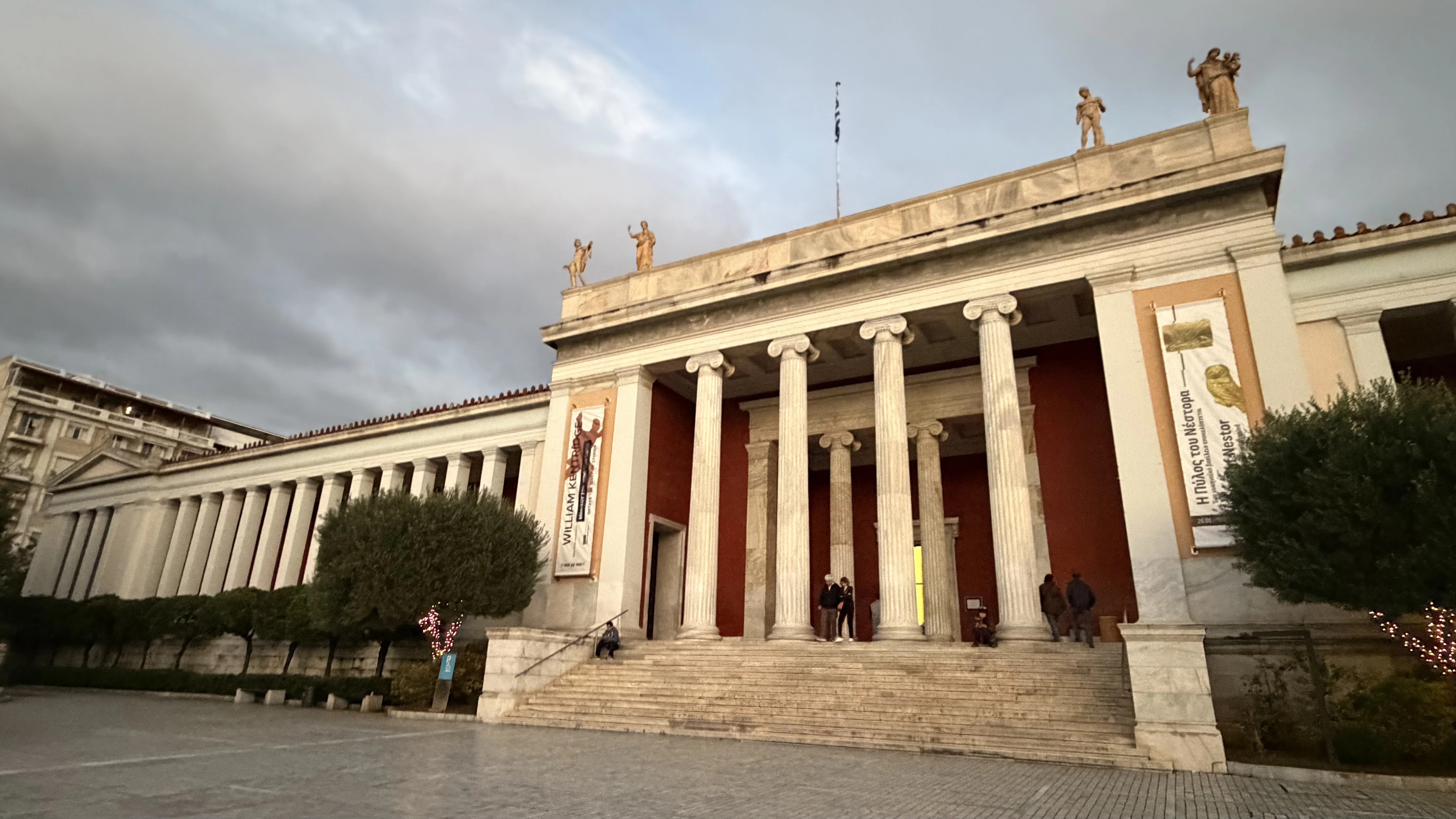
Hellenic National Archeologic Museum
The National Archaeological Museum, Athens: Healing Gods and Medical Instruments
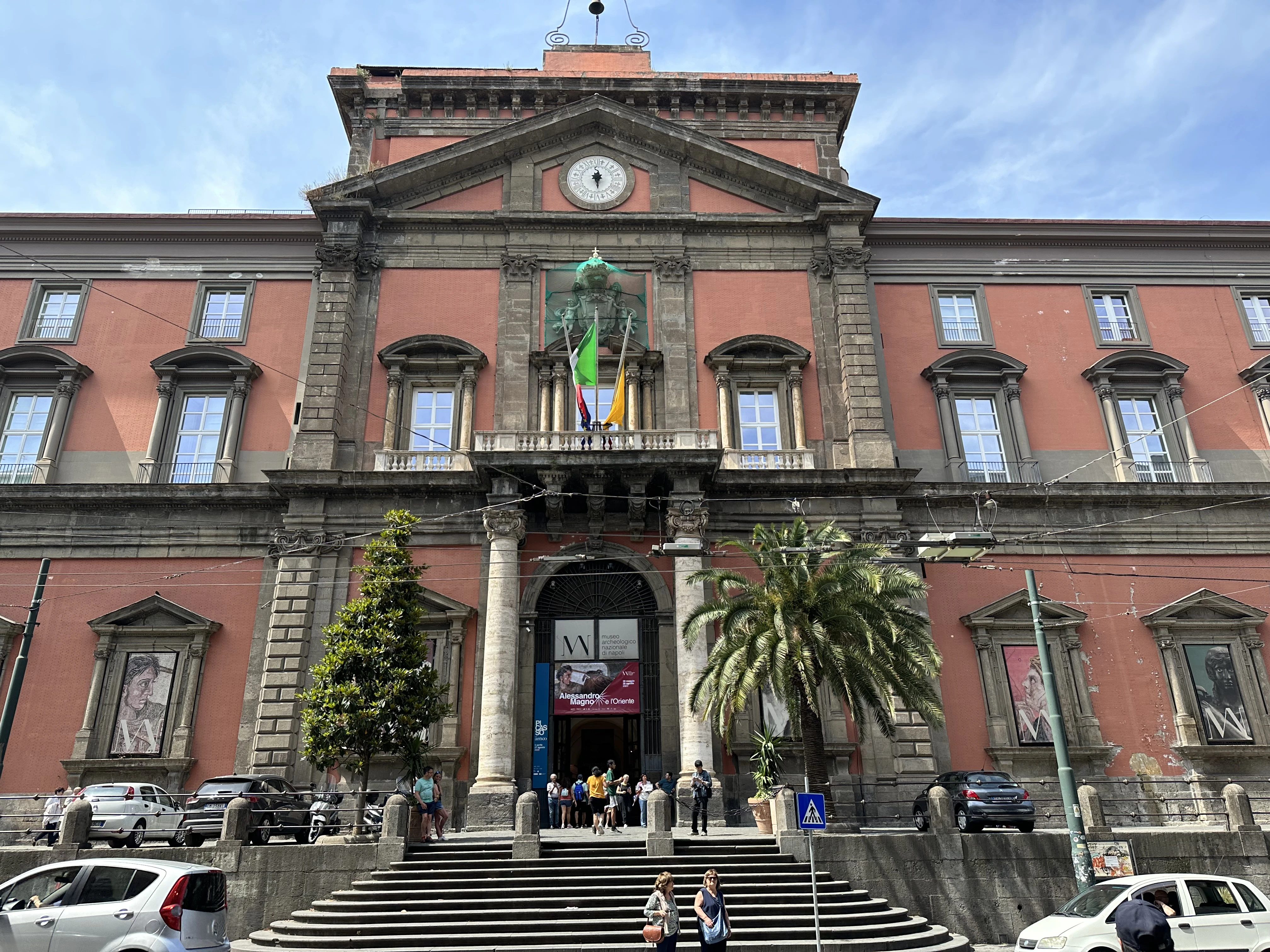
The National Archaeological Museum in Athens is Greece’s largest archaeological museum and a major repository of its ancient heritage. Bringing together antiquities from across the country, its collections place individual discoveries within the wider history of Greek civilisation, from prehistoric communities to the Roman world. Its national importance lies both in preserving these objects and in revealing the connections between art, religion, technology and everyday life.
The museum traces its origins to the first national archaeological museum established on Aegina in 1829, shortly after Greek independence. Construction of its present neoclassical building began in 1866, and the permanent exhibitions opened to the public in 1889. Within this broad archaeological collection, objects associated with healing offer a particularly compelling encounter with ancient medicine: sculptures express the hopes invested in divine protection, while medical instruments preserve the material evidence of practitioners’ work.
Statues from the Asklepieion: Giving Healing a Human Form
The museum holds original sculptures from the Asklepieion at Epidaurus — a sanctuary. It's collection includes representations of the ancient greek god of medicine and healing Asclepius (Ασκληπιός, closer to greek spelling Asklepios, in Roman mythology — Aesculapius), and his daughter Hygieia (Ὑγιεία, "Health"), the divine personification of health whose name gave rise to the modern word "hygiene." Their connection with the sanctuary is also reflected in the archaeological museum at Epidaurus, where casts of works held in Athens are displayed. These sculptures belong to the visual culture of one of antiquity’s most influential healing centres.
Seen within their original sanctuary setting, their images were more than decorative works: they gave a visible presence to the deities whom patients approached in search of relief. Their significance for medical history lies in showing how illness and recovery were understood within a religious and social environment.
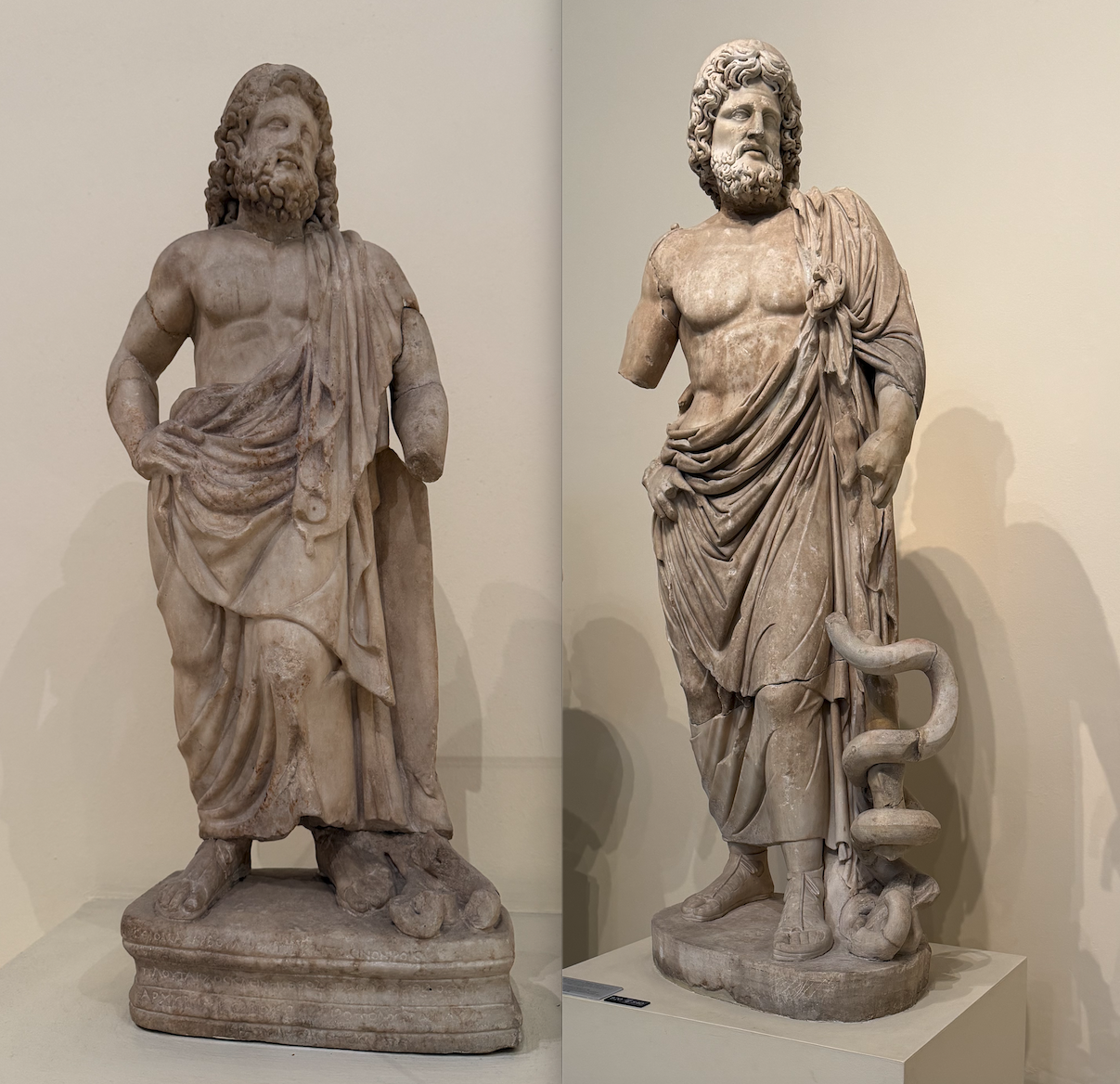
Two statues of the god Asclepius (in Roman mythology — Aesculapius). Pentelic marble. 2d–4th c. AD. The Hellenic National Archaeological Museum, Athens. Photo: Maxim Gorshkov
At Epidaurus, healing included ritual preparation and incubation—sleep within the sanctuary in the hope of receiving a healing visitation or guidance through a dream. Archaeological discoveries also include medical instruments and vessels associated with remedies. The sanctuary therefore provides evidence of a setting in which religious observance and practical care could coexist. It should not be understood simply as a modern hospital in an ancient architectural form.
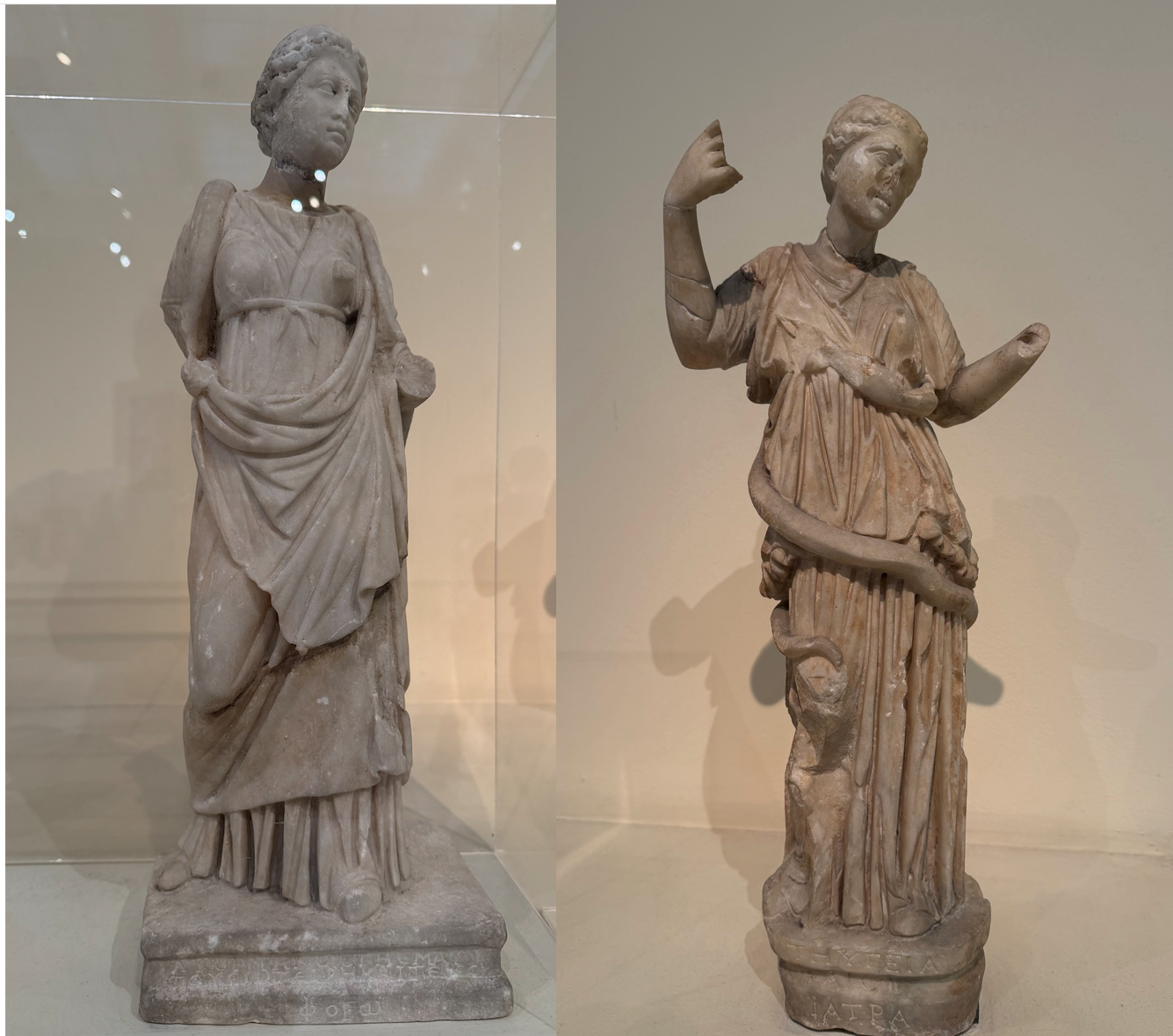
Two statues of the goddess Hygieia. Pentelic marble. 200 AD. The Hellenic National Archaeological Museum, Athens. Photo: Maxim Gorshkov
Bronze Medical Instruments: The Practitioner’s Tools
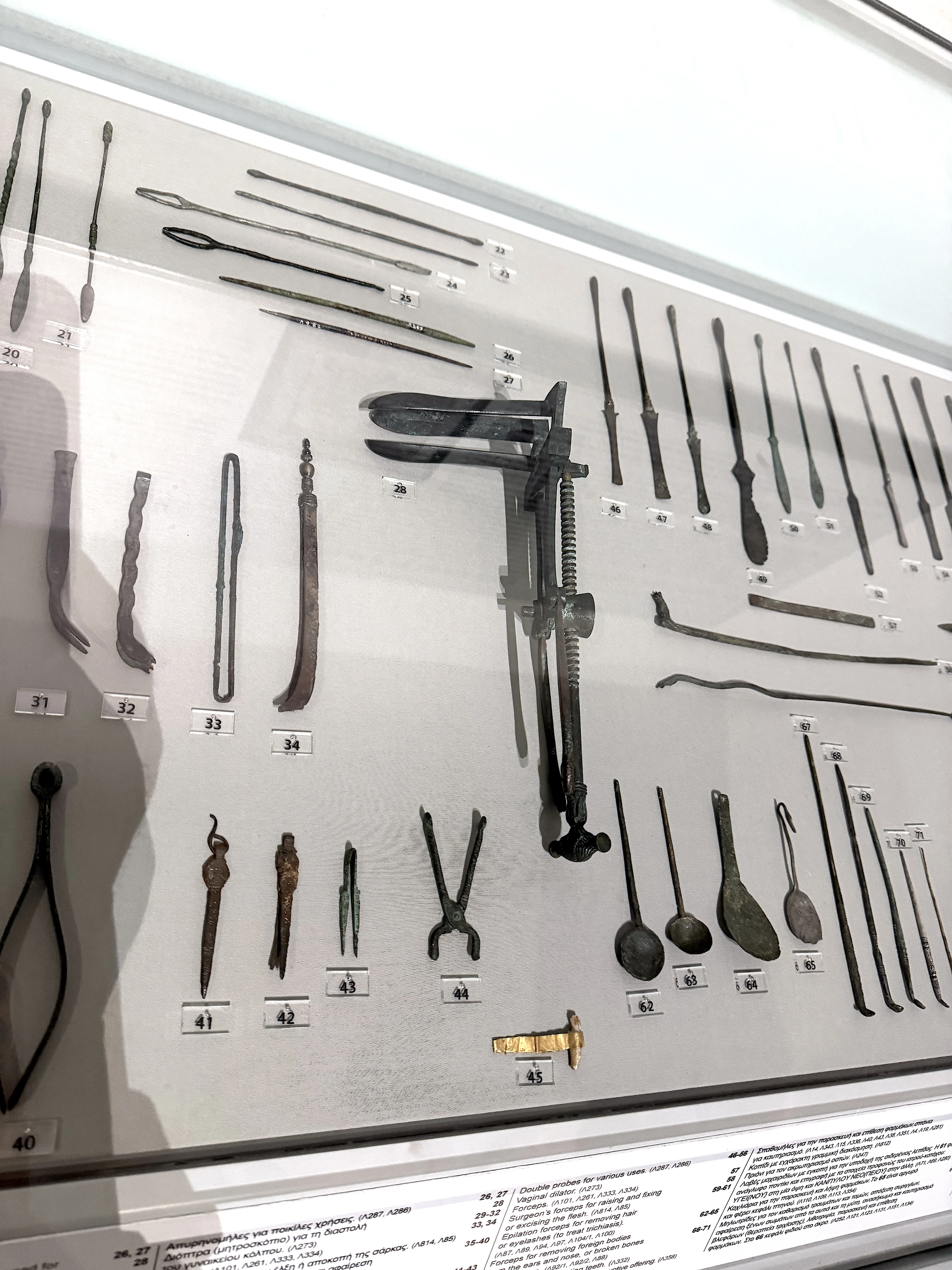
The museum’s Metalwork Collection preserves an important body of ancient medical equipment. A major contribution was the collection of physician Konstantinos Lambros, which entered the museum in 1899 and comprised 903 medical instruments. This history of acquisition is significant: the medical collection brings together objects with different backgrounds, rather than representing a single toolkit recovered from one healing sanctuary.
Among the instrument forms represented are slender probes, spoon-ended implements and scalpel handles. A bronze scalpel handle could accommodate an iron cutting blade, combining different metals within a single instrument. Double-ended tools made efficient use of a compact design, placing two working surfaces on the same shaft.
The instrument in the centre is a three-bladed vaginal speculum (Διόπτρα / μητροσκόπιο — Dioptra / mitroskopio) with a screw-operated mechanism, designed to separate the vaginal walls and allow examination of the vaginal canal and cervix. Turning the screw gradually spread the three blades, providing controlled dilation and maintaining the opening during examination or treatment. Its construction illustrates the mechanical sophistication of ancient medical instruments and the development of specialised equipment for gynaecological practice.
A particularly characteristic form is the spathomele (Σπαθομήλη), or spatula-probe, combining a rounded probing end with a flattened, leaf-shaped blade. Such instruments belonged to the overlapping worlds of medicine, pharmacy and personal care: their ends could serve in probing, preparing substances and applying ointments. Leaf-shaped, shallowly grooved blade could also serve as a pathway for the cutting instrument — by dissecting fascia or enlarging wound for its inspection.
These modest objects bring the history of medicine close to the individual practitioner. Their narrow shafts, shaped tips and carefully formed handles reveal the importance of manual skill and controlled movement. Alongside the monumental sculptures, they offer a different scale of encounter with antiquity: the small instrument held between a practitioner’s fingers.
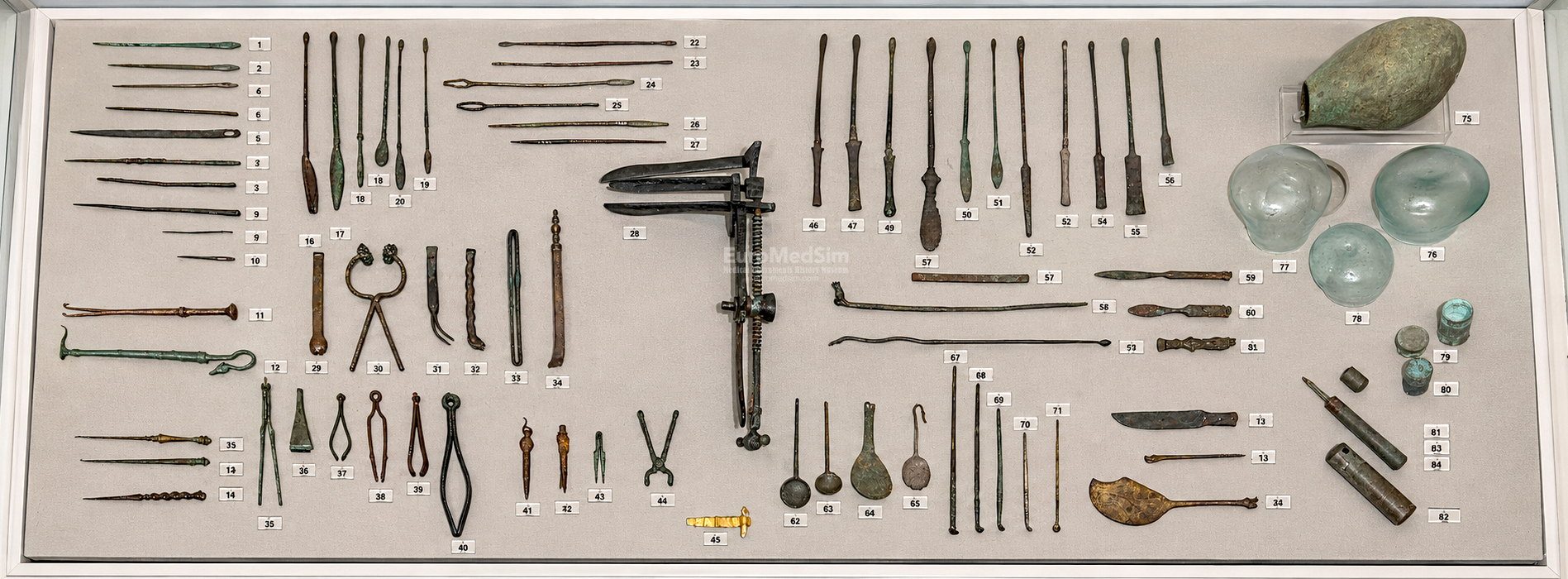
Display with the numbered ancient instruments in the HNAM Athens Greece (digital reconstruction by EuroMedSim) — see description below.
List of numbered medical instruments. HNAM, Athens, Greece
1–10. Needles of domestic or surgical use. The fine ones were possibly used for stitching internal organs. (Λ195, Λ199, Λ352, Λ211, Λ198, Λ202, Λ204, Λ208, Λ236, Λ201)
11, 12. Double hooks. 11 is decorated with silver bands, and 12 has a relief animal head at the upper end. (8329, Λ253)
13–15. Hooks for excising pieces of tissue and tonsils, and for fixing and retracting the edges of wounds. (Λ244, Λ245, Λ260)
16–21. Spoon probes. They were used for mixing and applying medicaments, as catheters, and as scrapers in gynaecological operations. (Λ48, Λ47, Λ53, Λ61, Λ51, Λ65)
22, 23. Probes with two olivary ends for cauterizing eyelids (to treat trichiasis, disease of the eyelashes), for urological use, and for applying and spreading ointments. (Λ77, Λ76)
24, 25. Bifurcated probes for extracting polypus from the nose and the throat. 25 was also used as a small spoon probe. (Λ241, Λ239)
26, 27. Double probes for various uses. (Λ287, Λ286)
28. Vaginal dilator. (Λ273)
29–32. Forceps. (Λ101, Λ261, Λ333, Λ334)
33, 34. Surgeon’s forceps for raising and fixing or excising the flesh. (Λ814, Λ85)
35–40. Epilation forceps for removing hair or eyelashes (to treat trichiasis). (Λ87, Λ89, Λ94, Λ97, Λ104/1, Λ100)
41–43. Forceps for removing foreign bodies from the ears and nose, or broken bones from the nose. (Λ92/1, Λ92/2, Λ88)
44. Tooth forcep for extracting teeth. (Λ332)
45. Tooth set in a gold band, probably a votive offering. (Λ358)
46–56. Spatula probes for mixing, measuring and applying medicaments; used more rarely for cauterization. (Λ14, Λ343, Λ15, Λ336, Λ40, Λ43, Λ38, Λ351, Λ4, Λ19, Λ281)
57. Cutting instrument with incised linear decoration. (Λ812)
58. Saw for cutting bones. (Λ247)
59–61. Scalpel handles with sockets for inserting iron blades. No. 61 is decorated with a mouse in relief and bears inscriptions on both sides, apparently identifying the physician who owned it: ΥΓΕΙ{ΝΟΥ} on one side and ΚΑΝΠΥΛΟΥ ΝΕΟ{ΠΕΙΟΥ} on the other. (Λ71, Λ69, Λ280)
62–65. Spoons for preparing and taking medicines. 65 is of silver and is adorned with a bird’s head. (Λ110, Λ109, Λ113, Λ354)
66–71. Small spoon probes for cleaning wounds and incisions, scraping fistulae, removing foreign bodies from the ears and nose, lifting and cauterizing the eyelids to treat trichiasis, crushing stones, and preparing and applying medicines. No. 66 has a snake’s head at its tip. (Λ252, Λ121, Λ123, Λ131, Λ151, Λ134)
72. Scalpel blade with an incised representation of a snake. (Λ330)
73, 74. Knives used as scalpels to cauterize the area of the planned operation. 74 has an incised representation of a snake on the blade and a snake’s head finial. (Λ246, Λ331)
75–78. Bleeding cups for treating cold. 76, 77 and 78 are made of glass. (Λ349α, Λ381, Λ382, Λ383)
79, 80. Cases, probably for keeping and transporting medicines and medicaments. (Λ266, Λ267)
81, 82. Needle cases. (Λ263, Λ262α)
83, 84. Needles, possibly for stitching internal organs. (Λ219, Λ22[…])
A Chest Confiscated in Berlin: The Story of the Lambros Collection
The ancient medical instruments on display at the National Archaeological Museum in Athens preserve more than just the history of medicine. They also tell the story of the collection, confiscation, and return of antiquities in the late 19th century.
This collection, known as the Konstantinos Lambros Collection, is named after a physician who, according to the museum’s report, was to have been the recipient of a large chest of antiquities confiscated in Berlin in the late 19th century.
The Greek Archaeological Service collaborated with the Ministry of Foreign Affairs and the Archaeological Society to secure the return of the antiquities. Subsequently, the Greek ambassador in Berlin sent the crate to Greece.
Upon arrival in Athens, the Archaeological Committee reviewed the case at its meeting on August 24, 1899. The committee, formed under the leadership of P. Kavvadias, performed functions comparable to those of the modern Archaeological Council.
The minutes of the meeting record an important moment in the collection’s history: the opening of the crate in the presence of the minister. Inside were bronze and glass objects, a red-figure vase, and other antiquities. Thus, the shipment contained a much wider range of items than just medical instruments.
Shortly before this, the Metalworks Collection had been established by royal decree on July 31, 1893; therefore, the acquisition of Lambros’s assembly took place early in the collection’s history. His complete collection comprised 903 medical instruments. Among the instruments on display today are bronze objects from the Hellenistic and Roman periods, such as medical spoons and gynecological instruments, as shown in the photographs of the exhibition.
9.1. Volume I of the Minutes of the Archaeological Committee, 1899–1902. First meeting (24 August 1899). Description of the Illustration in the "EXHIBITION CATALOG. Stories on Paper. Forms and Themes of Archaeology in 19th-Century Greece". It says: The Archaeological Committee established under P. Kavvadias exercised the responsibilities now held by the Archaeological Council. At its first meeting, it considered the case of a large crate containing antiquities that had been confiscated in Berlin and was addressed to the well-known physician Konstantinos Lambros. Working together with the Ministry of Foreign Affairs and the Archaeological Society, the Archaeological Service had secured the return of the antiquities. “The crate containing the antiquities of K. Lambros, sent by the ambassador in Berlin, was then opened, and its contents—including bronze, glass and other implements, a red-figure vase and other objects—were inspected in the presence of the Minister.” Containing, among other objects, a particularly large number of medical instruments, the collection known as the Konstantinos Lambros Collection is today one of the most important acquisitions of the Bronze Collection and is displayed at the National Archaeological Museum.
Remembering a Physician: The Disc of Aineias
Another remarkable medical object is the marble funerary disc of the physician Aineias, dated to approximately 510–500 BC. Its surface preserves the faint painted image of a seated, bearded man wrapped in a cloak, surrounded by an inscription. The disc entered the museum in 1889 after being confiscated in Piraeus.
Unlike the statues of healing deities, this monument commemorates a human practitioner. It adds a personal dimension to the collection, reminding visitors that ancient medicine was also a profession practised by individuals whose knowledge, work and reputation could become part of their public memory.
References
ΚΑΤΑΛΟΓΟΣ ΕΚΘΕΣΗΣ. Ιστορίες επί χάρτου. Μορφές και θέματα της Αρχαιολογίας στην Ελλάδα του 19ου αιώνα. EXHIBITION CATALOG. Stories on Paper. Forms and Themes of Archaeology in 19th-Century Greece (in Greek language). 2013, Ministry of Culture and Sports. ISBN: 978-960-386-138-6