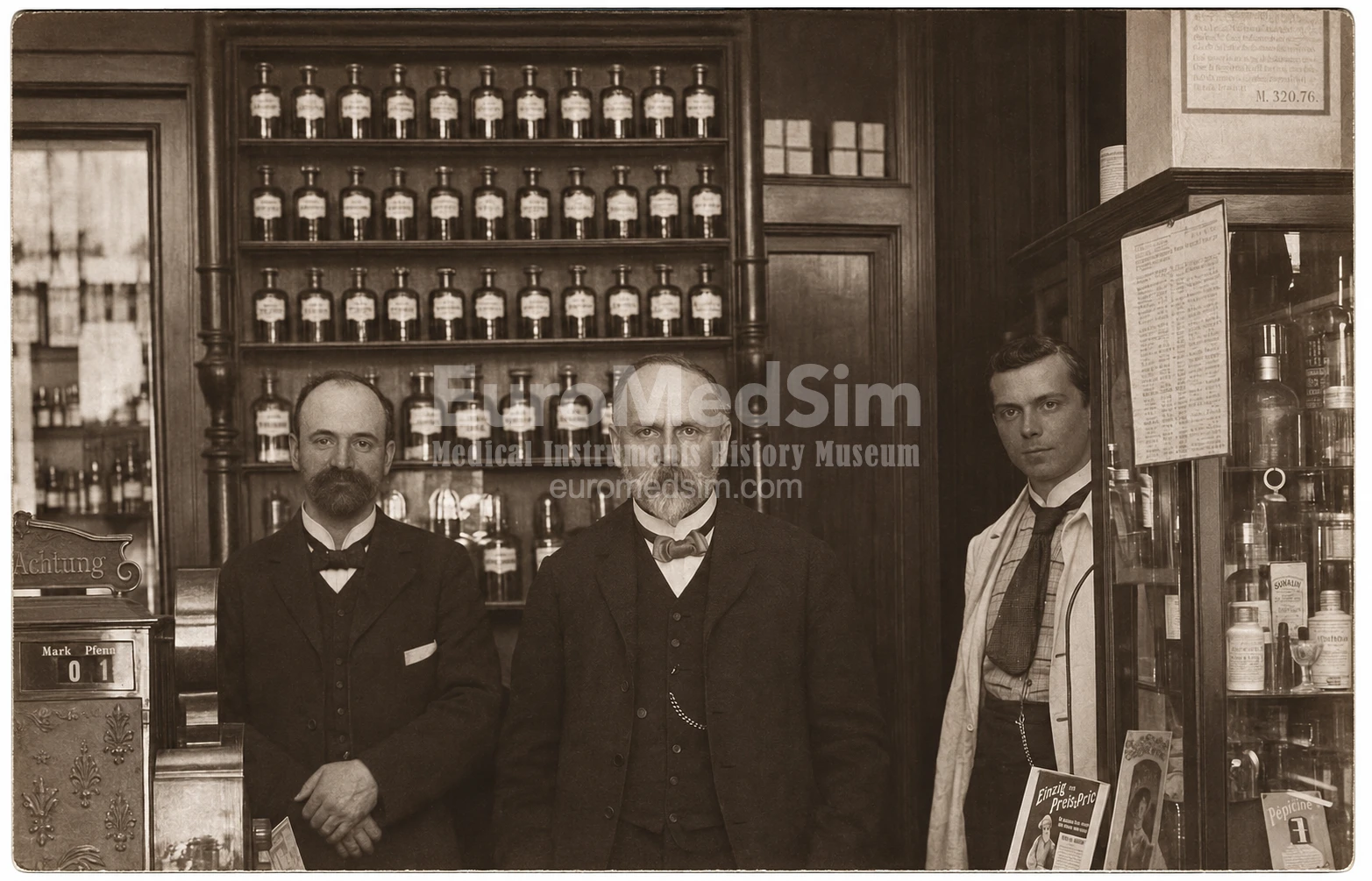
German Apotheke (Pharmacy) with Three Men, Postcard, ca. 1910
A German Pharmacy with Three Men, c. 1905–1910
Summary
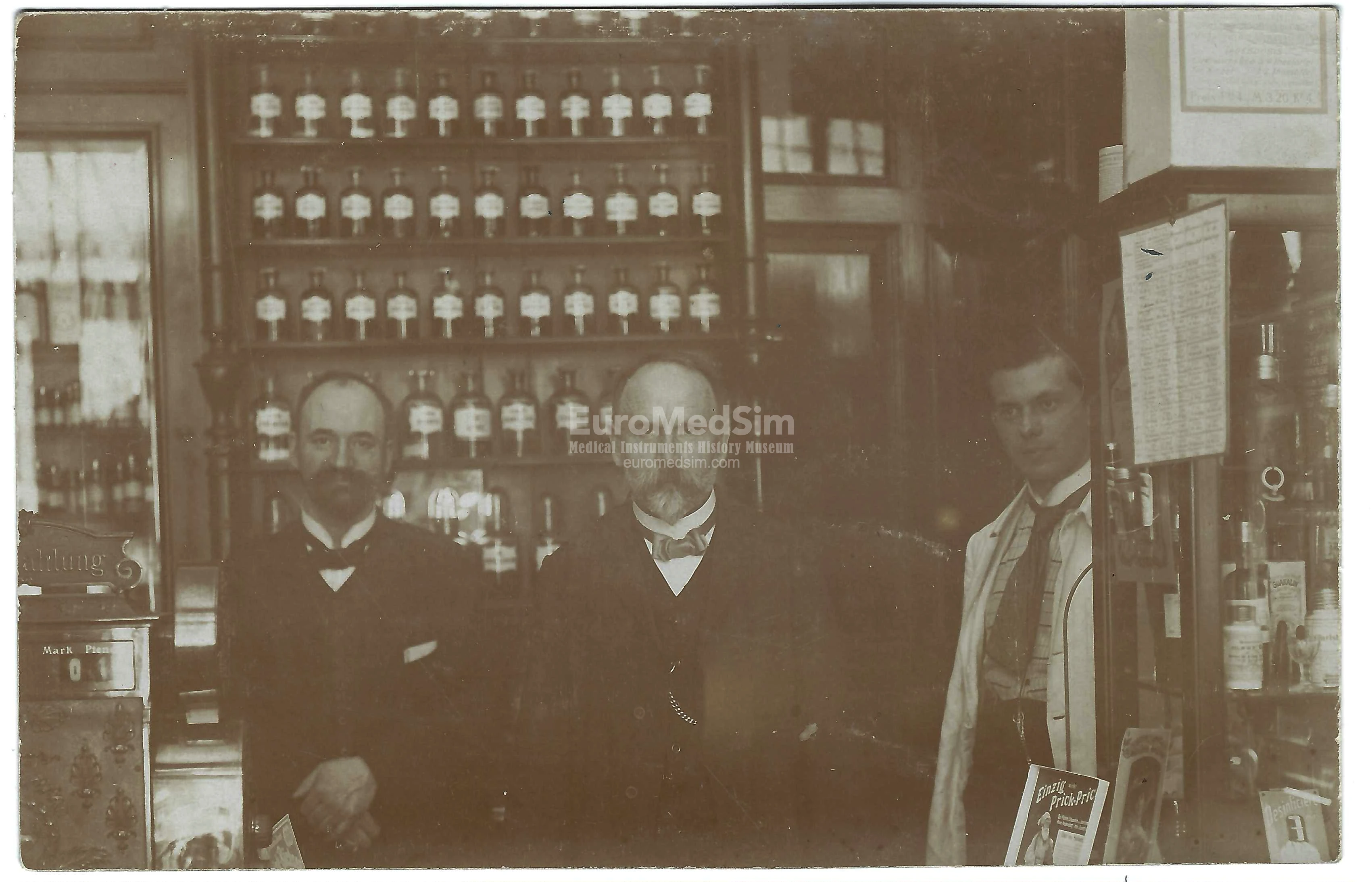
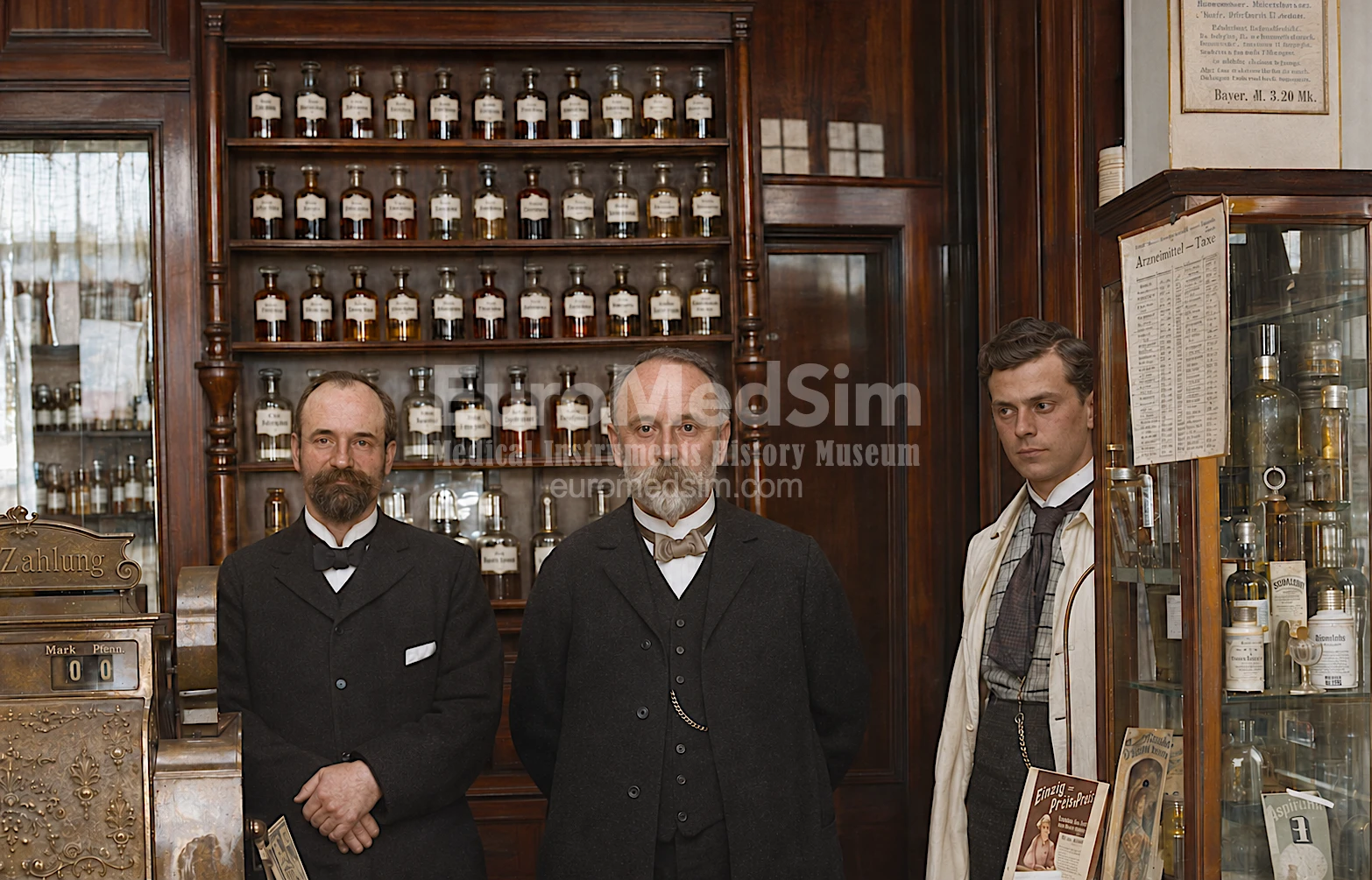
This photographic postcard depicts three men inside a German Apotheke (pharmacy) circa 1905–1910. Rows of labeled bottles, an ornate cash register, and a glass display case illustrate the convergence of pharmaceutical tradition and modern retail. In the lower right corner, a package of “Aspirin” bearing the Bayer trademark is visible (the drug was introduced to the market in 1899). The massive brass cash register, featuring decor characteristic of the 1890s–1900s, is inscribed with “Mark” and “Pfenn.” The German currency had been in use since 1873, but in 1914, the war began to devalue it. The dark wooden cabinets, rows of pharmacy glass jars with handwritten labels, and a display case with vials look like a classic German pharmacy from around 1900.
About the Object
An unidentified monochrome photographic postcard showing three men in the salesroom of a drugstore or pharmacy. The German-language inscriptions and the cash register’s Mark and Pfennig currency indicators strongly suggest Germany. A provisional date of c. 1905–1920 is consistent with the clothing, shop fittings and divided postcard back, although neither the establishment nor the individuals can presently be identified.
Description
The photograph presents a compact commercial interior dominated by dark wooden shelving and carefully ordered rows of glass bottles. Their pale labels form a striking pattern across the background, giving the room an appearance of abundance, organisation and professional competence. The inscriptions on the individual bottles are insufficiently legible to identify their contents reliably.
Three men face the camera. The central figure, an older man with a prominent moustache and short beard, wears a dark three-piece suit, a bow tie and a visible watch chain. To his left stands another bearded man in formal clothing. On the right, a younger, clean-shaven man wears a light work coat over a patterned waistcoat and tie.
Their arrangement suggests a portrait of the proprietor and his colleagues, possibly including an assistant or apprentice. However, their occupations, seniority and any family relationship remain conjectural. The central position of the older man gives him visual prominence without establishing his ownership of the business.
At the far left stands an ornate mechanical cash register. Its currency window bears the words Mark and Pfennig, among the clearest geographical clues in the photograph. On the right, a glass-fronted cabinet contains bottles, cartons and other packaged merchandise. Small advertising cards occupy the foreground, while a larger printed notice is attached above. Together, these details identify the setting as a salesroom rather than a laboratory.
Bottles, Brands and Professional Identity
The photograph brings together two forms of retail presentation: substances stored in reusable, labelled containers and manufactured products promoted through packaging and advertising.
The orderly bottles belong to a long pharmaceutical tradition, but their relatively uniform appearance also fits the growing standardisation of shop equipment. As the German Pharmacy Museum explains, industrially manufactured glass and ceramic storage vessels became increasingly widespread around the beginning of the twentieth century, replacing many individually commissioned designs[1].
The glass cabinet and advertising cards introduce another visual language: recognisable products competing for the customer’s attention. The shop thus appears as a place where specialist knowledge, personal service and branded merchandise coexisted.
The men’s clothing contributes to this presentation. Formal suits convey respectability, while the younger man’s light coat suggests practical work. These are visual signals rather than proof of qualifications. The photograph records how the men wished to present themselves and their workplace to the camera.
The Reverse
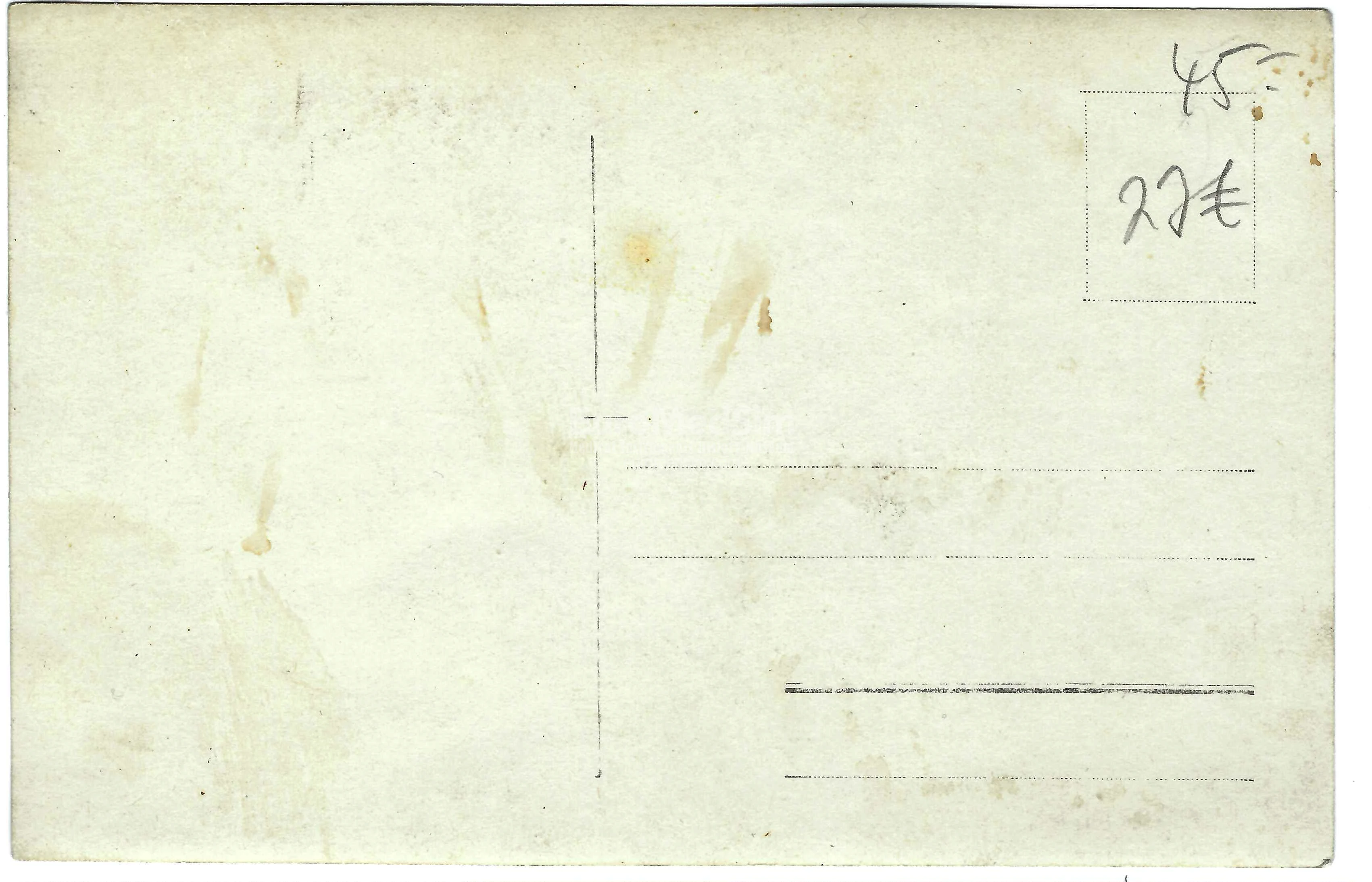
The reverse has a printed dividing line, address guidelines and a dotted rectangle for a postage stamp. It carries no contemporary correspondence or postal cancellation. Pencil annotations, including a price expressed in euros, belong to the card’s later collecting or antiquariate history and provide no evidence for the date of the original photograph.
Dating the photograph
Judging by the details, this is around 1905–1910, most likely the very beginning of the 20th century. It’s impossible to pinpoint the exact year based on a single frame, but here’s what I’m basing my assessment on:
- Aspirin. In the lower right corner, you can see a package of “Aspirin” bearing the Bayer logo. The drug was introduced to the market in 1899, so the photograph cannot be older than that date.
- Currency. The cash register is labeled “Mark” and “Pfenn.”, indicating that this is the German Empire. The mark was in circulation from 1873, and in 1914, the war began to devalue it.
- Cash register. This massive brass mechanical device with twisted decorative elements is typical of the 1890s–1900s.
- Advertisements and price list. A sheet titled “Arzneimittel-Taxe” (official drug price list), a flyer with the slogan “Einzig Preis-Preis,” and a Bayer advertisement listing prices in marks all point to the same era.
- Clothing. Tailcoats and dark three-piece suits, bow ties, high collars, the young man’s wide neckerchief, and a white lab coat are typical of Germany at the turn of the century.
- Interior. Dark wooden cabinets, rows of pharmacy glass jars with handwritten labels, and a display case with vials look like a classic German pharmacy around 1900.
- Format. The divided-back format is compatible with German postcard production from 1905 onward. This helps establish a broad context, but it does not independently date the exposure: a photographic image could also have been printed later. The proposed range of c. 1905–1910 should therefore remain provisional [2].
The color and sharpness of the image appear too modern for a photograph from that era. Most likely, this is a still from a historical film or a staged photograph, in which case the year may correspond to the time period depicted in the story. If you know the source of the image, please let me know, and I’ll try to narrow down the date.
References
- Deutsches Apotheken-Museum. Die Apotheken-Offizin. Heidelberg: Deutsches Apotheken-Museum.
- Spennemann DHR. The evidentiary value of late nineteenth and early twentieth century postcards for heritage studies. Heritage. 2021;4(3):1460–1496. doi:10.3390/heritage4030081.