Salpêtrière Hospice and Hospital in Paris, Main Entrance
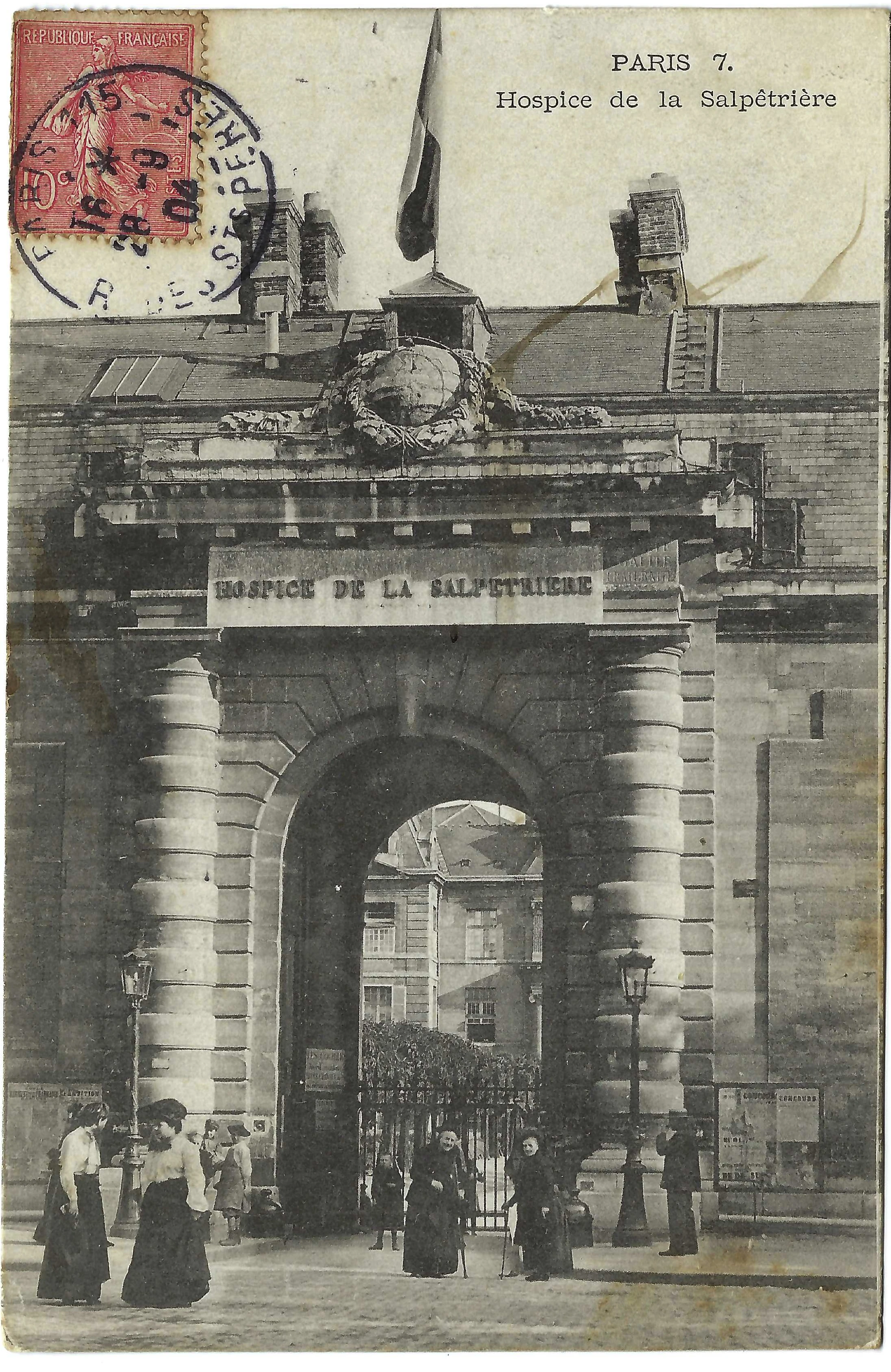
Main Entrance to the Salpêtrière Hospice and Hospital in Paris (todays The Mazarin entrance to the Pitié-Salpêtrière Hospital). Postcard sent to Vitto, presumably on September 28, 1909. Item type: scenic postcard. Date: 1903–1909. Original title: Paris 7. Hospice de la Salpêtrière. Publisher: not specified. Date of publication: early 20th century, before 1909. Date of mailing: September 28, 1909. Destination: Vitto, Côte-d’Or department, France. Material and technique: cardboard; monochrome photomechanical print; letterpress printing; handwritten text in ink. Language: French. Recipient: Mr. Vachar, road worker. Postage stamp: France, 10 centimes, Semeuse lignée type — “Sower on a Lined Background”.
The postcard is valuable in several respects. It documents the architecture and main entrance of the Salpêtrière in the early 20th century; the fact that the institution’s former official designation as a hospice; daily life near the gates of a major Parisian hospital; the presence of elderly women, for whom the institution was originally intended; French postal culture and everyday correspondence in 1909; the dissemination of images of medical institutions in mass visual culture.
The interplay between architecture and human figures is particularly striking. The heavy stone arch serves as a reminder of the Salpêtrière’s centuries-long history as a closed, regulated space. At the same time, the open gates, passersby, and personal letters transform the institution from an abstract medical monument into a part of everyday Paris.
Description of the front side—recto
The front side features a frontal view of the main entrance to the Hospice de la Salpêtrière—the historic Salpêtrière complex on Boulevard de l’Hôpital in Paris. The image is oriented vertically and is almost entirely occupied by the monumental gate. The massive semicircular arch is framed by large rusticated masonry. On either side of the passageway stand wide stone pylons, emphasizing the fortress-like, almost impregnable character of the architecture. A rectangular plaque is mounted above the arch:
HOSPICE DE LA SALPÊTRIÈRE
Above it is a sculpted cartouche featuring a sphere or globe, surrounded by floral ornamentation and decorative ribbons. The composition is set against the backdrop of a long roof with numerous chimneys, ventilation structures, and dormer windows. The French tricolor flies above the central part of the building.
Tall street lamps stand on either side of the gate. Through the open archway and the metal fence, one can see the inner courtyard and the hospital wing beyond it. This framing creates the effect of a gradual entry into the institution’s space: from the city street—through the monumental portal—into the inner world of the Salpêtrière.
Several people have gathered at the entrance. On the left are women in long skirts and headdresses typical of the early 20th century. In the center stand two elderly women in dark clothing; one or both are leaning on canes. Nearby are other visitors or residents of the institution. On the right, near the wall with posters, men in dark suits and headwear are depicted.
It is impossible to determine the status of individual people from the photograph alone: among them could have been patients, permanent residents of the shelter, visitors, or staff members. However, the presence of elderly women at the gate directly corresponds to the Salpêtrière’s function at that time as an institution providing long-term care and medical assistance to women.
In the upper right corner is printed:
PARIS 7.
Hospice de la Salpêtrière
The number 7 is most likely the serial number of the view in the publication series. It does not refer to a Parisian arrondissement: the Salpêtrière is located in the 13th arrondissement.
Postmark and stamp
A reddish-pink French postmark with a face value of 10 centimes is affixed in the upper left corner. It depicts a woman walking as a sower—an allegory of the French Republic. The upper part reads:
RÉPUBLIQUE FRANÇAISE
The stamp belongs to the Semeuse lignée type, designed based on a composition by medalist Louis-Oscar Roti and engraved by Louis-Eugène Mouchon. The pink 10-centime stamp entered circulation in May 1903; in catalogs, it is usually listed as Yvert et Tellier No. 129. (wikitimbres.fr)
The stamp is canceled with a large round Paris postmark. Part of the postmark is obscured by the stamp itself and blends into the background of the image, making it difficult to read the exact name of the post office. The central date most likely reads:
28–9
09
Thus, the postcard was apparently mailed from Paris on September 28, 1909. This date matches the arrival postmark on the reverse side. Placing the stamp on the picture side was not uncommon for French postcards of this period. In this case, it covers part of the sky and the roof, but barely affects the main architectural subject.
Description of the reverse side — verso
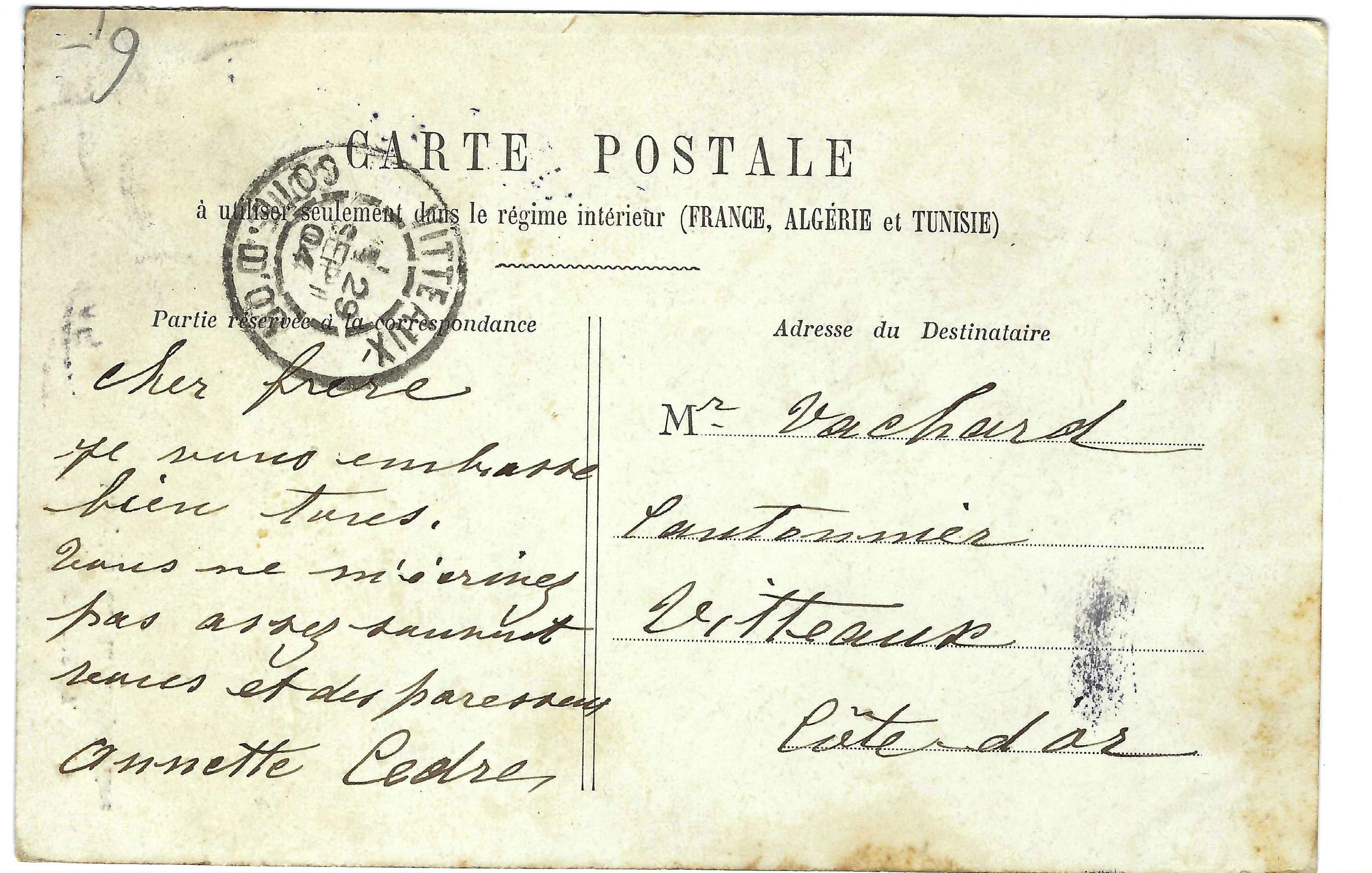
The reverse side is divided by a double vertical line into a message field on the left and an address field on the right. At the top, the following is printed in large type:
CARTE POSTALE
Below is the postal instruction:
à utiliser seulement dans le régime intérieur
(FRANCE, ALGÉRIE et TUNISIE)
Which means "For use only in domestic mail (France, Algeria, and Tunisia)."
Above the left field is printed: Partie réservée à la correspondance ("Section reserved for correspondence")
Above the right field: Adresse du Destinataire ("Recipient’s address.")
The postcard was indeed used for domestic mail: it was sent from Paris to the commune of Vitto in eastern France. In the upper left corner of the back is a later pencil mark with the upside-down number "6,–," which presumably stands for the price in euros from the later antique bookseller and is unrelated to the original mailing.
Handwritten Message
The text is written in dark ink in a sweeping French cursive script. The most likely transcription:
Cher frère
je vous embrasse
bien sûres.
Vous ne m'écrivez
pas assez souvent
vous êtes des paresseux
Annette Cèdre (?)
Transation:
Dear brother,
I send you
big hugs (?).
You don't write to me
often enough—
you're all lazy.
Annette Cèdre (?)
The last word on the third line cannot be identified with certainty. It might say “sûr,” “fort,” “fures,” or “tures,” but the first one doesn't look right, and the others don't make grammatical sense. The last name or addition to the first name is not entirely clear. Graphically, it most closely resembles Cèdre or Cedre, but another variant is possible, such as Cadre.
Although the letter is addressed to a single person—Cher frère, “dear brother”—the plural expression vous êtes des paresseux, “you’re lazy,” is used later on. This rebuke was likely directed not only at her brother but also at the relatives living with him. It’s also possible that the sender expected to receive letters from the entire family. Another possibility is that the switch to the formal “vous” was meant as a joke, expressing both a rebuke and dissatisfaction with her brother’s silence.
The brevity and emotional directness of the text are characteristic of everyday postcard correspondence. There is no sign to determine whether the sender was in the hospital or simply purchased a postcard depicting the Parisian landmark.
Address
The address reads as follows:
Mr. Vachard
Cantonnier
de Vitteaux
Côte d’Or
The word cantonnier referred to a worker responsible for maintaining a specific section of road: clearing it, performing minor repairs, and maintaining the shoulders and road structures. The name, occupation, and locality were sufficient for delivering correspondence in a small commune.
Postmark of Arrival
At the top of the reverse side is a round postmark from the destination post office. The following text is clearly legible around the circumference:
VITTEAUX
CÔTE-D’OR
In the center, the date is most likely indicated as:
29–9
09
Consequently, the postcard arrived in Vitteaux on September 29, 1909, that is, the day after it was presumably mailed from Paris. Some of the digits overlap with the printed text and handwriting, so the date should be considered highly probable but not absolutely indisputable.
Dating and Attribution
The postcard can be dated no earlier than December 1903 and no later than September 1909.
The earliest date is based on the layout verso and the postmark. The divided address side was introduced in France following a ministerial decree of 18 November 1903, effective from 1 December 1903. It allowed correspondence to be written on the left and the recipient’s address on the right. The double vertical rule on this card is an element of the publisher’s design rather than a prescribed postal feature. That give us the earliest possible date of publishing based on verso layout. The stamp belongs to the Semeuse lignée type, designed based on a composition by medalist Louis-Oscar Roti and engraved by Louis-Eugène Mouchon. The pink 10-centime stamp entered circulation in May 1903.
The photograph itself may have been taken somewhat earlier—probably in the early years of the 20th century. The Musée Carnavalet collection includes a photograph of the entrance to the Salpêtrière taken by Emmanuel Pottier in 1902, as well as a postcard with virtually the same composition. This shows that the institution’s monumental gates were a recurring and recognizable subject in Parisian photography and postal products of that time (parismuseescollections.paris.fr). The full name of the publisher is missing from the copy shown here. The discrepancy between the number "7" on this postcard and the number "248" on the Musée Carnavalet copy may indicate the existence of multiple publishing series or the reuse of a single popular photographic view.
History of the Salpêtrière
The name Salpêtrière derives from the French word salpêtre, meaning saltpeter. In the 17th century, this site was home to the Petit Arsenal, where gunpowder was manufactured; saltpeter was one of its main components. In 1656, by order of Louis XIV, the area was incorporated into the emerging Hôpital Général system—institutions intended not only to aid the poor but also to isolate, supervise, and discipline them. (pitiesalpetriere.aphp.fr)
For a long time, the Salpêtrière remained primarily a women’s institution. It housed the destitute, the elderly, people with chronic illnesses, women with mental disorders, as well as individuals placed there for social or administrative reasons. Consequently, its history intertwines charity, medicine, social welfare, and involuntary confinement.
By the early 19th century, the Salpêtrière served simultaneously as a residence, a shelter, and a medical facility with several thousand beds. In 1823, it was renamed Hospice de la Vieillesse-Femmes—Shelter for Elderly Women, a name it retained until 1885. It was not until the 20th century that medical and surgical departments finally supplanted the shelter’s original structure. (AP-HP Blogs)
Therefore, the word hospice in the caption of the card should not be understood exclusively in its modern sense as a palliative care facility. In the French of that time, it referred primarily to a large charitable long-term care home for the elderly, the poor, the infirm, and the chronically ill.
Today, Hôpital universitaire de la Pitié-Salpêtrière (Pitié-Salpêtrière University Hospital) is a charitable hospital in the 13th arrondissement of Paris, a part of the AP-HP Sorbonne University Hospital Group and a teaching hospital of Sorbonne University.
Reference
The Musée Carnavalet holds a similar postcard depicting the same entrance, but numbered 248; the museum dates it to the turn of the 19th and 20th centuries, identifies an anonymous publisher, and describes the technique as photomechanical printing. The museum’s copy measures 13.9 × 8.9 cm. (parismuseescollections.paris.fr)
Condition
The postcard is in satisfactory condition, consistent with its age and postal use. The following signs are visible on the front: general yellowing of the cardstock; scuffs and minor soiling; wear and rounded corners; minor damage along the edges; a long diagonal crease or soiling mark in the upper right corner; localized stains in the lower part of the image; partial loss of contrast in the shadowed areas of the gate. The postage stamp remains in its original position. Its upper edge and perforation show signs of wear, but the image, denomination, and main inscriptions are legible.
On the reverse side, there is uneven yellowing, small reddish spots, traces of soiling, and scuffing along the edges. Near the address, there is a small dark blue or purple spot, possibly an ink smudge or a mark from contact with another document. The handwritten text remains clearly legible. No significant tears or large areas of missing cardboard are visible.