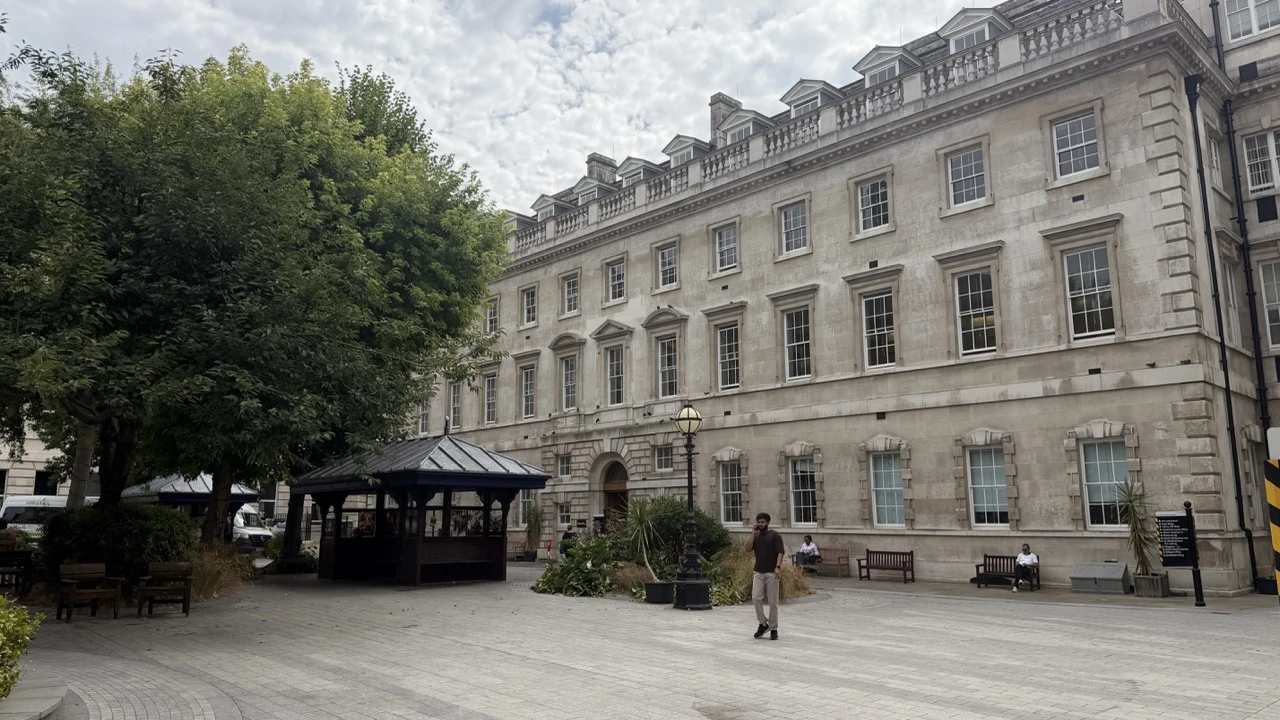
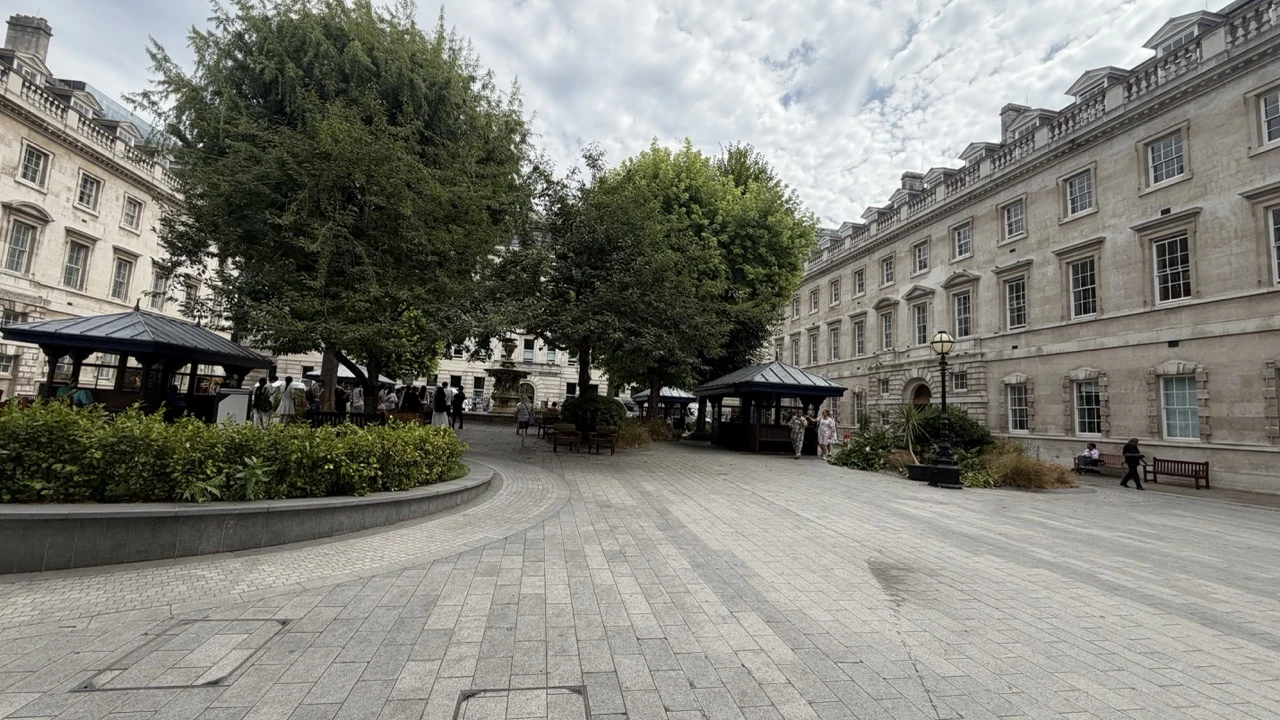
Quadrangle, St Bartholomew's Hospital in London
St Bartholomew’s Hospital, The Quadrangle
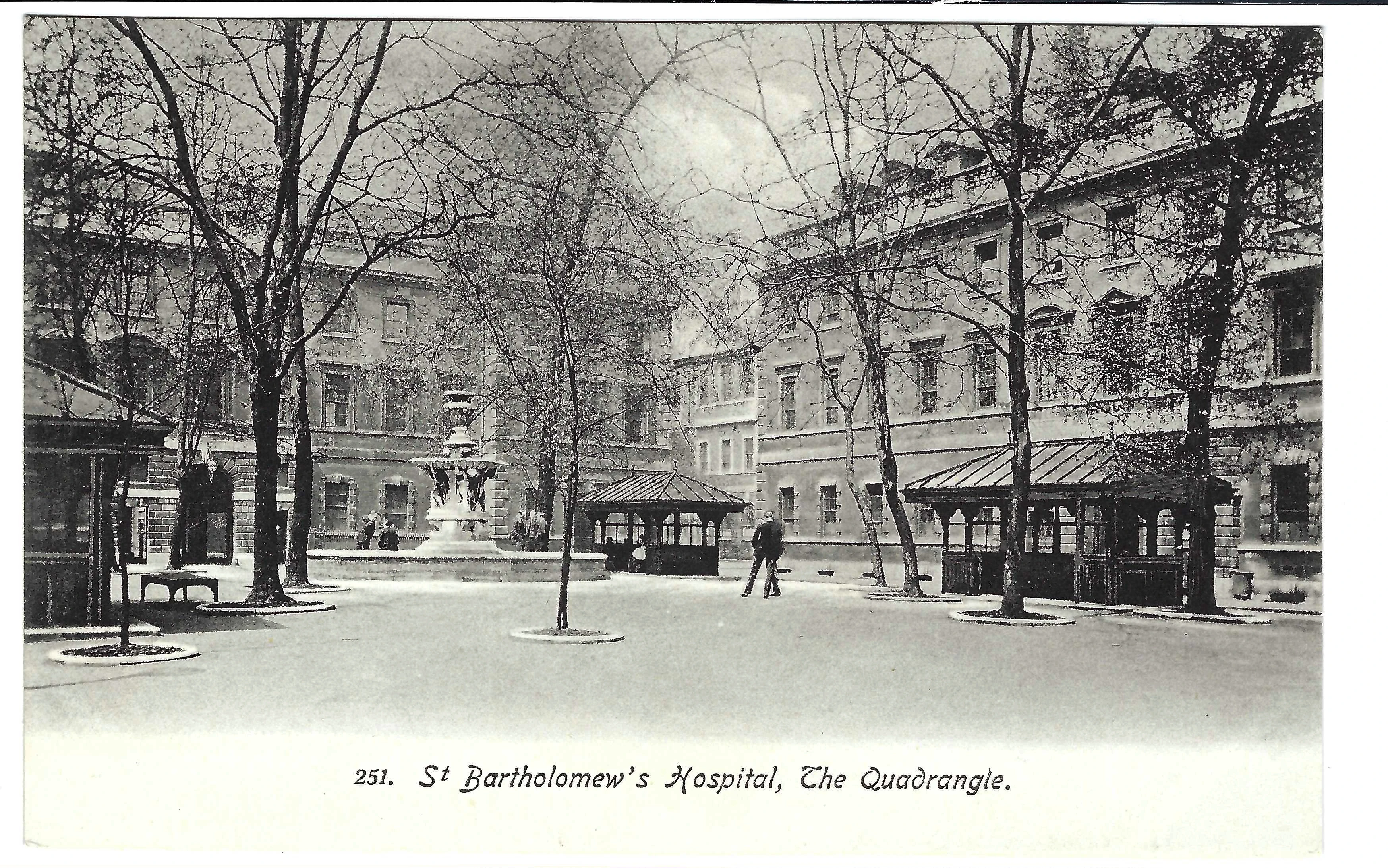
Black-and-white photographic postcard depicting the Quadrangle — the courtyard with the fountain in the centre — of St Bartholomew’s Hospital (also known as St Barts or Barts) in West Smithfield, London. Published by Gordon Smith, 15 Stroud Green Road, London N., and printed in Germany. Postcard No. 251. Presumably c. 1905–1910, most likely around 1908.
Early twentieth-century photographic postcard showing the historic quadrangle of St Bartholomew’s Hospital in West Smithfield, London, commonly known as Barts. The original caption printed beneath the photograph reads:
251. St Bartholomew’s Hospital, The Quadrangle
Publisher: Gordon Smith, 15 Stroud Green Road, N., London.
Printing: Printed in Germany.
Material and technique: cardboard; monochrome photographic reproduction; typographic printing on the reverse. Language: English.
Postal use: not postally used; no postage stamp, address or cancellation is present.
St Bartholomew’s Hospital and the Quadrangle
St Bartholomew’s Hospital occupies an exceptional place in the history of British medicine. Founded by Rahere in 1123, it is the oldest hospital in England still providing care on its original site in Smithfield for more than nine centuries. Following the Dissolution of the Monasteries, the institution survived and was refounded under Henry VIII in the 1540s. The medieval hospital was extensively rebuilt during the eighteenth century. The buildings were eventually replaced by an ambitious eighteenth-century reconstruction. Between 1730 and 1768, architect James Gibbs created a formal neoclassical hospital complex arranged around the central courtyard. The North Wing housed administrative and ceremonial functions, including the Great Hall and the staircase decorated with monumental paintings by William Hogarth, while the other major wings contained hospital wards.
The postcard shows this historic architectural ensemble after more than a century and a half of continuous medical use. By the time the photograph was taken, Barts had developed far beyond its eighteenth-century structure: formal medical teaching had become established, new specialist departments had appeared, and a School of Nursing had been founded in 1877. Yet the Georgian courtyard remained the physical and symbolic centre of the institution. The fountain added in 1859 further transformed the courtyard from a purely architectural space into something resembling a small urban garden within the hospital. Trees, paths and places of shelter softened the monumental stone surroundings and provided an outdoor environment for patients, staff and visitors.
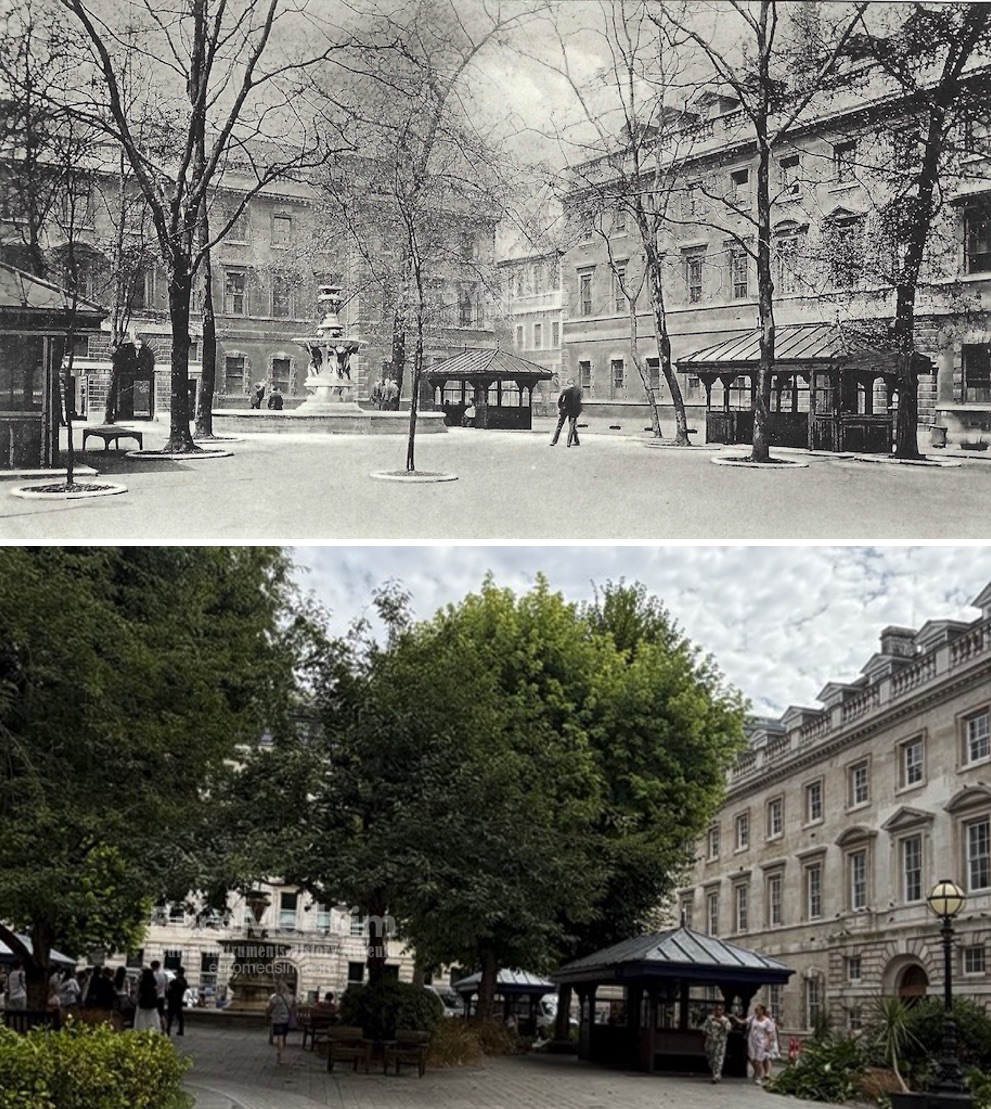
Comparative view of the Quadrangle in St Bartholomew Hospital, 1908–2026. Source: EuroMedSim
Description of the front side — recto
The recto presents a broad view across the quadrangle of St Bartholomew’s Hospital. The composition is dominated by the open courtyard, mature trees and the circular fountain positioned near its centre. Behind it rise the eighteenth-century hospital buildings, their restrained classical façades forming the architectural enclosure of the square.
The fountain is an especially prominent element of the image. It was added to the hospital square in 1859 and survives today as a Grade II listed structure.
The photograph is notable for the relatively informal appearance of the hospital environment. Trees grow throughout the courtyard, while low covered or glazed structures occupy parts of its perimeter. A small number of human figures are visible: one person stands near the fountain, another is seen beneath one of the covered structures, and a man crosses the courtyard in the foreground. Their small scale in relation to the buildings emphasizes the dimensions of the quadrangle.
The trees are largely without leaves, suggesting that the photograph was taken during the colder part of the year. The comparatively quiet courtyard, together with the scattered figures, creates an impression very different from the highly institutional character generally associated with hospital interiors.
Historically, the open space was not merely decorative. Nineteenth-century descriptions of St Bartholomew’s specifically referred to the quadrangle as a place where convalescent patients could take the air. Thus the courtyard formed part of the everyday therapeutic environment of the hospital as well as its architectural composition.
At the bottom of the card, within a broad white margin, appears the printed identification:
251. St Bartholomew’s Hospital, The Quadrangle.
The typography and photographic presentation are characteristic of the British view postcard of the early twentieth century.
Description of the reverse side — verso
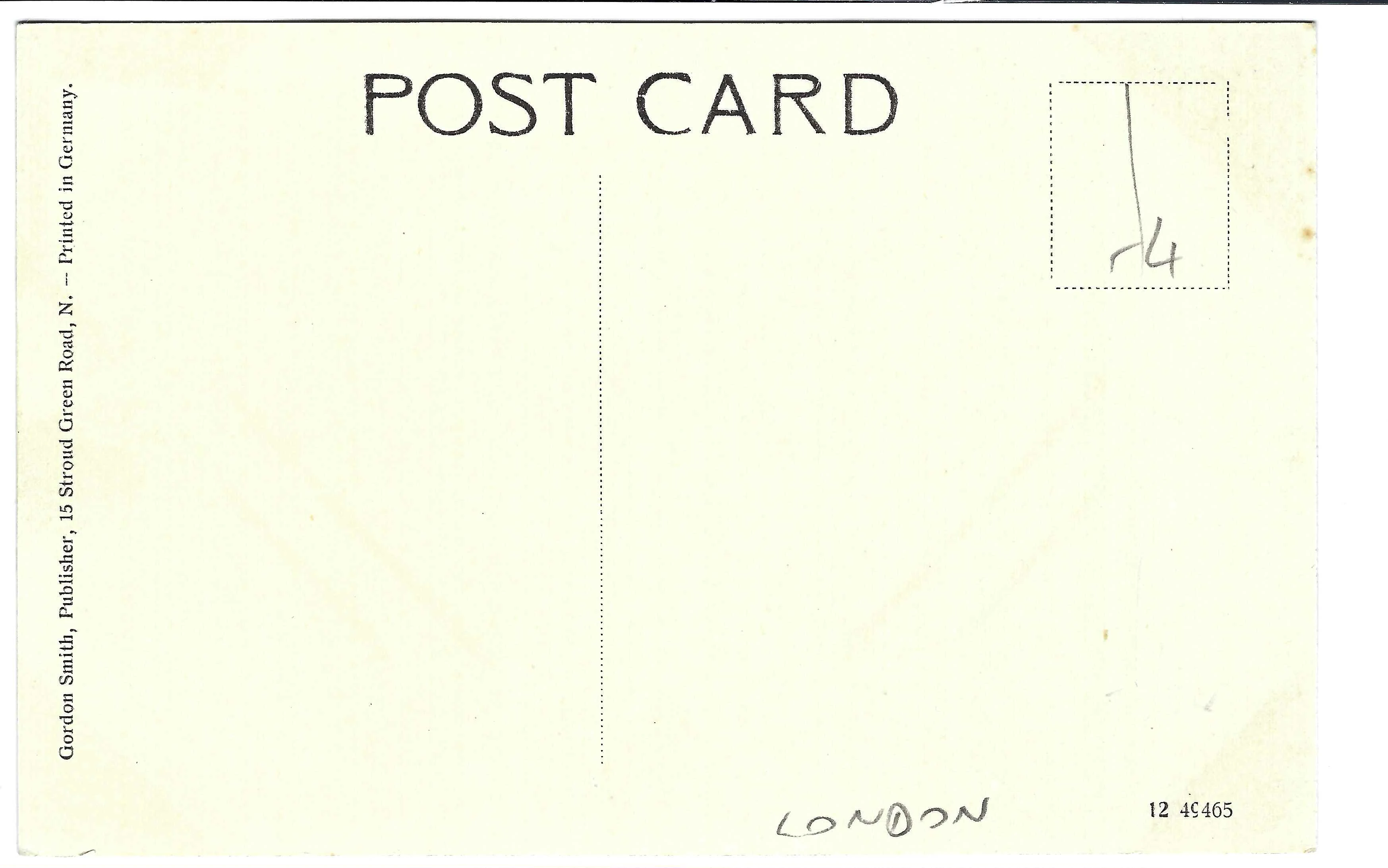
The reverse has the conventional divided-back format, with a vertical dotted line separating the correspondence area on the left from the address area on the right.
Across the upper centre is the large printed heading:
POST CARD
A dotted rectangular frame in the upper right corner marks the place intended for a postage stamp.
Along the left edge, printed vertically, is the publisher’s inscription:
Gordon Smith, Publisher, 15 Stroud Green Road, N. — Printed in Germany.
Near the lower right appears the printer’s or production number:
12 49465
The postcard was evidently never sent through the postal system. There is no postage stamp, postal cancellation, recipient’s address or correspondence. There are, however, later handwritten pencil markings: the word “LONDON” near the lower edge and a small numeral or inventory mark within the stamp box. These appear to be collecting or cataloguing annotations rather than postal markings.
The unused reverse is particularly useful for dating and attribution because the publisher’s full address and place of printing remain unobscured.
Gordon Smith and the Dating of the Postcard
The inscription “Gordon Smith, Publisher, 15 Stroud Green Road, N.” provides the principal evidence for dating the card.
Edward Gordon Smith was a London photographer and postcard publisher who began issuing local-view postcards in the early years of the twentieth century. His business moved to 15 Stroud Green Road in 1905. Smith died in 1906, but the postcard business was continued by his widow and daughters for approximately another decade. Cards bearing the Stroud Green Road address therefore cannot automatically be dated to Smith’s lifetime alone.
Of particular relevance are surviving photographs of St Bartholomew’s Hospital attributed to Gordon Smith in the Wellcome Collection. Several views of the hospital’s wards and clinical spaces are catalogued there as c. 1908, demonstrating that a substantial Gordon Smith photographic record of Barts existed at approximately this period.
The present postcard is not postmarked, so an exact year cannot be established from the object itself. Taken together, however, the Stroud Green Road address, the divided-back format, the pre-war German printing and the existence of related Gordon Smith photographs of St Bartholomew’s Hospital around 1908 support a cautious attribution of c. 1905–1910, with c. 1908 being particularly plausible.
Documentary Value
The postcard records the physical environment of one of Britain’s most important teaching hospitals during the early twentieth century. The photograph also demonstrates the remarkable continuity of the Barts site. The eighteenth-century buildings designed by Gibbs and the nineteenth-century fountain were already historic structures when the postcard was produced, yet they remained part of a functioning modern hospital. The image therefore captures several chronological layers of medical history within one courtyard: a medieval institution surviving on its original site, an eighteenth-century hospital reconstructed according to Enlightenment-era architectural principles, a nineteenth-century landscape feature, and an early twentieth-century community of patients and healthcare workers.
Gordon Smith photographed not only the exterior of St Bartholomew’s Hospital but also its wards and clinical spaces. Surviving examples in the Wellcome Collection include photographs of hospital wards, waiting areas and a clinical theatre dating from approximately the same period. Viewed together, such images constitute a valuable visual record of the architecture and everyday clinical environment of Barts in the years before the First World War.
In this sense, "St Bartholomew’s Hospital, The Quadrangle" postcard is a visual document of the environment in which healthcare, nursing, medical education and hospital life were conducted at the beginning of the twentieth century.
Condition
The postcard is in good overall condition for its age. The recto retains a clear and detailed monochrome image with good architectural definition. There is some age-related fading and minor surface wear, particularly toward the margins, together with slight spotting or discoloration characteristic of early twentieth-century card stock. The edges and corners show modest handling wear but no major tears or substantial losses are apparent. The reverse shows light age toning and scattered small marks. The printed typography remains clear and legible. There is no postage stamp, postmark or postal correspondence. Because the card was not postally used, the publisher’s imprint, German printing statement and original divided-back design have been preserved with unusual clarity.